
What blooming actually is
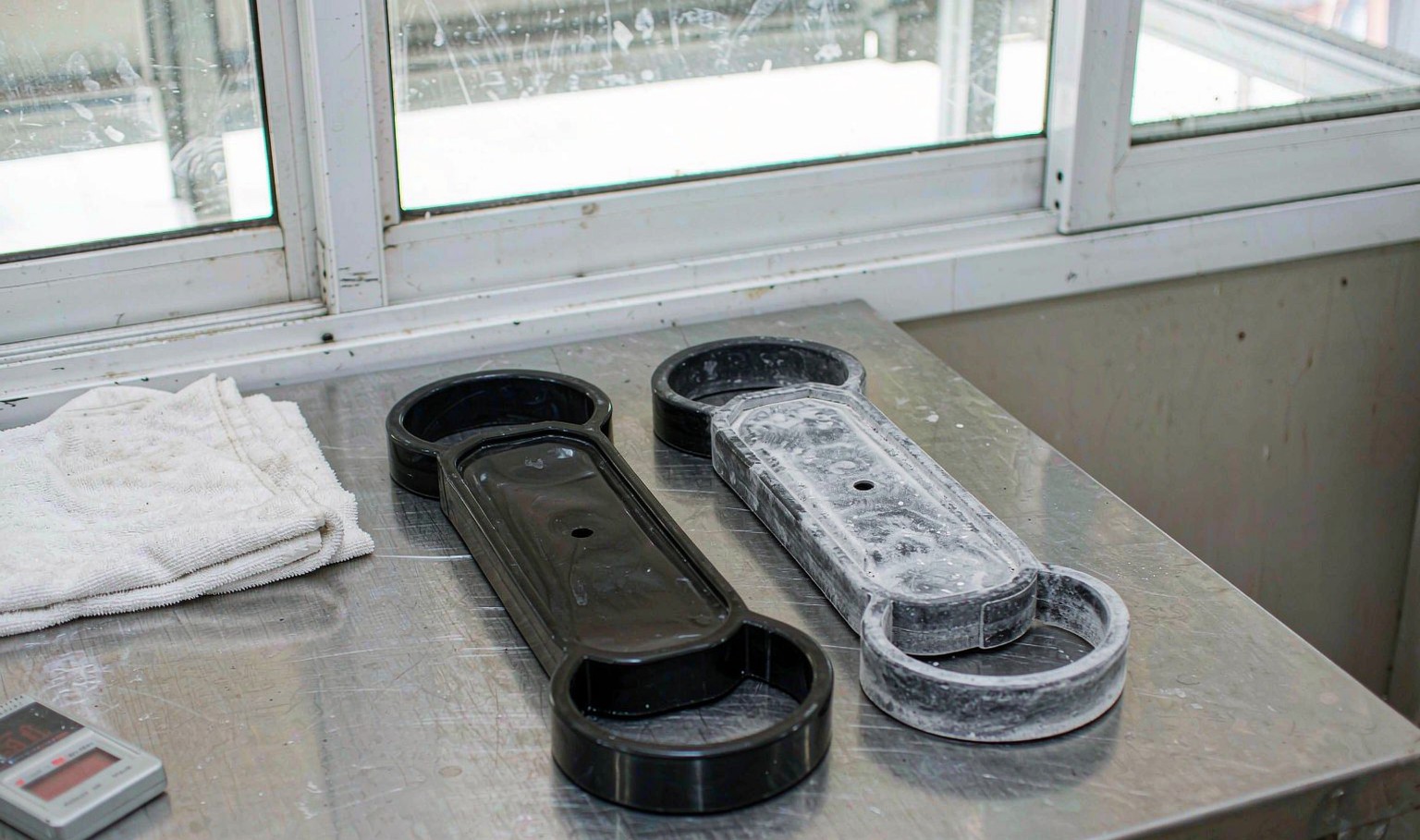
A silicone part comes out of the tool black and glossy. Four days later there is a grey-white haze on the surface that wipes off with a cloth and comes back a week later. Customers report it as dust, as mould release, as mould growth, as a supplier problem. It is none of those.
Blooming is migration. Silicone compounds contain low molecular weight fractions: unreacted oligomers, plasticising oils added to soften the compound, process aids, and the volatile siloxanes that are always present in a peroxide-cured system. These molecules are mobile inside the crosslinked network. They diffuse toward the surface, and when they arrive they form a film.
The film is white because the migrated layer scatters light. It is not a colour change in the silicone. A pigmented part blooms white over black, and the same part wiped clean is black again.
The reason it matters is not cosmetic alone. A bloomed surface is a release surface. Adhesive does not stick to it, printing does not adhere to it, and a gasket that has bloomed will not seal against a painted flange the way a fresh one does.
The film appears days later, and that timing is the clue
The delay is the diagnostic. Contamination is there immediately: dust, release agent, handling marks and mould deposits are all visible on the part as it leaves the tool. Migration takes time, because the molecules have to travel through the network to the surface.
Diffusion is slow and it is temperature dependent. A part stored at 25 C may take four days to show a visible film; the same part stored at 40 C shows it in a day and a half. A part shipped in a closed container in summer arrives bloomed, and the same part shipped in winter arrives clean.
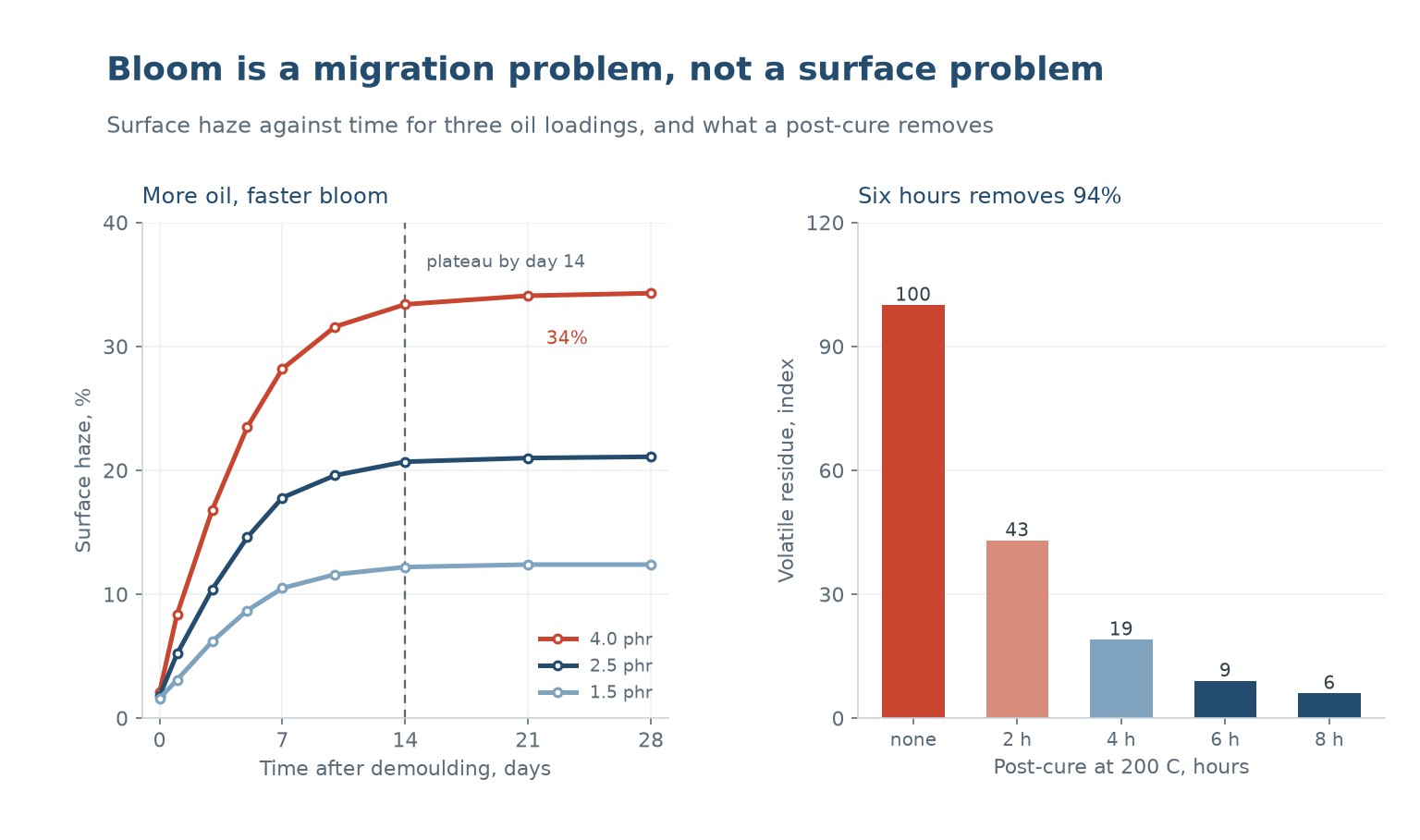
The film also plateaus. Once the mobile fraction near the surface has come out, the film stops growing, because the reservoir is finite. On a measured 4.0 phr oil loading the surface haze went from 2 percent as moulded to 8 at day one, 24 at day five, 32 at day ten, 33 at day fourteen, and 34 at day twenty-eight. Almost all of it happened in the first two weeks.
That plateau is why the problem seems to come and go. A customer who inspects on the day of receipt sees nothing. A customer who inspects after a month in the warehouse sees a film, and both of them are looking at the same parts.
Oil loading sets the rate, and hardness sets the loading
Soft silicone needs oil. A 30 Shore A compound may carry 4 phr of a low-viscosity silicone oil to reach that hardness with a workable unvulcanised consistency, where a 70 Shore A compound carries almost none. The oil is the plasticiser, and the plasticiser is the bloom.
That is why blooming is a soft-part problem. On the measured set, a 4.0 phr loading reached 34 percent haze, a 2.5 phr loading 21 percent, and a 1.5 phr loading 12 percent. The rate scaled with the loading, and the plateau level scaled with it too.
The oil choice matters as much as the amount. A high-viscosity oil diffuses slowly and stays in the network; a low-viscosity oil diffuses quickly and reaches the surface in days. Two compounds at the same phr can behave completely differently, which is why a formulation that worked at one supplier fails at another.
The third variable is cure. An under-cured part has a looser network, and a looser network lets everything move faster. A part at 90 percent cure blooms in three days where the same compound at full cure takes ten. Blooming is often the first visible symptom of a cure problem that the hardness test did not catch.
| Surface symptom | When it appears | Wipe test | What it is |
|---|---|---|---|
| Uniform white haze | 2 to 10 days | Wipes off, returns | Bloom, migrated oil |
| Patchy white streaks | At demould | Wipes off, stays off | Mould release residue |
| Grey dust in recesses | At demould | Wipes off, stays off | Filler or dust |
| White spots with a hard centre | At demould | Does not wipe | Filler agglomerate |
| Chalky, cracked film | Weeks to months | Wipes off, surface dull | UV or ozone ageing |
| Sticky film, not white | Days | Smears | Excess plasticiser, tacky surface |
Table 1 — Telling bloom from the four other white marks on a silicone part
Post-cure is the lever you control
A post-cure is a second bake after demoulding, usually 200 C for two to eight hours in air. Its stated purpose is to complete the cure and to drive off volatiles. Its practical effect on blooming is large and measurable: on the same 4.0 phr compound, a two hour post-cure cut the volatile residue index to 43, four hours to 19, six hours to 9 and eight hours to 6, against 100 as moulded.
Six hours removes 94 percent of what would have bloomed. The last two hours remove very little, which is the useful part of the curve: the difference between a six hour and an eight hour cycle is a 3 percent improvement and 33 percent more oven time.
The post-cure has to be done before packing, not after. A part packed hot and shipped straight from the press keeps its volatiles, and they come out in the bag. That is why the bloom is often worst on the parts that shipped fastest.
There is a cost side. A post-cure at 200 C for six hours is a real energy cost and a real throughput constraint, because the parts have to be racked, not piled. It also hardens the compound slightly: a 50 Shore A part typically gains 1 to 2 points of hardness and loses some tear strength after a long post-cure.
| Post-cure at 200 C | Residue index | Hardness change | Typical use |
|---|---|---|---|
| None | 100 | 0 | Sealed, short-life parts |
| 2 hours | 43 | +0.5 Shore A | General purpose |
| 4 hours | 19 | +1 Shore A | Visible parts, printing |
| 6 hours | 9 | +1.5 Shore A | Food, medical, bonding |
| 8 hours | 6 | +2 Shore A | Where bonding is critical |
Table 2 — What each post-cure step buys and costs
Testing it before the customer does
The problem with bloom as a defect is the timescale. A batch that is clean at dispatch fails at the customer, and by then the tool is running again and the compound has been consumed. A test that takes four days is not a test, it is a post-mortem.
The standard answer is accelerated ageing. Hold a sample at 70 C for 24 hours, cool it, and inspect against a visual standard. That is roughly equivalent to two to three weeks at 25 C for a silicone of moderate hardness, and it catches the parts that will fail.
The accelerated test has to be calibrated against real time, and the calibration is per compound. A 70 Shore A part and a 30 Shore A part do not have the same diffusion coefficient, so the same 24 hour bake does not mean the same thing to both. Build the correlation once, on the compound you actually use.
The second test is weight loss. Weigh a part before and after a 200 C bake and the loss is the volatile fraction, which is the reservoir that will bloom. A loss above 0.5 percent on a soft compound is a warning, and it is measurable in four hours rather than four days.
The third is a tape test on the finished surface. Press a piece of clear adhesive tape onto the part, peel it, and look at the tape against a white background. A bloomed part leaves a visible film on the tape. It is crude, it is fast, and it is what a customer will do in the meeting.
Storage and packaging are part of the specification
A part that has been correctly post-cured can still bloom if it is packed badly. The volatiles that remain are still mobile, and a sealed bag concentrates them at the surface. A part in a sealed polyethylene bag blooms faster than the same part on an open shelf, because the film traps what comes out.
Vented packaging, a paper interleaf, or a desiccant sachet all slow the process. So does storage below 25 C. None of them stop it, because the driving force is inside the part, but they buy the shelf life that the customer's inspection interval needs.
The shelf life question is the one nobody writes down. If a customer inspects on receipt and again at three months, the specification has to say what the surface looks like at three months, not at one day. A bloom that plateaus at 12 percent haze may be acceptable; one that reaches 34 percent is a return.
For parts that will be bonded, printed or painted, the answer is a short shelf life and a wipe before use. An isopropanol wipe removes the film, and the surface stays clean for days rather than weeks, which is enough if the process downstream happens promptly. It is not enough if the part sits in a bin for a month.
Why does the white film appear a week later and not on the day?
Because it is migration, not contamination. Low molecular weight oil has to diffuse through the crosslinked network to reach the surface, and that takes days at room temperature. Contamination is visible immediately; bloom is not.
Can I just wipe it off?
You can, and it stays clean for days rather than weeks. That is enough if the part is bonded or printed promptly, and not enough if it sits in a bin for a month. A post-cure is the permanent fix.
Does a post-cure stop blooming completely?
It removes most of the reservoir. Six hours at 200 C took the volatile residue to 9 percent of the as-moulded value, so what is left blooms very slowly and usually stays below a visible level.
Why do soft parts bloom more than hard ones?
Because softness comes from oil. A 30 Shore A compound may carry 4 phr of silicone oil where a 70 Shore A compound carries almost none, and the oil is what migrates.
Does blooming affect the part's function?
It affects anything that needs to stick. Adhesive, printing ink and paint do not bond to a bloomed surface, and a gasket that has bloomed may not seal against a painted flange. The mechanical properties are essentially unchanged.
Does storage temperature matter?
A lot. Diffusion is strongly temperature dependent: a part stored at 40 C can show in a day and a half what takes four days at 25 C. A container in a summer warehouse is an accelerated ageing test.
A white film on parts that were clean at dispatch?
Send the compound hardness, the oil loading if you know it, the post-cure cycle and the time between moulding and inspection. We will tell you whether it is bloom or something else.




 AR
 EN
 ES
 FR
 DE
 PT
 RU
 JA
 KO
 IT
 NL
 TR
 PL
 ID
