
Why cut length is harder than it looks
Cutting a profile to length sounds like the simplest operation on the line. The profile arrives at a known speed, a saw cuts it, the length is set by a number in the controller. What could go wrong is everything downstream of that number.
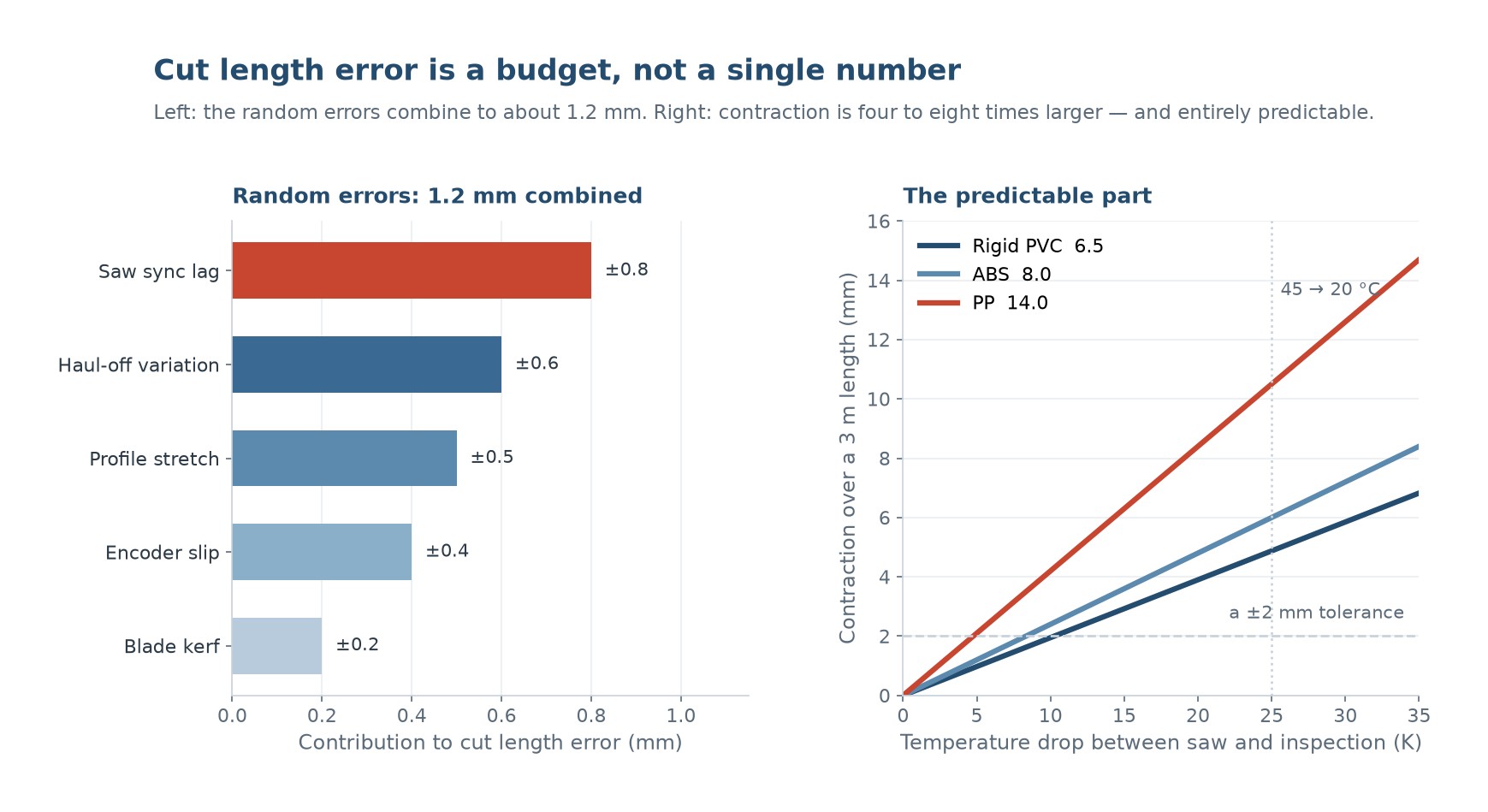
A profile quoted at 3,000 ±2 mm is a demanding tolerance when you consider that the same profile is 3,000 mm long when it is at 45 °C and 2,988 mm long when it has cooled to 20 °C. That 12 mm difference is six times the tolerance, and it happens after the saw, where the controller cannot see it.
Cut it long, or cut it at temperature? Either the cut length is set to allow for contraction, or the profile is measured at a defined temperature. Doing neither is how a tolerance of ±2 mm becomes a reject rate of 8%.
The three cutting methods
| الطريقة | How it works | الأفضل لـ | Length capability |
|---|---|---|---|
| Stop-and-cut | Haul-off stops, saw travels through, line restarts | Large profiles, tight tolerance, low speed | ±0.5 mm |
| Flying cut (on the fly) | Saw or knife travels with the profile while cutting | Continuous production, small sections | ±1.0 mm |
| Planetary / rotary cutter | Blade orbits the profile, cutting without stopping | Tube and small rod at speed | ±1.5 mm |
| Guillotine | Blade drops through the section | Soft profiles, loose tolerance | ±3 mm |
| Up-cut saw with servo feed | Servo positions the profile, saw cuts from below | Rigid profiles, medium tolerance | ±0.8 mm |
Table 1 — Cutting methods. The tolerance column is what the method can hold on a stable line, not what the brochure claims.
Stop-and-cut gives the best length because the profile is stationary during the cut, so there is no synchronisation error. It costs throughput: every cut stops the line, and on a 30-second cycle a 3-second stop is 10% of output. Flying cutters avoid the stop but introduce a synchronisation error between the saw carriage and the profile, which is where the extra millimetre comes from.
Where length error comes from
An error budget is the only way to improve cut length, because the contributions have different causes and different fixes. The table below is a realistic budget for a flying saw on a PVC profile at 6 m/min.
| المصدر | Typical contribution | Reducible? |
|---|---|---|
| Haul-off speed variation | ±0.6 mm | Yes — servo drive, belt tension |
| Encoder slip or resolution | ±0.4 mm | Yes — measuring wheel on the profile |
| Saw synchronisation lag | ±0.8 mm | Partly — servo carriage |
| Profile stretch under haul-off tension | ±0.5 mm | Yes — reduce puller force |
| Thermal contraction after cutting | −8 to −14 mm per 3 m | Only by compensation |
| Blade kerf variation | ±0.2 mm | Yes — blade condition |
| Measurement at the wrong temperature | ±3 mm | Yes — measure at 23 °C |
Table 2 — An error budget for a flying saw at 6 m/min. The thermal term is not an error in the same sense — it is predictable, and it should be compensated rather than reduced.
The lesson in the budget is that the controllable errors add up to about ±2 mm while the thermal term is an order of magnitude larger and entirely predictable. Plants that spend money on a better saw before they compensate for contraction are solving the smaller problem.
Thermal contraction after cutting
Every thermoplastic has a coefficient of linear thermal expansion roughly twenty times that of steel. A profile cut at 45 °C and measured at 20 °C is shorter than it was on the saw, by an amount that depends on the material and the temperature difference.
| المواد | CLTE (10⁻⁵ /K) | Contraction over 3 m, 45 → 20 °C |
|---|---|---|
| Rigid PVC | 5 – 8 | 3.8 – 6.0 mm |
| Plasticised PVC | 7 – 25 | 5.3 – 18.8 mm |
| ص | 10 – 18 | 7.5 – 13.5 mm |
| البولي إيثيلين عالي الكثافة | 12 – 18 | 9.0 – 13.5 mm |
| ABS | 7 – 9 | 5.3 – 6.8 mm |
| كمبيوتر شخصي | 6 – 7 | 4.5 – 5.3 mm |
| ب م أ م أ | 7 – 8 | 5.3 – 6.0 mm |
Table 3 — Contraction over a 3 m length cooling from 45 °C to 20 °C. The range reflects the spread between grades; the actual value for a specific compound should be taken from the supplier's data sheet.
Two things follow. First, the cut length must be set longer than the nominal by the expected contraction, or the parts must be measured and accepted at the line temperature. Second, the temperature at the saw must be stable, because a profile that arrives at 40 °C one hour and 55 °C the next will produce two different final lengths from the same setting.
Stabilising the saw temperature is usually cheaper than tightening the saw. A longer cooling run-out, or a spray section before the cutter, brings the profile to a consistent temperature and removes most of the day-to-day length drift.
Encoder and haul-off speed
The cutter's length reference comes from an encoder. If the encoder measures the haul-off belt rather than the profile, every source of slip between belt and profile becomes a length error. Belt slip on a wet profile is not small: 1% slip on 3 m is 30 mm.
The better arrangement is a measuring wheel running directly on the profile, close to the cutter, with a known circumference and a high-resolution encoder. That measures what is actually arriving at the saw rather than what the puller thinks it is delivering.
| Arrangement | What it measures | Error introduced |
|---|---|---|
| Encoder on haul-off motor | Motor rotation | Belt slip, wear, profile stretch |
| Encoder on haul-off belt pulley | Belt movement | Belt-to-profile slip |
| Measuring wheel on the profile | Profile movement | Wheel wear, contact pressure |
| Laser length measurement | Actual cut part | None, but it measures after the cut |
Table 4 — Length reference options. Moving the encoder closer to the profile always reduces the error, because it removes a transfer step that can slip.
Belt slip also has a second effect: it makes the cut length vary with line speed, because slip increases with tension. If the length error changes when you change speed, the encoder is measuring the wrong thing.
When to cut on the fly and when to stop
| النظر في | Stop-and-cut | Flying cut |
|---|---|---|
| Length tolerance | ±0.5 mm achievable | ±1.0 mm achievable |
| Throughput loss | 2 – 8% depending on cut frequency | None |
| Capital cost | أقل | Higher — servo carriage |
| Profile support during cut | بسيطة | Needs a travelling support |
| الأفضل لـ | Large section, tight tolerance, short runs | Small section, long runs, high speed |
Table 5 — Choosing between the two. The decision usually comes down to whether the tolerance is tighter than ±1 mm and whether the line runs long enough for throughput to matter.
A hybrid is common on large profile lines: the haul-off slows rather than stops, and the saw cuts during the slow phase. That gives most of the length accuracy of stop-and-cut with a smaller throughput penalty, at the cost of a more complex control scheme.
Setting a cut-length tolerance
A cut length tolerance should be set from what the assembly needs, then checked against what the process can hold. Quoting ±1 mm on a 4 m PP profile that contracts 13 mm between the saw and the assembly bench is a specification that cannot be met without controlling temperature.
| التطبيق | Reasonable tolerance | What it requires |
|---|---|---|
| Window and door profile | ±1.5 mm | Flying saw, temperature control |
| Pipe and conduit | ±5 mm or ±0.5% | Planetary cutter |
| Decorative trim | ±2 mm | Flying saw |
| Technical profile, machined later | ±0.5 mm | Stop-and-cut, climate-controlled |
| Packaging tube | ±0.3 mm | Servo cut, in-line gauge |
Table 6 — Typical cut length tolerances by application. The tolerance should always be quoted at a stated temperature, otherwise it is not a specification.
Measuring length properly
Length is the easiest dimension to measure badly. Three practices cover most of the error: measure at 23 °C after at least 30 minutes of conditioning, measure on a flat surface with the profile supported over its whole length, and measure the same way every time.
A 3 m profile measured on a bench with 200 mm overhanging each end will read short, because the ends sag. A profile measured immediately off the line will read long, because it has not contracted yet. Neither error is large individually, but together they can consume a tolerance that looked generous on the drawing.
Why are my cut lengths always short?
Thermal contraction. The profile is cut at 40–50 °C and measured at room temperature, so it shrinks by several millimetres over a 3 m length. Either set the cut length longer by the expected contraction or measure and accept at the line temperature.
How much does a profile shrink after cutting?
For rigid PVC, about 4–6 mm over 3 m cooling from 45 °C to 20 °C. For PP and HDPE it is 8–14 mm. The exact figure comes from the compound's coefficient of thermal expansion, and it is predictable enough to compensate exactly.
What cut length tolerance can a flying saw hold?
About ±1 mm on a stable line with a servo carriage and a measuring wheel on the profile. Stop-and-cut can reach ±0.5 mm. Anything tighter needs a controlled temperature and a slower line.
Why does cut length drift through the shift?
Because the profile temperature at the saw is drifting — usually the cooling water warms up as the shift goes on. Stabilise the temperature at the cutter, either with a longer run-out or with a controlled spray section, and the drift mostly disappears.
Does line speed affect cut length?
It should not, and if it does the encoder is measuring the wrong thing. Length error that changes with speed usually means belt slip is increasing with tension, which points to an encoder on the haul-off rather than on the profile.
Should I measure length hot or cold?
Cold, at 23 °C, after conditioning. But the acceptance criterion has to say so. A tolerance quoted without a temperature is not a specification, and arguing about it later is expensive for both sides.
Why do the ends of my cut look rough?
Blade condition, cut speed or profile temperature. A dull blade tears rather than cuts, and a profile that is too warm smears. On PVC, cutting below 30 °C gives a cleaner edge than cutting at 50 °C.
Can I cut to length after the fact?
Yes, and for tight tolerances it is sometimes the better route: extrude to a running length, let it condition, then cut on a separate saw at room temperature. It costs a handling step but removes the thermal term from the tolerance entirely.
Struggling to hold cut length?
Tell us the profile, the resin, the cutting method and the tolerance. We will tell you whether the limit is the saw, the encoder, the temperature at the cutter or the specification itself.




 AR
 EN
 ES
 FR
 DE
 PT
 RU
 JA
 KO
 IT
 NL
 TR
 PL
 ID
