

Frequency and diagnosis time are different problems
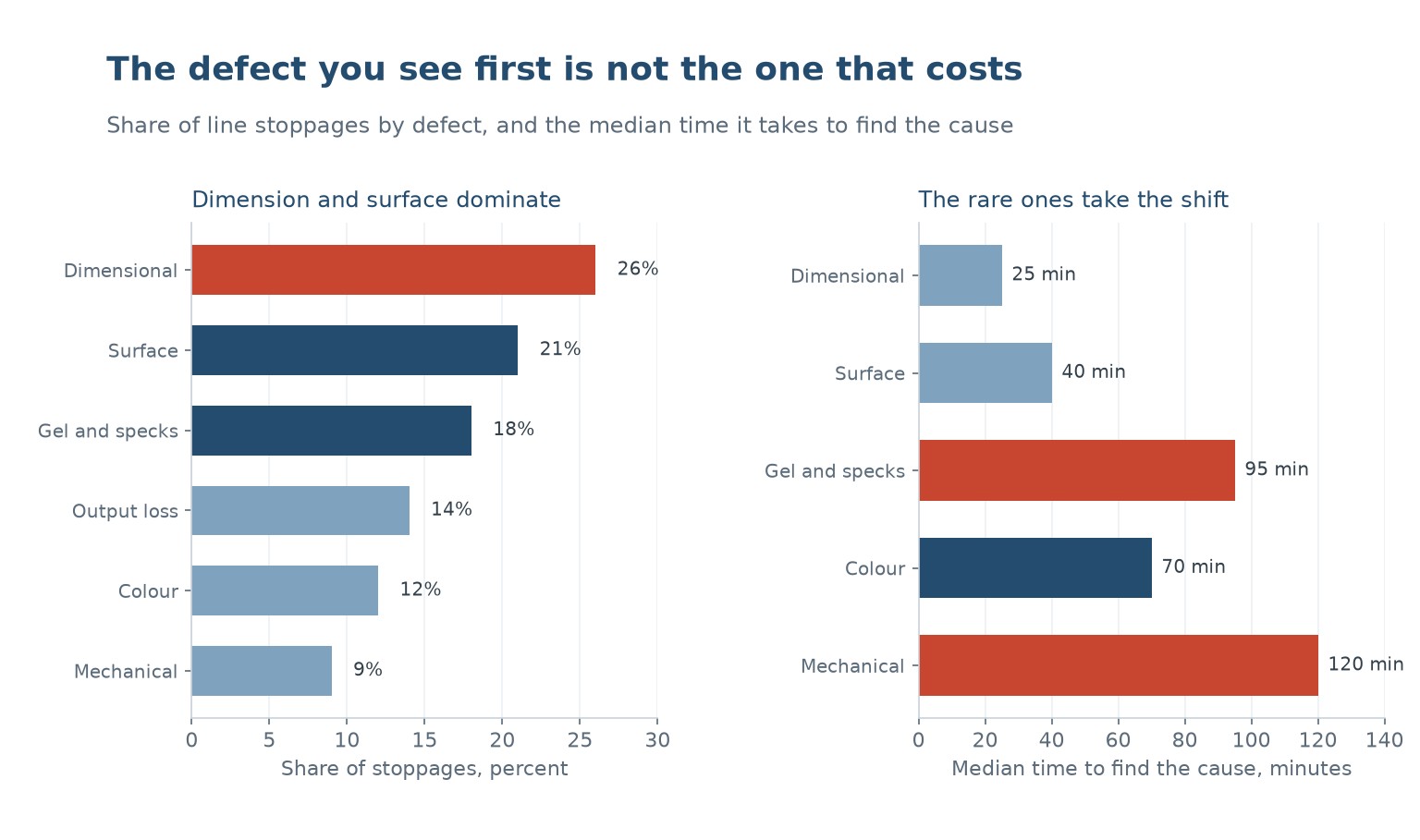
A troubleshooting matrix usually gets built around frequency, which is the wrong axis on its own. The chart on the left shows the frequency distribution: dimensional problems at 26 percent of stoppages, surface at 21, gel and specks at 18, output loss at 14, colour at 12 and mechanical at 9.
The right hand panel shows the same faults by the time it takes to find the cause. Dimensional is 25 minutes, surface 40, colour 70, gel 95 and mechanical 120. The order reverses: the two commonest faults are the two quickest to diagnose, and the rarest is the slowest.
Multiply the two and the picture changes. Dimensional problems cost the most in total lost time because they happen constantly, and gel costs almost as much because each event takes an hour and a half. Mechanical problems are rare and expensive, and they are the ones worth a written procedure rather than a matrix.
So the matrix should be built for the two categories that dominate the total, and the rare ones should get a procedure instead. A matrix that tries to cover everything is a matrix that covers nothing.
Four families of cause
Almost every extrusion fault traces back to one of four families: material, thermal, mechanical or die. Naming the family first cuts the search space by three quarters before any measurement is taken.
Material means the compound, the moisture, the regrind ratio, the masterbatch and the lot. It is the family that explains a fault which appeared with a new delivery and disappears with the old one, and it is the family people check last because it is the least convenient.
Thermal means the barrel profile, the die temperature, the cooling water and the ambient. It explains anything that changes over hours rather than minutes, and anything that is worse in the afternoon than in the morning.
Mechanical means the screw, the screen pack, the gear pump, the haul-off and the saw. It explains a step change, a noise, an amps reading that has moved, or a fault that appears only at one line speed.
Die means the flow channel, the land, the lips, the calibrator and the vacuum. It explains anything that is stable in time but wrong in shape, and it is the family that a dimensional fault almost always belongs to.
Build it from your own stoppages
A matrix copied from a textbook has two hundred rows and covers faults this line will never see. A matrix built from the last six months of the stoppage book has twenty rows and every one of them has happened here, which is why it gets used.
The build is mechanical. Take the stoppage log, group the entries into six defect categories, and for each one write down the first three checks that actually resolved it. Not the textbook checks, the ones that worked. Three is enough; a list of ten is a list nobody starts.
Then add the cost of each check. A visual inspection is free, a caliper reading is a minute, a melt temperature is five, a screen pack change is twenty and a die strip is half a shift. Ordering by cost rather than by likelihood is what makes the matrix usable under pressure.
The order matters because the cheap checks are usually also the fast ones. A setter who starts with a visual inspection and a caliper will find the dimensional faults, which are the majority, in the first two minutes. A setter who starts with a die strip will find the same fault in four hours.
| العيب | First check | Second | Third |
|---|---|---|---|
| Dimensional drift | Caliper, and the trend | Cooling water temperature | Haul-off tension |
| Surface roughness | Visual under a lamp | Die land and lips | درجة حرارة الذوبان |
| Gel and specks | Screen pack | Barrel profile | Regrind ratio |
| Output loss | Screw amps against speed | Feed throat | Die pressure |
| Colour drift | Residence time | Dosing record | Masterbatch lot |
| Brittleness or cracking | Regrind ratio | Moisture | درجة حرارة الذوبان |
Table 1 — Six defects and the first three checks that resolve most of them.
Order the checks by cost
Every check has a cost in minutes and a cost in risk, and the risk is what stops people doing the cheap ones. A screen pack change is twenty minutes and no risk; a die strip is half a shift and a re-setup. Ordering by time gets the cheap checks done first, which is what you want.
The exception is when a check has already been ruled out this shift. If the screen pack was changed at nine and the fault appeared at ten, checking it again is not cheap, it is wasted. So the matrix needs a column for what has already been done, or the setter needs to remember, and a whiteboard by the line does the remembering.
The second principle is that a check should be able to eliminate a family, not just a component. Measuring the melt temperature does not tell you whether the die is blocked, but it does tell you whether the thermal family is innocent, and that is worth more than a component-level check.
The third is that the first check should always be the same one. For a dimensional fault it is a caliper reading and a look at the trend, because a fault that has been drifting for three hours is a thermal problem and a fault that appeared instantly is a mechanical one. That single distinction saves more time than any other.
| Check | Time | المخاطر | Family it eliminates |
|---|---|---|---|
| Visual under a lamp | 1 minute | None | Surface and gross defects |
| Caliper on a cut section | 1 minute | None | Dimensional, and drift versus step |
| Trend on the chart | 2 minutes | None | Thermal versus mechanical |
| Melt temperature by probe | 5 minutes | None | Thermal |
| Screw amps against speed | 2 minutes | None | Mechanical and feed |
| Screen pack change | 20 minutes | منخفضة | Material and contamination |
| Die strip and clean | 4 hours | عالية | Die, and only die |
Table 2 — The checks, their cost, and what each one rules out.
The one-page version
The version that gets used is one page, laminated, on the wall at the line. Six rows, three checks each, and a column for the number to call when the three checks fail. Anything longer goes in a folder and the folder stays closed.
It should be written in the language of the line rather than the language of the textbook. Not melt fracture but rough surface, not die swell but the profile is fat coming out. The setter reading it at three in the morning is not going to translate.
It should also carry the escalation. Three checks and no answer means the process engineer, and the number should be on the page. A matrix without an escalation path is a matrix that produces a stopped line and an argument about who should have been called.
And it should be dated. A matrix from four years ago describes a line that no longer exists, and a setter who finds that out once will not trust the next version either.
Every resolved fault adds a row
The matrix is a living document and its value compounds. Every fault that took more than an hour to find should add a check, or move an existing check up the list. After a year the matrix contains the institutional memory of the line, which is otherwise stored in one person's head and leaves with them.
The discipline is to write it at the time. A note at the end of the shift takes two minutes; a reconstruction a month later takes an hour and loses the detail that made the fault hard.
The second discipline is to record the wrong turns as well as the right one. A check that was tried and eliminated is as valuable as a check that worked, because it stops the next person trying it. Most troubleshooting documents record only the answer, which is why the next person repeats the search.
And the third is to review the matrix when a machine or a die changes. A new die changes the die family checks, and an old matrix will send a setter to a bolt that is no longer there. The review takes ten minutes and it is the difference between a document that is trusted and one that is ignored.
What is the most common extrusion fault?
Dimensional problems, at about 26 percent of line stoppages, followed by surface defects at 21. Both are also the fastest to diagnose, at 25 and 40 minutes.
Why build a matrix from your own stoppages?
Because a textbook matrix has two hundred rows and covers faults the line will never see. One built from the last six months has twenty rows and every one of them has happened, which is why it gets used.
How many checks should a matrix have per defect?
Three. A list of ten is a list nobody starts, and in practice the first three resolve most faults if they are ordered by cost rather than by likelihood.
What should the first check always be?
For a dimensional fault, a caliper reading plus a look at the trend. A fault that has drifted for hours is thermal; a fault that appeared instantly is mechanical. That distinction saves more time than any other.
Why order checks by cost rather than likelihood?
Because the cheap checks are also the fast ones, and a setter under pressure will do them. Starting with a die strip finds the same fault in four hours that a caliper would have found in a minute.
Should the matrix record checks that failed?
Yes. A check that was eliminated is as valuable as one that worked, because it stops the next person repeating the search. Most troubleshooting notes record only the answer, which is why the search repeats.
Faults that get found in minutes
Tell us the profile and the stoppages you keep having. We will tell you which three checks belong on the wall and which fault deserves a procedure instead.




 AR
 EN
 ES
 FR
 DE
 PT
 RU
 JA
 KO
 IT
 NL
 TR
 PL
 ID
