

Cooling is dwell time, not distance
A profile leaves the die at melt temperature and has to be below its softening point before it reaches the haul-off. The cooling tank provides the time for that to happen, and the time is the tank length divided by the line speed.
That means tank length and line speed are not independent. A 6 metre tank at 3 metres per minute gives two minutes of cooling. The same tank at 6 metres per minute gives one minute, and the profile arrives at the haul-off at roughly double the temperature.
The heat has to come out through the wall, and the rate at which it does falls as the wall gets thicker. Cooling time scales roughly with the square of wall thickness, so doubling the wall quadruples the time needed for the same temperature drop.
This is why a tank sized for a 2 mm profile cannot run a 6 mm profile at the same speed, and why a line that adds a thicker product to its range often needs a longer tank rather than a colder one.
Length against speed and wall
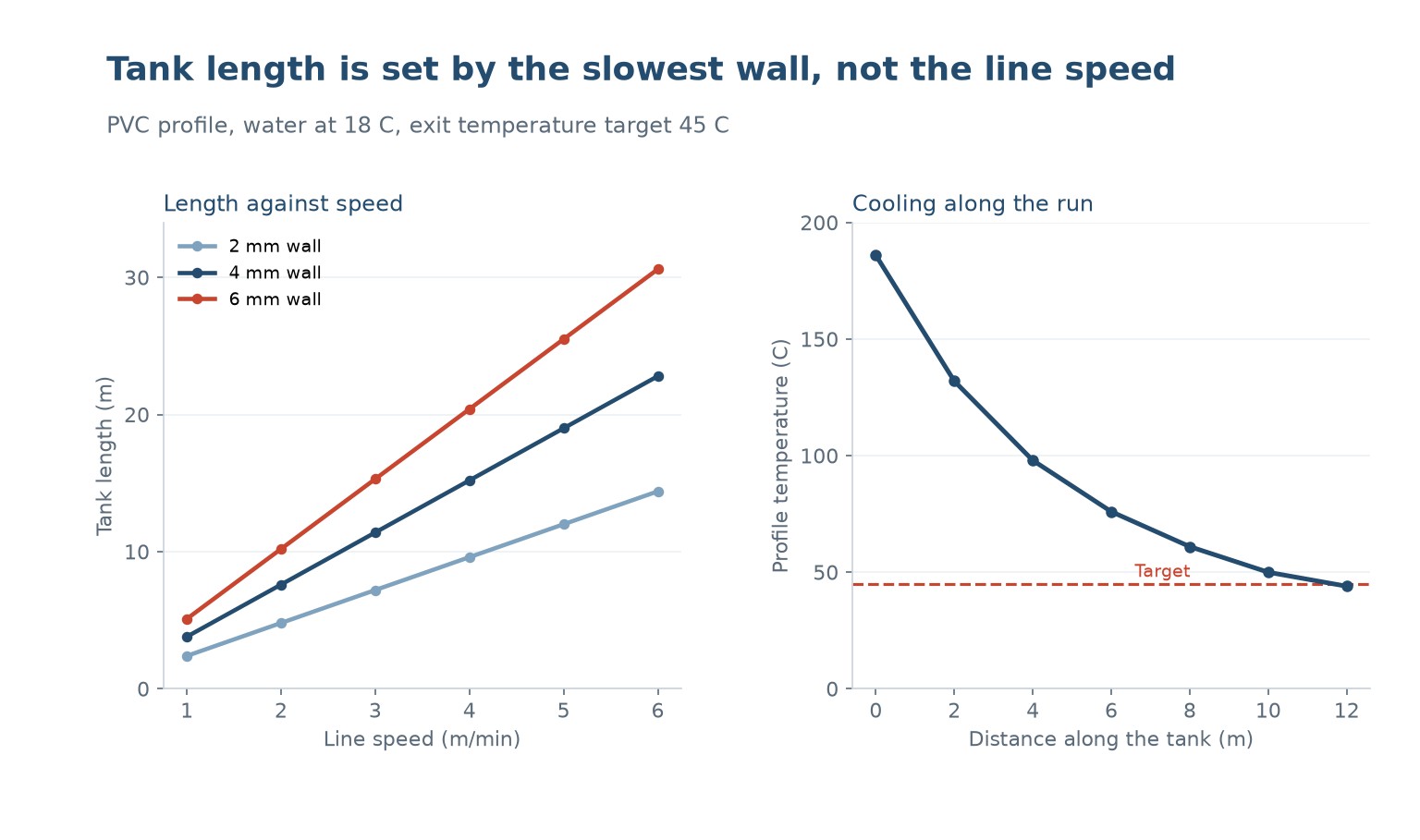
The chart on the left is required tank length against line speed for 2, 4 and 6 mm PVC profiles, with water at 18 degrees Celsius and an exit target of 45 degrees. At 3 metres per minute the requirement is 7.2 metres for a 2 mm wall, 11.4 for a 4 mm wall and 15.3 for a 6 mm wall.
At 6 metres per minute those become 14.4, 22.8 and 30.6 metres. The lines are straight because the relationship is linear in speed: twice the speed needs twice the length for the same cooling.
The vertical separation between the lines is the wall thickness effect, and it is not linear. Going from 2 to 4 mm adds about 58 percent to the length; going from 4 to 6 mm adds another 34 percent. The square law applies to time, and the geometry softens it.
In practice a line is specified for its thickest product at its target speed, and the thin products then run at lower speed than they could. That is the compromise that most lines accept, and it is worth knowing when a line is quoted as capable of a speed it can only reach on one product.
What the temperature profile looks like
The right hand panel is the profile temperature along a 12 metre tank for a 4 mm PVC profile at 3 metres per minute. It enters at 186 degrees, falls to 132 after 2 metres, 98 after 4, 76 after 6, 61 after 8, 50 after 10 and 44 after 12.
The curve is steep at the start and flat at the end, which is the signature of a cooling process approaching the water temperature. Most of the heat is removed in the first half of the tank, and the second half is doing very little except bringing the profile down to the last few degrees.
That shape is why a tank that is slightly too short is not as bad as it looks, and why a tank that is much too short is catastrophic. Losing the last two metres of a twelve metre tank costs four degrees; losing the first six costs ninety.
It is also why spray cooling at the entry is more effective than spray cooling at the exit. The heat flux is highest where the profile is hottest, so additional cooling capacity belongs at the front of the tank.
| Distance | درجة الحرارة | Heat removed |
|---|---|---|
| 0 m | 186 C | Entry |
| 2 m | 132 C | 54 C of the total |
| 4 m | 98 C | 34 C more |
| 6 m | 76 C | 22 C more |
| 8 m | 61 C | 15 C more |
| 10 m | 50 C | 11 C more |
| 12 m | 44 C | 6 C more |
Table 1 — Most of the cooling happens in the first half of the tank.
What a short tank does
A profile that arrives at the haul-off too hot is soft. The haul-off belts or caterpillars mark it, and the marks are permanent because the polymer is above its softening point when they are made.
It also stretches. The haul-off is pulling against the die, and a hot profile has less tensile strength, so it draws down more than the die dimensions intended. The result is a profile that is undersized in the direction of pull and correct across it.
And it deforms after the haul-off. A profile that is cut while still warm will bow as it cools on the table, and the bow appears hours later when the customer measures it.
The symptoms are easy to confuse with die problems, which is why a temperature measurement at the haul-off is worth taking before a die is blamed. A profile that is at 70 degrees at the haul-off is a cooling problem regardless of what the dimensions say.
| Symptom | السبب | Check |
|---|---|---|
| Haul-off marks | Profile too hot | Temperature at haul-off |
| Undersized in pull direction | Draw down from heat | Compare to die dimensions |
| Bow after cutting | Cut while warm | Temperature at saw |
| Surface drag marks | Soft profile in the calibrator | Water flow and temperature |
| Dimension drift along the run | Uneven cooling | Temperature profile along tank |
Table 2 — Symptoms that point to cooling rather than to the die.
Getting more from the tank you have
Water temperature is the first lever. Colder water increases the temperature difference and removes heat faster, but it also increases the risk of internal stress and of the profile shrinking onto the calibrator too quickly. A drop from 18 to 12 degrees is usually worth 5 to 8 percent of length.
Water flow and agitation are the second. A tank with still water cools by natural convection, which is far less effective than turbulent flow across the profile. Spray bars and circulation pumps are cheap and they often recover more than a tank extension would.
Contact cooling in the calibrator is the third. A vacuum calibrator with water flowing through it removes heat by conduction as well as convection, and it acts at the hottest point of the profile where it is most effective.
And air cooling before the tank is the fourth, if the profile can support itself. A short air gap lets the surface skin form without the profile collapsing, which reduces the load on the tank. It has to be short, because a long gap lets the profile sag.
Specifying a tank
Start from the thickest wall and the target speed for that product, and calculate the length. Then add 15 percent for the temperature rise on a hot day and for the fouling that accumulates on the heat exchanger surfaces.
Specify the water circuit for flow, not just temperature. A tank with a large volume and a small chiller will rise in temperature over a shift, and the last part of the shift will run at a different condition from the first.
Specify spray bars at the entry, where the heat flux is highest, and circulation along the length. A tank that is a still bath is a tank that is doing half its job.
And specify the seals. The entry seal is the point where air enters and where water escapes, and a worn seal produces both a cooling problem and a wet floor. It is a consumable and should be treated as one.
How long should a profile cooling tank be?
It depends on wall thickness and speed. A 4 mm PVC profile at 3 m/min needs about 11.4 m for an exit temperature of 45 C, and about 22.8 m at 6 m/min.
Does cooling time scale with wall thickness squared?
Approximately yes for the time needed to remove heat. The tank length effect is softer because the geometry and the surface area also change.
Why does my profile get haul-off marks?
It is still too hot when it reaches the haul-off. Measure the temperature there; above about 60 C most profiles will mark.
Can I run faster by making the water colder?
Partly. Dropping from 18 to 12 C is worth roughly 5 to 8 percent of effective length, but it increases internal stress and can shrink the profile onto the calibrator too fast.
Where should additional cooling be added?
At the entry to the tank. Most of the heat is removed in the first half, so spray bars and circulation at the front are more effective than at the back.
Why does my profile bow after cutting?
It is being cut while still warm and continues to cool on the table. Check the temperature at the saw and lengthen the cooling or slow the line.
Profile dimensions drifting along the line?
Send the profile section, the wall thickness and the line speed. We will check whether the tank is the constraint.




 AR
 EN
 ES
 FR
 DE
 PT
 RU
 JA
 KO
 IT
 NL
 TR
 PL
 ID
