
The problem
Symptom. A fabricator opens a pallet of white PVC trim after three weeks in a warehouse that logged 55 °C and finds the bottom 18 layers stuck together, peeling at 3.2 N/25 mm.
What it costs. Separating blocked lengths tears the decorative face and scraps 18 layers of a 50-layer stack, while the supplier points to a storage clause that never named a temperature limit.
This guide ties blocking to stack pressure and temperature, and gives the four numbers to write into the storage and packing clause.
Read the temperature logger before you blame the compound
Blocking is pressure-assisted surface tack. A 6 m length of 6.0 kg in a 50-layer stack loads the bottom interface with P = 49 x 6.0 kg x 9.81 m/s2 / 0.30 m2 = 9.6 kPa, enough to weld two warm faces.
| Storage temperature (°C) | Blocking peel force (N/25 mm) | Layers separating cleanly (%) |
|---|---|---|
| 40 (controlled store) | 0.2 | 100 |
| 45 (clause limit) | 0.4 | 99 |
| 50 | 1.5 | 72 |
| 55 (hot warehouse) | 3.2 | 28 |
Table 1 - Storage temperature against blocking peel force and stack recovery
Need a fixed price for this profile?
Send the cross-section drawing, material, cut length and annual volume. We will review die, calibration and tolerance, then return a written tooling and production quotation.
Trace the tack from stack pressure to the face
Treat the split below as illustrative engineering guidance, not a measured survey. Typically a blocked stack traces to a hot store, an over-high stack, no slip additive and missing interleaves, so read the temperature logger before questioning the compound.
A five-step diagnostic sequence
- Read the logger first.
Pull the warehouse temperature record; a 55 °C peak against a 45 °C clause explains blocking before any compound is questioned. - Count the layers.
Measure stack height; 50 layers of 6.0 kg put 9.6 kPa on the bottom interface, while 25 layers halve it to 4.7 kPa. - Peel a blocked pair.
Pull two stuck lengths at 180 degrees with a spring gauge; 3.2 N/25 mm against a 1.0 N/25 mm limit confirms pressure-assisted tack. - Check slip additive and interleaf.
Confirm 0.15% erucamide and a kraft sheet per layer; 0% slip peaks at 3.2 N/25 mm at 55 °C. - Write the storage clause.
Specify 45 °C with a logger, 25 layers, 0.15% slip additive and interleaving so a blocked pallet is a temperature record, not a re-order.
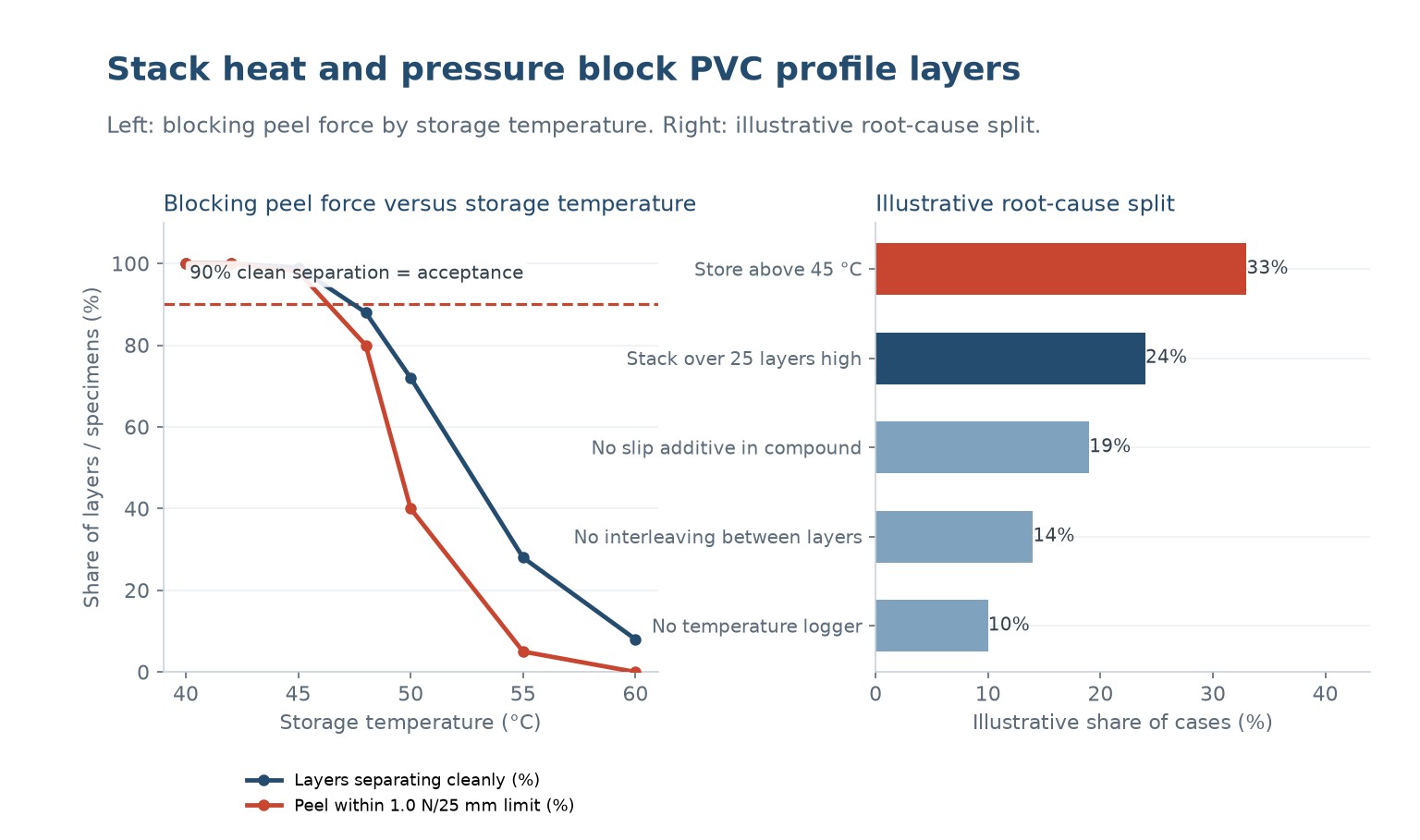
The chart below is a typical result from that measurement step. Use it to separate a design limit from a setting that can still be recovered.
Set the storage and packing parameters
Four settings keep layers free: storage below 45 °C, a stack of 25 layers or less (4.7 kPa), 0.15% erucamide slip additive and a kraft interleaf every layer. Together they hold peel at 0.6 N/25 mm even at 55 °C.
| المعلمة | Agreed value | What goes wrong outside it |
|---|---|---|
| Maximum storage temperature | 45 °C with logger | At 55 °C peel force reaches 3.2 N/25 mm |
| Stack height / bottom pressure | 25 layers / 4.7 kPa | 50 layers reach 9.6 kPa and fuse the base |
| Slip additive (erucamide) | 0.15% in the compound | 0% loading gives 3.2 N/25 mm at 55 °C |
| Interleaving | Kraft sheet every layer | Bare face-to-face contact blocks at the touch points |
Table 2 - Storage and packing settings that prevent blocking
Prove it with a storage-dwell trial
Run a storage-dwell trial with one lot: hold stacks at 40, 45, 50 and 55 °C for 21 days and peel at 180 degrees. Peel force reads 0.2, 0.4, 1.5 then 3.2 N/25 mm, putting the 1.0 N/25 mm limit near 47 °C.
| Field symptom | Most likely cause | Check that confirms it |
|---|---|---|
| Bottom layers fused, top layers free | Stack pressure plus floor heat | Logger reads 55 °C at the base of a 50-layer stack |
| Whole stack tacky after a hot week | Store above the 45 °C limit | Warehouse logger peaked at 55 °C for 3 days |
| Faces stick without a protective film | No slip additive in the compound | Peel reads 3.2 N/25 mm at 0% erucamide |
| Blocking only where layers touch | No kraft interleaf between lengths | Pallet shows bare face-to-face contact |
Table 3 - Matching blocked layers to the storage fault
Write the storage clause into the order
Write the storage clause into the order: a 45 °C ceiling with a data logger, a 25-layer stack limit, 0.15% slip additive and a kraft interleaf. Both parties reading one logger turn a blocked pallet into a temperature record, not an argument.
Need the section checked before tooling?
Send us the section and the installation conditions. We will review wall balance, tolerance and fixing detail, then return a marked-up drawing with a tooling quotation.
What to send us
- Cross-section drawing with wall thicknesses
- Material and colour
- Installation temperature range
- Fixing method and run length
What a cool store saves over a summer season
A cool store protects the face. A 0.15% slip dose costs little against 18 scrapped layers; holding 45 °C keeps peel near 0.4 N/25 mm and 99% of layers free, while one hot week can fuse a whole stack before it is opened.
Before you release this extruded profile
- A 45 °C storage ceiling with a data logger is written into the order
- A 25-layer stack limit and 4.7 kPa bottom pressure are stated
- 0.15% erucamide slip additive is required in the compound
- A kraft interleaf between every layer appears in the packing spec
- A 1.0 N/25 mm maximum blocking peel force is the acceptance test
Write the measurement temperature and the tolerance into the drawing; most disputes are really about how the part was measured.
Why do my stacked PVC profiles stick together?
Heat and pressure. A warehouse at 55 °C softens the face while a 50-layer stack loads the bottom with about 9.6 kPa, so peel force reaches 3.2 N/25 mm instead of 0.4.
Is blocking a compound fault?
Partly. A 0.15% erucamide slip additive cuts peel from 3.2 to 0.6 N/25 mm at 55 °C, but even a good compound blocks above 45 °C under a tall stack.
How much does stack height matter?
Pressure scales with layers. P = 49 x 6.0 kg x 9.81 m/s2 / 0.30 m2 = 9.6 kPa at 50 layers, falling to 4.7 kPa when the stack is halved to 25.
What storage temperature should the clause allow?
45 °C maximum with a logger. At 45 °C peel holds near 0.4 N/25 mm and 99% of layers separate cleanly; at 50 °C it already reaches 1.5 N/25 mm.
Do I need an interleaf?
Yes for a hot climate. A kraft sheet every layer removes bare face-to-face contact, which is where a 3.2 N/25 mm bond starts even with slip additive.
What should the acceptance test say?
A 45 °C ceiling with a logger, 25 layers, 0.15% slip additive, interleaving, and blocking peel force below 1.0 N/25 mm measured at 180 degrees after 21 days.
Get a profile that holds its dimension
Send us the profile section, the length and the service conditions. We will review die, calibration and tolerance, then quote tooling and production with a defined measurement method.
To get an accurate quote, send:
- Profile cross-section drawing
- Material and colour
- Cut length and annual volume
- Service temperature and exposure
Why buyers work with Uplastech
ISO 9001, ISO 14001 and ISO 45001 certified. Founded in 2016, with injection moulding lines in Shanghai and an extrusion plant in Jiangsu. Moulding machines from 90T to 1100T and a maximum shot weight of 5100 g. Samples and a written quotation are available on request.
Continue reading
- Extrusion dimensional drift
- Extrusion profile tolerance
- Profile calibration and cooling
- PVC profile weathering and colour
- PVC window profile design
Ready to specify? See our plastic profile extrusion services أو request a written quotation.





 AR
 EN
 ES
 FR
 DE
 PT
 RU
 JA
 KO
 IT
 NL
 TR
 PL
 ID