The problem
Symptom. A medical-device packer fails a cleanroom audit because trimmed PET blisters shed fine dust and hair-like strings that settle on the seal land and show up as particles above the ISO Class 7 limit.
What it costs. A single failed particulate audit can quarantine a 200 000-blister lot, and re-cleaning plus re-test wipes out the margin on the whole order.
This guide shows how to trace trim debris to die clearance and blade temperature, measure shed particles, and write a trim-cleanliness clause into the purchase order.
- 1. Stringing is a hot-knife problem, not a housekeeping problem
- 2. Count and size the debris before adjusting the press
- 3. Die clearance, blade temperature and trim timing to specify
- 4. Variables that bring dust back after a blade change
- 5. A trim-cleanliness clause for a cleanroom order
- 6. Costing matched punch-and-die tooling against a quarantine
Stringing is a hot-knife problem, not a housekeeping problem
PET does not shear cleanly when it is warm and the die clearance is wide; it draws into a hair, then snaps into dust. At 45 °C with 0.08 mm clearance, 2-5 mm strings are typical.
| What the audit finds | What is physically happening | First measurement |
|---|---|---|
| Hair-like strings on the flange | Warm PET drew across a wide die clearance | String length under 10× magnification |
| Fine dust on the seal land | Brittle fracture at a dull, rolled die edge | Particle count above 5 µm per 100 shots |
| Debris worse late in the run | Tool warmed and trimmed before the sheet cooled | Sheet temperature at the trim station over time |
| One upstroke worse than others | Local die damage or punch misalignment | Clearance survey around the full perimeter |
Table 1 - Classifying trim debris before cleaning the room
Need a fixed price for this formed tray?
Send the tray drawing, sheet gauge and annual volume. We will review draft, trim and material, then quote a production tool with a written line-acceptance test.
Count and size the debris before adjusting the press
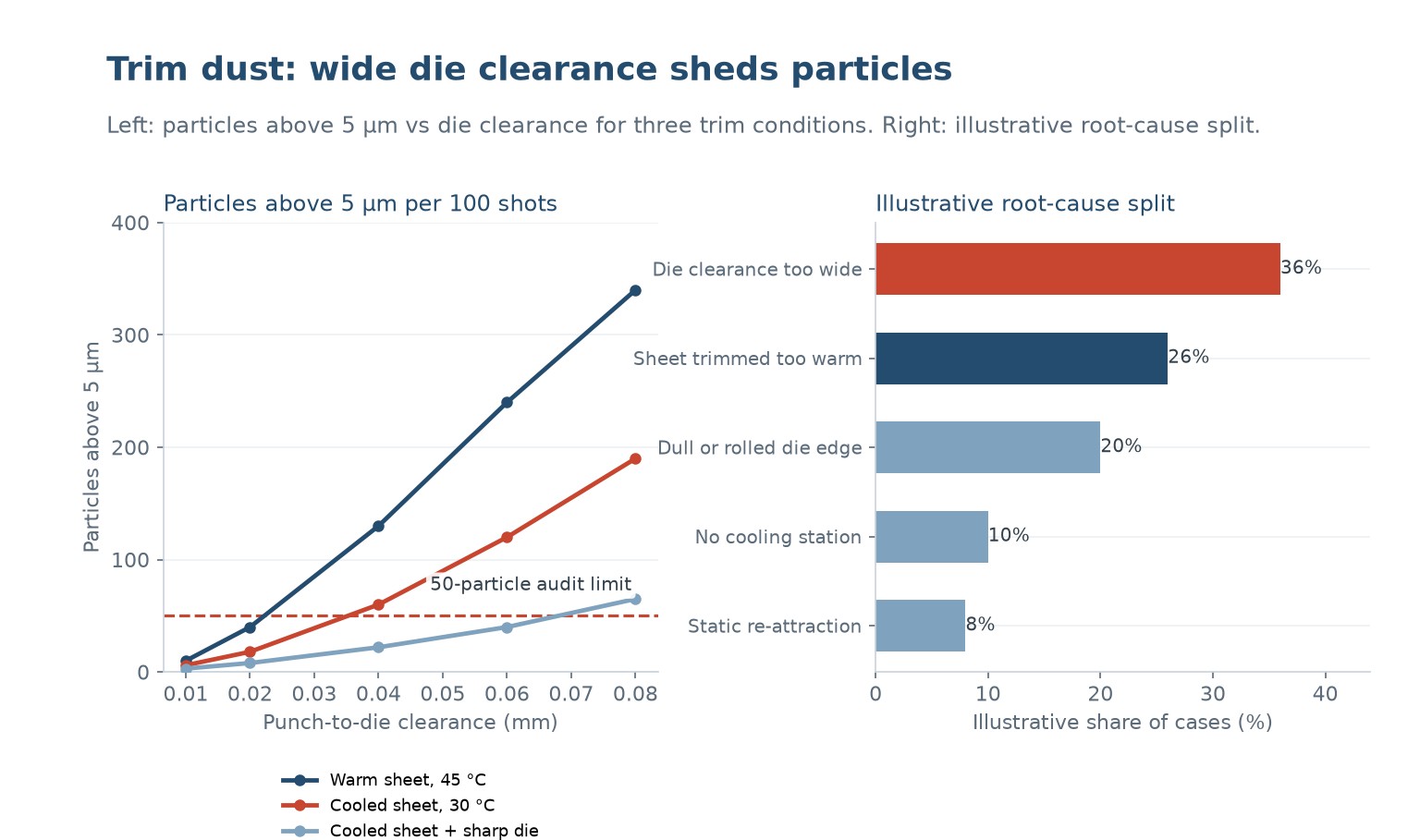
Tape a clean witness plate under the press for 100 shots and count particles above 5 µm. One audit logged 340 at 0.08 mm clearance and 40 at 0.02 mm, pointing straight at the die.
A five-step diagnostic sequence
- Capture 100 shots.
Place a clean witness plate under the trim station for a fixed 100-shot run. - Size the debris.
Count particles above 5 µm and measure the longest string under 10× magnification. - Measure the clearance.
Survey punch-to-die clearance at eight points around the perimeter with feeler gauges. - Log sheet temperature.
Record PET temperature at the trim station cold and after 60 minutes of running. - Repeat by stroke count.
Re-run the witness plate every 50 000 strokes to catch die wear early.
The chart below is a typical result from that measurement step. Use it to separate a design limit from a setting that can still be recovered.
Die clearance, blade temperature and trim timing to specify
Three parameters keep the trim clean: 0.02 mm clearance for 0.4 mm PET, sheet below 35 °C, and a knife at 20-25 °C. Clearance above 0.05 mm produces the strings seen in the audit.
| المعلمة | Typical target | What goes wrong outside it |
|---|---|---|
| Punch-to-die clearance | 0.02 mm for 0.4 mm PET | Wider clearance draws strings instead of shearing |
| Sheet temperature at trim | ≤ 35 °C | Warm PET smears and sheds fine dust |
| Knife temperature | 20 - 25 °C | A hot knife softens the edge and leaves a rolled burr |
| Particles above 5 µm per 100 shots | ≤ 50 | Higher counts fail an ISO Class 7 particulate audit |
Table 2 - Trim parameters to write on the cleanroom specification
Variables that bring dust back after a blade change
Dust returns as the tool wears. After roughly 150 000 strokes a rolled die edge raises effective clearance, a 15 °C warmer tool-room softens the PET, and a faster index trims before cooling.
| Process variable | Effect on debris | Practical control |
|---|---|---|
| Die clearance above 0.05 mm | PET draws into strings instead of shearing | Set and log clearance at 0.02 mm |
| Sheet above 35 °C at trim | Warm PET smears and strings | Add a cooling station before the press |
| Tool-room ambient up 15 °C | Sheet and knife both run hotter | Condition the trim cell or adjust timing |
| Die edge worn after 150 000 strokes | Rolled edge raises effective clearance | Sharpen on a stroke-count schedule |
Table 3 - Variables that restore trim dust after sign-off
A trim-cleanliness clause for a cleanroom order
Add a functional clause: fewer than 50 particles above 5 µm per 100-shot witness plate, zero strings over 1 mm, verified at steady-state tool temperature. That makes the audit pass repeatable.
Want the tray checked against your line?
Send us the tray drawing and the line conditions. We will flag the geometry and material choices that cause jams, and quote a tool with an acceptance test.
What to send us
- Tray drawing with draft and radii
- Sheet grade and gauge
- Stack depth and line speed
- Drawings of the magazine or denester
Costing matched punch-and-die tooling against a quarantine
Matched punch-and-die tooling with a cooled knife costs roughly £6 000-9 000 but removes the quarantine risk on a 200 000-blister lot. One failed particulate audit costs more than the tooling.
Before you sign off this thermoformed tool
- A maximum punch-to-die clearance is stated for the declared PET gauge
- A particle-count limit above 5 µm per 100-shot witness plate is written into the order
- Sheet temperature at the trim station is specified, not assumed
- A die sharpening or replacement interval is set by stroke count
- The cleanliness test is run at steady-state tool temperature, not cold first-off
A tray that looks right in the carton can still stop a filling line. Test the stack, not a single part.
Is the dust coming from the room or the trim?
A witness plate under the press separates them. If counts are high there but low in the room, the die is the source. Housekeeping cannot fix debris that is generated at every stroke.
Why does a sharper die help?
A dull, rolled edge stops shearing and starts tearing the PET, which leaves a burr and fine dust. Maintaining 0.02 mm clearance with a sharp edge produces a clean fracture and far fewer particles.
Should we trim the sheet hotter or colder?
Colder, within reason. Below about 35 °C PET fractures cleanly; above it the sheet smears and strings. Add a cooling station rather than slowing the whole former to get the trim temperature down.
Can an ionising bar remove the dust?
It controls static attraction but does not stop particles being created. Use it as a secondary control; the primary fix is clearance, blade condition and sheet temperature at the trim station.
How often should the die be sharpened?
Track particle count per 50 000 strokes and sharpen when the trend rises, rather than at a fixed calendar interval. On 0.4 mm PET a rolled edge typically appears around 150 000 strokes.
What should the cleanroom clause say?
Fewer than 50 particles above 5 µm per 100-shot witness plate, zero strings longer than 1 mm, measured at steady-state tool temperature, with the witness plate retained as the acceptance record.
Get a tray that runs on your filling line
Send us the tray drawing or a sample stack. We will review draft, trim and material, then quote a production tool with a measurable line-acceptance test written into it.
To get an accurate quote, send:
- Tray drawing or sample stack
- Sheet material and gauge
- Line speed and denesting method
- Annual volume and target unit price
Request a tool and tray quotation
Why buyers work with Uplastech
ISO 9001, ISO 14001 and ISO 45001 certified. Founded in 2016, with injection moulding lines in Shanghai and an extrusion plant in Jiangsu. Moulding machines from 90T to 1100T and a maximum shot weight of 5100 g. Samples and a written quotation are available on request.












 AR
 EN
 ES
 FR
 DE
 PT
 RU
 JA
 KO
 IT
 NL
 TR
 PL
 ID