The problem
Symptom. Silicone tubing that routes cleanly on the bench is found flattened and kinked at one tight corner after the assembly jig closes the housing, and the finished units fail a flow test.
What it costs. The kinked assemblies are scrapped or reworked by hand, and because the tube looks sound before fitting the fault is blamed on the extruder rather than the routing radius.
This guide links kinking to the centreline bend radius, gives a mandrel and flow-area test, and sets a minimum radius and assembly temperature on the drawing.
- 1. What a kink does to the flow area
- 2. Measure the bend radius on the jig, not on the drawing
- 3. Set a minimum bend radius and flow-area limit on the drawing
- 4. Separate a forced routing fault from a tube that is too soft
- 5. Specify reinforcement, wall and assembly temperature
- 6. Recovery actions ranked by rework effort
What a kink does to the flow area
A 10 mm OD silicone tube bent to a 10 mm centreline radius, R/D 1.0, folds on the inside of the bend as the outer wall thins. A 6 mm ID line retains just 8 % of its flow area there.
| Finding at assembly | Most likely cause | Confirming check |
|---|---|---|
| Kink at one fixed point on the jig | Clip or housing edge forces the route | Measure centreline radius at that point |
| Kinks at random points along the run | Tube too soft for the bend | Check Shore A and wall thickness |
| Tube folds only on a cold morning | Assembled below 23 C, compound stiff | Log assembly-area temperature |
| Bend passes the jig, fails after closing | Housing pushes the tube tighter | Flow-test the closed assembly |
Table 1 - Reading a silicone tube kink on the assembly line
Need a fixed price for this seal?
Send the gland drawing, temperature range, media and annual volume. We will recommend a compound with test data and return samples with a written production quotation.
Measure the bend radius on the jig, not on the drawing
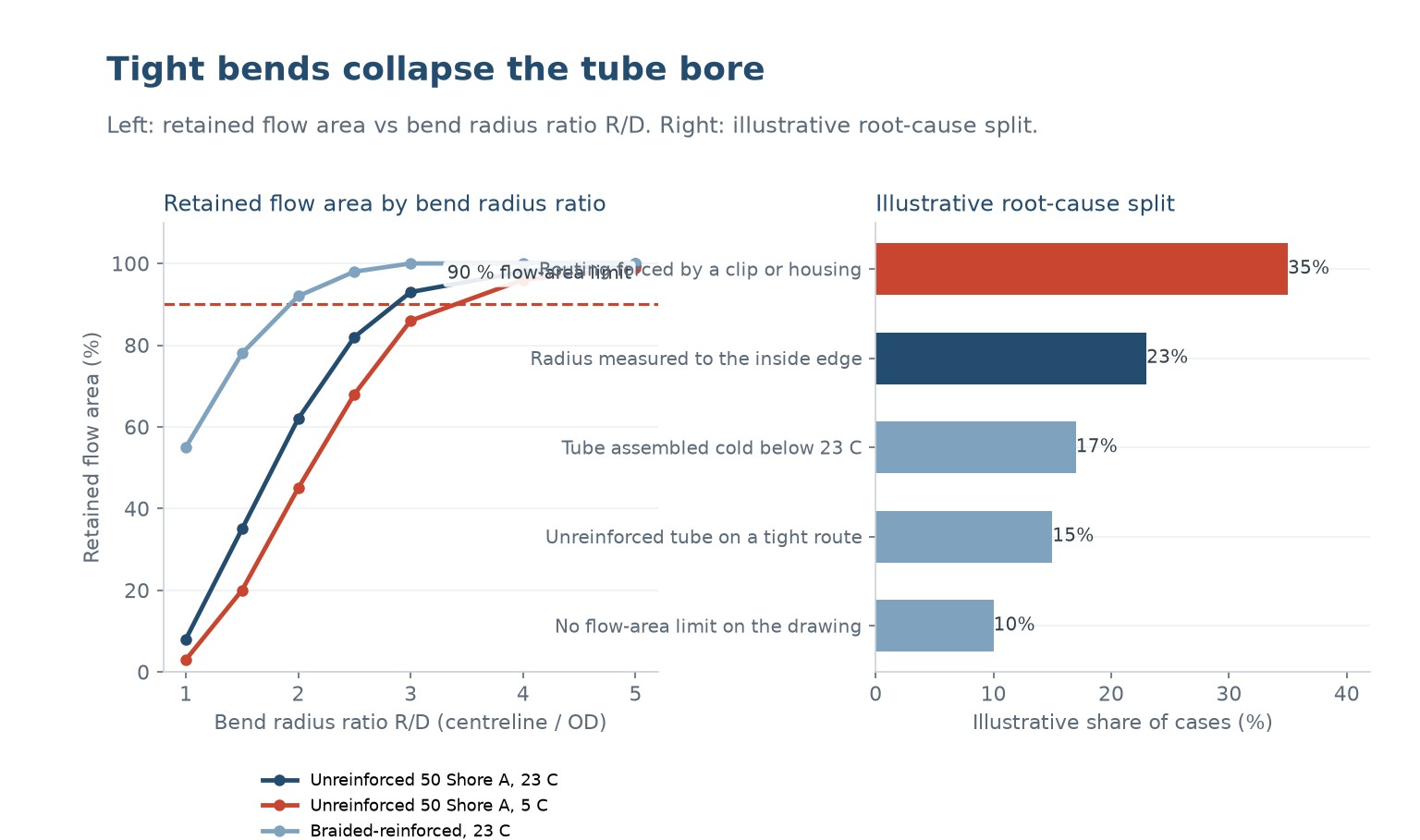
Bend the tube round a mandrel and measure the radius to the centreline, not the inside edge. The chart below plots retained flow area against R/D: 93 % at R/D 3.0, but only 62 % at R/D 2.0 for an unreinforced tube.
A five-step diagnostic sequence
- Mark the kink on the assembled unit.
Note its exact position relative to clips, brackets and the housing edge before dismantling anything. - Measure the radius to the tube centreline.
Use a mandrel gauge; add half the 10 mm OD to an inside-edge reading to get the centreline value. - Flow-test the fully closed assembly.
Measure water flow at 0.2 bar against a straight control and express it as retained area. - Log assembly temperature and tube hardness.
Confirm parts were conditioned at 23 C and that the compound is the specified 50 Shore A. - Re-route and re-test twenty assemblies.
Fit the 30 mm mandrel gauge and repeat the flow test before releasing the shift.
The chart below is a typical result from that measurement step. Use it to separate a design limit from a setting that can still be recovered.
Set a minimum bend radius and flow-area limit on the drawing
Specify a 30 mm centreline bend radius, three times the 10 mm OD, and 90 % of straight-tube flow at 0.2 bar water pressure after bending. State that the radius is measured to the centreline and condition parts 24 h at 23 C before assembly.
| المعلمة | Typical target | What goes wrong outside it |
|---|---|---|
| Minimum centreline bend radius | 30 mm (3 x OD) | At 20 mm flow area falls to 62 % |
| Retained flow area after bending | Above 90 % at 0.2 bar | Below 90 % the line restricts flow in service |
| Assembly temperature | 23 +/- 2 C | At 5 C an R/D 3.0 bend holds only 86 % |
| Radius measurement datum | Tube centreline, not inside edge | A 5 mm datum difference misreads a 30 mm bend as 25 mm |
Table 2 - Bend-radius and flow parameters to put on the drawing
Separate a forced routing fault from a tube that is too soft
Separate forced routing from a soft tube: a kink at one fixed jig point points to a clip or housing edge; random kinks mean the compound is too soft. Assembled at 5 C, the same R/D 3.0 bend holds only 86 % of flow area.
| Option | When it fits | Trade-off |
|---|---|---|
| Re-route to a 30 mm radius | Jig or clip is forcing the bend | Housing or bracket change |
| Fit a braided-reinforced tube | Route cannot be opened out | Higher price per metre, stiffer handling |
| Raise the wall from 2 to 2.5 mm | Ovalisation at marginal radii | Reduced bore for a fixed OD |
| Condition tubes to 23 C before fitting | Cold assembly area | Storage and handling space |
Table 3 - Options for a tube that kinks at the specified radius
Specify reinforcement, wall and assembly temperature
For a tight route, a braided tube holds the 90 % limit down to R/D 2.0, and a 2.5 mm wall ovalises less than the standard 2 mm. Send the routing drawing and bend radii for a tube and jig-gauge recommendation before tooling.
Want a compound check before you re-order?
Send us the gland drawing and the service conditions. We will compare the compound data against your temperature range and return a recommendation with sample parts.
What to send us
- Gland dimensions and cross-section
- Temperature range and media
- A failed seal if available
- Annual volume
Recovery actions ranked by rework effort
Recover the line by adding a 30 mm mandrel gauge, conditioning tubes to 23 C and re-routing the tight clip, then flow-test twenty assemblies. If a bend stays below 90 %, change the route or tube; a closed housing only hides the kink.
Before you release this silicone seal
- A 30 mm minimum centreline bend radius is dimensioned on the routing drawing
- The radius datum is stated as the tube centreline, not the inside edge
- A 90 % retained-flow test at 0.2 bar water pressure is in the purchase order
- Assembly temperature of 23 +/- 2 C and a 24 h conditioning step are specified
- A mandrel gauge of the minimum radius is fitted to the assembly jig
Most cold or heat failures are specification gaps, not bad batches. Fix the specification before changing suppliers.
How tight is too tight for a 10 mm OD silicone tube?
Keep the centreline radius at or above 30 mm, three times the OD. At a 20 mm radius, R/D 2.0, an unreinforced tube retains only 62 % of its flow area and ovalises visibly.
Does the radius mean the inside edge or the centreline?
Specify the centreline. A bend with a 30 mm centreline radius has a 25 mm inside radius for a 10 mm tube, so the same bend reads 5 mm tighter on the inside edge and is wrongly rejected.
Why does the tube kink more in winter?
Cold silicone is stiffer and buckles rather than bending smoothly. The same R/D 3.0 bend holds 93 % of flow area at 23 C but only 86 % when assembled at 5 C.
Will a thicker wall stop the kink?
It helps. Raising the wall from 2 to 2.5 mm reduces ovalisation at marginal radii, though it narrows the bore for a fixed OD. A braided tube resists kinking far better.
Can a braided tube use a tighter route?
Yes. A braided-reinforced 50 Shore A tube holds the 90 % flow limit down to about R/D 2.0, where an unreinforced tube has already collapsed.
Should we just force the housing closed?
No. A bend that looks acceptable on the open jig can be pushed tighter when the housing closes. Flow-test the fully assembled unit, not the loose tube.
Get a seal specified for the real service conditions
Send us the gland drawing and the service conditions. We will recommend a compound with documented test data, review the squeeze, and supply samples with a production quotation.
To get an accurate quote, send:
- Gland drawing or seal cross-section
- Temperature range and media
- Pressure and movement
- Annual volume and target unit price
Request samples and a quotation
Why buyers work with Uplastech
ISO 9001, ISO 14001 and ISO 45001 certified. Founded in 2016, with injection moulding lines in Shanghai and an extrusion plant in Jiangsu. Moulding machines from 90T to 1100T and a maximum shot weight of 5100 g. Samples and a written quotation are available on request.
Continue reading
- Silicone compression set
- Silicone gasket and seal design
- Silicone hardness: Shore A
- Silicone industrial seals
- Silicone o-ring manufacturing
Ready to specify? See our silicone rubber moulding services أو request a written quotation.

 AR
 EN
 ES
 FR
 DE
 PT
 RU
 JA
 KO
 IT
 NL
 TR
 PL
 ID