

What draw ratio means
Draw ratio is the depth of the formed part divided by its smallest in-plane dimension. A 100 millimetre deep tray that is 100 millimetres across the narrow end has a draw ratio of one; the same depth on a 50 millimetre end gives two.
It is the single number that predicts whether a part will form at all. A shallow tray with a draw ratio of half is forgiving; a deep box at two and a half is fighting the material for every millimetre of wall.
The reason is stretch. To reach a deep corner the sheet has to thin and elongate, and the further it stretches the thinner and weaker the wall becomes until it either webbing tears or simply will not fully form.
So draw ratio is not a styling choice. It is a material limit dressed up as a design dimension, and the limit is different for every polymer on the rack.
How deep each material goes
Amorphous materials with some ductility at forming temperature pull deeper than brittle or stiff ones. ABS and PETG sit at the top of the practical range, polyolefins at the bottom because they stiffen and webbing tears.
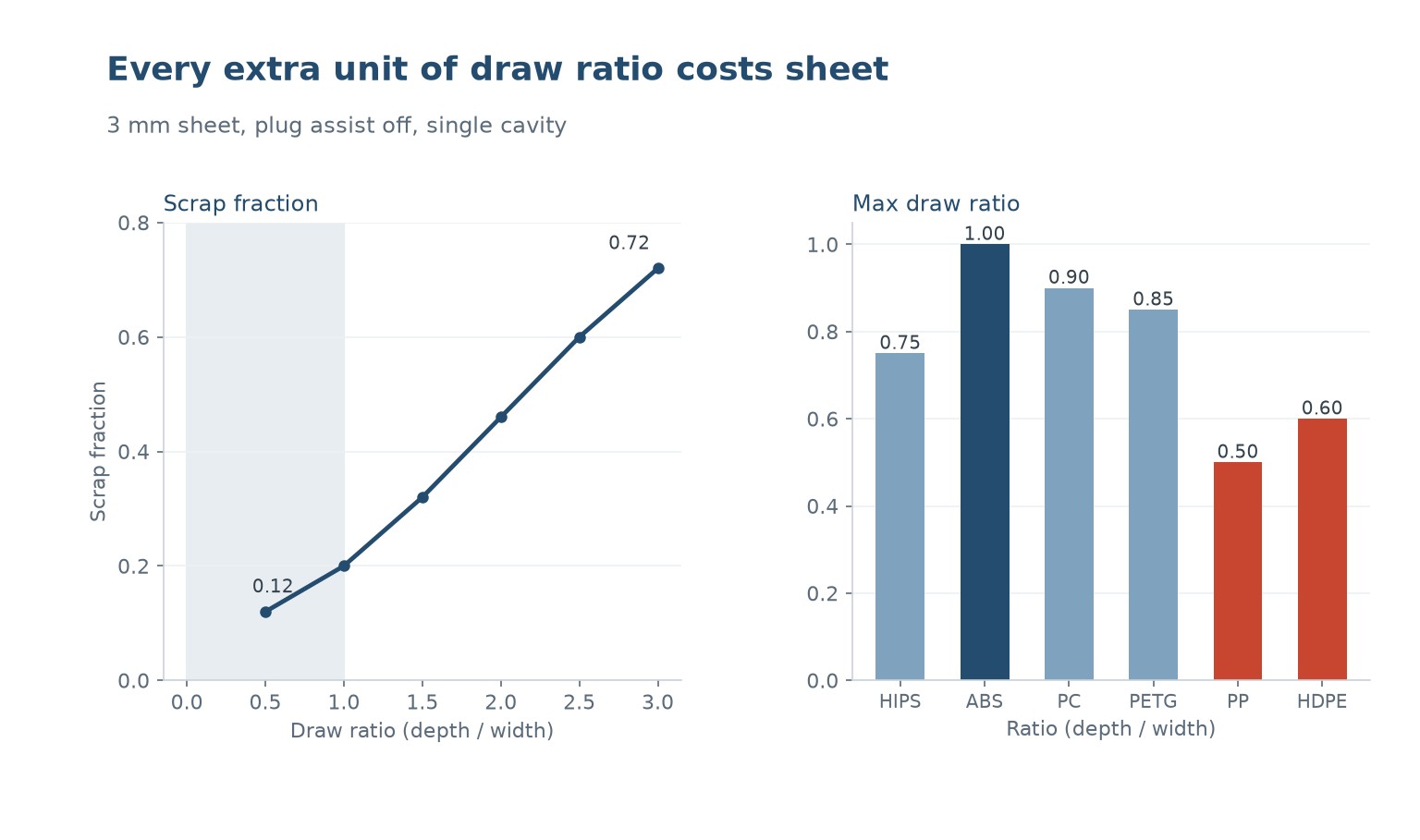
The right hand panel lists the maximum draw ratio for common sheet. ABS reaches about one, HIPS three quarters, and polypropylene only half, which is why PP is a shallow lid material and not a deep box material.
These are ceilings, not targets. Real parts run below them because walls thin as you approach the limit, and a part at ninety percent of maximum draw ratio has a corner that is filmsy and a scrap rate that is climbing.
The chart on the left is the cost side of the same story. As draw ratio rises the fraction of sheet that ends up as trim rather than part rises just as fast as the difficulty does.
Why scrap climbs with depth
A deep draw needs a large flat blank to cover the mould, and most of that blank becomes the clamp frame and the trimmed flange. At a draw ratio of one the trim is modest; at two and a half it is more than half the sheet.
The table shows the trend for a three millimetre sheet. Wall thinning runs from eight percent at a shallow draw to over half at the deepest, and scrap tracks it almost exactly because the same geometry drives both.
This is why deep parts are expensive twice: the wall is thin so the part is light, and the trim is large so the sheet use per part is high. The cost per kilogram of finished part rises steeply with draw ratio.
The usual answer is to redesign the part to a lower draw ratio, or to accept the scrap and price it in. What does not work is hoping a deeper draw will somehow use less material.
| Draw ratio | Wall thinning | Scrap fraction |
|---|---|---|
| 0.5 | 8% | 12% |
| 1.0 | 18% | 20% |
| 1.5 | 30% | 32% |
| 2.0 | 42% | 46% |
| 2.5 | 55% | 60% |
Table 1 — Wall thinning and scrap against draw ratio for 3 mm sheet.
Wall thinning at the corner
The corner of a deep draw is where the sheet stretches most, so it is always the thinnest point. A part that measures correctly on the wall and fails on the corner has hit its draw ratio limit there.
Thinning also makes the corner the weak point in service. A tray that holds its shape on the flat sides collapses at the corner because that is where the material ran out first.
Heating the sheet more evenly helps, because a warmer sheet stretches more uniformly and the thinning spreads instead of concentrating at the corner.
But there is a ceiling on heating too, because an overheated sheet sags before it reaches the mould. The balance between sag and thinning is exactly the forming window the material gives you.
Plug assist changes the maths
A plug assist is a shaped former that pre-stretches the sheet into the cavity before the vacuum pulls it the rest of the way. It moves material toward the corners before the draw begins, so the corner is not doing all the stretching.
Used well, a plug can raise the effective draw ratio by a third without thinning the corner, which is how deep boxes are formed at all on production lines.
The plug has to be the right shape and the right temperature. A plug that is too large pushes material aside instead of distributing it, and a cold plug chills the sheet it touches and creates a local thin spot.
And the plug speed matters. Too fast and it doughnuts the sheet; too slow and the sheet sags around it. The window is narrow, which is why plug assist is a tuned process rather than a fitted part.
Designing inside the limit
The cheapest deep part is a shallow part that looks deep. Radii instead of sharp corners, a wider narrow end, and a draft angle that lets the sheet release all lower the effective draw ratio without changing the function.
Keep the narrowest in-plane dimension generous. Because draw ratio divides by that dimension, widening the narrow end buys more depth than any change to the material does.
Specify the sheet thickness for the thinnest corner, not the nominal wall, so the part still meets its job at the point that stretches most.
And agree the scrap allowance up front. A part at a draw ratio of two is a different cost per unit than the same footprint at one, and that difference should be designed, not discovered on the invoice.
| المواد | Max draw ratio | Typical use |
|---|---|---|
| HIPS | 0.75 | Signage, trays |
| ABS | 1.00 | Automotive, enclosures |
| كمبيوتر شخصي | 0.90 | Machine guards, glazing |
| PETG | 0.85 | Medical, display |
| ص | 0.50 | Packaging, lids |
| البولي إيثيلين عالي الكثافة | 0.60 | Tanks, liners |
Table 2 — Maximum draw ratio for common thermoforming materials.
What is draw ratio in thermoforming?
The depth of the formed part divided by its smallest in-plane dimension. It predicts whether a part will form and how thin the wall becomes.
Which material can be drawn deepest?
ABS at about a ratio of one, with PETG and PC close behind. Polypropylene and HDPE are limited to roughly half that and suit shallow parts.
Why does scrap increase with draw ratio?
A deep draw needs a large blank and most of it becomes the trimmed flange. At a high draw ratio more than half the sheet can end up as trim.
How does plug assist help a deep draw?
It pre-stretches the sheet toward the corners before vacuum forming, distributing the material so the corner thins less and the effective draw ratio rises.
Why is the corner the weakest point?
It is where the sheet stretches most, so it is always the thinnest. A part that measures correctly on the wall often fails at the corner first.
How do I lower the draw ratio of a part?
Widen the narrowest dimension, use radii instead of sharp corners, add draft, and specify thickness for the thinnest corner rather than the nominal wall.
Deep parts thinning at the corner?
Send the part geometry and the sheet you plan to use. We will tell you the draw ratio you are asking for and whether it will form.






 AR
 EN
 ES
 FR
 DE
 PT
 RU
 JA
 KO
 IT
 NL
 TR
 PL
 ID
