

The square law and where it comes from
Heat moves through a plastic sheet by conduction, and the time it takes to raise the core to forming temperature scales with the square of the thickness. Double the thickness and the heat has twice as far to travel and twice as much material to heat, so the time goes up by four.
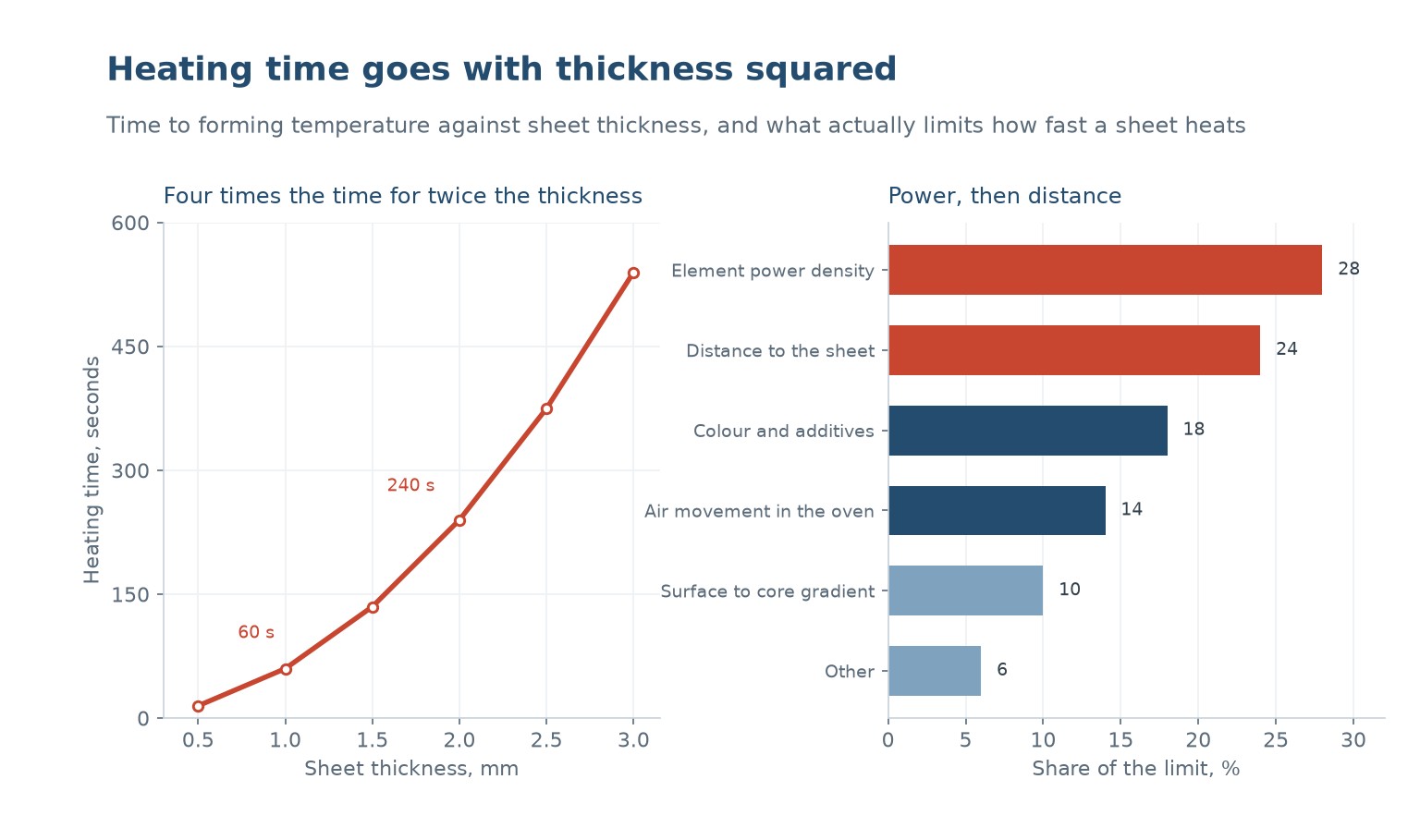
The chart on the left shows it for a typical ABS or PS sheet with a 60 second base: 0.5 mm takes 15 seconds, 1.0 mm takes 60, 1.5 mm takes 135, 2.0 mm takes 240, 2.5 mm takes 375 and 3.0 mm takes 540. The base of 60 seconds per millimetre squared is a working number for a well-set oven, not a law of nature.
The practical consequence is that thick gauge forming is a different process, not a slower version of thin gauge. A 3 mm sheet takes nine minutes to heat, which means the oven is the bottleneck, the sheet has to be supported to avoid sag, and the cycle is dominated by heating rather than by forming or cooling.
It also means that a small thickness change has a large time consequence. Going from 1.5 to 2.0 mm is a 33 percent increase in thickness and a 78 percent increase in heating time. A quote prepared on the thin gauge cycle will be badly wrong on the thick one.
The surface arrives first
While the sheet is heating, there is a temperature gradient through it. The surface facing the elements reaches forming temperature quickly and then keeps absorbing heat, while the core is still cold. If the oven is left on too long the surface degrades while the core is still below temperature.
The forming window is therefore defined by the core, not the surface. A sheet is ready when the core is at forming temperature, and by then the surface may be 20 to 30 degrees hotter. This is why a two-sided oven heats faster and more evenly than a one-sided one: it halves the distance the heat has to travel from the nearest surface to the core.
The gradient also explains the sag. A sheet whose surface is hot and core is cold sags less than one that is uniformly hot, so a sheet that looks ready may still be too cold in the middle, and a sheet that sags heavily may already be over-heated at the surface. Judging readiness by eye is judging the wrong variable.
The practical measurement is a contact probe on both faces, or a thin thermocouple laminated into a scrap sample. A shop that measures surface temperature only will run the oven hotter than necessary to get the core up, and pay for it in surface degradation and colour shift.
What actually limits the rate
The right hand panel shows the limits: element power density 28 percent, distance to the sheet 24, colour and additives 18, air movement in the oven 14, and the surface to core gradient 10. The first two are the ones that can be changed on an existing machine.
Power density is watts per square centimetre of element surface, and it sets the maximum heat flux the oven can deliver. A machine with low power density cannot heat thick sheet quickly whatever the setpoint, because the elements simply cannot deliver the energy. This is the reason thick gauge machines have more or bigger elements rather than just longer ovens.
Distance matters because radiant heat falls with the square of the distance. Moving the elements from 150 mm to 200 mm from the sheet reduces the flux by more than 40 percent, which is why a machine set up for thin sheet heats thick sheet very slowly. The adjustment is free and it is often the first thing to check.
Colour and additives at 18 percent is the one that surprises people. Black sheet heats faster than white because it absorbs more radiant energy, and a white sheet with a high titanium dioxide loading can take 30 percent longer. A change of colour in the same tool is a change of heating time, and the process sheet has to say so.
Air movement helps and hurts
Air movement at 14 percent is the variable with two directions. A fan that circulates air in the oven evens out the temperature across the sheet and removes the boundary layer of hot air that insulates the surface, which speeds heating and improves uniformity. Too much air, or air from a cold shop, cools the sheet and wastes energy.
The usual arrangement is a low-velocity recirculation inside the oven, baffled so that it does not blow directly on the sheet. A shop with an open oven in a cold building has a permanent draught across the sheet, and the resulting temperature variation across the sheet is a common cause of uneven forming that gets blamed on the elements.
The second effect of air is on the sheet supports. A sagging sheet that touches an element is destroyed, and the air movement that keeps the sheet cool enough not to sag is the same movement that slows the heating. Thick gauge forming manages this with a support frame or with a controlled sag rather than with more air.
| Sheet | وقت التسخين | What dominates the cycle |
|---|---|---|
| 0.5 mm | 15 to 20 seconds | Forming and cooling |
| 1.0 mm | 55 to 70 seconds | التبريد |
| 1.5 mm | 2 to 2.5 minutes | Cooling, then heating |
| 2.0 mm | 3.5 to 4.5 minutes | التدفئة |
| 3.0 mm | 8 to 10 minutes | Heating, and sag control |
Table 1 — Heating time against thickness for a well-set two-sided oven.
Checking a heating profile
The check that costs nothing is a sag test. Clamp a sheet of the production thickness, heat it for the calculated time with no vacuum or pressure, and watch the sag. A sheet that sags 20 to 30 mm per metre is at about the right temperature; one that barely moves is cold and one that touches the lower element is far too hot.
The check that costs a little is a surface probe at several points across the sheet at the end of the heating cycle. A variation of more than 5 degrees across the sheet means the elements or the distance are not uniform, and that variation will show up as uneven wall thickness in the part.
The check that settles it is a thermocouple laminated into a scrap sample, which gives the core temperature directly. It is a one-off measurement for each new material and thickness, and the result goes on the process sheet as a heating time with a tolerance rather than a setpoint.
Whichever method is used, the number that should be recorded is time, not oven percentage. A percentage setting means nothing without the oven, the distance and the element condition; a time in seconds means the same thing on any machine of the same type, and it is the number that transfers when a job moves.
| Check | What it tells you | التكلفة |
|---|---|---|
| Sag test | Whether the sheet is at forming temperature overall | One scrap sheet |
| Surface probe, several points | Whether the oven is even across the sheet | A contact thermometer |
| Laminated thermocouple | The core temperature directly | An hour of sample preparation |
| Bend test on the formed part | Whether the sheet was hot enough to form | One part |
| Wall thickness scan | Whether the heating was even enough | A section and a micrometer |
Table 2 — Five ways to check a heating profile, cheapest first.
What the square law costs
The commercial consequence is that thick gauge parts have a very different cost structure. On a 3 mm sheet the oven runs for nine minutes and the forming and cooling take perhaps one, so the machine is a heating machine with a forming station attached. The output is set by the oven and the only way to raise it is a longer oven or a second one.
The quality consequence is that thick sheet is much less forgiving. The window between too cold to form and too hot to hold is narrower in absolute terms, and the surface degrades while the core is still coming up. A process developed on 1 mm sheet will produce scrap on 3 mm sheet until the heating time and the support are both changed.
The quoting consequence is that a heating time estimate based on thickness rather than on thickness squared will be wrong by a large factor on thick work. It is the single most common error in a first quote for a heavy gauge part, and it is worth checking before the price goes out rather than after the tool is built.
Why does heating time go with thickness squared?
Because heat travels through the sheet by conduction. Doubling the thickness doubles the distance the heat must travel and doubles the mass to be heated, so the time goes up by a factor of four.
How long does it take to heat a 2 mm sheet?
About 3.5 to 4.5 minutes in a well-set two-sided oven, against about a minute for 1 mm. The exact figure depends on the material, the colour, the element power density and the distance.
How do I know when a sheet is ready?
By the core temperature, not the surface. The surface reaches forming temperature well before the core does, so judging by eye judges the wrong variable. A sag of 20 to 30 mm per metre is a useful proxy.
Why does black sheet heat faster than white?
Because it absorbs more radiant energy. A white sheet with a high titanium dioxide loading can take 30 percent longer to reach forming temperature, which is why a colour change needs a heating time change.
Does moving the elements closer help?
Yes, substantially. Radiant heat falls with the square of distance, so moving elements from 200 mm to 150 mm increases the flux by more than 40 percent. It is free and it is often the first thing to check on thick work.
Is heating or cooling the bottleneck?
It depends on thickness. Below about 1.5 mm cooling dominates; above 2 mm heating dominates and the oven becomes the constraint on output.
A heating cycle that is calculated, not guessed
Send us the material, the thickness and the draw depth. We will tell you the heating time the oven has to deliver and whether the machine you are planning to use can actually get there.




 AR
 EN
 ES
 FR
 DE
 PT
 RU
 JA
 KO
 IT
 NL
 TR
 PL
 ID
