Colour drift is heat history you cannot see
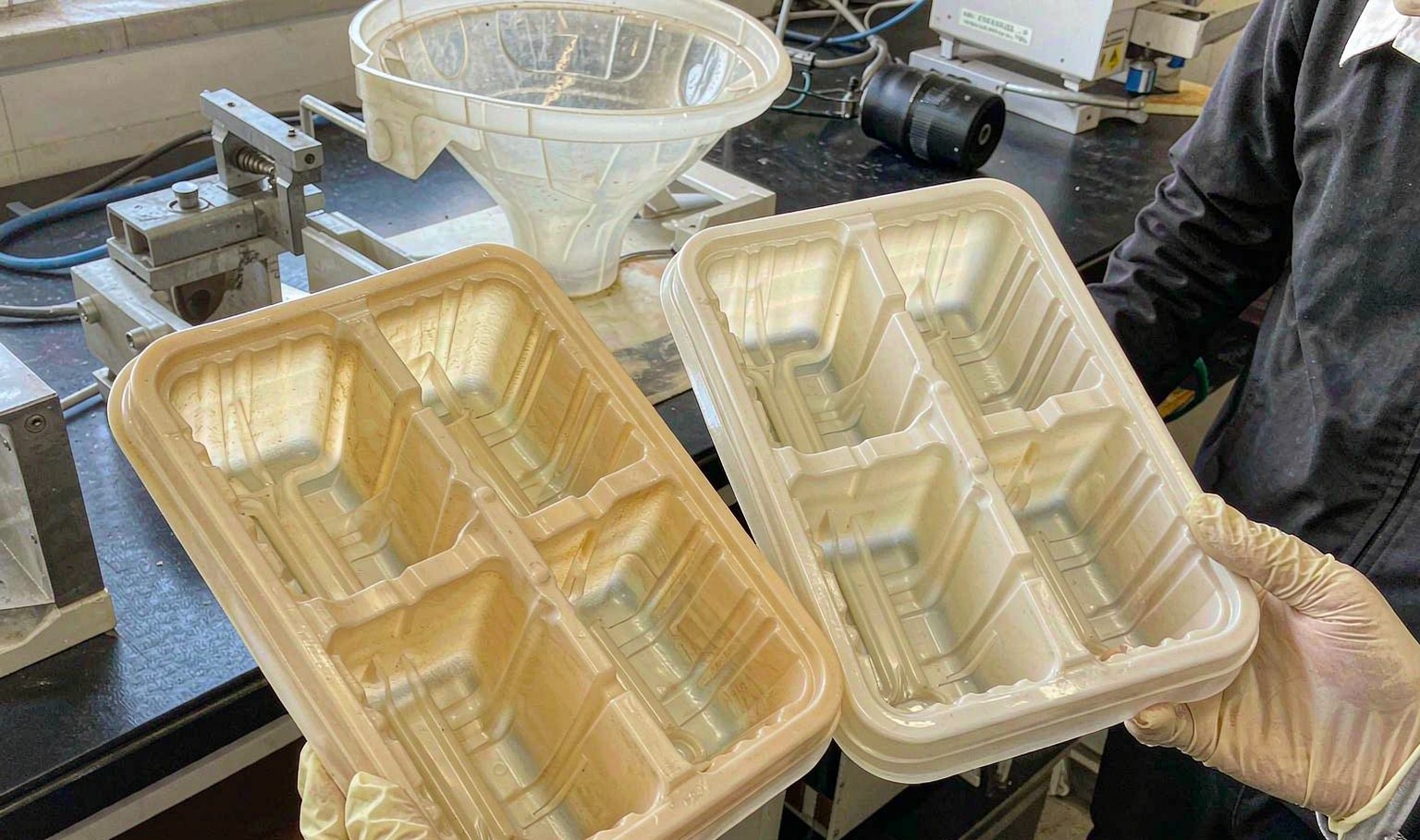
A thermoplastic sheet does not change colour when it is heated, it changes colour when it is overheated. The change is chemical: the polymer chain scissions, the stabiliser is consumed, and the products of that reaction absorb light differently. The visible result is a shift towards yellow or brown, and it appears gradually rather than as a step.
That is why colour problems in thermoforming are so often intermittent. A heater setting that is 8 percent high will not yellow a part immediately. It will consume the stabiliser faster, and after a few hundred cycles the sheet that used to come out white comes out cream. The setting never changed; the margin did.
The same mechanism explains why two cavities on the same tool can differ. If one cavity sits closer to a heater bank, or under a hotter zone, or is shielded differently by the clamp frame, it sees a different heat history and produces a different colour. The tool is identical; the thermal environment is not.
This matters because colour is one of the few defects a customer can see without any equipment. A warped part can be argued about; a part that is visibly the wrong shade cannot. Colour complaints therefore arrive first and are investigated last, which is the wrong way round.
Heat history is the main cause
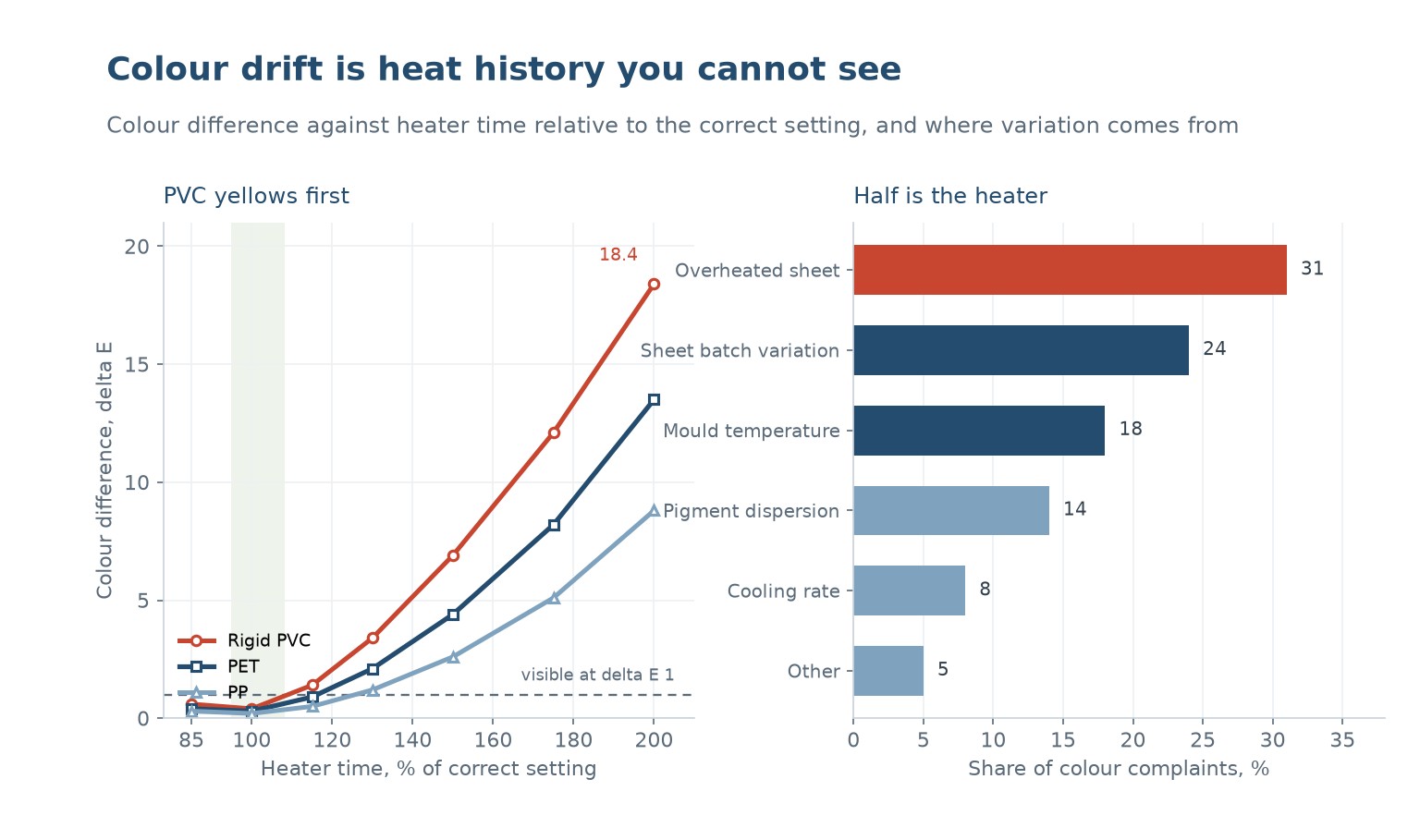
The chart on the left plots colour difference against heater time as a percentage of the correct setting, for three common sheet materials. Up to about 110 percent the colour is stable: the delta E stays under 1, which is the threshold at which a trained eye begins to see a difference in a side by side comparison.
Beyond that the curves turn up sharply, and they turn up at different rates. Rigid PVC is the most sensitive, reaching delta E 6.9 at 150 percent and 18.4 at 200 percent. PET reaches 4.4 and 13.5 at the same settings, and PP is the most forgiving at 2.6 and 8.8.
The reason PVC is worst is that it dehydrochlorinates. Above a certain temperature the polymer releases hydrogen chloride, which catalyses further degradation, and the reaction accelerates. A PVC sheet that has been run 20 percent too hot is not slightly yellow, it is chemically different, and no amount of cooling will bring the colour back.
The practical rule is that heater time has a working window of about plus or minus 10 percent around the correct setting, and outside that window colour becomes a process variable rather than a material property. On a machine with a percentage timer, that is a setting range of 20 percent, which is narrower than most operators assume.
Pigment, dispersion and sheet batch
The second largest cause, at 24 percent of complaints in the survey on the right, is variation between sheet batches. A sheet is a compounded product, and the pigment loading, the dispersion quality and the base resin colour all vary within the supplier's tolerance. Two batches that both meet the specification can differ by delta E 1.5, which is visible on a large flat panel.
Pigment dispersion is the part of that variation that a converter can influence. A poorly dispersed pigment leaves agglomerates that scatter light differently, and the effect is stronger in thin gauges because there is less material to hide them. A sheet with visible specks under a magnifier will produce parts with a mottled appearance after forming, because the forming stretches the sheet and spreads the agglomerates apart.
Titanium dioxide is a special case. It is the white pigment in most opaque sheets, and it is also a photo-catalyst. An uncoated or poorly coated grade will accelerate degradation at the surface, which shows up as chalking and yellowing on parts that face a window. A rutile grade with a proper coating costs more and lasts years longer.
The control here is incoming inspection, not process adjustment. A colour plaque retained from each sheet batch, measured against a master, catches the batch variation before it becomes a formed part. It takes ten minutes per delivery and it removes a quarter of the complaints.
Mould temperature and cooling rate
Mould temperature affects colour in two ways. The first is thermal: a hot mould keeps the part hot for longer, which extends the heat history beyond the forming step and allows further degradation. The second is physical: the cooling rate affects crystallinity, and in semi-crystalline materials such as PP and PET the crystal size and distribution change the way light is scattered.
A PP part formed on a 30 C mould and one formed on an 80 C mould from the same sheet will not match. The hot mould produces larger crystallites, which scatter light more, and the part looks lighter and less translucent. The difference is not a defect in either part; it is a difference in the process, and it is entirely reproducible.
The chart on the right puts mould temperature at 18 percent of complaints. That is a large share for a variable that is often not controlled at all. A mould with a water circuit that is fed from a common line, shared with three other machines, will drift by 15 C over a shift as the other machines cycle.
Cooling rate also interacts with the pigment. A fast cooled part traps the pigment in a less ordered structure and appears slightly darker; a slow cooled part appears lighter. On a colour critical part, the mould temperature should be treated as a colour parameter and controlled to plus or minus 3 C, not as a utility.
Measuring colour: delta E and the light source
Delta E is the numerical difference between two colours in a defined colour space. The scale is designed so that a delta E of 1 is roughly the threshold of a trained eye under controlled lighting, 2 to 3 is visible to an untrained observer, and above 5 the colours read as different rather than as a mismatch.
The number is only meaningful with the light source and the observer stated. A pair of parts that match under D65 daylight can mismatch badly under a warm white LED, because the pigments have different spectral curves even when their tristimulus values coincide. This is metamerism, and it is the reason a colour approved in a warehouse looks wrong in a showroom.
The measurement geometry matters as well. A textured surface measured at 8 degrees diffuse will read differently from the same surface measured at 45 degrees, because the texture shadows the light differently. On a formed part with draw marks, the measurement position has to be specified, not left to the operator.
For production control, a handheld spectrophotometer with a defined aperture, a defined light source and a retained master plaque is enough. The instrument costs a few thousand euro and pays for itself the first time it settles an argument about whether a batch is acceptable.
| Delta E | What it means | Typical action |
|---|---|---|
| Under 1.0 | Not visible side by side to a trained eye | Accept |
| 1.0 to 2.0 | Visible on large flat areas in daylight | Accept for non cosmetic parts |
| 2.0 to 3.5 | Clearly visible to anyone comparing | Reject on visible surfaces |
| 3.5 to 6.0 | Reads as a different shade | Reject, investigate the batch |
| Above 6.0 | Different colour, often with degradation | Stop the line, check the heater |
Table 1 — Delta E thresholds as they are applied in practice
Getting colour back under control
The first step is to find out whether the variation is within a run or between runs. If parts from the start and the end of a shift differ, the cause is drift: a heater zone losing output, a mould circuit warming up, a sheet batch changing. If parts from different cavities differ at the same moment, the cause is the thermal environment of the tool.
Within a run, the heater is the first suspect. A quartz element that is 15 percent down on power still heats, still forms, and yellows the sheet on the side nearest to it. Checking element current against the machine data takes twenty minutes and finds this class of fault immediately.
Between runs, the sheet batch is the first suspect. Retaining a plaque from every delivery and measuring it against the master turns an intermittent complaint into a traceable one. When a complaint arrives, the question becomes which batch it came from rather than what went wrong.
The last resort is to compensate in the pigment. Adding a tint to correct a drift caused by overheating is treating the symptom, and it usually makes things worse, because the degradation continues and the colour keeps moving. Correct the heat, then check the colour.
Writing a colour specification that works
A colour specification needs four elements to be usable: a master sample or a numerical target in a stated colour space, a light source and observer, a measurement geometry and position, and a tolerance in delta E. A specification that says only a RAL or Pantone number is a starting point, not a specification, because those references are defined for paint and print, not for formed plastic.
The tolerance has to match the visibility. On a large flat panel viewed in daylight, delta E 1.5 is a reasonable limit. On a small internal bracket, delta E 3 is generous and costs nothing. Applying a cosmetic tolerance to a hidden part raises the scrap rate for no benefit, which is a common and expensive mistake.
The specification should also state the surface. A textured part and a smooth part from the same sheet will not measure the same, and neither will a part measured on a draw mark and one measured on a flat land. Fixing the measurement position removes most of the argument.
| السبب | Share | Where to look | Fix |
|---|---|---|---|
| Overheated sheet | 31 % | Heater element current, timer setting | Restore the profile, replace the element |
| Sheet batch variation | 24 % | Incoming plaque against master | Reject the batch, tighten the purchase spec |
| Mould temperature | 18 % | Circuit temperature over a shift | Dedicated chiller, plus or minus 3 C |
| Pigment dispersion | 14 % | Magnified view of the sheet | Change the masterbatch grade |
| Cooling rate | 8 % | Cooling time and air flow | Fix the cycle, do not vary it |
| Other | 5 % | Contamination, regrind ratio | Segregate regrind, clean the line |
Table 2 — The six causes in the order they should be checked
The order in the table is the order of investigation, and it is roughly the order of cost as well. The heater check is free and finds a third of the problems. The batch check costs ten minutes per delivery. The chiller is a capital item, and it is only justified once the first two are under control.
Why do parts from the same sheet come out different colours?
Because they did not see the same heat. Cavities closer to a heater bank, or under a hotter zone, or shielded differently by the clamp frame, absorb more energy and degrade further. The sheet is the same; the thermal history is not.
Does overheating always show as yellowing?
In PVC and most styrenics, yes. In PP and PE the first sign is often a loss of gloss or a faint pink or brown tint, and in PET it is a grey haze before it is a yellow. By the time the colour is obvious, the stabiliser is already consumed.
What delta E is acceptable?
Under 1.0 is not visible side by side. Between 1.0 and 2.0 is visible on large flat areas in daylight. Above 2.0 it is clearly visible and should be rejected on cosmetic surfaces. The limit should match how the part is seen, not be applied uniformly.
Can I correct colour by adding pigment?
It treats the symptom. If the drift comes from overheating, the degradation continues and the colour keeps moving, so the tint has to be adjusted again. Fix the heat history first, then check whether pigment correction is still needed.
Why does the colour look different in the showroom?
Metamerism. Two colours can match under one light source and mismatch under another because their spectral curves differ. A colour approved under D65 daylight can look wrong under warm white LED. Specify the light source, and check under the one the customer will use.
Does regrind affect colour?
Yes, and it accumulates. Regrind has already been through one heat history, so it degrades faster the second time. Above about 20 percent regrind in a colour critical sheet the drift becomes visible, and the regrind ratio has to be fixed and recorded.
Colour drifting between batches?
Send the material, the forming temperature and a photograph of a good part beside a bad one. We will tell you whether it is heat history, sheet batch or tooling.






 AR
 EN
 ES
 FR
 DE
 PT
 RU
 JA
 KO
 IT
 NL
 TR
 PL
 ID