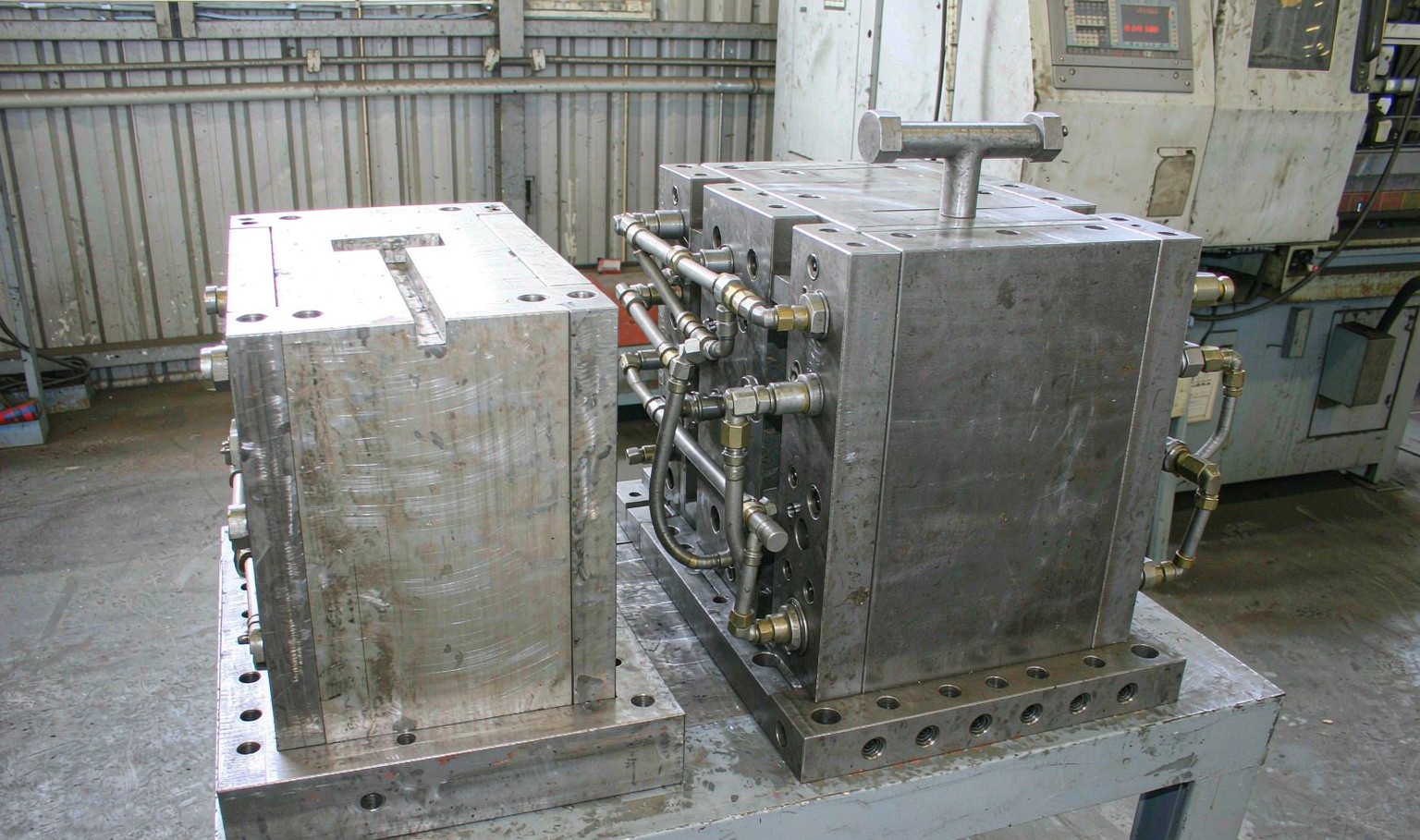
Trays from a cost-reduced run split at the rim during de-nesting, and the scrap content in the blend is higher than the agreed figure.
What the failure looks like on the line
Agricultural mouldings live outdoors, see fertiliser and wash-down chemicals, and are judged a season later rather than on the day they are moulded.
A batch of seedling trays cracks at the thin rim when stacked trays are separated, while an earlier, stiffer batch de-nests cleanly. The parts look well filled and show no visible contamination.
Each heat history through the screw shortens polymer chains, so a rising regrind fraction lowers molecular weight, melt strength and elongation at break. Contaminated or mixed-grade regrind adds incompatible phases that act as crack initiators, and repeated drying of hygroscopic scrap can compound hydrolysis in polyamide grades. The thin rim is the first place the lost ductility shows up under de-nesting strain.
The useful question is not whether the part conforms, but which condition was never written into the specification. On a buyer's specification this distinction matters: a part can measure inside tolerance and still fail in use, because the drawing records geometry while the complaint records behaviour. Regrind fraction is usually the first value both sides compare, and it is also the one most often quoted without the conditions attached to it.
The process window that decides it
Four variables move this result more than the rest. The ranges below are illustrative engineering guidance for a first discussion; confirm them on your own tool, material grade and part geometry before they become contract terms.
| متغير | Typical window | What fails outside it |
|---|---|---|
| Regrind fraction | 0-20 % by mass | Above the window chain scission lowers rim elongation |
| Regrind pass count | < 3 heat histories | Repeated passes multiply the molecular-weight loss |
| درجة حرارة الذوبان | 200-230 C | High heat adds degradation on top of the regrind |
| Regrind moisture content | < 0.2 % by mass | Wet scrap hydrolyses the blend further |
Table 1. Starting window for a joint process trial. Values are engineering guidance, not a measured survey.
Regrind fraction is typically held at 0-20 % by mass. Above the window chain scission lowers rim elongation Record it together with the measurement point and the moment in the cycle; a single number without a location is not a process setting.
Regrind pass count is typically held at < 3 heat histories. Repeated passes multiply the molecular-weight loss When this drifts, the symptom usually appears at one cavity, one sheet position or one lane before it appears across the whole batch.
درجة حرارة الذوبان is typically held at 200-230 C. High heat adds degradation on top of the regrind A change here is cheap during a trial and expensive after tooling release, so treat it as a controlled variable with a documented re-approval.
Regrind moisture content is typically held at < 0.2 % by mass. Wet scrap hydrolyses the blend further Put it on the change-control list, otherwise an unannounced material or setting substitution will be mistaken for ordinary process noise.
Reading the response curve
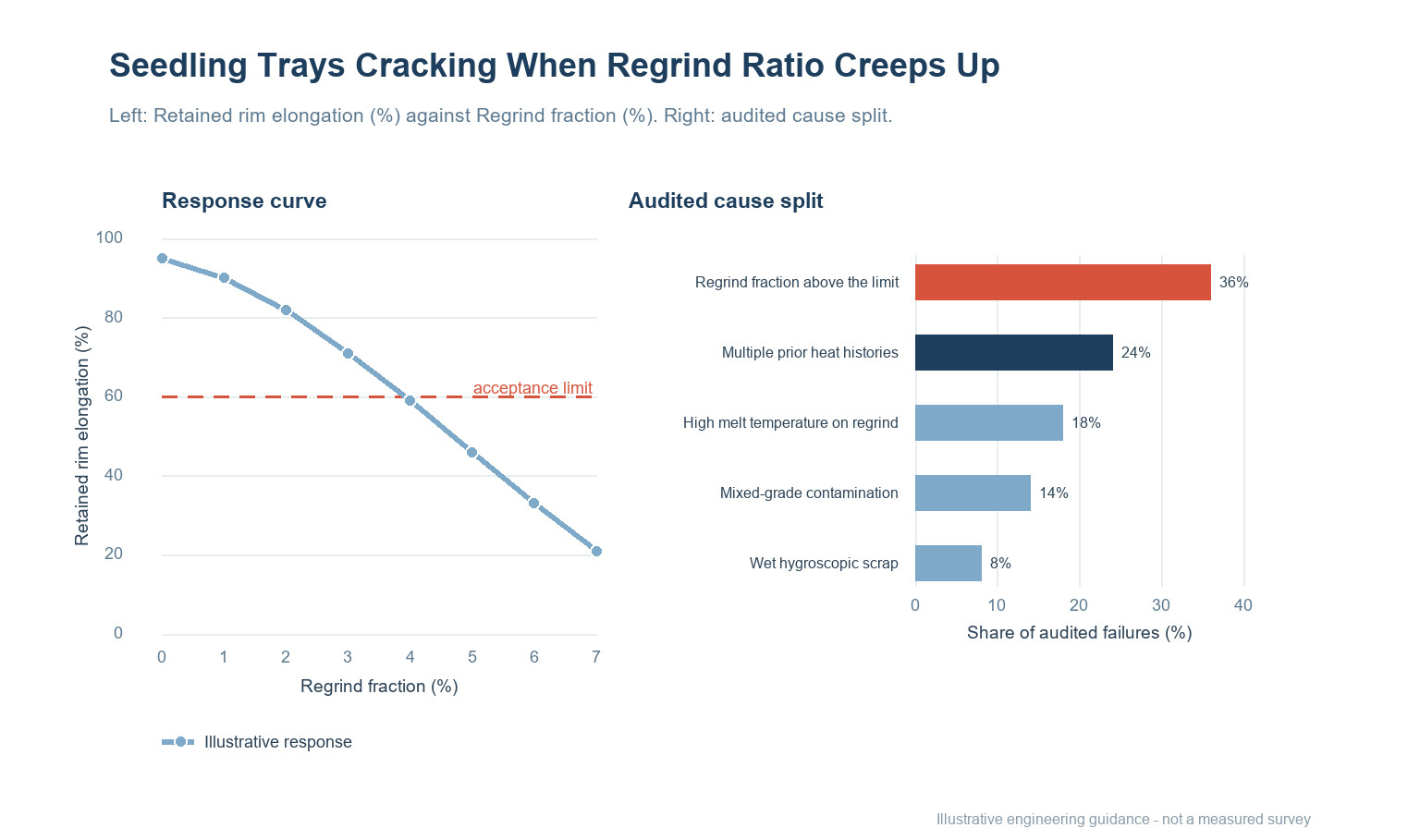
The left panel shows retained rim elongation (%) as regrind fraction (%) increases: the response falls from 95 to 21 on the illustrative 0–100 scale. The dashed line at 60 marks a proposed acceptance limit, not a universal standard. Move that line only after the test method and the sample plan have been agreed, otherwise two suppliers can both be compliant and still deliver different parts.
Read the shape rather than a single point. A curve that changes quickly near the limit is more sensitive to ordinary process noise than one that approaches it gradually, and that difference should be reflected in how tightly the setting is controlled and how often it is checked.
Where the causes actually sit
The right panel of Figure 1 splits audited failures of this type into five groups. The percentages are illustrative engineering guidance for prioritising an investigation, not a measured survey and not a prediction for your line.
| السبب | Illustrative share | First check |
|---|---|---|
| Regrind fraction above the limit | 36% | Verify the declared regrind fraction against the blending record for the run. |
| Multiple prior heat histories | 24% | Compare melt flow index of the blend against virgin resin. |
| High melt temperature on regrind | 18% | Inspect regrind for mixed colours, grades or contamination. |
| Mixed-grade contamination | 14% | Measure rim elongation at break on a tensile strip from the tray. |
| Wet hygroscopic scrap | 8% | Trace how many heat histories the regrind has already seen. |
Table 2. Cause split and the corresponding first check. Shares are indicative and sum to 100.
Regrind fraction above the limit accounts for roughly 36% of the illustrative split. Verify the declared regrind fraction against the blending record for the run. Start here before authorising a material or tooling change, because it is the fastest explanation to confirm or eliminate.
Multiple prior heat histories accounts for roughly 24% of the illustrative split. Compare melt flow index of the blend against virgin resin. Start here before authorising a material or tooling change, because it is the fastest explanation to confirm or eliminate.
High melt temperature on regrind accounts for roughly 18% of the illustrative split. Inspect regrind for mixed colours, grades or contamination. Start here before authorising a material or tooling change, because it is the fastest explanation to confirm or eliminate.
Checks before sign-off
Work through these in order; measuring a later variable before an earlier one hides the cause rather than finding it.
- Verify the declared regrind fraction against the blending record for the run.
- Compare melt flow index of the blend against virgin resin.
- Inspect regrind for mixed colours, grades or contamination.
- Measure rim elongation at break on a tensile strip from the tray.
- Trace how many heat histories the regrind has already seen.
Keep a retained reference sample beside every result. When a batch is disputed, the comparison that settles it is almost always between the retained part and the current one under the same method, not between either part and a number on a drawing. Record the instrument, the operator, the conditioning time and the position on the part or sheet for each reading.
Writing it into the specification and the evidence pack
The regrind fraction shall be recorded per lot and shall not exceed the agreed upper limit; rim elongation at break shall be checked against an agreed lower limit set from a signed limit sample, and a tray cracking on de-nesting is rejectable.
Write the requirement as a behaviour at a stated condition, not as a brand of material or a machine setting. State the test method, the conditioning, the sample plan and the rule for deciding a pass. Where a document is needed, ask the supplier for documentation that covers the actual construction and check its scope against your own market before approval; a document for the base material alone does not describe the finished part you are buying.
At first-article approval, freeze the drawing revision, the material and colour identification, the process window, the tool and cavity identification, and the inspection method. Any later change to grade, site, tool, or window should trigger a new first article rather than a paper waiver. Keep retained samples from the approved lot and from each production lot so that a future comparison is possible.
| Evidence item | What it must show |
|---|---|
| Approved drawing and revision | The exact geometry and tolerances the decision applies to |
| Material and colour identification | Grade, supplier, colour reference and any declared recycled content |
| Process window and change log | The agreed settings and any deviation since approval |
| Inspection record and retained samples | Method, conditions, results and a physical reference from the same lot |
Table 3. Minimum evidence pack for a first-article decision and a later batch dispute.
All ranges in this article are illustrative engineering guidance rather than measured data. Treat them as a starting agenda for a process trial, not as a certificate for a batch that has not been run.
Questions buyers ask
Is this a material problem or a process problem?
Each heat history through the screw shortens polymer chains, so a rising regrind fraction lowers molecular weight, melt strength and elongation at break. Contaminated or mixed-grade regrind adds incompatible phases that act as crack initiators, and repeated drying of hygroscopic scrap can compound hydrolysis in polyamide grades. The thin rim is the first place the lost ductility shows up under de-nesting strain. It is worth separating the two before a supplier changes a grade: hold the material constant for one controlled run, then move one setting at a time. If the symptom follows the setting, the material was never the cause.
Can regrind fraction be traded against cycle time?
Only within the window stated in Table 1, and only with a recorded trial. Above the window chain scission lowers rim elongation A faster cycle that sits outside the window usually moves the failure downstream, where it costs more to find.
What should be recorded at incoming inspection?
Keep the measurement, the method, the sample identity and the conditions together. Verify the declared regrind fraction against the blending record for the run. A result without its conditions cannot be compared with a later batch.
Does a change of agricultural require re-approval?
Treat any change to material grade, tool, site or process window as a change that needs a new first-article decision. For injection moulding work the drawing alone is not enough; the process route is part of what was approved.
How many samples are enough for a first-article decision?
There is no universal number. Sample across cavities, lanes, sheet positions or reel lengths so that the spread is visible, not just the average. Agree the sample plan and the acceptance rule with the supplier before the trial starts.
What belongs in the evidence pack?
The approved drawing and revision, the material and colour identification, the process window, the inspection method and results, the retained reference samples, and documentation covering the actual construction. Ask the supplier to state the scope of each document and check it against your own market.
Seeing this on a current injection moulding job?
Send the drawing, the material and grade, the process window you are running, and the point in the cycle or the shelf life where the fault appears. We will help you separate a material question from a process question and a specification question before anyone changes a tool.
Continue reading
- Recycled Resin in Injection Molding: What the Percentage Actually Changes
- Regrind Percentage Disputes: When a Cheaper Blend Fails Impact
- Regrind in Extrusion: Ratio, Contamination and the Property That Falls First
- Injection Molding Material Selection: 14 Plastics Compared
- Writing the Resin Specification Into an Injection Moulding RFQ








 AR
 EN
 ES
 FR
 DE
 PT
 RU
 JA
 KO
 IT
 NL
 TR
 PL
 ID