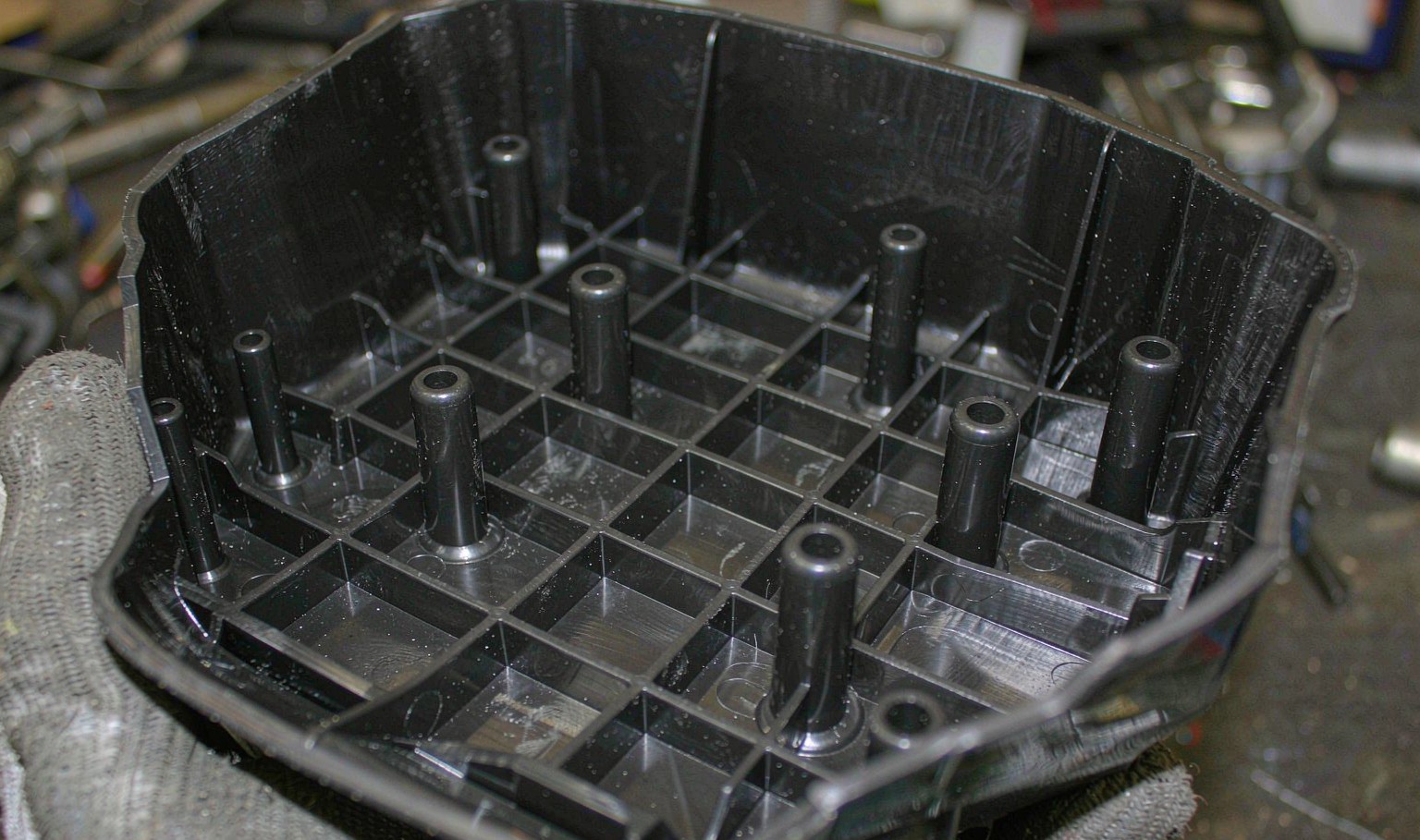
Polypropylene greenhouse clips snap during a routine adjustment after one outdoor season, even though they passed a flex check at goods-in.
What the failure looks like on the line
Agricultural mouldings live outdoors, see fertiliser and wash-down chemicals, and are judged a season later rather than on the day they are moulded.
A clip cracks cleanly at its hinge when a grower opens it in spring. The surface has faded and shows a fine chalky bloom, while clips from the same carton kept indoors still flex.
Ultraviolet radiation breaks polymer chains at the exposed surface, so a thin oxidised layer loses ductility and becomes a notch initiator. Carbon-black or hindered-amine stabiliser packages slow but do not stop the process when the loading is too low for the wall thickness. A hinge concentrates strain in exactly the layer that has degraded most.
The useful question is not whether the part conforms, but which condition was never written into the specification. On a buyer's specification this distinction matters: a part can measure inside tolerance and still fail in use, because the drawing records geometry while the complaint records behaviour. UV stabiliser loading is usually the first value both sides compare, and it is also the one most often quoted without the conditions attached to it.
The process window that decides it
Four variables move this result more than the rest. The ranges below are illustrative engineering guidance for a first discussion; confirm them on your own tool, material grade and part geometry before they become contract terms.
| Variable | Typical window | What fails outside it |
|---|---|---|
| UV stabiliser loading | 0.3-0.8 % by mass | Below the window surface chain scission outpaces protection within one season |
| Carbon-black content | 2.0-2.5 % | Low loading leaves the hinge surface UV-transparent |
| Wall thickness at hinge | 1.2-1.8 mm | Thin sections expose a larger surface-to-volume ratio to oxidation |
| Melt temperature | 200-230 C | Overheating degrades the stabiliser package before moulding |
Table 1. Starting window for a joint process trial. Values are engineering guidance, not a measured survey.
UV stabiliser loading is typically held at 0.3-0.8 % by mass. Below the window surface chain scission outpaces protection within one season Record it together with the measurement point and the moment in the cycle; a single number without a location is not a process setting.
Carbon-black content is typically held at 2.0-2.5 %. Low loading leaves the hinge surface UV-transparent When this drifts, the symptom usually appears at one cavity, one sheet position or one lane before it appears across the whole batch.
Wall thickness at hinge is typically held at 1.2-1.8 mm. Thin sections expose a larger surface-to-volume ratio to oxidation A change here is cheap during a trial and expensive after tooling release, so treat it as a controlled variable with a documented re-approval.
Melt temperature is typically held at 200-230 C. Overheating degrades the stabiliser package before moulding Put it on the change-control list, otherwise an unannounced material or setting substitution will be mistaken for ordinary process noise.
Reading the response curve
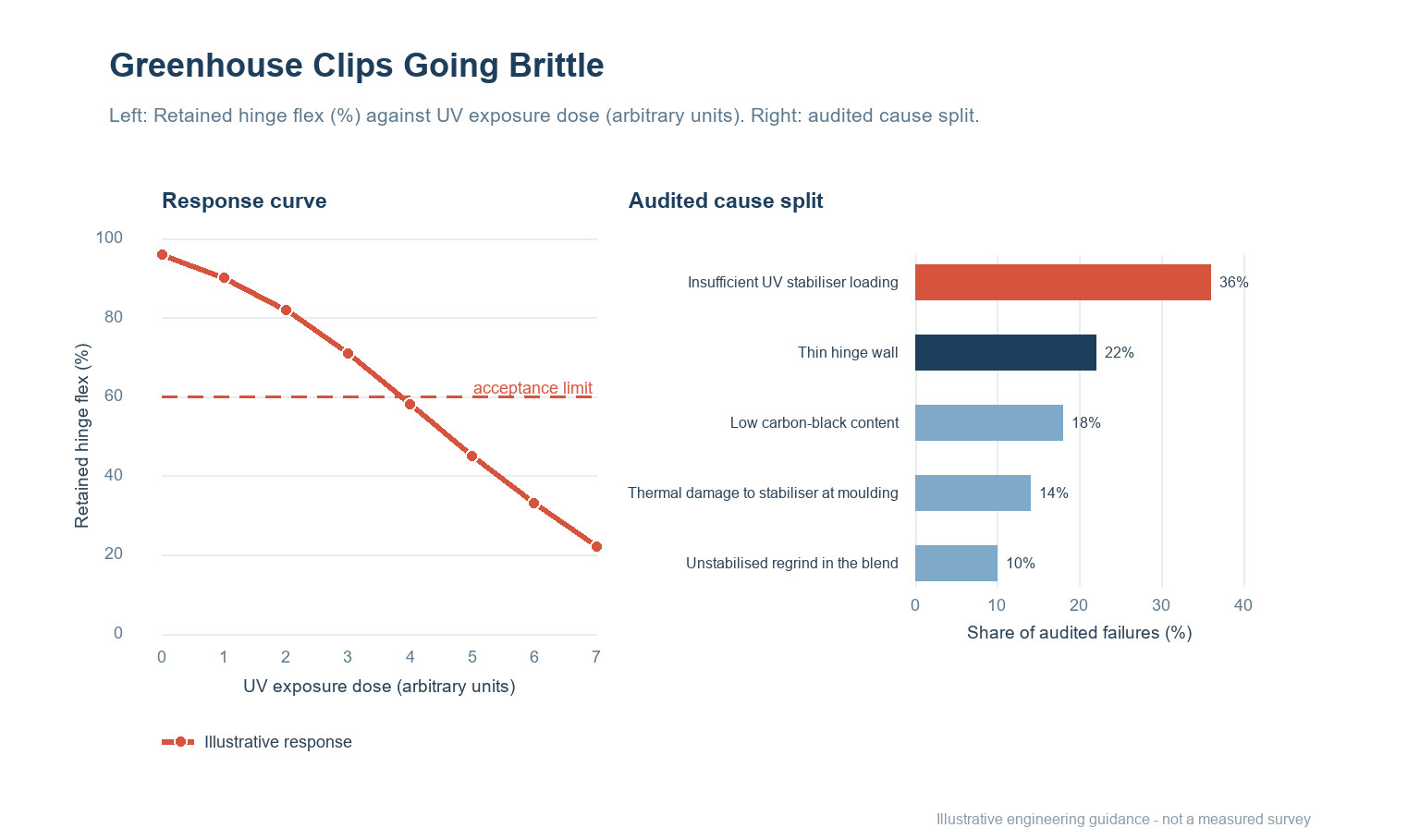
The left panel shows retained hinge flex (%) as uv exposure dose (arbitrary units) increases: the response falls from 96 to 22 on the illustrative 0–100 scale. The dashed line at 60 marks a proposed acceptance limit, not a universal standard. Move that line only after the test method and the sample plan have been agreed, otherwise two suppliers can both be compliant and still deliver different parts.
Read the shape rather than a single point. A curve that changes quickly near the limit is more sensitive to ordinary process noise than one that approaches it gradually, and that difference should be reflected in how tightly the setting is controlled and how often it is checked.
Where the causes actually sit
The right panel of Figure 1 splits audited failures of this type into five groups. The percentages are illustrative engineering guidance for prioritising an investigation, not a measured survey and not a prediction for your line.
| Cause | Illustrative share | First check |
|---|---|---|
| Insufficient UV stabiliser loading | 36% | Compare the flex behaviour of a returned clip against a retained indoor sample from the same lot. |
| Thin hinge wall | 22% | Rub the hinge surface with a white cloth and look for chalking or colour fade. |
| Low carbon-black content | 18% | Measure hinge wall thickness against the drawing rather than the nominal. |
| Thermal damage to stabiliser at moulding | 14% | Request and verify the stabiliser loading declared in the compound documentation. |
| Unstabilised regrind in the blend | 10% | Accelerate a sample set under a controlled UV source and re-test flex after a fixed dose. |
Table 2. Cause split and the corresponding first check. Shares are indicative and sum to 100.
Insufficient UV stabiliser loading accounts for roughly 36% of the illustrative split. Compare the flex behaviour of a returned clip against a retained indoor sample from the same lot. Start here before authorising a material or tooling change, because it is the fastest explanation to confirm or eliminate.
Thin hinge wall accounts for roughly 22% of the illustrative split. Rub the hinge surface with a white cloth and look for chalking or colour fade. Start here before authorising a material or tooling change, because it is the fastest explanation to confirm or eliminate.
Low carbon-black content accounts for roughly 18% of the illustrative split. Measure hinge wall thickness against the drawing rather than the nominal. Start here before authorising a material or tooling change, because it is the fastest explanation to confirm or eliminate.
Checks before sign-off
Work through these in order; measuring a later variable before an earlier one hides the cause rather than finding it.
- Compare the flex behaviour of a returned clip against a retained indoor sample from the same lot.
- Rub the hinge surface with a white cloth and look for chalking or colour fade.
- Measure hinge wall thickness against the drawing rather than the nominal.
- Request and verify the stabiliser loading declared in the compound documentation.
- Accelerate a sample set under a controlled UV source and re-test flex after a fixed dose.
Keep a retained reference sample beside every result. When a batch is disputed, the comparison that settles it is almost always between the retained part and the current one under the same method, not between either part and a number on a drawing. Record the instrument, the operator, the conditioning time and the position on the part or sheet for each reading.
Writing it into the specification and the evidence pack
A retained sample from each production lot shall be flex-tested to the agreed deflection after a defined UV exposure dose; clips failing below the agreed retention-of-flex limit are rejectable, with the limit agreed against a signed limit sample.
Write the requirement as a behaviour at a stated condition, not as a brand of material or a machine setting. State the test method, the conditioning, the sample plan and the rule for deciding a pass. Where a document is needed, ask the supplier for documentation that covers the actual construction and check its scope against your own market before approval; a document for the base material alone does not describe the finished part you are buying.
At first-article approval, freeze the drawing revision, the material and colour identification, the process window, the tool and cavity identification, and the inspection method. Any later change to grade, site, tool, or window should trigger a new first article rather than a paper waiver. Keep retained samples from the approved lot and from each production lot so that a future comparison is possible.
| Evidence item | What it must show |
|---|---|
| Approved drawing and revision | The exact geometry and tolerances the decision applies to |
| Material and colour identification | Grade, supplier, colour reference and any declared recycled content |
| Process window and change log | The agreed settings and any deviation since approval |
| Inspection record and retained samples | Method, conditions, results and a physical reference from the same lot |
Table 3. Minimum evidence pack for a first-article decision and a later batch dispute.
The values quoted here are illustrative engineering guidance, not a measured survey. Agree the test method, the sample size and the acceptance rule before comparing numbers across suppliers.
Questions buyers ask
Is this a material problem or a process problem?
Ultraviolet radiation breaks polymer chains at the exposed surface, so a thin oxidised layer loses ductility and becomes a notch initiator. Carbon-black or hindered-amine stabiliser packages slow but do not stop the process when the loading is too low for the wall thickness. A hinge concentrates strain in exactly the layer that has degraded most. It is worth separating the two before a supplier changes a grade: hold the material constant for one controlled run, then move one setting at a time. If the symptom follows the setting, the material was never the cause.
Can uv stabiliser loading be traded against cycle time?
Only within the window stated in Table 1, and only with a recorded trial. Below the window surface chain scission outpaces protection within one season A faster cycle that sits outside the window usually moves the failure downstream, where it costs more to find.
What should be recorded at incoming inspection?
Keep the measurement, the method, the sample identity and the conditions together. Compare the flex behaviour of a returned clip against a retained indoor sample from the same lot. A result without its conditions cannot be compared with a later batch.
Does a change of agricultural require re-approval?
Treat any change to material grade, tool, site or process window as a change that needs a new first-article decision. For injection moulding work the drawing alone is not enough; the process route is part of what was approved.
How many samples are enough for a first-article decision?
There is no universal number. Sample across cavities, lanes, sheet positions or reel lengths so that the spread is visible, not just the average. Agree the sample plan and the acceptance rule with the supplier before the trial starts.
What belongs in the evidence pack?
The approved drawing and revision, the material and colour identification, the process window, the inspection method and results, the retained reference samples, and documentation covering the actual construction. Ask the supplier to state the scope of each document and check it against your own market.
Seeing this on a current injection moulding job?
Send the drawing, the material and grade, the process window you are running, and the point in the cycle or the shelf life where the fault appears. We will help you separate a material question from a process question and a specification question before anyone changes a tool.
Continue reading
- UV Stabilisers: Hindered Amine, Absorber and the Outdoor Life They Buy
- PVC Profile Weathering: TiO2, Stabilisers and Colour Retention
- Recycled Resin in Injection Molding: What the Percentage Actually Changes
- Last-Time-Buy Volume After a Resin Grade End-of-Life Notice
- Injection Molding Material Selection: 14 Plastics Compared



 EN
 ES
 FR
 DE
 PT
 AR
 RU
 JA
 KO
 IT
 NL
 TR
 PL
 ID