
The problem
Symptom. A resin producer issues an end-of-life notice for the exact copolymer grade running a volume part, with a 90-day last-time-buy window and no agreed replacement.
What it costs. At 24,000 pieces a month and an assumed 0.18 kg of resin per part, an unplanned switch leaves a 14-week gap, and a rushed substitute with a different melt flow index jams the runner.
This article calculates the last-buy volume, sets a bridging cover and defines the alternative-grade trial before the notice window closes.
- 1. When a last-time-buy notice reaches production
- 2. Quantify the resin needed to bridge the switch
- 3. Calculate cover, shelf life and store boundaries
- 4. A controlled alternative-grade trial and bridging lot
- 5. Clause the notice period into the agreement
- 6. Track the bridging stock through to sign-off
When a last-time-buy notice reaches production
An illustrative end-of-life notice lands for the copolymer running a 24,000-piece monthly part, with a 90-day last-time-buy window. No replacement grade is approved, so the plan depends on one final order placed before the window shuts.
| What the notice shows | Gap behind it | First figure to check |
|---|---|---|
| 90-day last-buy window | No consumption figure | 4,320 kg per month |
| 14-week bridging period | No cover calculation | 15,120 kg last-buy volume |
| Replacement grade unapproved | Melt flow not compared | 18 vs 12 g/10 min |
| Old stock to be stored | Shelf life not stated | Assumed 12-month shelf life |
Table 1 - Reading a last-time-buy notice before placing the final order
Need a fixed price for this moulded part?
Send the 2D drawing, resin grade and annual volume. Our engineers return a DFM review, a material recommendation and a written quotation you can compare line by line.
Quantify the resin needed to bridge the switch
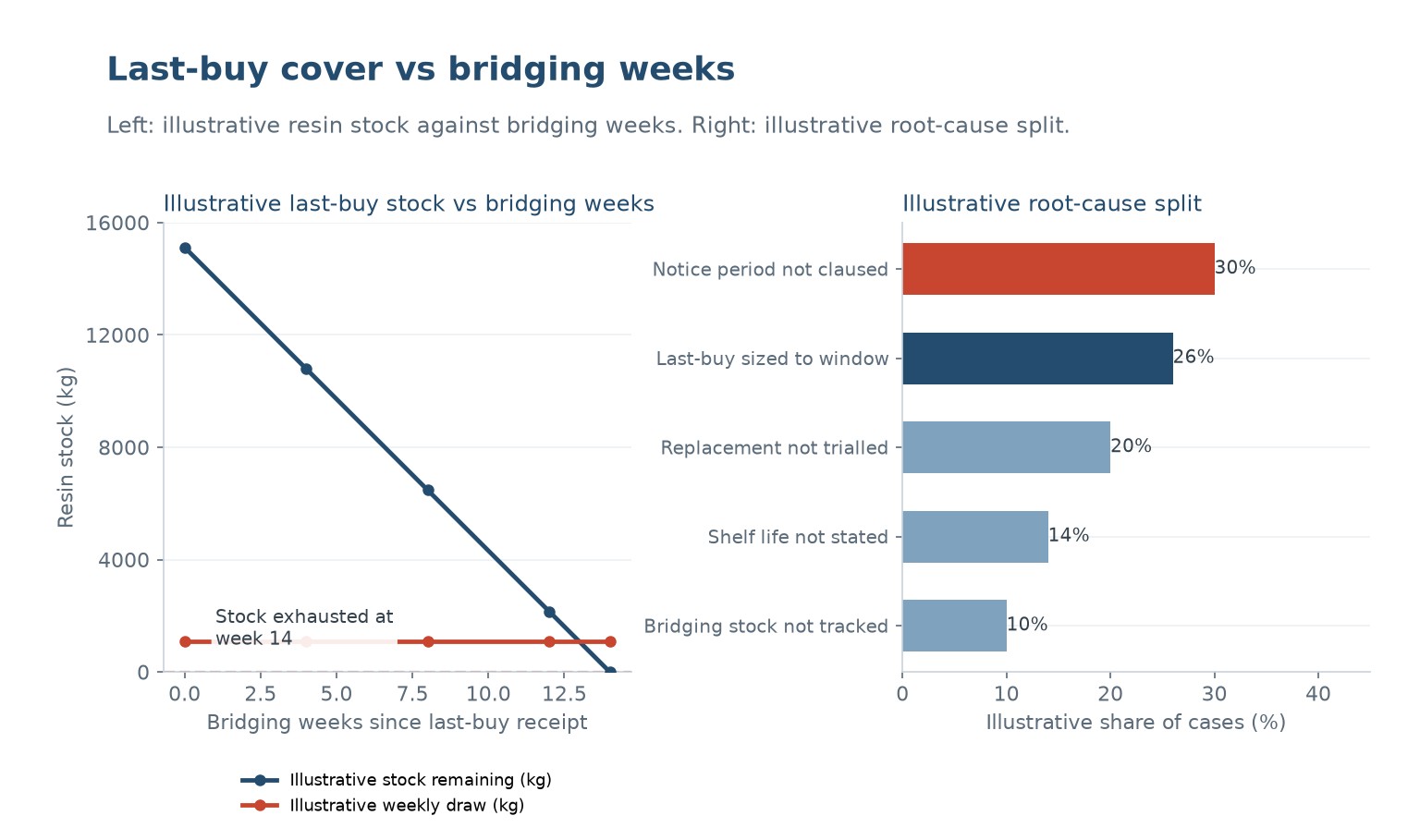
Size the last buy from consumption, not the notice length. At an assumed 0.18 kg per part and 24,000 parts a month that is 4,320 kg monthly; a 14-week illustrative bridge needs 15,120 kg. Ordering to the 90-day window leaves the line short.
A five-step diagnostic sequence
- Log the notice date.
Record the 6-month notification and 90-day last-buy window so the deadline is a dated entry, not an email. - Compute monthly consumption.
At an assumed 0.18 kg per part and 24,000 parts, the line uses 4,320 kg each month. - Size the bridge.
A 14-week illustrative cover at 4,320 kg a month gives a 15,120 kg last-buy volume. - Trial the alternative.
Compare the 18 g/10 min replacement against the 12 g/10 min current grade on a 300-piece bridging lot. - Close on sign-off.
Hold the final stock unopened until the replacement holds the ±0.05 mm bore, then release it.
The chart below is a typical result from that measurement step. Use it to separate a design limit from a setting that can still be recovered.
Calculate cover, shelf life and store boundaries
Set the boundaries: a 14-week bridge, an assumed 12-month resin shelf life and a 15,120 kg last-buy ceiling. These are illustrative worked values from stated assumptions for one example programme, not a market forecast, a supplier quotation or a measured series.
| Clause or parameter | Agreed value | What goes wrong outside it |
|---|---|---|
| Notification period | 6 months before end-of-life | No time to qualify a grade |
| Last-buy volume | Consumption-based 15,120 kg | Order sized to the 90-day window |
| Resin shelf life | Assumed 12 months, sealed | Stock degrades before use |
| Alternative grade | Named, 18 g/10 min MFI | A quiet swap jams the runner |
Table 2 - Last-time-buy clauses for the supply agreement
A controlled alternative-grade trial and bridging lot
Run a controlled transition: trial the replacement at an assumed 18 g/10 min melt flow against the current 12 g/10 min, mould a 300-piece bridging lot and confirm the ±0.05 mm bore. Hold the last-buy stock unopened until sign-off.
| Control action | What it fixes | Cost or trade-off |
|---|---|---|
| Buy to 14-week cover | Bridges the switch | Assumed 15,120 kg of working capital |
| Trial the replacement grade | Confirms the process window | A 300-piece bridging lot |
| Hold last-buy stock sealed | Protects shelf life | Assumed 12-month storage |
| Clause the notification | Gives time to qualify | A 6-month notice duty |
Table 3 - Last-time-buy controls ranked by supply risk
Clause the notice period into the agreement
Write the terms into the agreement: a 6-month end-of-life notification, a 90-day last-buy window, a consumption-based last-buy volume and an assumed 12-month shelf life. Name the alternative grade and state who funds the 15,120 kg final order.
Not sure whether the fault is in the tool or the process?
Send us the drawing, the process window and a few sample parts. We will tell you which change fixes the fault before you commit to a tool modification.
What to send us
- Part drawing with the affected dimension
- Current process settings
- Sample parts from a good and a bad batch
- Annual volume
Track the bridging stock through to sign-off
Track the bridging stock weekly: kg consumed, lots moulded and the alternative trial result. A dated record closes the change when the replacement reaches the same ±0.05 mm bore, and stops a quiet grade swap after the last-buy material runs out.
Before you release this injection moulding job
- The agreement sets a 6-month end-of-life notification and a 90-day last-buy window
- The last-buy volume is sized from an assumed 0.18 kg per part and 14 weeks of cover
- An assumed 12-month shelf life and sealed storage are stated for the final stock
- A named alternative grade is trialled on a 300-piece bridging lot before sign-off
- Ownership of the illustrative 15,120 kg final order is written down
Attach this list to the RFQ. Most moulding faults are decided at the drawing stage.
How large should the last buy be?
Size it from consumption. At an assumed 0.18 kg per part and 24,000 parts a month, a 14-week illustrative bridge is 15,120 kg, not simply the 90-day window.
Why a 6-month notification?
It gives time to trial a replacement. A 90-day window alone is too short to qualify a grade and mould a 300-piece bridging lot.
What is checked on the alternative?
Its assumed 18 g/10 min melt flow against the current 12 g/10 min, plus the ±0.05 mm bore on a bridging lot before the old stock is released.
Who funds the final order?
Clause it. An illustrative 15,120 kg last-buy is a large working-capital item, so the agreement names who pays and stores it.
Can the new grade be swapped in quietly?
No. A different melt flow changes the runner and the bore. Hold the last-buy stock sealed until the alternative is signed off.
How is the change closed?
Track kg consumed each week and close when the replacement holds the ±0.05 mm bore across the bridging lots.
Get a mouldable part and a fixed quotation
Send us the part file and the failure history. Our engineers will return a DFM review, a material recommendation and a fixed quotation with a defined first-article acceptance test.
To get an accurate quote, send:
- 3D file or 2D part drawing
- Resin grade and any regrind limit
- Annual volume and target unit price
- The failed sample or defect photos
Request a DFM review and quote
Why buyers work with Uplastech
ISO 9001, ISO 14001 and ISO 45001 certified. Founded in 2016, with injection moulding lines in Shanghai and an extrusion plant in Jiangsu. Moulding machines from 90T to 1100T and a maximum shot weight of 5100 g. Samples and a written quotation are available on request.








 EN
 ES
 FR
 DE
 PT
 AR
 RU
 JA
 KO
 IT
 NL
 TR
 PL
 ID
