
Both make a hollow part, badly in different ways
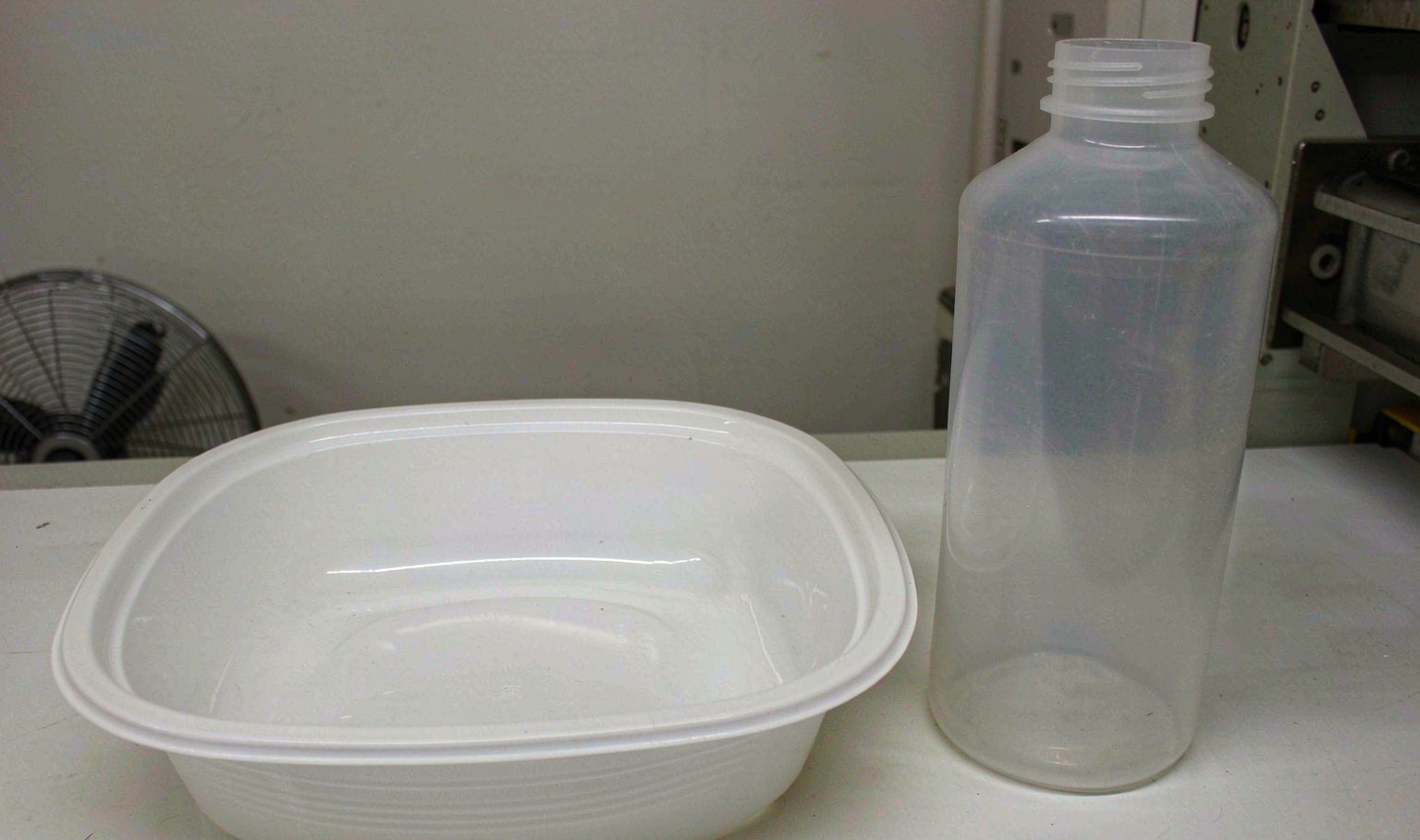
A thermoformed tray and a blow moulded bottle are both hollow, both cheap, and both made in enormous numbers. Beyond that they have almost nothing in common, and the reason is where the material comes from. Thermoforming starts with a flat sheet that is heated and pulled over or into a mould. Blow moulding starts with a tube of melt that is pinched shut and inflated against a mould cavity.
That difference sets everything else. Thermoforming can only make a shape that can be released from a one-sided mould, so no undercuts, no closed hollows, no handles with a hole in them unless the hole is cut afterwards. Blow moulding can make a closed hollow with a neck, a handle, and a body that is wider than its opening, which is why every bottle in the world is blow moulded.
Wall thickness follows the same logic. A thermoformed part starts at a known sheet thickness and thins where it stretches, so the wall is thinnest at the deepest point and thickest at the flange. A blow moulded part starts as a parison of controlled thickness and thins where it inflates, so the wall is thinnest where the mould is widest. Both are non-uniform, in different places.
The consequence is that the process choice is usually made by geometry before anyone calculates cost, and only looks like a cost decision afterwards. The cost curves matter when both processes can physically make the part, which is a narrower overlap than most buyers expect.
The cost curves cross
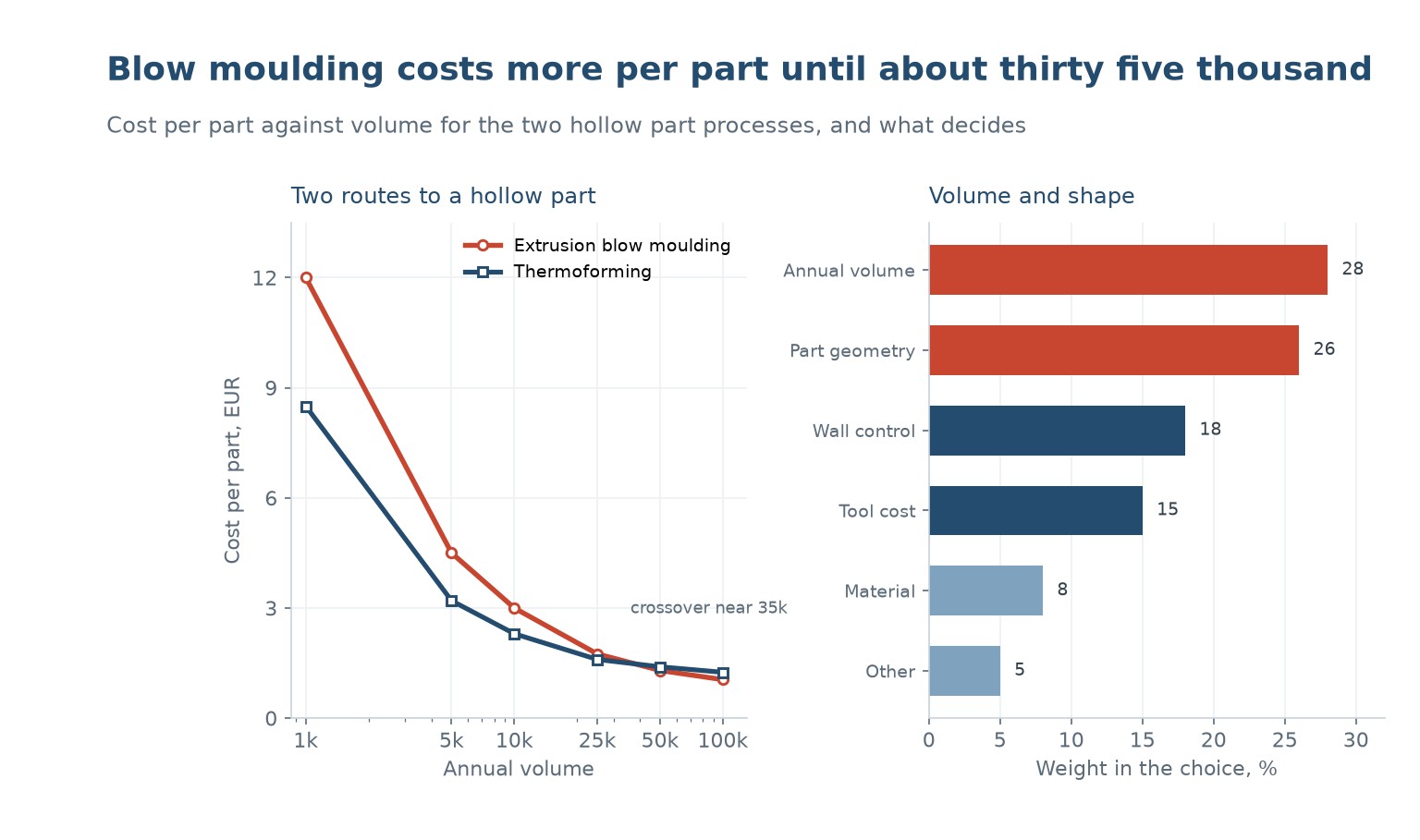
The chart on the left plots cost per part against annual volume for the two processes on a part both can make: a simple open container of about 500 millilitres. Thermoforming starts at 8.50 euro per part at 1 000 a year and falls to 1.25 at 100 000. Blow moulding starts at 12.00 and falls to 1.05.
The shape of both curves is the same fixed-cost argument that governs every moulded part: a tool costs a fixed amount, and dividing it by more parts makes each part cheaper. The curves differ because the tools differ. A thermoforming tool is a machined aluminium or epoxy form with vacuum holes, typically a few thousand euro. A blow moulding tool is a split steel cavity with a pinch-off, cooling channels and often a neck insert, typically several times that.
Where the curves cross is near 35 000 parts a year, and that number is not a constant of nature. It moves with part size, with the number of cavities in the blow mould, with whether the thermoforming tool needs a plug assist, and with the resin. What is constant is the mechanism: the process with the cheaper tool wins at low volume and the process with the cheaper cycle wins at high volume, and the crossover is where the two advantages balance.
The variable cost side is worth stating explicitly, because it is where blow moulding's advantage lives. A blow moulded bottle at 100 000 a year runs at 1.05 euro against 1.25 for the thermoformed equivalent, a 16 percent advantage per part. On 100 000 parts that is 20 000 euro a year, which pays back a tool that cost three times as much within two years.
Geometry decides more than cost
The right hand panel shows the weights in a real process selection: annual volume 28 percent, part geometry 26, wall control 18, tool cost 15, material 8, and other 5. Geometry is essentially tied with volume, and it is the criterion that can eliminate a process outright rather than merely penalise it.
The geometric rules are short. A thermoformed part needs a draft angle of at least two degrees per side, a depth to width ratio under about 1.5 without a plug assist, and no undercut that cannot be trimmed away afterwards. A blow moulded part needs a parison that can reach every point of the cavity, a pinch-off region that can be trimmed, and a neck that is either calibrated or cut.
Wall control at 18 percent is the criterion buyers underestimate. A thermoformed part's minimum wall is set by the draw ratio: stretch a sheet to three times its original area and the average wall is a third of the starting thickness, with the deepest point thinner still. A blow moulded part's wall is set by the parison programme, which can be adjusted axially point by point, so a bottle can have a thick base and a thin shoulder deliberately.
| Feature | Thermoforming | Extrusion blow moulding |
|---|---|---|
| Open or closed shape | Open only | Closed, with a neck |
| Undercuts | Not possible without a split tool | Possible in the parting plane |
| Wall distribution | Set by draw ratio, thin at depth | Set by parison programme, controllable |
| Minimum wall | Draw ratio limited | Parison thickness limited |
| Typical tool cost | Low | Three to five times higher |
| Typical cycle | Slower per part at small size | Faster per part |
Table 1 — What each process can and cannot do, before cost is considered.
Wall thickness: stretch against blow
The two processes fail on wall thickness in opposite directions, and knowing which failure you can tolerate is often the real decision. Thermoforming fails at the deep end: a tall narrow container will have a wall at the base that is a fraction of the sheet it started from, and the only remedies are a thicker sheet, a plug assist, or a different shape.
Blow moulding fails at the wide end: the parison has to stretch furthest where the mould is widest, so a bottle with a wide body and a narrow neck ends up thin at the shoulder unless the parison programme thickens that region deliberately. Modern machines do exactly that, with 30 to 100 control points along the parison, which is why blow moulded containers can be made reliably at 0.4 mm wall.
For structural parts neither process gives the control of injection moulding, and that is why a structural hollow part is often injection moulded in two halves and welded. The comparison in this article applies to containers and enclosures, not to anything that has to carry a bending load.
A practical test that resolves most cases: draw the part, mark the minimum wall the function requires, and see where that wall falls. If the thin point is at the bottom of a deep draw, thermoforming will struggle. If the thin point is at the widest section of a closed body, blow moulding will need a programmed parison and the tool will cost more.
Tooling and the volume threshold
Tooling cost is 15 percent of the decision but it is the whole of the crossover arithmetic. A thermoforming tool for a 500 millilitre container is a single aluminium form, often with a plug, and can be in production in three to five weeks. A blow moulding tool is two steel halves, a neck insert, a pinch-off blade and a trimming fixture, and runs eight to twelve weeks.
The volume threshold moves with the number of cavities. A single cavity blow mould at 35 000 a year is running at about 4 000 parts a month, which is comfortable. A four cavity blow mould has four times the tool cost and four times the output, so it only makes sense above about 120 000 a year, and below that the crossover moves back toward thermoforming.
| Annual volume | Thermoforming | Blow moulding, 1 cavity | Blow moulding, 4 cavity |
|---|---|---|---|
| 1 000 | 8.50 | 12.00 | Not viable |
| 10 000 | 2.30 | 3.00 | Not viable |
| 35 000 | 1.55 | 1.55 | Not viable |
| 100 000 | 1.25 | 1.05 | 1.40 |
| 500 000 | 1.05 | 0.95 | 0.70 |
Table 2 — Cost per part in euro at four volumes and three tool configurations.
The four cavity column is the one that catches planners out. Adding cavities raises the tool cost roughly in proportion to the cavity count but not the output, because cycle time is set by cooling and does not fall with more cavities. So the four cavity tool is only cheaper per part above a volume where its output is actually used, and below that it is a more expensive way to make the same part.
A decision procedure
Start with geometry and eliminate. Can the part be released from a one-sided mould? If not, thermoforming is out and the question becomes which blow moulding variant. Does the part need a closed hollow with a narrower opening? If so, thermoforming is out for the same reason. This step removes most of the ambiguity before any numbers are calculated.
Then calculate cost per part at three volumes: the volume you expect, half of it, and double it. If the answer changes between them, the decision is sensitive to a forecast you do not control, and the process with the lower tool cost is the lower risk choice even if its per part cost is higher at the central estimate.
Then check the wall. Take the minimum wall the function needs and confirm each candidate process can hold it at the deepest or widest point, not on average. A process that meets the average and misses the minimum is not a candidate, and this check is where most late redesigns originate.
Finally, ask what happens at the end of life. A thermoformed tray nests and ships flat, which is a real logistics advantage for a product that travels. A blow moulded bottle does not nest, so the same number of parts occupies several times the volume. For an export product the freight difference can exceed the moulding cost difference, and it belongs in the comparison.
Can thermoforming make a bottle?
Not a closed bottle with a narrow neck. Thermoforming needs a one-sided mould and a part that releases from it, so it makes open containers, trays, tubs and clamshells. A closed hollow with an opening narrower than the body requires blow moulding or injection blow moulding.
At what volume does blow moulding become cheaper than thermoforming?
For a simple 500 millilitre container, around 35 000 parts a year with a single cavity blow mould. That number moves with part size, cavity count and tool complexity: a four cavity blow mould only becomes cheaper above about 120 000 a year because its tool cost is four times higher.
Which process gives better wall thickness control?
Blow moulding, because the parison thickness can be programmed along its length with 30 to 100 control points. Thermoforming wall thickness is set by the draw ratio, so the deepest point is always thinnest and the only remedies are a thicker starting sheet or a plug assist.
Is a thermoformed part weaker than a blow moulded one?
Not inherently, but the weak point is in a different place. A thermoformed part is thinnest at the bottom of the draw, which is often where impact lands. A blow moulded part is thinnest where the body is widest. Compare minimum wall, not average wall, and compare it at the point where the part is loaded.
How long does each tool take to make?
A thermoforming tool for a container is typically three to five weeks. A blow moulding tool with a neck insert and a trimming fixture is eight to twelve weeks. That difference matters when the product launch date is fixed, because it is often larger than the per part cost difference.
What about injection blow moulding?
It makes a better bottle: a precision injection moulded neck and a controlled wall, at a higher tool cost and a slower cycle. It is the right choice for pharmaceutical and carbonated products where the neck dimension is critical. For a simple container it is over-engineered and the cost curve never crosses thermoforming.
Which route fits your part
Send a drawing and an annual volume. We will tell you which of the two processes can hold your minimum wall, and give you cost per part at three volumes so the decision is not sensitive to a single forecast.





 EN
 ES
 FR
 DE
 PT
 AR
 RU
 JA
 KO
 IT
 NL
 TR
 PL
 ID
