
Why a second bake
A silicone part comes out of the mould fully cured in the sense that it holds its shape, and not fully cured in the sense that its properties are stable. The mould cure leaves volatile by-products in the rubber, and it leaves the crosslink network in a state that is still rearranging. A second bake, without pressure and usually without a mould, finishes both jobs.
The by-products depend on the cure system. A peroxide cure leaves fragments of the peroxide, which are volatile and which smell. An addition cure leaves almost nothing, which is why platinum-cured parts can often be used without post-cure and peroxide-cured parts usually cannot.
The network continues to develop during the bake. Crosslink density rises slightly, the modulus rises, and the compression set improves because the network has had time to relax into its final state. That is why a datasheet compression set figure is almost always a post-cured figure.
The practical reason is the one customers care about: a part that has not been post-cured will out-gas in service. In a sealed enclosure that fogging appears on a lens or a window. In a food application it is a taste. In a medical device it is a failed biocompatibility test.
Volatiles leave fast, then slowly
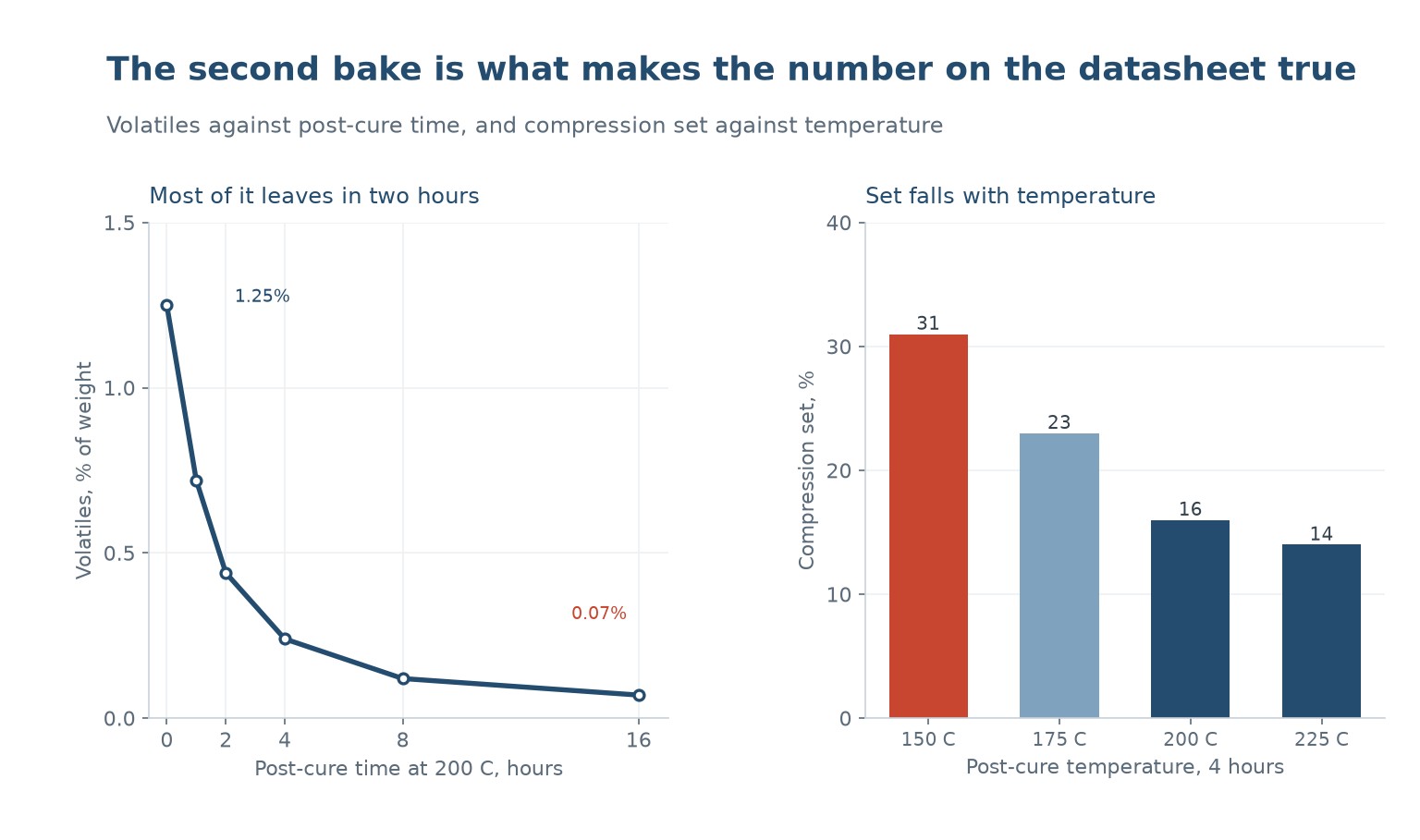
Measured on a 60 Shore A peroxide-cured sheet, the volatile content was 1.25 percent as moulded, 0.72 after one hour at 200 C, 0.44 after two, 0.24 after four, 0.12 after eight and 0.07 after sixteen.
Half of the total leaves in the first hour, and three quarters in the first two. That is why a two-hour post-cure at 200 C is a common production compromise: it removes most of what matters and it fits a shift.
The tail matters for some applications. Going from 0.24 to 0.07 percent takes another twelve hours, and for a part that will be sealed into an optical assembly that last 0.17 percent is the difference between a clear window and a fogged one. The specification has to say which is needed.
Temperature does more than time. At 150 C the same volatiles take four times as long to leave, and some of them never leave because the diffusion rate through the rubber is too low. A post-cure that is too cool is a post-cure that does not finish.
Compression set is the number that moves
Compression set is the permanent deformation left after a seal has been squeezed at temperature for a defined time. It is the single most important property for a gasket, and it is the one most improved by post-cure.
Measured at 22 hours at 175 C on the same compound, compression set was 31 percent after a four-hour bake at 150 C, 23 percent at 175, 16 percent at 200 and 14 percent at 225. The curve flattens above 200, which is why 200 C is the usual production temperature.
A part that has not been post-cured can show a set 50 percent worse than the datasheet value, and the customer sees it as a leak after a few weeks in service. The failure is slow, so it is usually attributed to the design rather than to the missing bake.
The bake also stabilises the hardness. A moulded part often reads a few points soft and settles to its nominal value after post-cure. If the drawing specifies 60 plus or minus 5 Shore A, the measurement should be made after the bake, not before.
| Post-cure | Volatiles | Compression set | Typical use |
|---|---|---|---|
| None | 1.25% | 31%+ | Prototypes only |
| 2 h at 200 C | 0.44% | 18% | General purpose |
| 4 h at 200 C | 0.24% | 16% | Seals and gaskets |
| 8 h at 200 C | 0.12% | 15% | Optical and sealed parts |
| 16 h at 200 C | 0.07% | 14% | Medical and food contact |
Table 1 — Post-cure against the two properties it changes
Ovens, airflow and loading
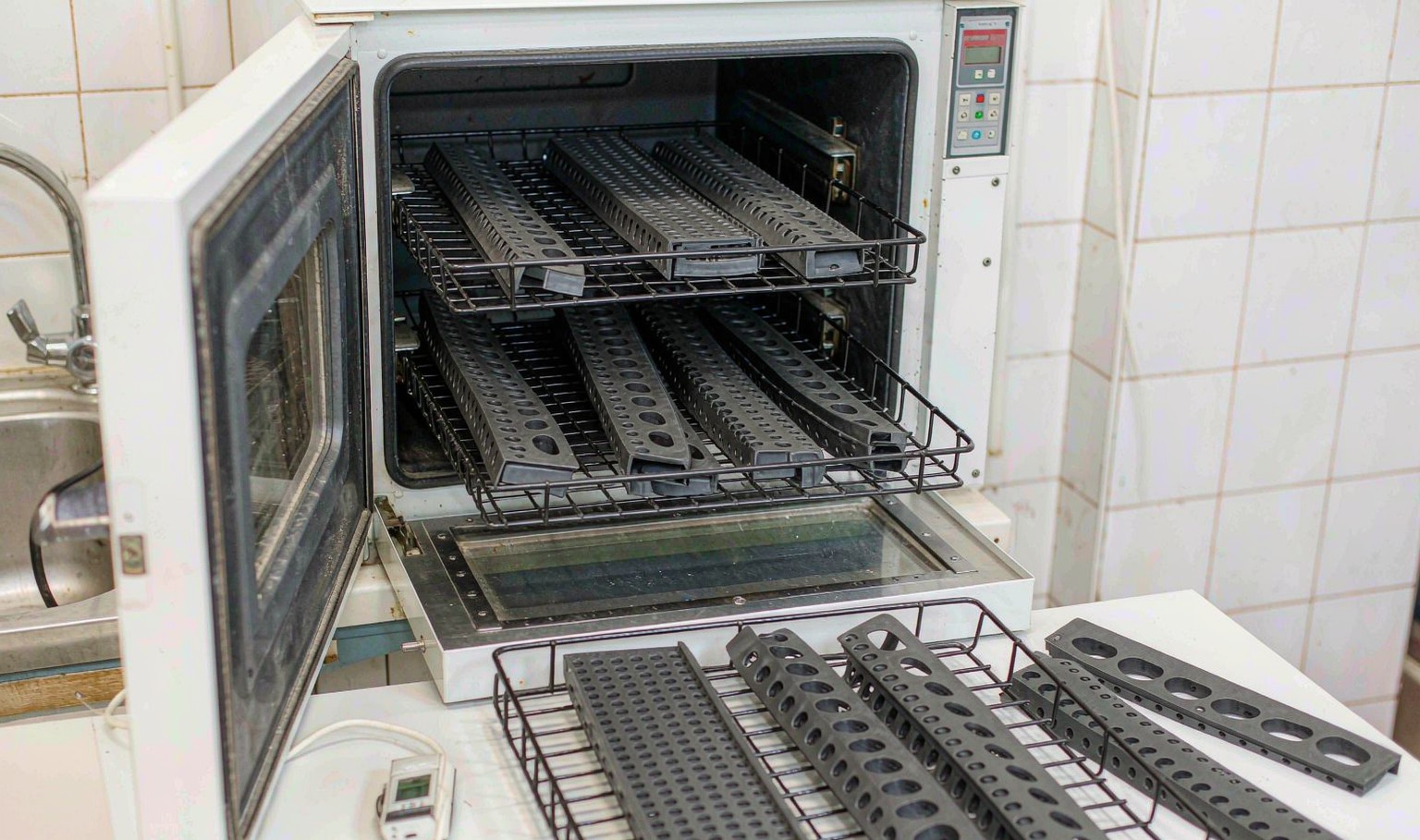
A post-cure oven is a convection oven with good air circulation and a controller that holds within a few degrees. The airflow matters more than the setpoint: a part sitting in a dead corner of the oven will take twice as long to reach the same volatile level as one in the airstream.
Loading density matters too. A tray packed with parts restricts the airflow between them, so the parts in the middle lag behind the ones at the edge. A loose single layer is faster and more even than a deep pile, and the difference can be a factor of two on the time to reach specification.
The oven should be vented. Volatiles have to leave the oven, not just leave the part, and a closed oven saturates and stalls. A small extraction fan on the roof is enough, and it should run for the whole cycle, not just at the start.
Temperature uniformity should be surveyed, not assumed. A cheap oven can be 15 degrees cooler at the bottom than at the top, which means half the batch is under-cured and half is over-cured, and the certificate says one number for both.
| Oven variable | Effect on the result | Controlo |
|---|---|---|
| Airflow | Dead corners lag by 2x | Fan on, survey the corners |
| Loading density | A deep pile halves the rate | Single loose layer |
| Venting | Saturated air stalls diffusion | Extraction on for the cycle |
| Uniformity | 15 C spread gives mixed cure | Survey and map the oven |
| Setpoint recovery | Door opening drops 30 C | Load fast, then close |
Table 2 — Oven variables that change the outcome
What the bake does to dimensions
Silicone shrinks during post-cure, typically 0.5 to 1.5 percent linearly, and more for a highly filled compound. That shrinkage is real and it is why a part measured before the bake will not match the drawing after it.
The shrinkage is also anisotropic in a moulded part, because the material was oriented during flow. A part that is round before the bake can be slightly oval after it, and a long thin part can bow. For tight-tolerance parts the bake has to be done before the final measurement, and sometimes before the final machining.
The countermeasure in the tool is to cut the cavity oversize by the post-cure shrinkage, which is a known number for a given compound. That number belongs on the tool drawing, and it is different from the moulding shrinkage.
For parts that must hold a dimension through the bake, fixturing is used: the part is baked on a mandrel or in a nest that holds it straight while the network relaxes. That is common for O-rings and for long extrusions.
When post-cure can be skipped
An addition-cure (platinum) silicone with no peroxide fragments has very little to drive off, and many such parts are used without post-cure. The exceptions are parts that will be sealed, parts for medical or food contact, and parts where compression set is critical.
A thick part needs less post-cure time per unit volume than a thin one might suggest, because the diffusion path is longer and the volatiles are trapped in the middle. In practice a thick part is baked longer, not shorter, and the centre is what determines the result.
A part that will be bonded or printed after moulding should be post-cured first, because the volatiles that come out during service will also come out under a label or an adhesive and cause it to lift. This is a common cause of label failure on silicone keypads.
A prototype does not need it, provided everyone understands that the prototype's properties are not the production properties. That is the one case where skipping is legitimate, and it should be written on the drawing so it does not become the production process by accident.
Recording the bake
A post-cure is a process step that leaves no visible trace, so it has to be recorded or it did not happen. The record should include the batch, the oven, the setpoint, the actual temperature trace, the load and the time in and out.
A chart recorder or a data logger is the only reliable evidence. A handwritten sheet that says 200 C for four hours proves that someone wrote it down, not that the oven was at 200 C.
The batch traceability matters because post-cure failures are found late. A customer complaint about fogging arrives months after the parts were made, and without a record of which parts were baked there is no way to bound the problem.
The simplest system that works is a traveller card with the oven number, the time in and out, and a printed trace stapled to it. It costs a minute per batch and it is the difference between a recall and a sorted lot.
Why does silicone need a post-cure?
To remove cure by-products and to finish developing the crosslink network. Without it the part out-gasses in service and its compression set is worse than the datasheet value.
How long should silicone be post-cured?
Two hours at 200 C removes most volatiles; four hours is standard for seals; eight to sixteen hours for optical, medical or sealed parts.
What temperature is used for post-cure?
200 C for most compounds. Below 175 the volatiles diffuse too slowly, and above 225 there is little further gain and a risk of reversion.
Does post-cure change the dimensions?
Yes, typically 0.5 to 1.5 percent shrinkage. The tool has to be cut oversize for it, and parts should be measured after the bake.
Can platinum-cured silicone skip post-cure?
Often yes, because there are no peroxide fragments. Skip it only if the part is not sealed, not for medical or food contact, and not compression-set critical.
Why do my silicone parts fog a lens?
Volatiles from an incomplete post-cure. The parts need a longer bake, usually eight hours or more at 200 C with good airflow.
Silicone parts failing on set or out-gassing?
Send the compound, the drawing and the post-cure record. We will tell you whether the bake, the compound or the tool shrinkage is the problem.




 PT
 EN
 ES
 FR
 DE
 AR
 RU
 JA
 KO
 IT
 NL
 TR
 PL
 ID
