Why nylon for a tube
Nylon tube occupies a space that neither polyethylene nor PTFE fills: it is stiff enough to hold a shape, flexible enough to route, resistant to fuels and oils, and it works from minus 40 to over 100 degrees. Air brake lines, fuel lines, pneumatic control lines and cable jackets are the volume applications.
The choice between PA6, PA66, PA11 and PA12 is a choice between strength and dimensional stability. PA6 and PA66 are stronger and cheaper and absorb more water; PA11 and PA12 are expensive and dimensionally stable. The water absorption is the number that drives the rest.
| Grade | Melting point, C | Water absorption at saturation, % | Post-shrinkage over 60 days, % | Typical use |
|---|---|---|---|---|
| PA6 | 220 | 9 to 10 | 3.0 | Pneumatic, cable jacket, general |
| PA66 | 260 | 8 to 9 | 1.8 | Fuel line, high temperature |
| PA11 | 190 | 1.5 | 0.6 | Fuel line, automotive |
| PA12 | 180 | 1.4 | 0.5 | Fuel line, precision pneumatic |
Table 1 - Nylon grades for tubing. The two columns on the right are the reason a PA6 tube and a PA12 tube at the same nominal size are not interchangeable in a fixture.
Post-shrinkage: the month after extrusion
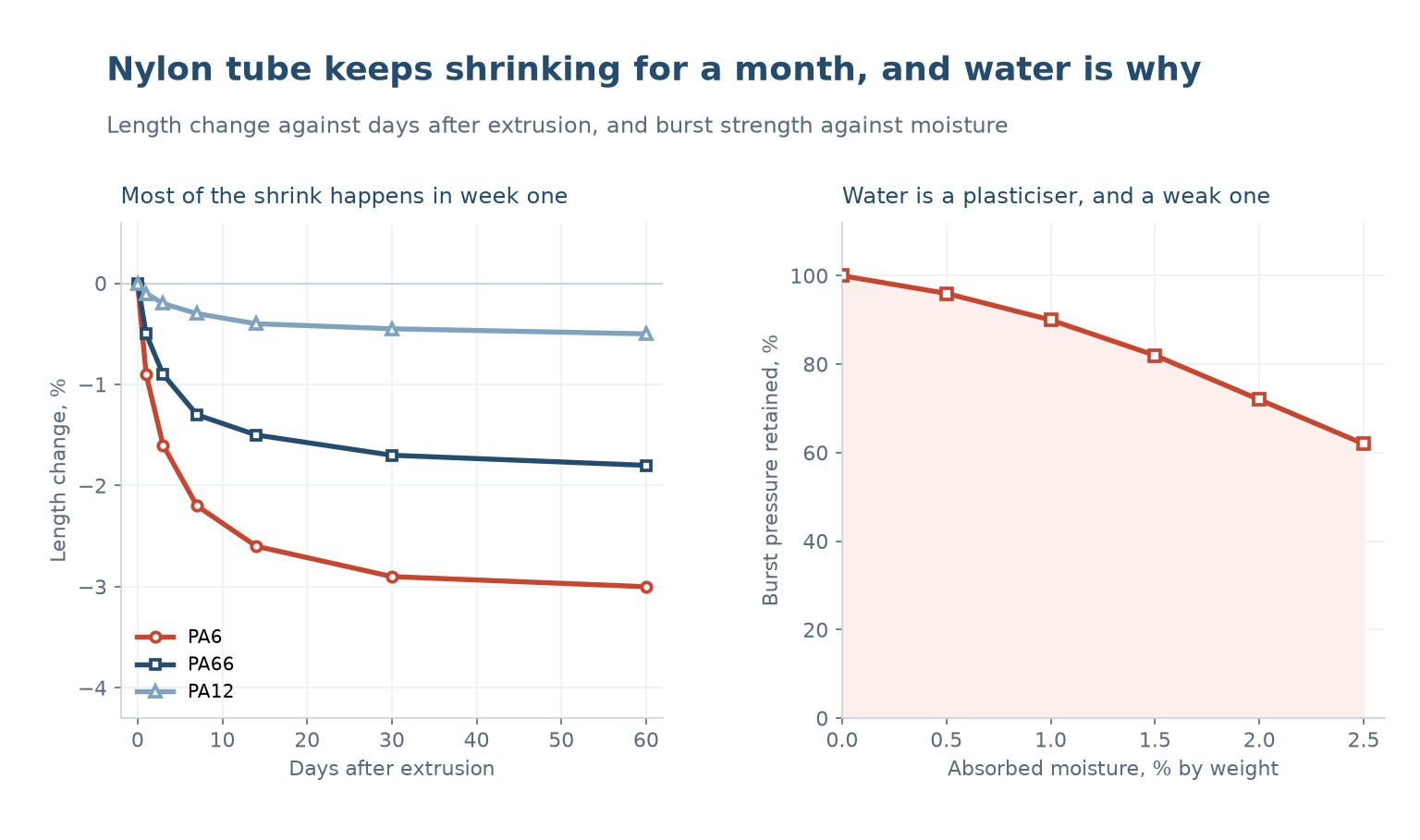
A nylon tube does not reach its final dimensions when it leaves the water bath. It continues to shrink for weeks, and the mechanism is crystallisation rather than cooling. The quench in the bath freezes the polymer in a partly amorphous state; over the following days and weeks the chains continue to organise, the density rises, and the tube gets shorter and slightly thicker.
| Days after extrusion | PA6, % | PA66, % | PA12, % |
|---|---|---|---|
| 0 | 0 | 0 | 0 |
| 1 | 0.9 | 0.5 | 0.1 |
| 3 | 1.6 | 0.9 | 0.2 |
| 7 | 2.2 | 1.3 | 0.3 |
| 14 | 2.6 | 1.5 | 0.4 |
| 30 | 2.9 | 1.7 | 0.45 |
| 60 | 3.0 | 1.8 | 0.5 |
Table 2 - Length change against time for a 10 mm tube quenched in a 20 C bath. Two thirds of the total happens in the first week, and the last third takes a month.
This is why nylon tube is cut long. The standard practice is to cut to a length that allows the expected shrinkage plus a margin, and to state on the drawing the time and the condition at which the length is measured. A 1,000 mm PA6 tube cut to 1,000 mm at the winder is 970 mm a month later.
Annealing accelerates the process. A hot water bath at 80 to 90 degrees for an hour, or an oven at 100 degrees, brings the tube close to its final dimensions before it is cut. The tube is then dimensionally stable from the day it ships, at the cost of an extra operation and a slight loss of flexibility.
Moisture: a plasticiser and a weak one
Nylon absorbs water into the amorphous regions, where it breaks the hydrogen bonds between chains and acts as a plasticiser. The tube grows in diameter and length, becomes more flexible, and loses a large part of its strength.
The numbers are large enough to design around. At 2.5 percent moisture, a PA6 tube retains about 62 percent of its dry burst pressure, and it has grown by 1.5 to 2 percent in each dimension. At 1 percent, the burst loss is about 10 percent and the dimensional change is under 0.5 percent.
The consequence is that a dry burst rating and a wet burst rating are two different specifications. A pneumatic line in a humid plant reaches equilibrium at 2 to 3 percent moisture within weeks, so the dry number on the datasheet is not the number the application sees.
Crystallinity: what the water bath decides
The water bath is the crystallinity control on a nylon line, and it is usually set for cooling rather than for structure. A cold bath at 15 to 20 degrees quenches the tube into a low-crystallinity, tougher, more shrinkage-prone state. A warm bath at 40 to 60 degrees gives a higher crystallinity, a stiffer tube and less post-shrinkage.
For PA6 the difference is visible in the tube: a quenched tube is translucent and slightly flexible, a slowly cooled one is opaque white and stiffer. Both meet a dimensional drawing and neither is wrong, but they behave differently in a fitting and they shrink differently.
The practical rule is to match the bath temperature to the application. A tube that will be cut and assembled within a day should be warm-bath crystallised so that it is stable. A tube that will be coiled and stored for a month can be quenched, because the shrinkage will happen on the shelf rather than in the customer's fixture.
Extrusion: temperature, screw and sizing
Nylon is hygroscopic before processing as well as after, and it must be dried to below 0.1 percent before it reaches the hopper. A desiccant dryer at 80 to 90 degrees for four hours, with the dew point measured, is the standard.
- Melt temperature 230 to 260 C for PA6, 250 to 280 for PA66, 200 to 230 for PA12. Nylon has a sharp viscosity change near its melting point, so the temperature profile matters more than on a polyolefin line.
- Screw with a 3.0 to 3.5 compression ratio and an L/D of 25 to 30. Nylon needs compression, and a general purpose screw gives unstable output.
- Vacuum sizing for the outside diameter, with a water bath at 20 to 40 degrees depending on the crystallinity wanted.
- Puller tension as low as the line allows, because nylon is still soft at the puller and a high tension orients the tube and adds to the shrinkage.
- Cut length allowance for the post-shrinkage, stated on the process sheet rather than left to the operator.
The die and the sizing sleeve set the diameter; the bath sets the crystallinity; the puller sets the orientation. All three contribute to the length that the customer measures a month later, which is why a nylon tube line needs a dimensional check at 24 hours and at 30 days rather than only at the end of the line.
Testing: what to measure and when
A nylon tube test plan has a time axis that most extrusion test plans do not have.
- Dimensions at 1 hour, 24 hours and 30 days, on the same sample, stored at 23 C and 50 percent relative humidity.
- Moisture by Karl Fischer or loss on drying, on the same samples, because the dimensional change and the moisture change are the same process.
- Burst pressure dry and after conditioning to 2 percent moisture, because the two numbers differ by a third.
- Impact at minus 20 degrees, where nylon is at its most brittle and where most field failures happen.
- Ring stiffness or crush resistance for the larger sizes, which is a different failure mode from burst.
The 30 day dimension is the one that matters commercially, and it is the one most often skipped because it takes 30 days. A supplier who has measured it once for the grade and the wall can use a correlation afterwards; a supplier who has never measured it is guessing, and the customer finds out when the tubes will not fit.
Why does my nylon tube keep shrinking?
Crystallisation continues for weeks after the water bath. The quench freezes the polymer partly amorphous, and the chains keep organising. Warm-bath crystallising or annealing before cutting removes most of it.
How much does moisture affect burst pressure?
At 2.5 percent moisture a PA6 tube retains about 62 percent of its dry burst pressure. At 1 percent it retains about 90 percent. Nylon in a humid plant reaches 2 to 3 percent within weeks.
Should I use PA6 or PA12?
PA12 for dimensional stability and fuel resistance, PA6 for strength and cost. The difference in post-shrinkage is a factor of six, which decides whether the tube can be cut to length at the winder.
What water bath temperature should I run?
20 to 40 C for general tube. A cold bath gives a tougher, more translucent, more shrinkage-prone tube; a warm bath gives a stiffer, opaque, more stable one.
Can nylon tube be annealed?
Yes, in hot water at 80 to 90 degrees for an hour or in an oven at 100 degrees. It brings the tube close to final dimensions so it can be cut to length immediately.
Why is my nylon tube brittle after storage?
It has dried out. Nylon that has lost its absorbed water is stronger and much more brittle, and impact failures at low temperature are usually a dry tube in a cold environment.
Specifying a nylon tube to a length?
Tell us the length tolerance, the time between extrusion and assembly, and the humidity. We will tell you the cut allowance and whether the tube needs annealing before it ships.






 PT
 EN
 ES
 FR
 DE
 AR
 RU
 JA
 KO
 IT
 NL
 TR
 PL
 ID