

Why wet sheet forms badly
Every polymer absorbs some water from the air, and how much depends on its chemistry. Polyolefins absorb almost nothing; polyamide can take up more than two percent of its own weight.
That water is invisible and harmless until the sheet reaches forming temperature. At 180 to 200 degrees Celsius the absorbed water flashes to steam inside the sheet, and steam has to go somewhere.
Where it escapes at the surface it leaves a silver streak, a shiny drag mark that looks like a scratch. Where it cannot escape it forms a bubble, a lens-shaped void trapped between the surfaces.
Both defects appear after the sheet has been formed, so they read as forming faults. They are drying faults, and no change to vacuum, plug or oven profile will remove them.
Which polymers need drying
The rule follows the chemistry. Amorphous, polar polymers that hydrogen bond with water are the problem: polycarbonate, polyamide, PET, PMMA and ABS all need drying before forming.
Polyolefins and polystyrene are effectively hydrophobic. PP, HDPE and HIPS form straight from the pallet, and a dryer on a PP line is mostly a waste of energy.
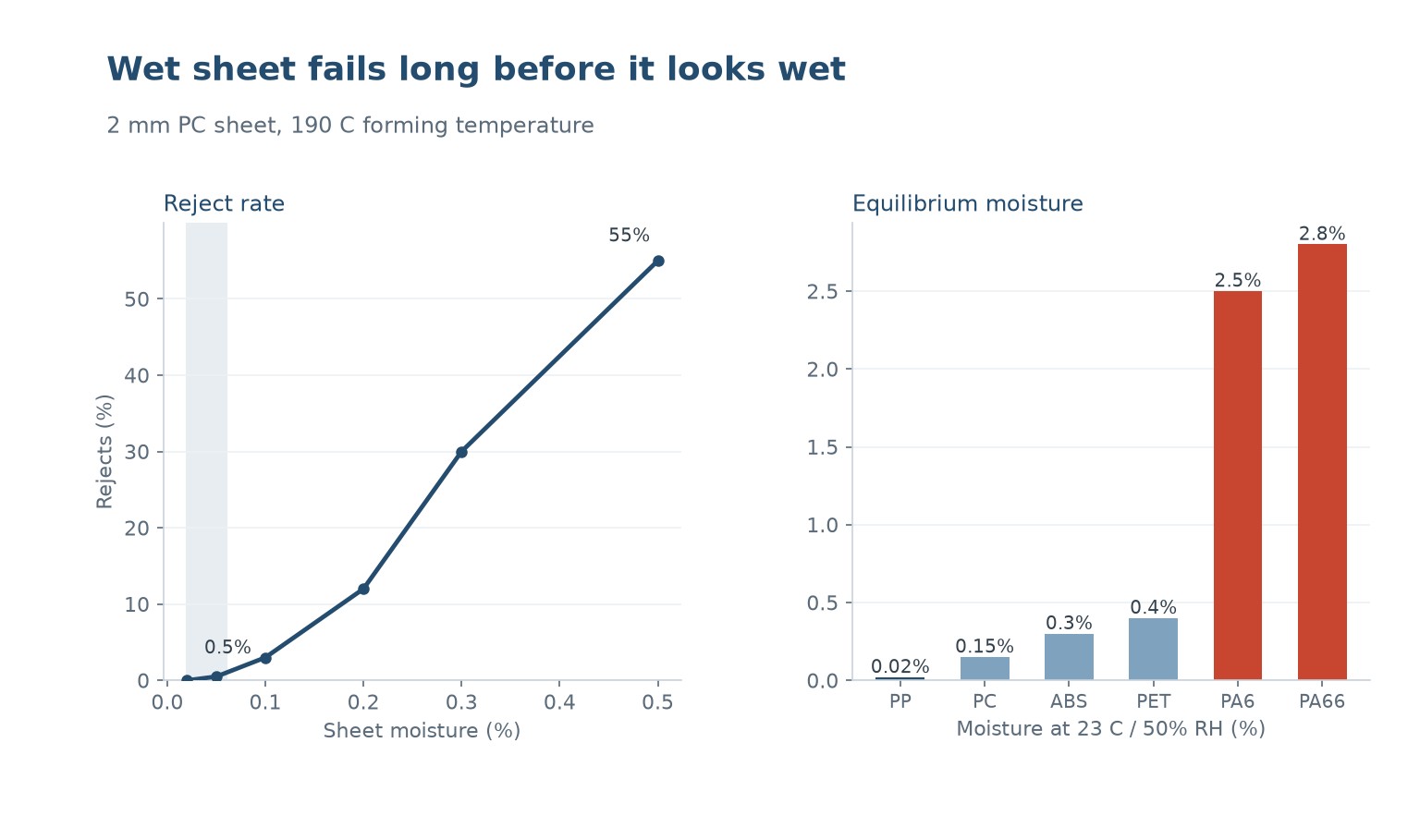
The right hand panel shows equilibrium moisture for common sheet at 23 degrees and 50 percent relative humidity. The difference between PP at 0.02 percent and PA66 at 2.8 percent is two orders of magnitude.
PVC is a special case: rigid PVC sheet holds little water but is very heat sensitive, so drying is about removing surface moisture without cooking the sheet, which is a gentler process than for PC.
How much water is too much
The threshold is not zero and it is not the same for every polymer. Polycarbonate forms cleanly below about 0.02 percent; at 0.1 percent bubbles start and at 0.3 percent the sheet is scrap.
The left chart is reject rate against sheet moisture for a 2 millimetre PC sheet. The curve is flat until roughly 0.05 percent and then climbs steeply, which is why the working target is well below the visible threshold.
Polyamide tolerates less and absorbs more, so it is the hardest material on a thermoforming line. PET sits between the two and is complicated further by crystallinity, which changes how the water moves.
Practically, treat the specification as a ceiling you never approach. A sheet dried to 0.015 percent has margin; a sheet dried to 0.019 percent passes today and fails on a humid afternoon.
Hot air is not enough for PC
A hot air oven circulates warm air over the sheet. It works, but only slowly, because the air carries its own humidity and once it is saturated it stops taking water from the sheet.
A desiccant dryer removes water from the air before heating it, so the air arriving at the sheet is very dry and keeps pulling moisture out. For polycarbonate and polyamide this is the difference between four hours and overnight.
The trap is running a desiccant dryer with spent desiccant. The controller says the set point is reached because the temperature is right, but the dew point has drifted and the sheet is not drying.
Check the dew point, not just the temperature. A dryer that cannot hold below about minus 20 degrees Celsius is not doing the job for hygroscopic sheet, whatever the display shows.
Time, temperature and thickness
Drying is diffusion, so it slows sharply with thickness. A 2 millimetre PC sheet needs about four hours at 120 degrees; a 6 millimetre sheet of the same material needs more than twelve.
Raising the temperature speeds diffusion but must stay below the point where the sheet softens or the polymer degrades. For PC, 120 degrees is the usual compromise between speed and safety.
Stacking matters. Sheet dried in a solid stack takes far longer than sheet on a rack with air between the layers, because the water has to travel out of the stack, not just out of the sheet.
And dried sheet re-absorbs water as soon as it cools in ambient air. A sheet left on the bench overnight is wet again in the morning, which is why drying belongs immediately before forming.
| Material | Dry at (C) | Time (h) | Target (%) |
|---|---|---|---|
| PC | 120 | 4 | 0.02 |
| PET | 150 | 4 | 0.02 |
| PA6 | 100 | 6 | 0.05 |
| PMMA | 80 | 2 | 0.05 |
| ABS | 80 | 2 | 0.05 |
| PP / HDPE | not required | 0 | n/a |
Table 1 — Drying schedule for 2 mm sheet in a desiccant dryer.
Proving the sheet is dry
The only reliable check is measurement. A moisture analyser that weighs a sample before and after driving the water off gives a number in minutes and costs far less than a scrap batch.
A simpler shop check is a trial form of one blank from each batch. If it bubbles, the batch is wet, and the answer is more drying time rather than a process adjustment.
Record the dew point, the drying start time and the moisture result per batch. When bubbles appear, the record says whether the dryer failed or the sheet was taken out too early.
And keep the dryer lid closed. An open dryer in a humid plant is a machine that heats sheet and lets it re-absorb at the same time, which is the most common reason drying appears not to work.
| Defeito | Aparência | What it means |
|---|---|---|
| Bubbles | Lens-shaped voids in the wall | Moisture flashed to steam |
| Silver streaks | Shiny drag marks | Surface moisture |
| Blisters at the corner | Local swelling | Wet edge, poor air flow |
| Cloudy wall | Haze through the sheet | Condensation during cooling |
Table 2 — Moisture defects and what each one tells you.
Do I need to dry PP or HDPE sheet before forming?
No. Polyolefins are effectively hydrophobic and form straight from the pallet. Drying them wastes energy and time without improving the part.
Why does my polycarbonate sheet bubble when I form it?
Absorbed moisture flashing to steam at forming temperature. PC must be dried to about 0.02 percent in a desiccant dryer before forming.
How long does it take to dry 4 mm PC sheet?
Roughly six to eight hours at 120 degrees in a desiccant dryer. Drying time rises steeply with thickness because it is a diffusion process.
Can I dry sheet in a hot air oven instead of a desiccant dryer?
For PMMA and ABS yes, but not for PC or PA. Hot air saturates and stops taking water out, while a desiccant dryer keeps the air dry enough to keep working.
Why do silver streaks appear on the surface?
Surface moisture turning to steam and dragging across the sheet as it is stretched. It looks like a scratch but it is a drying defect.
Can I dry sheet the day before?
Only if it stays in the dryer. Dried sheet re-absorbs moisture from ambient air as it cools, so drying has to finish just before forming.
Bubbles and streaks in formed parts?
Tell us the material, the sheet thickness and how you dry it. We will tell you whether it is moisture, drying time or the dryer itself.





 PT
 EN
 ES
 FR
 DE
 AR
 RU
 JA
 KO
 IT
 NL
 TR
 PL
 ID
