
The problem
Symptom. A consignment of 0.9 mm HIPS trays arrives with cracked corners on the bottom pallet layer, and the carrier rejects the claim because no drop height or carton orientation was written into the order.
What it costs. A 48 000-tray shipment is written off while the packer, the moulder and the carrier each blame the other, with no drop-test clause or despatch record to allocate the damage.
This guide shows how to compute drop energy, set a drop height and carton orientation, and assemble the evidence pack a transit claim needs.
- 1. Cracked corners are a shock fault, not a resin fault
- 2. Compute drop energy and stack load before blaming the tray
- 3. Drop height, orientation and stack limits to specify
- 4. Variables that raise impact after a packaging change
- 5. A drop-test and evidence clause for the order
- 6. Costing a foam insert against a written-off shipment
Cracked corners are a shock fault, not a resin fault
A dropped carton converts height into shock at the corner. A 12 kg carton falling 0.8 m carries 12 × 9.81 × 0.8 ≈ 94 J, and five stacked layers put 4 × 12 × 9.81 ≈ 0.47 kN on the bottom carton.
| What goods-in finds | What is physically happening | First measurement |
|---|---|---|
| Cracked corners, flat walls intact | Impact concentrated at the smallest corner radius | Sectioned corner wall thickness |
| Only the bottom pallet layer cracked | Stack compression added to the drop shock | Cartons per pallet and layer position |
| Damage worse in winter | HIPS is more brittle near -5 °C | Drop test at the declared service temperature |
| One carton face always struck | Orientation marks ignored in loading | Despatch photo of the marked carton |
Table 1 - Classifying transit damage before changing the tray
Need a fixed price for this formed tray?
Send the tray drawing, sheet gauge and annual volume. We will review draft, trim and material, then quote a production tool with a written line-acceptance test.
Get a thermoforming quotationEmail [email protected]WhatsApp
Compute drop energy and stack load before blaming the tray
Drop the carton on one corner, three edges and six faces at 0.8 m and -5 °C, then section the corner. A 0.9 mm HIPS tray with a 0.45 mm corner wall cracks where a 0.60 mm wall survives the same 94 J.
A five-step diagnostic sequence
- Define the drop.
Specify 0.8 m at -5 °C, one corner, three edges and six faces. - Weigh the carton.
Record the 12 kg gross mass and compute the 94 J drop energy. - Section the corner.
Measure corner wall at four corners and compare with the 0.45 mm minimum. - Check the stack.
Log cartons per pallet and confirm the five-layer limit was met. - Assemble the evidence.
Retain despatch photos, orientation marks, pallet count and the carrier's note.
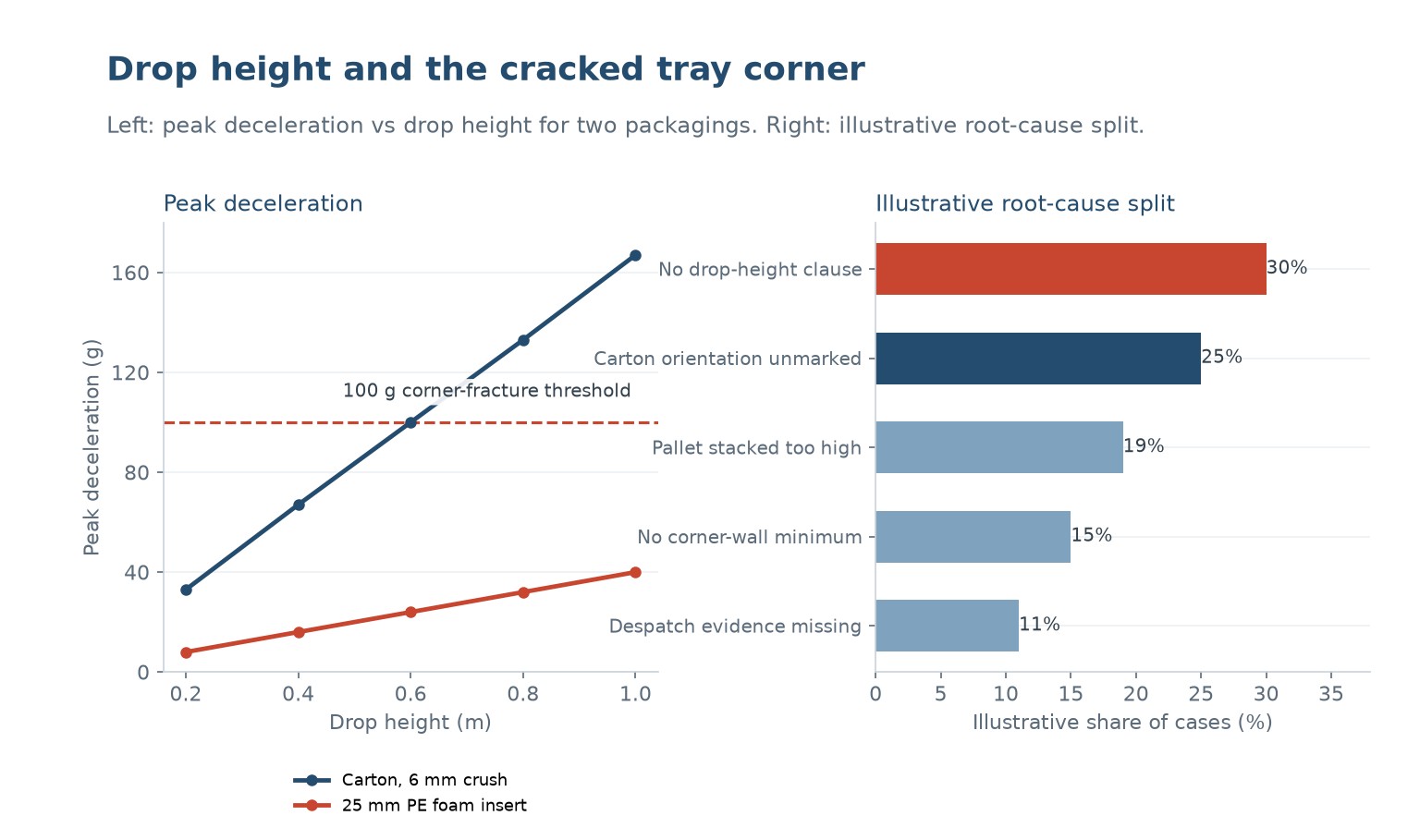
The chart below is a typical result from that measurement step. Use it to separate a design limit from a setting that can still be recovered.
Drop height, orientation and stack limits to specify
Three numbers protect the corner: a 0.8 m drop at -5 °C, a minimum 0.45 mm corner wall, and a five-layer pallet limit. A 25 mm PE foam insert cuts peak deceleration from 133 g to 32 g at 0.8 m.
| Parametr | Typical target | What goes wrong outside it |
|---|---|---|
| Drop height and temperature | 0.8 m at -5 °C | Room-temperature drops miss cold-brittle corner cracks |
| Minimum corner wall | ≥ 0.45 mm by sectioning | A 0.45 mm wall cracks at 94 J |
| Pallet stacking | ≤ 5 layers | Seven layers double the bottom carton load |
| Cushioning | 25 mm PE foam, 32 g at 0.8 m | An uncushioned carton sees 133 g |
Table 2 - Transit parameters to write on the line-acceptance test
Variables that raise impact after a packaging change
Damage grows again as handling changes. A carton stored at 30 °C is more brittle in HIPS, an unmarked 'this way up' orientation puts the corner down, and a pallet stacked seven high doubles the bottom load.
| Process variable | Effect on impact | Practical control |
|---|---|---|
| Pallet stacked seven high | Bottom carton load roughly doubles | Cap the stack at five layers |
| No foam insert | Peak deceleration reaches 133 g at 0.8 m | Fit a 25 mm PE foam insert |
| Orientation not marked | Corner takes the drop instead of a face | Print 'this way up' on two faces |
| Storage at 30 °C before despatch | Handling and brittleness shift | Log shipment temperature |
Table 3 - Variables that increase transit damage after sign-off
A drop-test and evidence clause for the order
A claim without evidence is an argument. Add a clause: no cracked corners after a 0.8 m drop at -5 °C on 30 trays from three lots, with despatch photos, orientation marks, pallet count and the carrier's exception note retained.
Want the tray checked against your line?
Send us the tray drawing and the line conditions. We will flag the geometry and material choices that cause jams, and quote a tool with an acceptance test.
What to send us
- Tray drawing with draft and radii
- Sheet grade and gauge
- Stack depth and line speed
- Drawings of the magazine or denester
Costing a foam insert against a written-off shipment
A 25 mm foam insert and a written drop test add roughly 2-3 p per tray but protect the 48 000-tray shipment. One written-off consignment costs more than the packaging across the whole contract.
Before you sign off this thermoformed tool
- A 0.8 m drop at -5 °C and its corner-edge-face sequence are written into the acceptance test
- A minimum 0.45 mm corner wall is dimensioned on the tray drawing
- A five-layer pallet limit and a 25 mm foam insert are specified
- Cartons carry orientation marks on two faces and despatch photos are retained
- The drop test covers 30 trays from three lots at the declared service temperature
A tray that looks right in the carton can still stop a filling line. Test the stack, not a single part.
Why do only the corners crack?
The corner has the smallest radius and the thinnest wall, so the 94 J of a 0.8 m drop concentrates there. A flat wall can read in gauge while the corner is down to 0.45 mm.
Is the tray or the carrier at fault?
Compute the loads first. A 12 kg carton at 0.8 m carries about 94 J, and five layers add 0.47 kN to the bottom carton. Compare that with the drop-test clause and the despatch record.
Does a foam insert really help?
Peak deceleration scales as drop height divided by stopping distance. At 0.8 m a 6 mm carton crush gives 133 g, while 25 mm of PE foam gives about 32 g, below the corner-fracture threshold.
Why test at -5 °C?
HIPS is markedly less ductile near 0 °C, so a corner that survives a room-temperature drop can crack in a cold vehicle. Qualify at the coldest declared service temperature.
What evidence does a claim need?
Despatch photos of the stacked pallet, 'this way up' marks, the carton and layer count, the 0.8 m drop-test certificate, a sectioned corner from the same lot, and the carrier's exception note.
What should the transit clause say?
No cracked corners after a 0.8 m drop at -5 °C on 30 trays from three lots, a 0.45 mm minimum corner wall, five-layer pallet limit and retained despatch evidence.
Get a tray that runs on your filling line
Send us the tray drawing or a sample stack. We will review draft, trim and material, then quote a production tool with a measurable line-acceptance test written into it.
To get an accurate quote, send:
- Tray drawing or sample stack
- Sheet material and gauge
- Line speed and denesting method
- Annual volume and target unit price
Request a tool and tray quotation
Why buyers work with Uplastech
ISO 9001, ISO 14001 and ISO 45001 certified. Founded in 2016, with injection moulding lines in Shanghai and an extrusion plant in Jiangsu. Moulding machines from 90T to 1100T and a maximum shot weight of 5100 g. Samples and a written quotation are available on request.

 PL
 EN
 ES
 FR
 DE
 PT
 AR
 RU
 JA
 KO
 IT
 NL
 TR
 ID