
Gloss is a skin, not a bulk property
Gloss is the fraction of light reflected at the specular angle, and it comes almost entirely from the top few micrometres of the surface. The bulk of the sheet can be identical in every other respect and still read 60 or 90 units, because the difference is whether the surface is a smooth optical film or a field of micro-roughness that scatters light in all directions.
That is why gloss cannot be set by the resin grade alone. The same polymer, on the same line, at the same thickness, will give a different number depending on how fast the surface was quenched. A fast quench freezes the surface while it is still being pressed flat against the roll, and it stays flat. A slow quench lets the surface relax and crystallise while it is no longer constrained, and the resulting micro-topography scatters light.
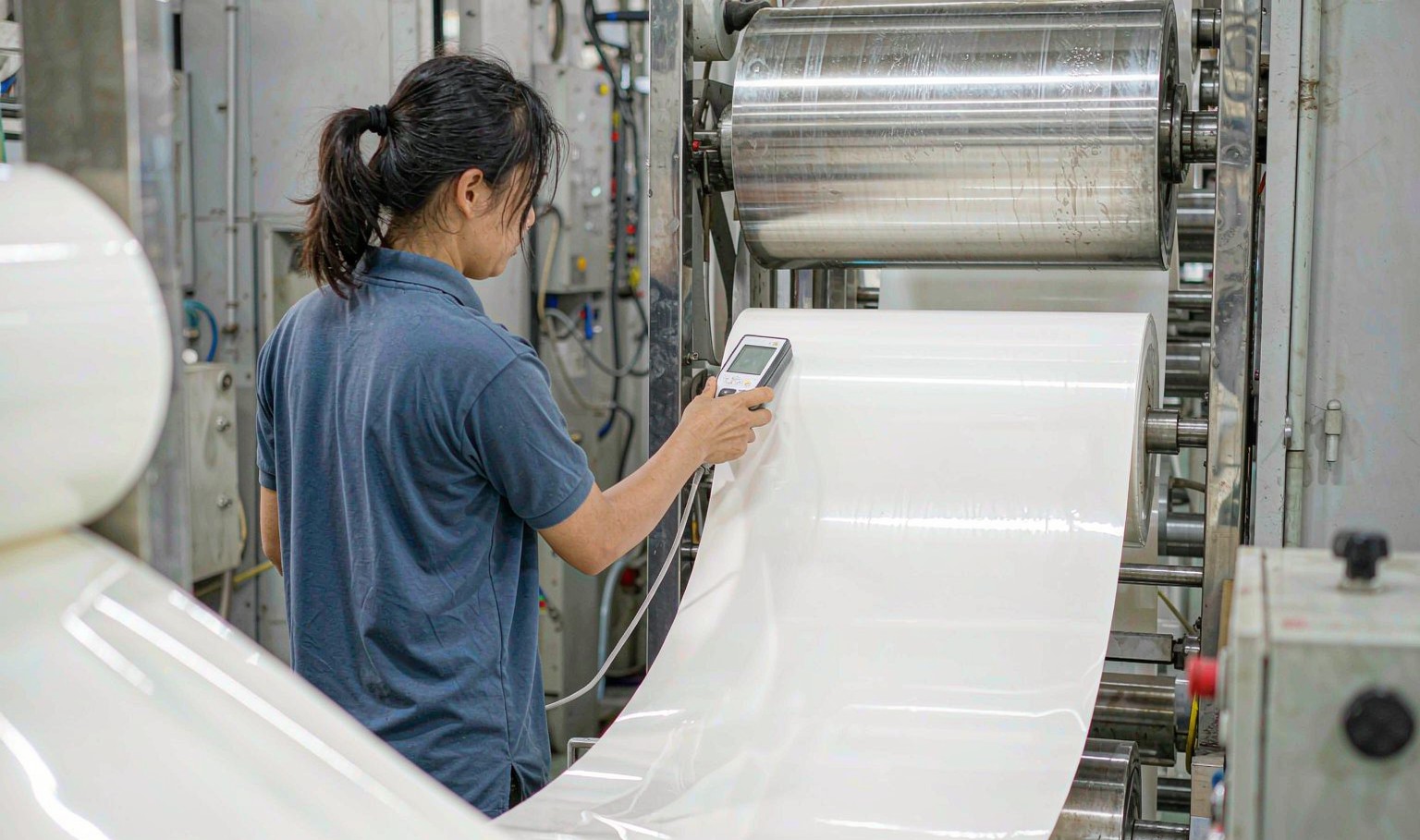
This is also why gloss is the first thing to change when anything about the cooling changes, and why it is a useful early indicator. A gloss meter on the line is measuring the roll surface, the quench rate and the die lip condition at the same time, whether the operator wants it to or not.
Chill roll temperature sets the skin
A chill roll at 20 C gives a hard, fast quench and a glossy surface. The same roll at 100 C gives a soft quench, more time for the surface to relax, and a matte finish. On a 300 micrometre sheet the difference between 20 C and 100 C can be 45 gloss units, which is the difference between a window-grade sheet and a liner.
The relationship is not linear. Most of the loss happens between 60 C and 100 C, where the surface is cool enough to hold a shape but warm enough to relax into roughness. Below about 40 C the gloss is close to its maximum and further cooling buys very little; above about 90 C the surface starts to look deliberately matte and the number becomes sensitive to small temperature changes.
That sensitivity is the practical problem. A roll temperature controller holding plus or minus 2 C is fine at 30 C and marginal at 95 C, because at 95 C a 2 C change moves gloss by 4 or 5 units. Lines that run matte sheet usually need tighter temperature control than lines that run gloss sheet, which is the opposite of what most people assume.
The drift nobody measures
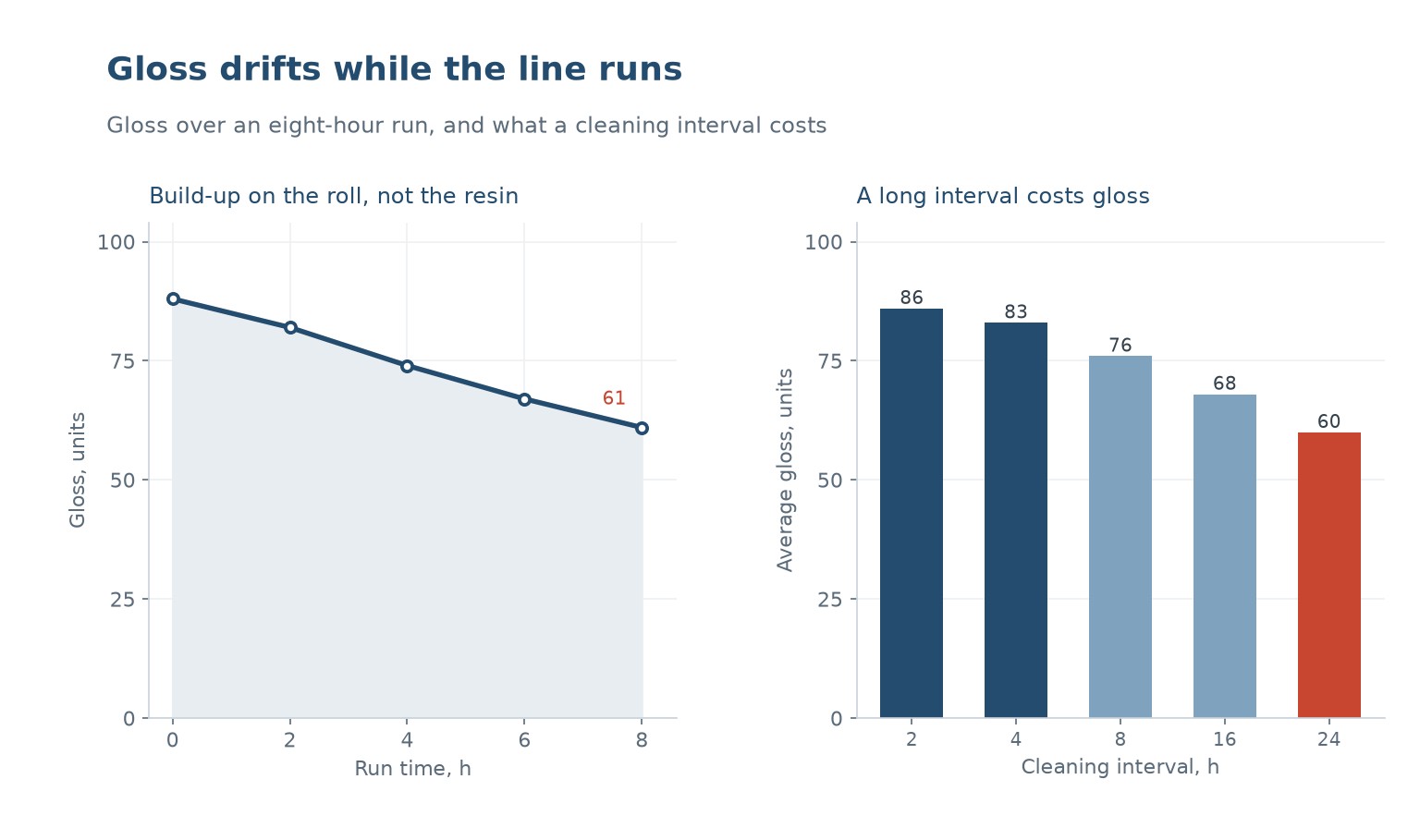
The eight-hour curve is the one that costs money. It starts at 88 and ends at 61, with no setpoint changed, no resin change and no operator intervention. The cause is a slow build-up on the chill roll: low molecular weight material, additives, dust and condensed volatiles forming a film that is thinner than a micrometre and enough to change the surface it transfers.
The film does two things. It insulates, so the quench slows down, and it roughens, so the surface it presses into the sheet is no longer the polished chrome it was designed to be. Both push gloss down, and they push it down gradually enough that nobody notices until a customer measures a sample from the end of the run.
The curve is also why a single gloss reading at the start of a run is not a quality record. A sheet that measured 88 at 08:00 and 61 at 16:00 is two different products, and if the specification says 85 minimum, half the shift is out of specification and nobody knew.
What builds up, and what removes it
The deposit is mostly polymer, not dirt. Low molecular weight tails and oligomers migrate to the surface of the sheet, transfer to the roll on contact and stay there because the roll is hot and the material is tacky. Additives that bloom, such as slip agents and antiblocks, make it worse because they are designed to migrate.
The removal method matters as much as the frequency. A solvent wipe removes the film but can leave a residue that changes gloss in the other direction for the first few hundred metres. A brass or copper scraper removes the film without solvent, but it can scratch chrome if it is used with too much pressure. Most lines end up with a felt wiper and a mild solvent, changed on a schedule.
The cleaning interval is a straight trade against average gloss. Cleaning every two hours holds an average of 86 units; every twenty-four hours holds 60. The right interval is the one that keeps the worst case inside the specification, not the one that maximises the average, because it is the end of the run that gets sampled.
| Cleaning interval | Average gloss | Worst case at end of interval |
|---|---|---|
| 2 h | 86 | 82 |
| 4 h | 83 | 79 |
| 8 h | 76 | 68 |
| 16 h | 68 | 57 |
| 24 h | 60 | 48 |
Table 1 — What a cleaning interval costs in gloss units
Measuring gloss so the number means something
Gloss is measured at a specified angle, and the angle changes the number. A 60 degree head is the general-purpose choice, a 20 degree head is more sensitive on high-gloss surfaces and an 85 degree head is used on matte surfaces where the other two read too low to resolve. Quoting a gloss number without the angle is meaningless.
The surface also has to be flat and clean, and it has to be the surface that matters. Measuring the air side of a sheet that is used face-down is a common and expensive mistake. On a textured sheet, gloss depends on the direction of measurement relative to the grain, so the reading has to be taken in the specified direction.
Finally, the meter has to be checked against a standard before the shift, not after a complaint. A gloss meter drifts, and a drifted meter that reads high will pass material that should be rejected, which is worse than no measurement at all.
| Measurement angle | Range it suits | Typical use |
|---|---|---|
| 20 degrees | High gloss, above about 70 units | Window sheet, display sheet |
| 60 degrees | General purpose, 10 to 70 units | Most packaging and industrial sheet |
| 85 degrees | Low gloss, below about 30 units | Matte sheet, liner, textured sheet |
Table 2 — Choosing the geometry before arguing about the number
Holding a gloss target over a long run
The first requirement is a specification that states the angle, the surface and the sampling position. Without those three, a gloss target is a number that two people can measure differently and both be right.
The second is a cleaning schedule derived from the drift curve rather than from habit. Measure at the start and end of a run for a week, plot the drift, and set the interval so the end-of-run value stays inside specification with margin. That is a two-week exercise that removes a recurring complaint permanently.
The third is to treat roll temperature as a controlled variable with an alarm, not a setpoint that someone adjusts. On a matte target the gloss is sensitive enough that a drifting controller shows up as a drifting product, and a 5 C excursion that nobody notices is a batch of sheet that has to be downgraded.
Can gloss be changed after the sheet is made?
Only by adding or removing a surface layer. Gloss is set at the roll, and once the skin has formed it is a property of that skin. Post-treatment can clean it or damage it, but it cannot make a matte sheet glossy without coating it.
Why does the same sheet read differently on two meters?
Almost always a different angle, a different surface, or a meter that has not been checked against a standard. Gloss meters are comparative instruments, and two meters that disagree by 5 units are both probably in calibration but measuring different geometries.
Does thickness affect gloss?
Not directly, but it changes the cooling and therefore the skin. A thin sheet on a cold roll quenches faster than a thick one on the same roll, so a line running several thicknesses will see gloss move with thickness unless the roll temperature is adjusted.
What causes gloss bands across the width?
Uneven roll temperature or uneven roll contact. A roll with a temperature gradient across its face transfers that gradient into the sheet as a gloss band, and a roll with a crown problem does the same through contact pressure rather than temperature.
Is matte sheet harder to make than gloss sheet?
It is harder to hold. Gloss is the natural result of a polished roll and a fast quench; matte requires a deliberately slower quench, a controlled roll temperature and often a textured roll, and the number is more sensitive to small changes.
How often should the roll be cleaned?
Set it from the drift curve, not from a calendar. Measure gloss at the start and end of several runs, find how fast it falls, and choose the interval that keeps the end-of-run value inside specification with margin.
A gloss target that keeps drifting?
Tell us the target, the angle and the sheet, and send a sample from the start and end of a run. We will tell you whether the drift is the roll, the resin or the measurement.
Continue reading
- ABS Sheet Extrusion: Gloss, Grain and the Roll That Sets Both
- Sheet Thickness Control: Die Bolt, Gauge and the Cross-Profile Nobody Measures
- PP Sheet Extrusion: Cooling, Shrink and the Roll Stack
- PET Sheet Extrusion: Drying, IV Loss and the Crystalline Haze
- Custom Plastic Extrusion: Profiles, Sheet and Tube




 PL
 EN
 ES
 FR
 DE
 PT
 AR
 RU
 JA
 KO
 IT
 NL
 TR
 ID
