
What PPSU is
Polyphenylsulfone is an amorphous high-temperature thermoplastic with a glass transition of 220 °C. It is transparent, amber-tinted, and it survives repeated steam sterilisation at 134 °C without hydrolysing, cracking or losing significant strength.
That combination is rare. Polycarbonate is clear but hydrolyses in an autoclave within a few dozen cycles. PEI is stronger and more heat resistant but is amber and notch-sensitive. PPSU occupies the specific niche of a clear part that must be sterilised hundreds of times.
The medical applications follow directly:infant feeding bottles, sterilisation trays, surgical instrument handles, dental instruments, dialysis components. In each, the specification is not 'transparent' but 'transparent after 1,000 cycles', and only PPSU delivers that.
| Własność | PPSU | PC | PEI |
|---|---|---|---|
| Glass transition | 220 °C | 147 °C | 217 °C |
| Autoclave cycles | 1,000+ | 20 – 50 | 500 – 1,000 |
| Przejrzystość | Amber, clear | Clear | Amber, translucent |
| Notched impact | 70 J/m | 600 – 900 J/m | 50 J/m |
| Temperatura topnienia | 350 – 390 °C | 280 – 320 °C | 350 – 400 °C |
| Cost index | Wysoki | Niski | Very high |
Table 1 — PPSU against the two materials it is usually compared with. The autoclave column is the one that decides most projects.
The autoclave requirement, in numbers
A steam autoclave cycle at 134 °C exposes the part to water at 2.1 bar for 4 to 18 minutes, followed by drying. The damage mechanisms are hydrolysis of the polymer chain and stress cracking at moulded-in stress points.
PPSU resists hydrolysis because its sulfone groups are stable in steam. What it does not resist is stress: a part with high moulded-in stress will craze at the gate or a sharp corner after a few hundred cycles, even though the material is fine. The autoclave is a stress test disguised as a sterilisation process.
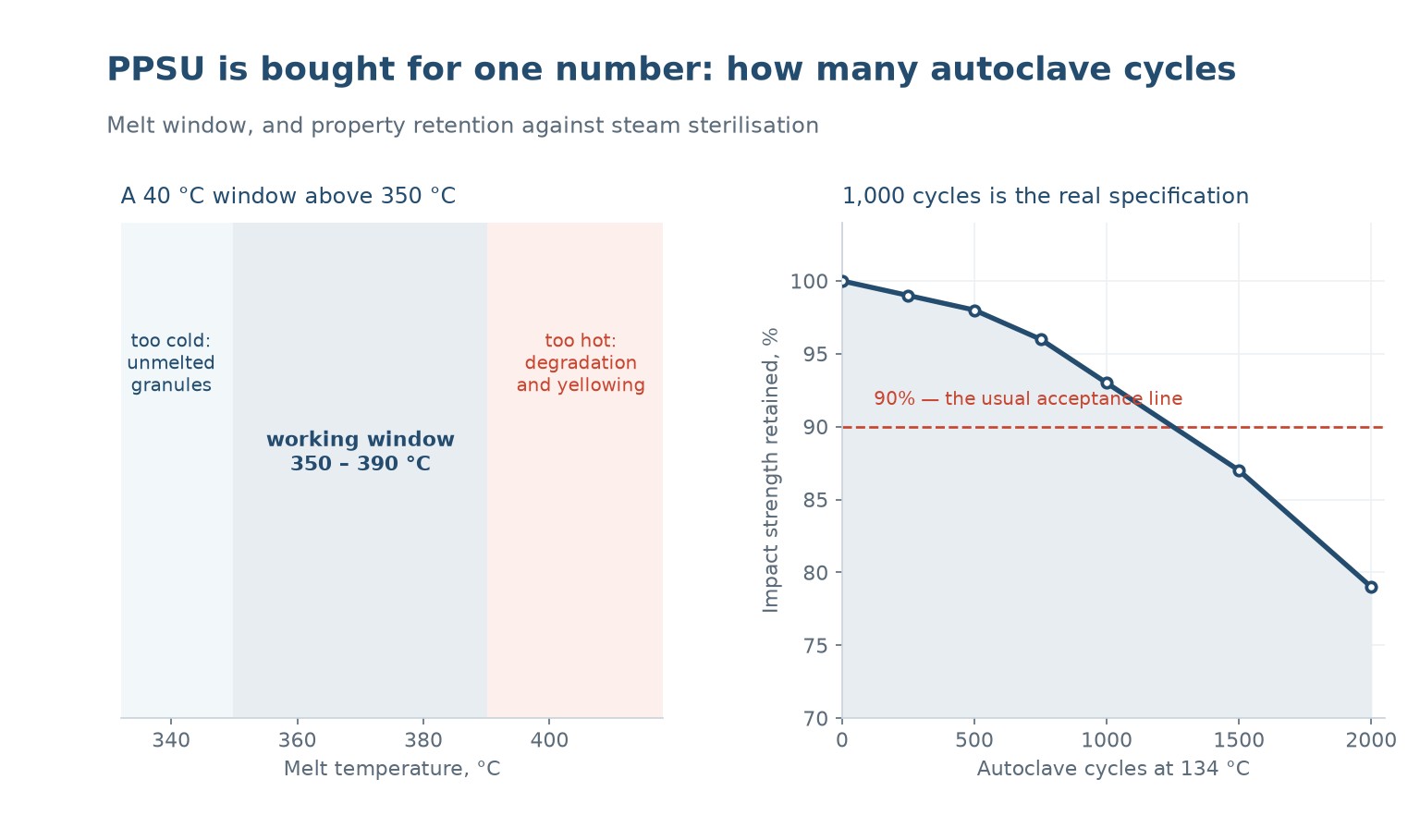
Impact strength retention is the usual acceptance criterion. A well-moulded PPSU part retains about 93 percent after 1,000 cycles and 79 percent after 2,000. A poorly moulded one with high stress can fail at 300. The difference is entirely in the tool and the process, not the resin.
Drying and the melt window
PPSU absorbs about 0.5 percent moisture and must be dried to 0.02 percent. At 150 °C in a desiccant dryer that takes four hours; at 120 °C it takes eight and is less effective. A hopper dryer at 150 °C with a dew point below −40 °C is the standard.
The melt window is 350 to 390 °C. Below 350 the granules do not fully melt and the part has unmelted specks and weak weld lines. Above 390 the polymer degrades and the amber colour darkens toward brown, which is irreversible.
The window is 40 °C wide but the consequences at each end are asymmetric. Running cold gives a part that looks acceptable and fails mechanically. Running hot gives a part that is visibly wrong. This means the cold end is the dangerous one, and it is where most PPSU problems originate.
| Parametr | Value | Note |
|---|---|---|
| Drying | 150 °C, 4 h, −40 °C dew point | To 0.02% |
| Temperatura topnienia | 350 – 390 °C | 370 °C typical |
| Mould temperature | 140 – 180 °C | Hot oil, not water |
| Injection pressure | 100 – 140 MPa | High viscosity |
| Packing pressure | 50 – 70% | Long hold, slow gate freeze |
| Residence time | Under 8 min at 380 °C | Degradation is cumulative |
Table 2 — PPSU process parameters. Mould temperature requires an oil circuit; water will not reach 180 °C.
Tooling for 370 °C
A PPSU tool runs at 140 to 180 °C. Water circuits cannot reach that, so the tool needs an oil heater, and the manifold, hoses and seals must be rated for it. This is the first thing that surprises a shop new to high-temperature resins.
The steel must be a hot-work grade. P20 softens at these temperatures and will lose its polish and its dimensions. H13 or a similar hot-work tool steel, hardened to 48 to 52 HRC, is the normal specification.
Gates need to be generous. PPSU at 370 °C is still viscous, and a small gate produces high shear, high orientation and a stress concentration exactly where the part is most likely to fail in the autoclave. A gate that would be adequate for PC will cause PPSU stress cracks.
Cooling is slow because the mould is hot and the material has a high heat capacity. Cycle times of 30 to 60 seconds for a small part are normal, and a 5 mm wall can take two minutes. Tool cooling design matters more than for commodity resins, not less.
Stress and transparency together
PPSU is transparent, which means stress is visible as birefringence. A polarised light check on a moulded part shows the frozen orientation as coloured bands, and the bands concentrate at the gate and at sharp corners. This is useful: it is a non-destructive stress map.
The fixes are the standard ones applied more aggressively. Raise the mould temperature to the top of the range. Slow the injection. Increase the gate. Add radius at every internal corner. Anneal the part at 180 °C for two hours if the geometry allows.
Annealing is common for PPSU medical parts and it is not optional for a part that will see 1,000 autoclave cycles. A two-hour anneal at 180 °C reduces the moulded-in stress enough to move the failure point from 300 cycles to beyond 1,000.
Defects
| Wada | Przyczyna | Fix |
|---|---|---|
| Brown or dark amber colour | Melt too hot or residence too long | Drop 15 °C, reduce shot size |
| Unmelted specks | Melt too cold | Raise 10 °C, check screw compression |
| Bubbles | Moisture | Extend drying, verify dew point |
| Crazing after autoclave | Moulded-in stress | Hotter mould, bigger gate, anneal |
| Weak weld line | Cold melt or poor venting | Melt temperature, then venting |
| Visible flow marks | Cold mould or slow fill | Raise mould temperature |
| Part sticks | Insufficient draft on a hot tool | Add 1.5° draft, polish |
| Brittle part | Degradation from residence time | Smaller shot, shorter cycle |
Table 3 — PPSU defects. Three of the eight are thermal history, which is the dominant risk with high-temperature resins.
How many autoclave cycles can PPSU take?
Over 1,000 at 134 °C with impact strength above 90 percent of the original, provided the part is properly moulded and annealed. Poorly moulded parts with high stress can fail at 300 cycles.
What melt temperature does PPSU need?
350 to 390 °C, with 370 °C typical. Below 350 the granules do not fully melt; above 390 the colour darkens permanently.
Why does PPSU need an oil-heated tool?
The mould runs at 140 to 180 °C, which is above the practical limit of a water circuit. Oil heaters, rated hoses and hot-work tool steel are all required.
Is PPSU the same as polysulfone?
No. PSU (polysulfone) and PES (polyethersulfone) are related but have lower autoclave resistance and different colour. PPSU, polyphenylsulfone, has the highest toughness and hydrolysis resistance of the family.
Can PPSU be sterilised by gamma radiation?
Yes, and it tolerates gamma and EtO as well as steam. Gamma can cause some yellowing at high doses, which is usually acceptable for a medical device but may not be for a cosmetic part.
Why does my PPSU part crack after sterilisation?
Stress cracking, not chemical attack. The autoclave is a stress test. Raise the mould temperature, enlarge the gate, add radius and anneal the part at 180 °C.
Moulding PPSU parts for sterilisation?
Send us the drawing, the autoclave cycle count and the transparency requirement. We will tell you the gate, the mould temperature and the annealing schedule the part needs.




 PL
 EN
 ES
 FR
 DE
 PT
 AR
 RU
 JA
 KO
 IT
 NL
 TR
 ID
