What antistatic actually means
Static is a surface phenomenon. Two materials touch, charge moves from one to the other, and when they separate the charge stays where it landed. On an insulator it stays for minutes or hours, and in that time it attracts dust, makes sheets stick together, discharges into a sensitive component or produces a spark.
The fix is not to make the plastic conductive. It is to give the surface enough mobility that the charge leaks away faster than it accumulates. That is a much smaller change. A surface resistivity of 1e12 ohm per square is still an insulator by any electrical definition, but it is twelve decades below an untreated polyolefin and it is enough to stop dust attraction.
The unit matters because the test is a surface test. Surface resistivity is quoted in ohms per square, and it is measured with two electrodes on the same face, so it describes the path along the surface rather than through the material. Volume resistivity describes the path through the bulk and is a different number for the same sample.
Most specifications quote surface resistivity because most static problems are surface problems. A part that has to drain charge through its wall to a grounded fixing is a different design and needs volume resistivity instead, which usually means a conductive filler rather than an antistatic one.
The percolation threshold
An antistatic additive works by forming a network. Below a certain loading the molecules are dispersed as isolated islands and the surface resistivity barely moves. Above it the islands connect and the resistivity falls steeply, often by four or five decades over a narrow range of loading. That point is the percolation threshold.
The threshold is what makes antistatic compounding difficult. It sits at a loading that depends on the additive, the polymer, the dispersion and the thermal history, and a small change in any of them moves it. A batch that disperses slightly better than the last one can fall below the threshold and fail, and the difference is invisible in the pellet.
The practical consequence is that antistatic masterbatches are dosed with a margin. A compound that needs two percent to reach the threshold is usually sold at three to four percent so that batch-to-batch variation stays on the safe side. The margin costs money and it changes the mechanical properties, which is why the loading is a compromise rather than an optimum.
The threshold also depends on the polymer's own surface energy. A polar polymer such as PET or PVC already has a surface that holds a little moisture and leaks charge slowly, so it needs less additive. A non-polar polyolefin has nothing to work with and needs more, which is why the same masterbatch is dosed differently for PP and for PET.
Humidity is half the answer
The chart on the left plots surface resistivity against antistatic loading at three humidities. At 80 percent relative humidity, half a percent of additive already gives 1e12 and two percent gives 1e8, well inside the antistatic window shaded on the plot. At 20 percent relative humidity the same two percent gives 1e10, and it takes five percent to reach 1e9.
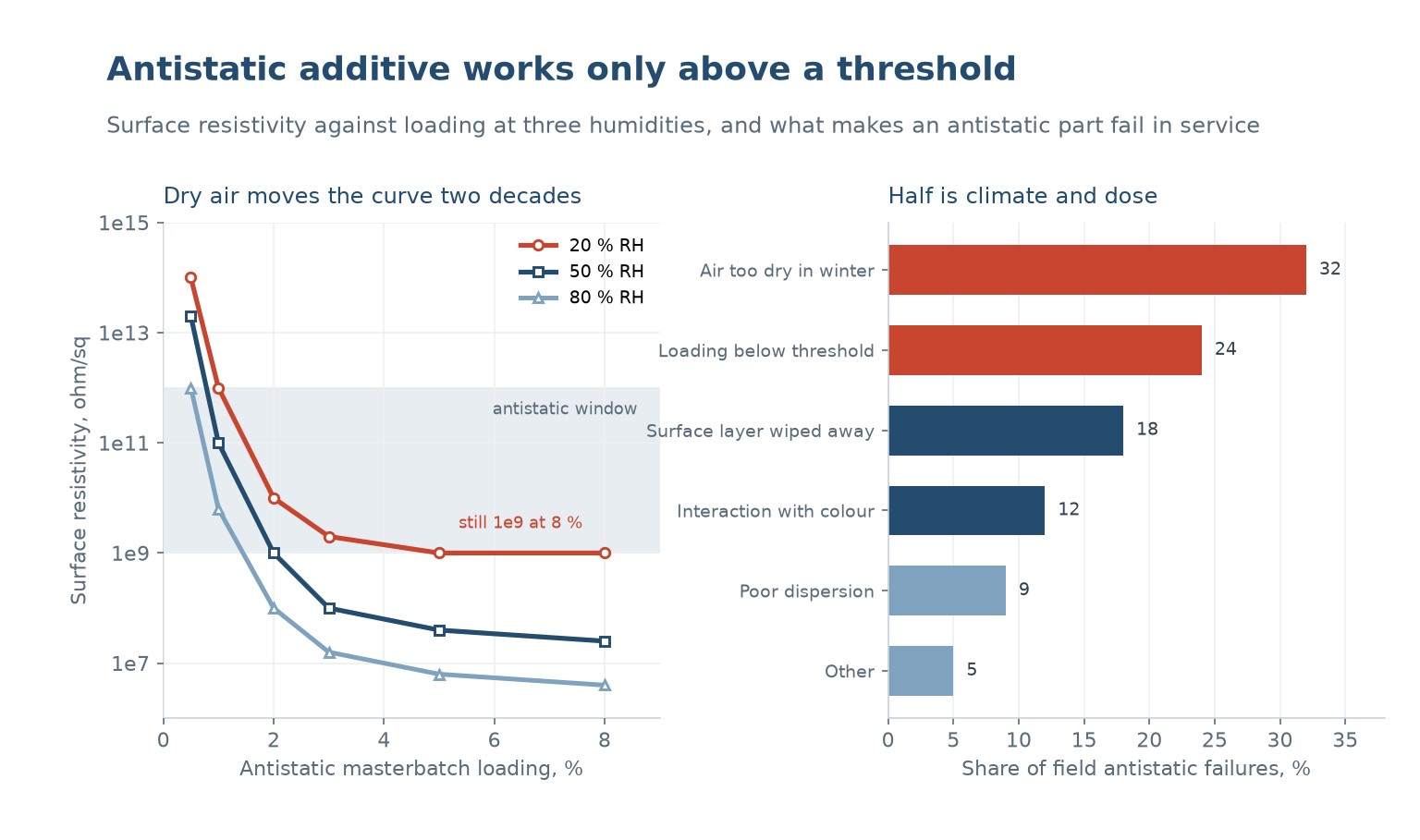
The gap between the curves is the whole problem. Between 20 and 80 percent relative humidity the resistivity changes by two decades at low loading and by one decade at high loading. A part specified at 1e9 in a humid lab can measure 1e11 in a heated warehouse in February, and 1e11 is outside the window for most electronics packaging.
The mechanism is water. Most antistatic additives are hygroscopic, and they work by drawing a molecular layer of water onto the surface. That layer is what carries the charge. Remove the water and the additive is still there but it has nothing to conduct through, which is why the curve flattens rather than continuing to fall at high loading in dry air.
That flattening is visible in the plot: at 20 percent relative humidity the curve stops falling at about 1e9 and stays there from five percent loading to eight. Doubling the dose in dry conditions buys nothing, and that is the single most expensive misunderstanding in antistatic specification.
Migrating versus permanent
There are two families of antistatic additive and they fail in different ways. Migrating additives are surfactants that are incompatible with the polymer by design. They bloom to the surface over a day or two after extrusion, form the conductive layer, and are replenished from the bulk when the surface is rubbed or washed.
The migration is the feature and the weakness. A fresh part needs a day or two to reach its final resistivity, so a part tested straight off the line reads higher than the same part tested next week. A part that is wiped with a solvent, washed, or handled heavily loses its surface layer and recovers over hours, which is fine in service and awkward in a test.
Permanent systems are polymers with intrinsic conductivity, or conductive fillers such as carbon black, carbon nanotubes or inherently dissipative polymers. They do not migrate, so the resistivity is stable from the first hour and does not depend on surface renewal. They cost more and they load the compound more heavily, which shows up in impact strength and in colour.
The choice usually comes down to whether the part is cleaned. A tray that is washed between uses needs a permanent system, because a migrating one will be washed off and the tray will slowly become an insulator. A part that is used once and discarded can use a migrating system and save the cost.
| Typ | How it works | Siła | Weakness |
|---|---|---|---|
| Migrating surfactant | Blooms to the surface, draws water | Low loading, low cost | Needs days to mature, washes off |
| Permanent polymer | Intrinsically dissipative | Stable from hour one | Higher loading, higher cost |
| Carbon black | Conductive network in the bulk | Cheap, very stable | Black only, hurts impact |
| Carbon nanotube | Network at very low loading | Low loading, keeps colour | Cost, dispersion is critical |
| Metal fibre | Physical contact network | Very low resistivity | Cost, weight, corrosion |
Table 1 — Five routes to a dissipative surface
What breaks an antistatic part
The chart on the right breaks down field failures. Dry air in winter accounts for 32 percent, loading below the threshold for 24, the surface layer being wiped away for 18, interaction with colour for 12, poor dispersion for 9, and everything else for 5. More than half the failures are climate and dose, which means they were predictable from the specification.
The colour interaction is the one that surprises people. A masterbatch carries its own carrier resin and its own additives, and those compete with the antistatic for the surface. A part that is coloured with a high-loading masterbatch often reads one or two decades higher than the same part in natural, because the pigment particles occupy the surface and block the conductive path.
Dispersion is the second surprise. An antistatic that is poorly dispersed forms clumps, and clumps mean the network is uneven. The part then has a resistivity that varies across its surface by decades, and a measurement taken in one place does not represent the part. That is why a single spot reading is a weak test and a map is a better one.
The last mechanism is contact. Antistatic performance is a surface property, and a surface that is coated, painted, laminated or covered by a label has lost it. A printed antistatic tray is only antistatic on the unprinted side, and that is often the side that faces the product.
Testing before you ship
The test that matters is the one done at the humidity the part will see. A reading taken in an air-conditioned lab at 50 percent relative humidity tells you what the part does in an air-conditioned lab. If the part ships to a heated warehouse or an unheated container, the number that matters is the one at 20 percent or lower.
Conditioning takes time. A sample needs at least 24 hours at the test humidity before the reading stabilises, and a migrating system needs 48 to 72 hours after extrusion before it is mature. Testing a fresh part and rejecting it for being out of specification is a common and expensive mistake.
The electrodes matter as much as the meter. Surface resistivity depends on the electrode geometry, the contact pressure and the voltage applied, and two labs using different fixtures will not agree. The standards exist for that reason, and quoting a number without the standard it was measured to is quoting nothing.
The final check is a map rather than a spot. Five readings across a part, at the corners and the centre, will show whether the dispersion is even and whether the surface is uniform. A part that reads 1e9 in the middle and 1e12 at a corner is a part with a flow problem, and it will fail in service even though the average looks fine.
| Resistivity, ohm/sq | Band | Typical use |
|---|---|---|
| Above 1e14 | Insulating | Untreated plastics, static builds up |
| 1e12 to 1e14 | Static dissipative, marginal | Dust control on non-critical parts |
| 1e9 to 1e12 | Antistatic | Electronics packaging, trays, tubes |
| 1e6 to 1e9 | Conductive | Grounding paths, fuel system parts |
| Below 1e6 | Highly conductive | EMI shielding, special applications |
Table 2 — The bands and what each one is good for
What surface resistivity counts as antistatic?
Between 1e9 and 1e12 ohms per square for most electronics packaging. Below 1e9 the part is conductive rather than dissipative, which is fine for some uses and a discharge risk for others.
Why does my part measure differently in winter?
Most antistatic additives work by drawing a layer of water onto the surface. In dry air there is less water, so the surface conducts less and the resistivity rises, often by two decades.
How long after extrusion can I test?
Twenty four hours minimum for a permanent system, and 48 to 72 hours for a migrating one. A migrating additive needs time to bloom to the surface, and a fresh part reads higher than a mature one.
Does the colour affect antistatic performance?
Yes. Pigment particles compete for the surface and can block the conductive path, so a coloured part often reads one or two decades higher than the same part in natural.
Can an antistatic part be washed?
Only if it uses a permanent system. A migrating additive is a surface layer and a wash removes it, after which the part recovers slowly and never fully in a dry environment.
Does more additive always mean lower resistivity?
No. In dry air the curve flattens once the additive has drawn all the water it can, so doubling the dose above five percent buys almost nothing while costing impact strength and money.
An antistatic part that fails in dry weather?
Send the resistivity specification, the climate it ships into and the loading you are using. We will tell you whether the dose, the system or the dispersion is the problem.




 PL
 EN
 ES
 FR
 DE
 PT
 AR
 RU
 JA
 KO
 IT
 NL
 TR
 ID