
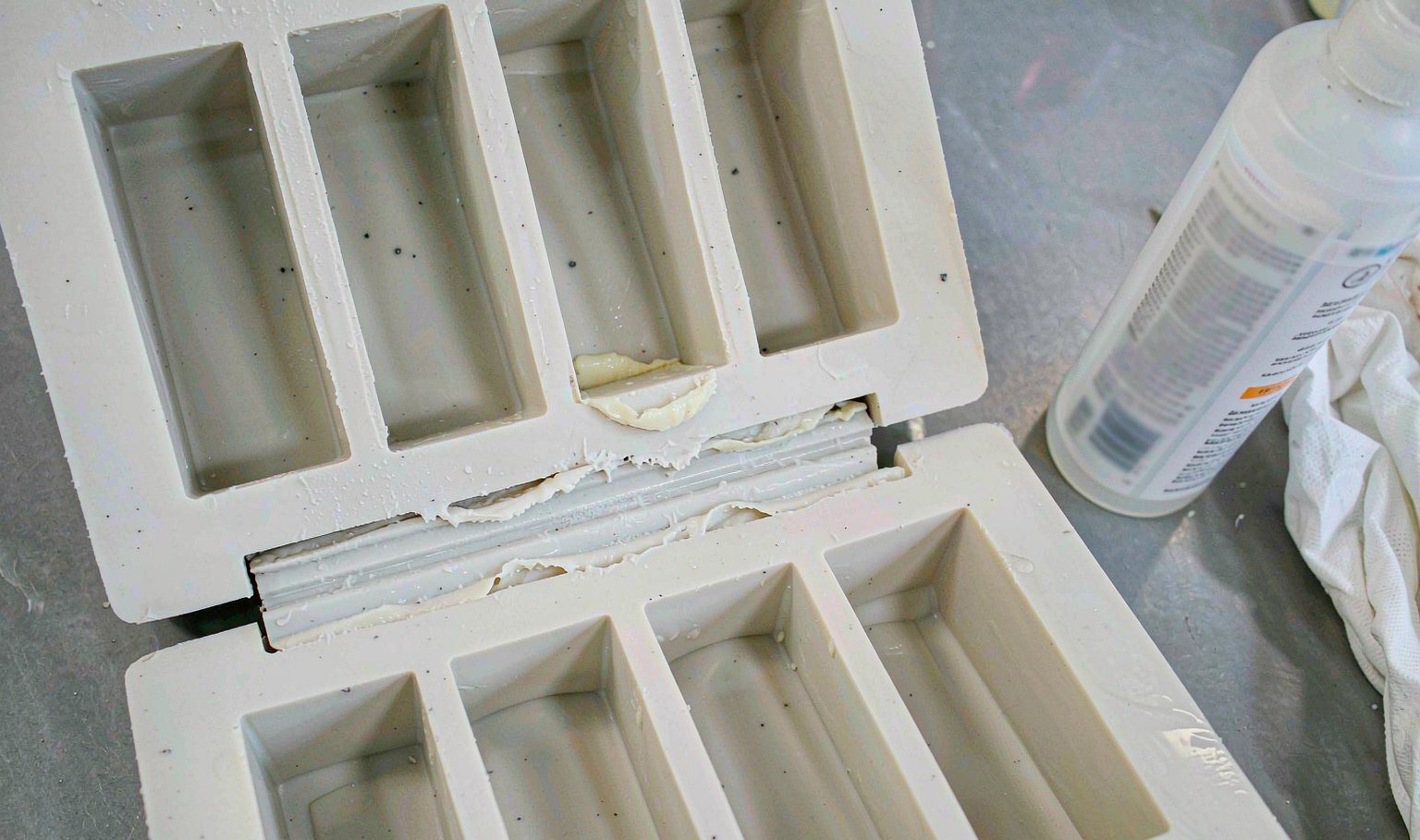
Sticking has two causes and one symptom
A silicone part sticks to the mould when the adhesion between the part and the tool is stronger than the cohesive strength of the part, or stronger than the demould force available. That is the whole mechanism, and it has two independent inputs: how cured the part is, and how the tool surface behaves.
An under-cured part is soft, tacky and weak. It adheres to everything, and it tears before it releases. A fully cured part is dry, strong and releases from a good tool with almost no force.
The tool surface is the other half. Silicone wets a high-energy surface and does not wet a low-energy one. A polished steel tool at 40 mN/m is a surface that silicone grips; a tool at 20 mN/m, whether by material or by coating, is a surface that silicone slides off.
The symptom is the same either way: the part stays in the tool, or it tears. The diagnosis is the order of checks, and the first check is the cure, because it is free to measure and it is the more common cause.
Cure time is the first lever
Silicone cures by a platinum-catalysed addition reaction or by a peroxide. In both cases the cure is a function of time and temperature, and the part is not fully cured until the reaction has run to a sufficient conversion.
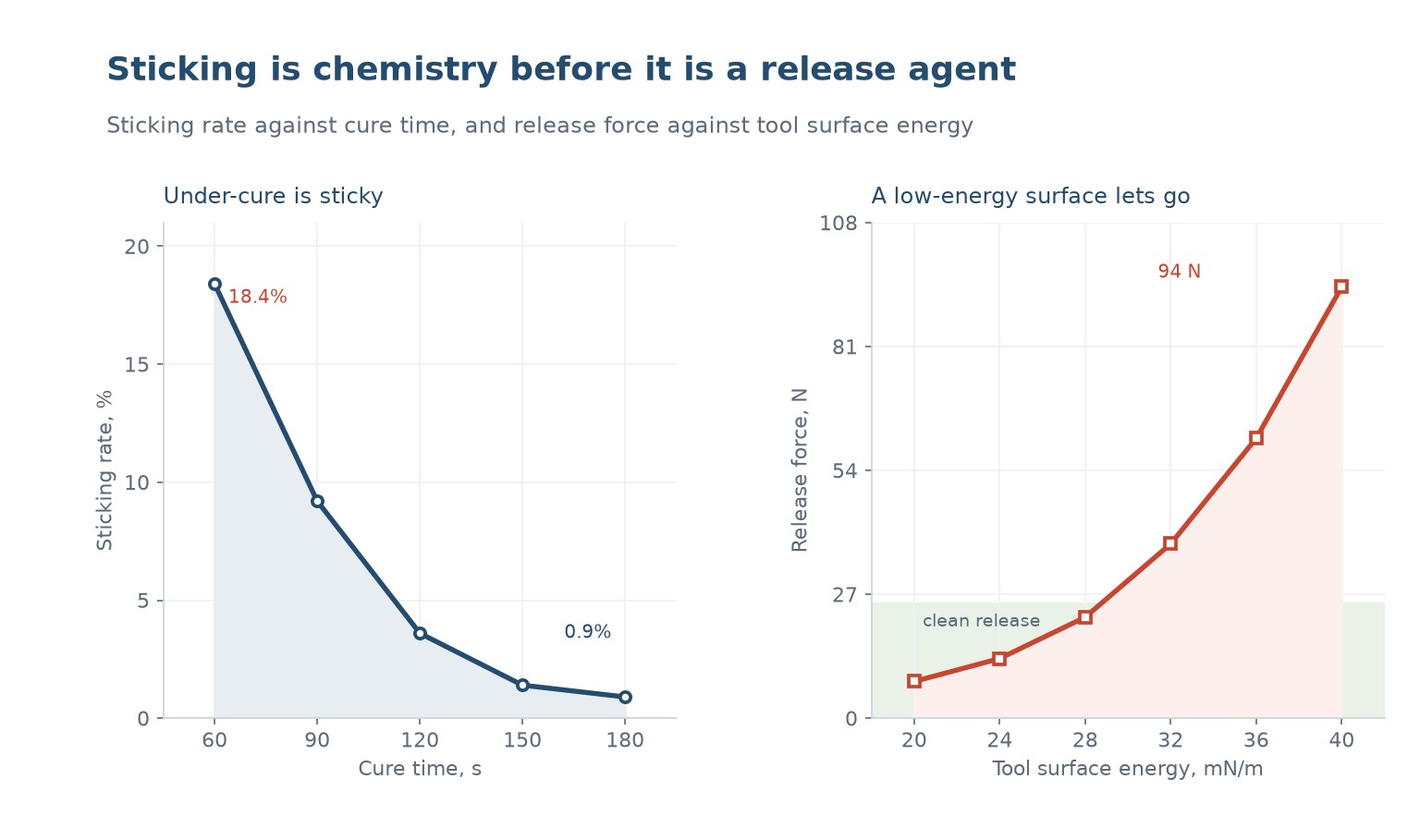
A part cured for 60 seconds at 175 C is about 80 percent cured. It is firm enough to handle and it will tear rather than release, because the surface is still tacky and the tear strength is a fraction of its final value. The measured sticking rate at 60 seconds is 18.4 percent.
At 90 seconds it is 9.2 percent, at 120 seconds 3.6, at 150 seconds 1.4 and at 180 seconds 0.9. The curve falls steeply and then flattens, which is the shape of a reaction approaching completion.
The cost of curing longer is cycle time, and it is direct: 120 seconds of extra cure on a 90 second cycle is a 130 percent increase. That is why the operating point is usually 150 to 180 seconds, where the sticking rate is under 1.5 percent and the cycle is still viable.
The other cure variable is temperature uniformity. A tool that is 10 C cooler at one corner is a tool where that corner is 10 percent less cured, and the sticking appears there first. A thermal image of the tool at demould is the fastest way to find it.
Surface energy is the other half
Surface energy is measured in millinewtons per metre and it describes how strongly a liquid wets a solid. A clean, polished steel tool sits at 38 to 42 mN/m. Silicone has a surface energy of about 20 mN/m, which is why cured silicone is non-stick.
The problem is that uncured silicone wets the steel. It spreads on a high-energy surface, and once it has spread it has intimate contact, and intimate contact is what adhesion needs. A low-energy tool surface does not allow that spreading.
The measured release force follows the surface energy directly. At 20 mN/m the force is 8 newtons. At 24 it is 13, at 28 it is 22, at 32 it is 38, at 36 it is 61, and at 40 it is 94. Doubling the surface energy multiplies the release force by twelve.
A release force of 60 newtons is about the limit for hand demoulding, which corresponds to a surface energy of about 35 mN/m. Above that the part needs a stripping tool or a lower-energy surface.
The ways to get a lower-energy surface are a coating, a release agent or a different tool material. A PTFE coating gives about 18 mN/m and lasts thousands of cycles. A silicone release agent gives a similar number but it is a film that has to be renewed. A hardened, polished steel tool gives 38 to 42 and needs a release agent.
| Tool surface | Surface energy | Release force | Uwagi |
|---|---|---|---|
| PTFE coated | 18 mN/m | 6 to 8 N | Thousands of cycles |
| Silicone release film | 20 mN/m | 8 N | Renewed regularly |
| Hardened polished steel | 38 mN/m | 85 N | Needs an agent |
| Unpolished steel | 42 mN/m | 100 N | Also traps material |
| Aluminium | 40 mN/m | 94 N | Corrodes, avoid |
Table 1 — What the tool surface costs in release force
Release agents, and why more is worse
A release agent works by putting a low-energy film between the part and the tool. The film has to be thin, continuous and dry. A thick film is a film that transfers to the part, and a wet film is a film that boils at mould temperature and leaves a patch.
The failure mode of too much agent is build-up. Silicone release agents are themselves silicone, and a build-up of cured agent on the tool is a rough, uneven surface that grips the part in some places and releases it in others. The symptom is sticking that gets worse the more agent is applied.
The failure mode of too little is the opposite: a dry tool, high release force and torn parts. The right amount is a thin film that is almost invisible, applied to a clean tool at the start of a run, and renewed only when the release force rises.
The third failure mode is the wrong agent. A silicone-based agent on a silicone part is a contamination risk, because the agent and the part are chemically similar and the agent can migrate into the part surface. A solvent-based agent that has not flashed off is a wet tool.
The fourth is the interaction with a post-cure or a secondary operation. A part with release agent on it does not bond, does not print and does not pass a surface-energy test. A medical part cannot have a release agent at all, which is why a medical silicone tool is PTFE coated instead.
Diagnosing it in the right order
Measure the cure first. A hardness reading on a part against the specification, or a simple tear by hand, takes a minute. A part that is 5 Shore A soft against its specification is under-cured and no release agent will fix it.
Then check the tool temperature uniformity. A thermal image at demould shows whether the sticking is in the cool corner or everywhere. If it is everywhere, the cure time is the issue; if it is in one place, the tool is.
Then check the tool surface. A tool that has been polished recently has a high surface energy and will grip; a tool with a build-up of cured agent will grip unevenly. A clean, coated tool is the reference.
Then look at the compound. A compound that has been stored past its shelf life, or one where the catalyst and the base have been mixed in the wrong ratio, cures to a tacky surface even at full cure time. A batch record is what catches that.
| Observation | Likely cause | Check |
|---|---|---|
| Sticks everywhere, part tacky | Under-cure | Hardness, cure time |
| Sticks in one corner | Tool temperature | Thermal image |
| Gets worse with more agent | Agent build-up | Clean the tool |
| Sticks only on new parts | Batch or ratio | Mix ratio, shelf life |
| Sticks and tears at a feature | Undercut | Dial indicator on the core |
| Sticks after a tool clean | Surface energy too high | Re-apply coating or agent |
Table 2 — Reading a sticking problem from where it happens
Preventing it rather than chasing it
The reliable setup is a PTFE-coated tool, a cure time with 30 percent margin over the minimum, and a compound that is measured on receipt. That combination removes the three common causes and it costs a coating and a slower cycle.
The margin is the part that gets argued about. A cure time set at the minimum that releases is a cure time that will fail on a cold morning or with a slightly different lot. A 30 percent margin costs cycle time and buys a process that does not need an operator to watch it.
The tool maintenance is the other half. A tool that is cleaned with the right solvent and recoated on a schedule does not develop the build-up that causes uneven sticking. A tool that is cleaned with the wrong solvent loses its coating and grips everywhere.
Why does my silicone part stick to the mould?
Either the part is under-cured and tacky, or the tool surface has too high an energy. Check the hardness first, then the tool temperature uniformity, then the surface.
How much does cure time affect sticking?
A lot. The sticking rate is 18.4 percent at a 60 second cure, 3.6 at 120 and 0.9 at 180. A 30 percent margin over the minimum release time is the usual recommendation.
What surface energy should a silicone tool have?
About 20 mN/m for clean release. At 40 mN/m the release force is 94 newtons against 8 at 20, which is the difference between a part that drops out and one that tears.
Does more release agent help?
No. A build-up of cured agent is a rough surface that grips unevenly, and the sticking gets worse the more you apply. Clean the tool and reapply a thin film.
Why can't a medical silicone part use a release agent?
Because the agent migrates into the part surface and fails the extractables and surface tests. A medical tool is PTFE coated instead.
The part sticks only in one corner. Why?
That corner of the tool is cooler, so the part is less cured there. A thermal image at demould will show it, and the fix is a cooling circuit or a heater, not more release agent.
Parts that stay in the tool, or tear coming out?
Send the compound, the cure time and a photo of the tool. We will tell you whether it is cure, surface energy or an undercut, and what to change first.




 PL
 EN
 ES
 FR
 DE
 PT
 AR
 RU
 JA
 KO
 IT
 NL
 TR
 ID
