
Hardness is a proxy for three different things
A mould steel is chosen for four properties: how long it lasts, how well it polishes, how it resists corrosion, and how easy it is to machine. Hardness is the number that gets quoted and it is a proxy for the first two, and the proxy is imperfect in both directions.
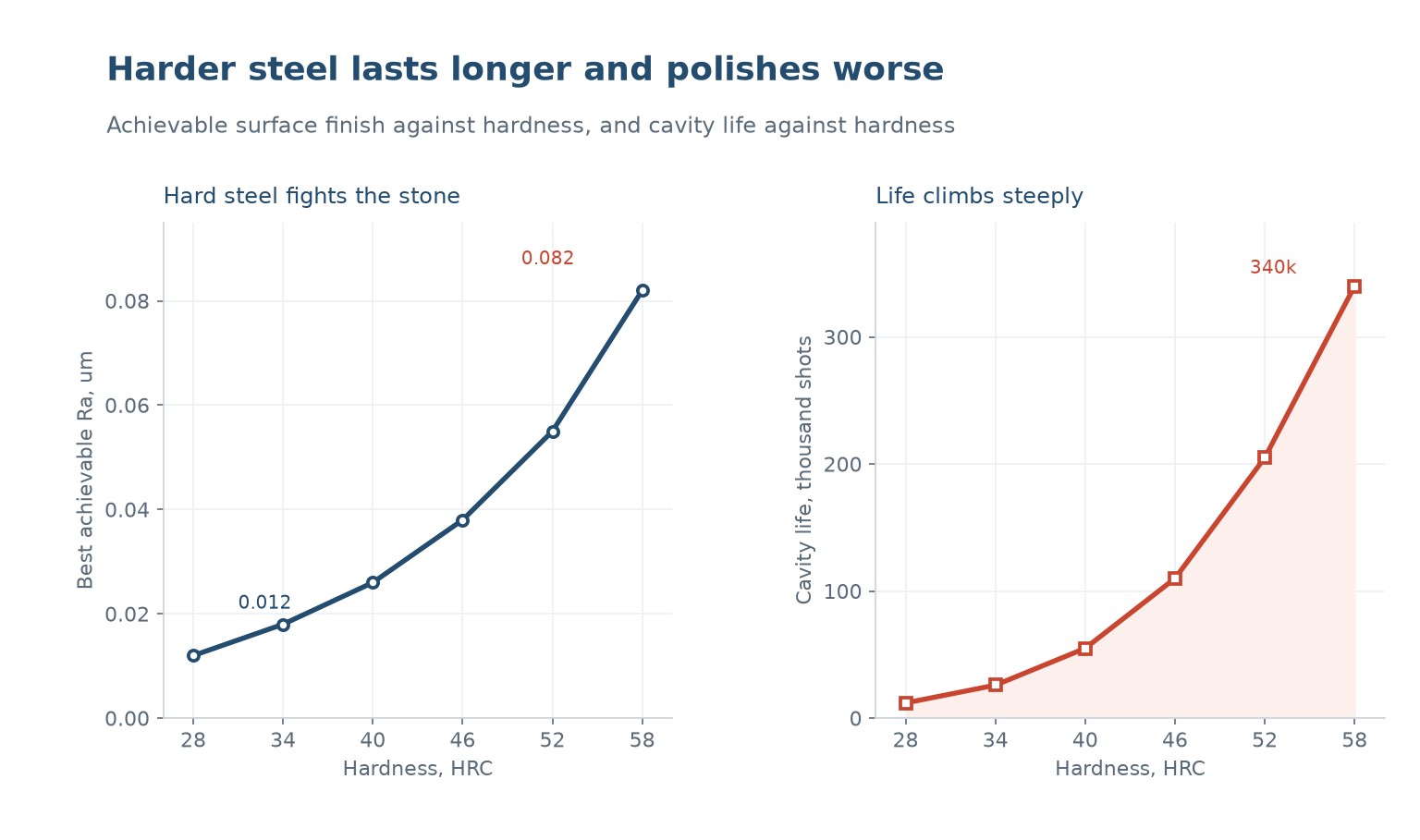
Wear resistance scales with hardness, and it scales steeply. On a production tool running an unfilled resin, a cavity at 28 HRC lasts about 12,000 shots. At 34 HRC it is 26,000, at 40 it is 55,000, at 46 it is 110,000, at 52 it is 205,000, and at 58 it is 340,000. The curve is not linear, it is closer to exponential, which is why the difference between 46 and 52 HRC is worth more than the difference between 28 and 34.
Polishability goes the other way. The best surface a toolmaker can achieve on a 28 HRC block is about 0.012 micrometres Ra. At 34 HRC it is 0.018, at 40 it is 0.026, at 46 it is 0.038, at 52 it is 0.055, and at 58 it is 0.082. A hard steel resists the polishing stone as much as it resists the wear, and a 0.082 Ra surface is a surface that shows every mark on a high-gloss part.
That is the trade in one line. A clear polycarbonate lens needs 0.010 to 0.015 Ra and it needs 100,000 shots. No single steel gives both, and the answer is either a coated steel, a different cavity insert for the optical surface, or an acceptance that the tool is re-polished on a schedule.
Polishability is a microstructure, not just a number
Two steels at the same hardness can polish very differently, and the reason is the microstructure. A steel with large, uneven carbides tears at the polishing stage: the carbide stands proud, the matrix around it wears away, and the surface ends up with a fine orange-peel texture that cannot be polished out.
That is why a through-hardened steel and a pre-hardened steel at the same hardness are not interchangeable for an optical cavity. A pre-hardened P20 at 32 HRC has a relatively uniform structure and polishes to 0.015 to 0.020 Ra. A 1.2344 at 50 HRC has a finer structure and can reach 0.02, but a badly annealed 1.2344 at 50 HRC can be worse than the P20.
Sulphur is the other variable. A free-machining grade with 0.05 to 0.10 percent sulphur machines beautifully and polishes badly, because the sulphide inclusions are soft and they pull out at the surface. A free-machining grade is right for a mould base and wrong for a cavity that has to be polished.
The practical rule is that the steel specification has to say what the surface is for. A drawing that says P20 does not say whether it is a free-machining grade, and a drawing that says 1.2344 does not say whether it is ESR re-melted. The two versions of each differ by a factor of two in polishability.
The hardness ceiling is toughness
There is a reason not to use the hardest steel available, and it is not cost. Above about 54 HRC, most tool steels lose toughness faster than they gain wear resistance, and a cavity with a thin core, a sharp internal corner or a deep rib will crack rather than wear.
The classic failure is a thin core pin in a high-hardness insert. The pin is loaded in bending every cycle, and at 58 HRC a small notch or a grinding mark is a crack initiation site. The tool then fails at 20,000 shots, having been bought to last 300,000.
The other reason is repair. A 58 HRC cavity that is damaged cannot be welded in place without a pre-heat and a post-heat, and a welded repair on a hard cavity is a stress raiser. A 32 HRC cavity can be welded, re-machined and re-polished on the bench in an afternoon.
So the choice is not the hardest steel that will do the job, it is the softest steel that will last the required number of shots. On a 50,000 shot tool that is 40 HRC. On a 500,000 shot tool it is 52 to 56 HRC with a coating, and the coating is what carries the wear rather than the substrate.
Corrosion: when P20 is simply wrong
P20 is a 1.2311-type pre-hardened steel with about 1.5 percent chromium. It is tough, it machines well, it polishes reasonably and it rusts. In a dry plant running a dry resin, that is fine. In a plant running PVC, a water-based release agent, or a resin with an acidic additive, it is not.
The corrosion products are worse than the rust. A corroded cavity surface pits, and a pit is a mark on every part. A P20 cavity in a PVC tool will show pitting within a few months, and the fix is either a stainless insert or a coating.
The stainless options are the 420-type martensitic grades, of which 1.2083 and its variants are the common ones, and the higher-alloy 1.2083-type with 0.5 percent molybdenum. They polish to 0.010 to 0.015 Ra, they hold 50 to 54 HRC, and they resist PVC and moisture. They are also more expensive and harder to weld.
The coating route is cheaper for a small tool: a PVD coating on a P20 cavity gives wear resistance comparable to a harder steel and corrosion resistance better than any stainless, at the cost of a coating that can chip at a sharp edge. For a large tool with a complex cavity, the stainless insert is usually the better answer.
| Steel type | Hardness | Polish | Corrosion | Typical use |
|---|---|---|---|---|
| P20 / 1.2311 | 28 to 34 HRC | 0.012 to 0.018 Ra | Povero | Large, low volume |
| 718 / 1.2738 | 30 to 36 HRC | 0.014 to 0.020 Ra | Povero | Large, general |
| 1.2344 / H13 | 48 to 54 HRC | 0.038 to 0.055 Ra | Fiera | High volume, abrasive |
| 1.2083 / 420 | 50 to 54 HRC | 0.012 to 0.018 Ra | Buono | PVC, corrosive |
| NAK80 | 38 to 42 HRC | 0.010 to 0.014 Ra | Fiera | Optical, pre-hardened |
Table 1 — The five steels that cover most moulds
Life, and the arithmetic nobody does
A tool steel decision is a cost per shot decision, and the arithmetic is simple enough that it is worth doing. A 12,000 shot tool that costs 1 unit and a 340,000 shot tool that costs 2 units are not comparable on price; they are comparable on cost per thousand shots, which is 83 versus 6.
That arithmetic assumes the tool is running the full number of shots. A tool built for 340,000 shots on an order of 20,000 has paid for life it will never use. That is the case for a pre-hardened steel on a short-run tool, and it is why the same product can be made on two very different tools depending on whether it is a launch or a long run.
The other cost that gets left out is downtime. A tool that needs re-polishing every 40,000 shots costs a day of toolroom time and a day of production, four times more often than one that needs it every 160,000. On a machine that is the bottleneck, that is the dominant cost.
And the cost that never gets counted is the one where the tool fails early. A 58 HRC insert that cracks at 20,000 shots on a 300,000 shot order costs the tool, the lost production and the customer relationship. That is why the hardness ceiling exists, and why the specification should say what the tool has to survive rather than what it should be made of.
What to write on the drawing
A mould drawing that says P20 leaves the steelmaker and the toolmaker to interpret. The three things that decide whether the tool works are the hardness range, the cleanliness class and the surface requirement, and all three can be written down.
The hardness should be a range, not a single number, and it should be stated at the point of use. A 30 to 34 HRC range on a pre-hardened block is a real specification; a note that says pre-hardened is not.
The cleanliness class is the one that is almost never written and it is the one that decides polishability. An ESR or VAR re-melted steel has far fewer inclusions than an air-melted one, and the difference shows on a polished cavity as a scatter of tiny pits that only appear after the first polish.
The surface requirement should be stated as an Ra value on the cavity surface, with the measurement method. A 0.015 Ra on a flat test coupon is not the same as 0.015 Ra in a 40 mm deep pocket, and the toolmaker needs to know which one is being asked for.
| Failure | What you see | Usual cause |
|---|---|---|
| Cracked thin core | Break at a notch | Hardness too high for the section |
| Pitting in a PVC tool | Rough patches, marks on parts | Non-stainless steel |
| Orange peel after polish | Fine texture, will not clear | Coarse or banded carbide |
| Wear at the gate | Gate grows, parts change | Hardness too low, abrasive resin |
| Chip at a sharp edge | Coating flake, then wear | Coated sharp corner |
| Polishing pits | Scattered micro pits | Non-ESR steel, inclusions |
Table 2 — Six steel-related failures and the specification that prevents them
Is harder steel always better for a mould?
No. Above about 54 HRC most tool steels lose toughness faster than they gain wear resistance, so a thin core or a sharp corner will crack. Choose the softest steel that lasts the required shots.
Why does a hard steel polish worse?
Because it resists the polishing stone as much as it resists wear. The best achievable surface goes from 0.012 Ra at 28 HRC to 0.082 at 58, and coarse carbides make it worse.
When should I use stainless instead of P20?
When the resin is PVC, when a water-based release agent is used, or when the plant is humid. P20 pits in a PVC tool within months and every pit marks the part.
What does ESR steel buy me?
Fewer inclusions, which means fewer micro pits after polishing. It matters on an optical cavity and it is invisible on a structural one.
How many shots does a 32 HRC tool last?
About 20,000 to 26,000 on an unfilled resin. At 46 HRC it is about 110,000 and at 58 HRC about 340,000.
Is a coated P20 as good as a hard steel?
For wear, close. For corrosion, better. The weakness is a sharp edge, where the coating chips and exposes the soft substrate, so the geometry has to suit it.
A tool that wears out before the order does?
Tell us the resin, the shot count and the surface you need. We will tell you the steel, the hardness range and whether a coating is cheaper than a harder block.




 IT
 EN
 ES
 FR
 DE
 PT
 AR
 RU
 JA
 KO
 NL
 TR
 PL
 ID
