
Unmodified PVC is brittle by design
Rigid PVC has a chlorine atom on every other carbon along the chain, which makes it polar, which makes the chains pack tightly and hold each other strongly. That is why it is stiff, why it holds a shape, and why it is cheap per unit of stiffness. It is also why a crack, once started, runs through it without meeting anything that will stop it.
An impact modifier is a second polymer dispersed in the PVC as small particles, typically 0.1 to 0.3 micrometres across. When a crack front reaches a particle, the particle cavitates or the matrix around it yields, and either mechanism absorbs energy that would otherwise have gone into extending the crack. The result is a material that dents instead of shattering.
The three modifiers in commercial use are acrylic, usually a butyl acrylate rubber with a methyl methacrylate shell; MBS, a butadiene-styrene core with a methyl methacrylate shell; and CPE, chlorinated polyethylene. All three work by the same dispersion mechanism. They differ in how efficiently they do it, how they behave outdoors, and what they do to the optical properties of the compound.
The reason the choice matters is that a window profile, a pipe and a foam board are three different problems. A profile has to survive a hammer at minus 10 Celsius after ten years of UV. A pipe has to survive a drop test at minus 5 after a season in the ground. A foam board has to survive being walked on and has no optical requirement at all. The same curve does not answer all three.
Three curves, two of them twins
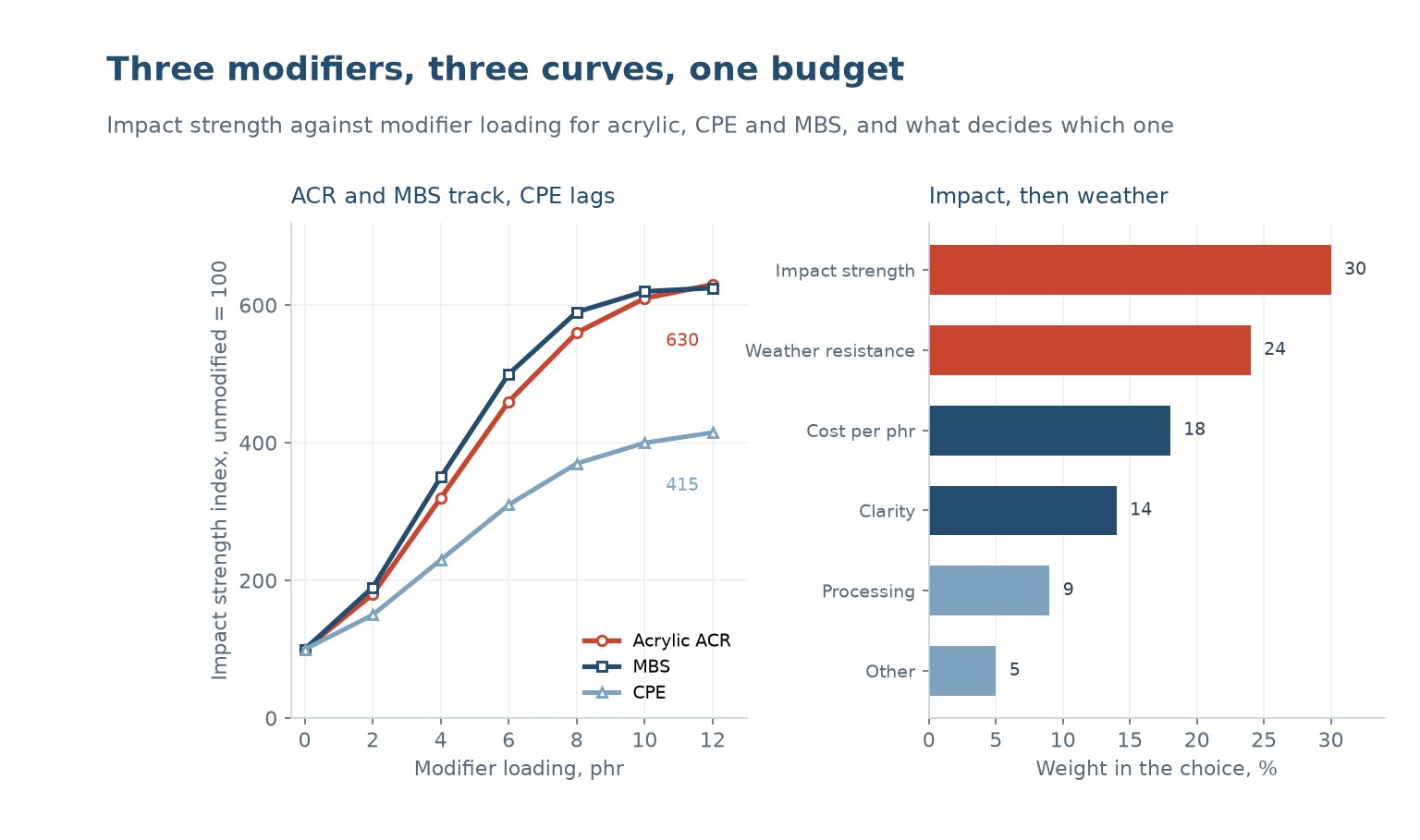
The chart on the left plots impact strength against modifier loading from zero to twelve parts per hundred resin, with unmodified PVC indexed at 100. Acrylic and MBS follow almost the same path: at 2 phr they are 180 and 190, at 6 phr 460 and 500, and both plateau near 620 to 630 at 10 to 12 phr. CPE starts lower and stays lower, reaching 415 at 12 phr.
The plateau is the important feature and it is not a property of the modifier alone. Beyond about 8 to 10 phr the particles are close enough together that adding more does not create more crack-stopping events, it just adds cost and reduces stiffness. A formulation at 15 phr is not tougher than one at 10, it is softer and more expensive.
The difference between acrylic and MBS is not on this chart, which is why the chart alone is a bad way to choose. Acrylic has a saturated backbone with no double bonds, so it resists UV and oxygen without the yellowing and chalking that butadiene undergoes. MBS has butadiene in its core, which is why it is more efficient per part in impact terms and why it is the wrong choice for an outdoor profile.
CPE's lower curve is also not the whole story. It is the cheapest of the three per part at equivalent loading, it improves processing by acting as a mild external lubricant, and it does not depress the heat distortion temperature as much as the other two. For a pipe or a foam board, where weathering is irrelevant and cost is decisive, being at 415 rather than 625 is a fair trade.
What each chemistry is doing
Acrylic modifiers are core-shell particles: a rubbery butyl acrylate core for energy absorption and a glassy methyl methacrylate shell for compatibility with the PVC matrix and for free-flowing powder handling. Because the shell is chemically similar to PVC in polarity, dispersion is good and the particles stay where the compounding put them.
MBS uses the same architecture with a butadiene-styrene core. Butadiene is a better energy absorber per unit volume than butyl acrylate, which is why MBS reaches the same impact at slightly lower loading. The cost is the residual double bonds, which are the site for UV-initiated oxidation. An MBS-modified profile in direct sun will yellow and embrittle, and the embrittlement is progressive rather than cosmetic.
CPE is a different animal: it is not a core-shell particle but a chlorinated polyethylene that forms a separate phase during compounding. Its compatibility depends on the chlorine content, typically 35 to 40 percent, and on the compounding shear. It is less efficient because its particle size distribution is broader and less controlled, but it brings lubricity and a lower glass transition penalty.
There is a fourth option worth knowing about: a hybrid, usually acrylic with a small amount of CPE, used when a formulator wants most of the acrylic performance at a slightly lower cost. These exist because the cost difference between the three is not stable, and a formulation that was optimised when acrylic was expensive may no longer be the cheapest route to the same impact.
Loading, cost and the plateau
Modifier cost is the reason the plateau matters commercially. A typical acrylic impact modifier costs two to three times what PVC resin costs per kilogram, and MBS and CPE sit somewhat below acrylic. Every part per hundred of modifier added to a formulation is a direct addition to the compound cost, and it is also a reduction in stiffness, which for a profile means a thicker wall or a reinforcement to hold the same wind load.
The table works through a window profile formulation and shows why 6 phr is such a common number. At 6 phr the impact index is 460, which is enough to pass a falling dart test at minus 10 Celsius on a 2.8 mm wall. Going to 8 phr buys another 100 index points for a further cost step, and going to 12 buys almost nothing.
| Loading | Impact index | Stiffness change | Relative modifier cost |
|---|---|---|---|
| 0 phr | 100 | Baseline | None |
| 2 phr | 180 | About 3 percent lower | Low |
| 4 phr | 320 | About 6 percent lower | Moderate |
| 6 phr | 460 | About 9 percent lower | Moderate |
| 8 phr | 560 | About 12 percent lower | High |
| 12 phr | 630 | About 17 percent lower | High, with little gain |
Table 1 — The impact and stiffness trade for an acrylic modifier, indexed to unmodified PVC.
The stiffness loss is the hidden cost. A profile designed at 6 phr has a wall thickness that assumes a certain modulus. If the formulation moves to 10 phr because a customer complained about a crack, the profile gets softer, deflects more under wind load, and may fail a different test. Impact complaints are often solved more cheaply by changing a radius or a wall than by adding modifier.
Choosing between them
The right hand panel shows what actually decides the choice in practice: impact strength 30 percent, weather resistance 24, cost per part 18, clarity 14, processing 9, and other 5. The order is instructive, because it puts weather above cost and puts clarity above processing.
Weather at 24 percent is the reason outdoor profiles use acrylic almost exclusively. A white window profile in northern Europe sees the equivalent of several thousand hours of UV in a decade, and an MBS-modified compound will have yellowed and embrittled well before that. The acrylic version costs more per kilogram and is still the cheaper decision over a twenty year service life.
Clarity at 14 percent matters for a different product family: clear or translucent sheet, blister packaging, and bottles. MBS is the standard choice there because its refractive index can be matched to PVC closely enough to give a clear compound, while acrylic particles scatter light and CPE gives a hazy product. A clarity requirement removes two of the three options immediately.
| Criterion | Acrylic ACR | MBS | CPE |
|---|---|---|---|
| Impact efficiency | High | Highest | Moderate |
| Outdoor weathering | Excellent | Poor, yellows and embrittles | Good |
| Clarity in rigid PVC | Poor, hazy | Good when index matched | Poor |
| Cost per part | High | Moderate | Low |
| Effect on heat distortion | Moderate reduction | Moderate reduction | Small reduction |
| Processing | Neutral | Neutral | Mild external lubricant |
Table 2 — The three modifiers against the criteria that decide real formulations.
A useful way to use the table is to eliminate rather than to score. If the part is outdoors, MBS is out. If the part must be clear, acrylic and CPE are out. If the part is buried and cost-driven, CPE wins by elimination. That leaves a single candidate in most real cases, and the curve only matters for choosing the loading.
Common formulation mistakes
The first mistake is adding modifier to fix a crack that is caused by a stress concentration. A sharp internal corner in a profile concentrates stress by a factor of three or more, and no modifier loading compensates for it. Radiusing the corner costs nothing and does more than doubling the modifier.
The second is ignoring the interaction with calcium carbonate. A formulation with 10 phr of filler and 6 phr of modifier does not behave like either alone, because the filler particles and the modifier particles compete for the same matrix volume and the filler can act as a crack initiator. Filled and impact-modified compounds need the modifier loading set by test, not by rule.
The third is measuring impact at the wrong temperature. A compound that passes a 23 Celsius test comfortably can fail at minus 10, because PVC's own beta transition sits near minus 20 to minus 30 Celsius and the modifier's efficiency drops sharply as the matrix stiffens. If the product is used outdoors in a cold climate, the test temperature is the specification, not room temperature.
The fourth is assuming the modifier is fully dispersed because it was added. Core-shell powders need enough specific mechanical energy in the compounding step to break the agglomerates down to primary particles. Under-compounded material tests well on a plaque made from a small sample and fails in production because the extruder did not put in the work.
How much impact modifier should a rigid PVC profile contain?
Five to seven parts per hundred is typical for an outdoor window profile using acrylic. That reaches an impact index around 460, enough for a falling dart test at minus 10 Celsius on a normal wall thickness. Above eight parts the curve flattens and the cost and stiffness penalty keep rising.
Why is MBS used for clear PVC but not for outdoor profiles?
MBS can be refractive-index matched to PVC, so a clear compound stays clear. But its butadiene core contains residual double bonds that oxidise under UV, so an outdoor MBS-modified profile yellows and then embrittles. Acrylic has a saturated backbone and survives decades of sunlight, at the cost of haze.
Is CPE a cheaper equivalent of acrylic?
It is cheaper and it is not equivalent. CPE reaches about two thirds of the impact strength of acrylic at the same loading, it improves processing as a mild lubricant, and it depresses heat distortion less. For pipes, conduit and foam board it is often the better engineering choice. For a visible outdoor profile it is not.
Does more modifier always mean tougher?
No. The curve plateaus at about eight to ten parts per hundred because the particles are already close enough together that adding more does not create more energy-absorbing events. Beyond the plateau the compound gets softer and more expensive without getting tougher, and it may fail a stiffness test it previously passed.
Can impact modifier fix a profile that cracks at a corner?
Only partly, and it is the wrong tool. A sharp internal corner concentrates stress several-fold, and radius it removes that concentration at no material cost. Modifier should be set for the general toughness requirement, then corners and wall transitions designed so the requirement is not exceeded locally.
Why does an impact test pass in summer and fail in winter?
Because PVC's impact behaviour is strongly temperature dependent: the matrix stiffens as it cools and the modifier's cavitation mechanism becomes less effective. A compound that passes at 23 Celsius can fail at minus 10. If the product is used in a cold climate, the low temperature result is the specification.
Formulating for a cold climate test
Tell us the profile, the wall thickness, the test standard and the lowest service temperature. We will recommend a modifier chemistry and loading, and quote the compound with the impact data attached.




 EN
 ES
 FR
 DE
 PT
 AR
 RU
 JA
 KO
 IT
 NL
 TR
 PL
 ID
