
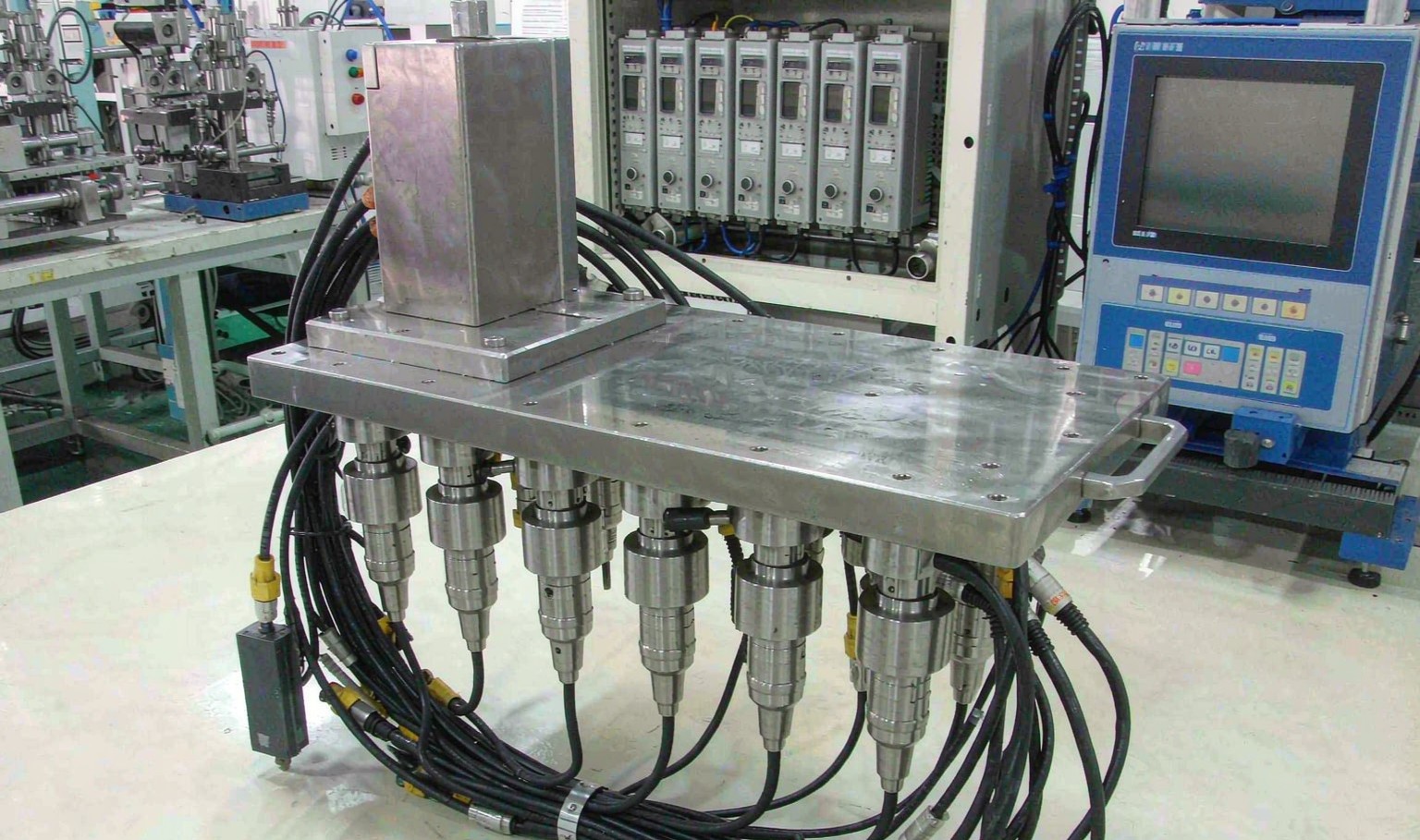
A hot runner is a thermal system first
A hot runner is described as a balancing problem, and the balancing matters. But the reason a hot runner is difficult is thermal: the manifold has to be hot enough to keep the melt flowing, and cold enough not to heat the tool, and it is bolted to a tool that is trying to cool it.
Every drop is a heat path from the manifold to the cavity plate. The heat flows through the nozzle body, through the contact between the nozzle tip and the gate, and through the air gap around the nozzle. The design of that gap is what decides how much heat reaches the tool and how much stays in the melt.
The consequence of getting it wrong is not a machine fault. It is a manifold where one end runs 8 C cooler than the other, and a set of cavities that fill at different rates, and a part that is dimensionally different in the eighth cavity.
So a hot runner design starts with the thermal layout: where the heaters are, how the manifold is supported, how big the air gaps are, and how the nozzles are isolated from the cavity plate. The flow layout comes after, and it is the easier half.
Eight degrees across a manifold is a fill imbalance
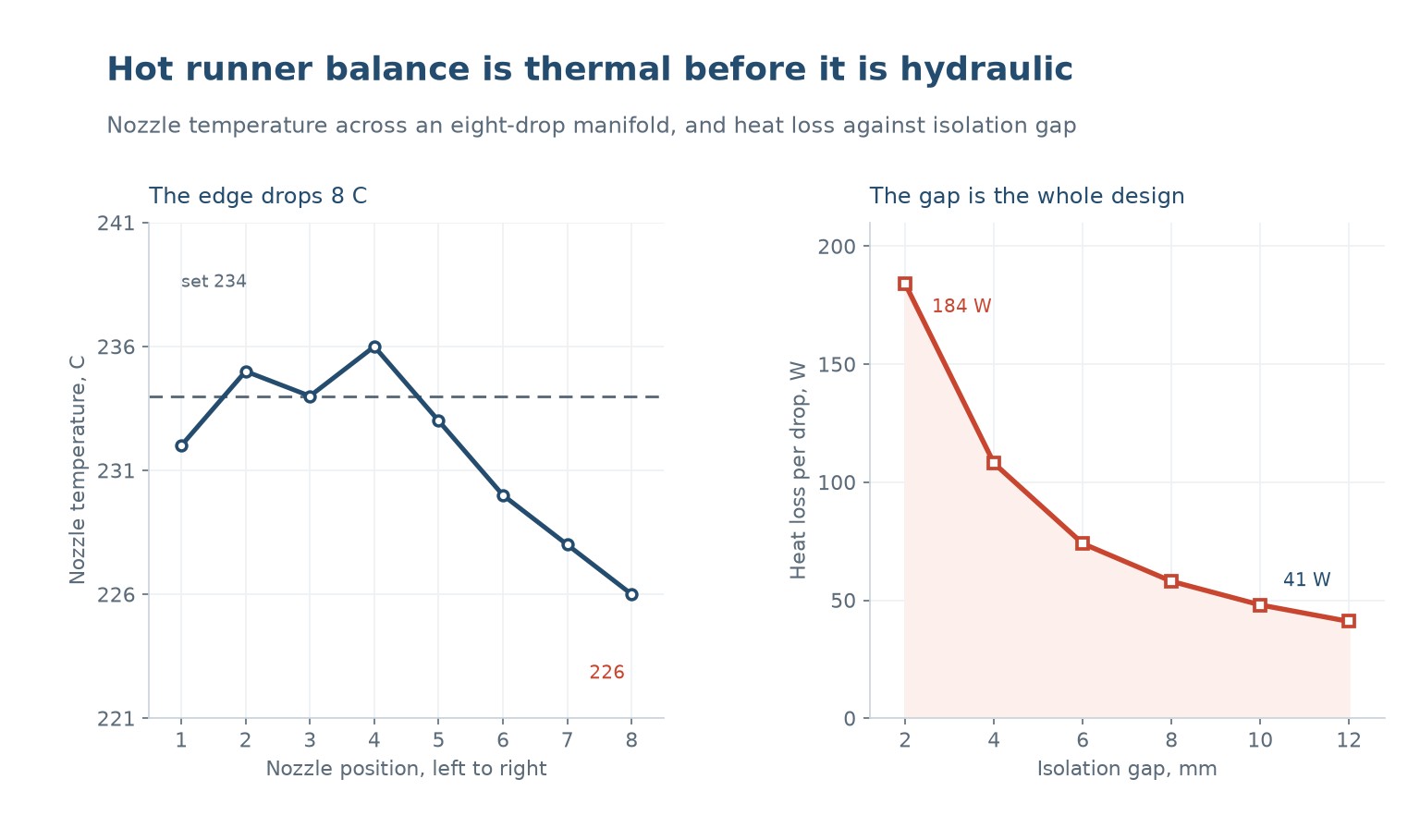
On a measured eight-drop manifold held at 234 C, the nozzle temperatures ran 232, 235, 234, 236, 233, 230, 228 and 226 from one end to the other. The middle four were within 3 C of setpoint. The two at the far end were 6 and 8 C low.
The pattern is diagnostic. A manifold that is hotter in the middle and cooler at the ends is a manifold where the ends are losing heat to the surrounding plates faster than the middle is. That is a support and isolation problem, not a heater problem: the heater is on and drawing current, and the heat is leaving faster than it arrives.
An 8 C melt temperature difference is a 20 to 25 percent viscosity difference on a typical polymer. On a balanced runner that is enough to move the fill order, and it is exactly the mechanism behind a cavity that always fills last.
The fix is rarely more heater power. It is more isolation: a bigger air gap at the ends, a lower-conductivity support pad, or a separate heater zone on the end of the manifold so the ends can be driven harder without overheating the middle.
The isolation gap is the whole design
Heat loss from a drop is dominated by the air gap between the nozzle body and the cavity plate. Air is a poor conductor, so a bigger gap loses less heat, and the relationship is steep at small gaps and flattens out.
At a 2 mm gap the loss is about 184 watts per drop. At 4 mm it is 108, at 6 mm 74, at 8 mm 58, at 10 mm 48 and at 12 mm 41. Most of the benefit is in the first 6 mm, and beyond 10 mm the curve is almost flat.
That is why a hot runner nozzle is not simply surrounded by as much air as possible. A large gap means a large hole in the cavity plate, which weakens it, and it means a longer nozzle, which is more expensive and more prone to bending. The practical gap is 6 to 10 mm.
The gap has to be uniform. A nozzle that is 8 mm from the plate on one side and 3 mm on the other loses three times as much heat on the 3 mm side, and the nozzle runs with a temperature gradient across its own diameter. That gradient bends the nozzle, and a bent nozzle misaligns the gate.
| Isolation gap | Heat loss per drop | What it costs |
|---|---|---|
| 2 mm | 184 W | Cold nozzle, high tool heat |
| 4 mm | 108 W | Workable, needs more heater |
| 6 mm | 74 W | The usual minimum |
| 8 mm | 58 W | Good balance |
| 10 mm | 48 W | Diminishing return |
| 12 mm | 41 W | Big hole, long nozzle |
Table 1 — What the isolation gap buys and costs
Flow balance, and why it follows the thermal one
A geometrically balanced manifold gives every drop the same flow length from the sprue. That is the starting point, and it is not sufficient for the same reason it is not sufficient in a cold runner: the viscosity is not the same everywhere.
On a hot runner the viscosity difference comes from temperature, and the temperature difference comes from the thermal layout. So a manifold that is thermally unbalanced cannot be flow balanced, whatever the runner lengths are. Fixing the temperature is the first step, and it is often the only one needed.
The second lever is the nozzle tip. A tip with a larger orifice passes more melt at the same pressure, so a manifold that is thermally balanced but flow-unbalanced can be corrected with tip sizes rather than with manifold machining. A 0.1 mm change in tip orifice moves the balance noticeably, and tips are consumables that are replaced anyway.
The third lever is gate size. A hot drop with a 0.8 mm gate freezes off later than one with a 0.6 mm gate, so the cavity with the larger gate packs longer. On a multi-drop tool the gates should be the same, and the tips should be the same, and any imbalance should be found in the thermal layout.
Drool, stringing and the tip temperature
Drool is melt that runs out of the gate when the tool is open. Stringing is the same melt drawn into a thread as the part leaves. Both come from the same place: the melt at the gate is too hot, or too fluid, or under pressure when it should not be.
A gate that is too hot does not freeze off. The melt stays liquid, the pressure behind it pushes it out, and it drools onto the part or the tool. The tip temperature is the variable, and it is set by the tip heater, not by the manifold.
A gate that is too cold freezes off too early and leaves a short, cold slug that is dragged out as a string. So the tip temperature has a window, and it is narrower than the manifold window because the tip has less thermal mass.
The other cause of drool is decompression. A hot runner needs a suck-back or a decompression stroke after injection, and a machine without one leaves the melt under pressure at the gate. The symptom is drool that appears only on the cavities with the shortest flow path, because they see the highest residual pressure.
| Symptom | Cause | First fix |
|---|---|---|
| Drool on the part | Tip too hot, no decompression | Lower tip setpoint, add suck-back |
| Stringing at demould | Tip too cold, gate freezes late | Raise tip setpoint slightly |
| Cold slug in the part | Tip too cold | Raise tip, check heater |
| Gate freezes off early | Tip heater failed | Check tip thermocouple |
| One cavity fills last | Thermal imbalance | Check nozzle temperatures |
| Black specks at the gate | Dead spot or degraded melt | Clean the tip, check residence time |
Table 2 — Reading a hot runner problem from the gate
What to specify on a hot runner
A hot runner specification should carry the number of drops, the drop spacing, the gate diameter and type, the tip style, the manifold material and the number of heater zones. It should also carry the isolation gap, because that is the number the toolmaker will otherwise choose for convenience.
The zone count is worth arguing about. A manifold with one zone per drop costs more in controllers and wiring, and it is the only way to compensate for the end losses. A manifold with two zones for eight drops is cheaper and it will run 8 C cooler at one end.
The gate type matters as much as the size. A thermal gate freezes off on its own and leaves a small mark; a valve gate has a pin that closes mechanically and leaves a flat mark. A thermal gate is cheaper and needs a hotter tip; a valve gate is more expensive and needs a pneumatic or hydraulic circuit.
Why do the end nozzles of a manifold run colder?
Because they lose heat to the surrounding plates faster than the middle does. It is an isolation problem, not a heater problem: the heater is on and drawing current, and the heat is leaving faster than it arrives.
How big should the isolation gap be?
6 to 10 mm. Heat loss falls from 184 W at 2 mm to 74 W at 6 mm and 48 W at 10 mm, and beyond 10 mm there is very little gain for a bigger hole in the plate.
What causes drool at a hot gate?
A tip that is too hot, or no decompression stroke after injection. The melt stays liquid and the residual pressure pushes it out. Drool appears first on the cavities with the shortest flow path.
What causes stringing?
Usually a tip that is too cold, so the gate freezes late and a cold slug is drawn out with the part. Raise the tip setpoint slightly rather than the manifold.
Do I need one heater zone per drop?
It is the only way to compensate for end losses. Two zones on eight drops is cheaper and will run one end 8 C cool, which is enough to unbalance the fill.
Thermal gate or valve gate?
A thermal gate is cheaper, leaves a small mark and needs a hotter tip. A valve gate leaves a flat mark and needs a pneumatic circuit, but it does not depend on the melt freezing at the right moment.
A cavity that always fills last, on a hot runner tool?
Send the drop layout, the nozzle temperatures and the part weight by cavity. We will tell you whether it is thermal isolation, tip size or the gate.




 EN
 ES
 FR
 DE
 PT
 AR
 RU
 JA
 KO
 IT
 NL
 TR
 PL
 ID
