
What sag is and when it happens
Sag is the downward deflection of a heated sheet under its own weight. It happens during heating, before the sheet reaches the mould, and it is a consequence of the sheet getting soft before it gets to the tool. Every thermoforming process has some of it; the question is whether it is controlled or whether it is deciding the wall thickness for you.
The mechanism is a thermal gradient. A radiant heater heats the surface first, so the sheet becomes a sandwich with a soft, low-viscosity skin on a stiff, cool core. The soft skin cannot carry the load, the core is too thin to act as a beam on its own, and the whole sheet creeps downward. The thicker the sheet, the larger the gradient and the greater the mass, so heavy gauge sags much more than thin gauge.
Sag matters for three reasons. It changes the distance from the heater, so a sagging sheet heats unevenly and sags faster, which is a runaway. It changes the amount of material available at the centre of the part, so the wall thins there. And when the sheet finally touches the mould, it touches in the wrong place first, which produces marks, webbing and trapped air.
Temperature is the trigger
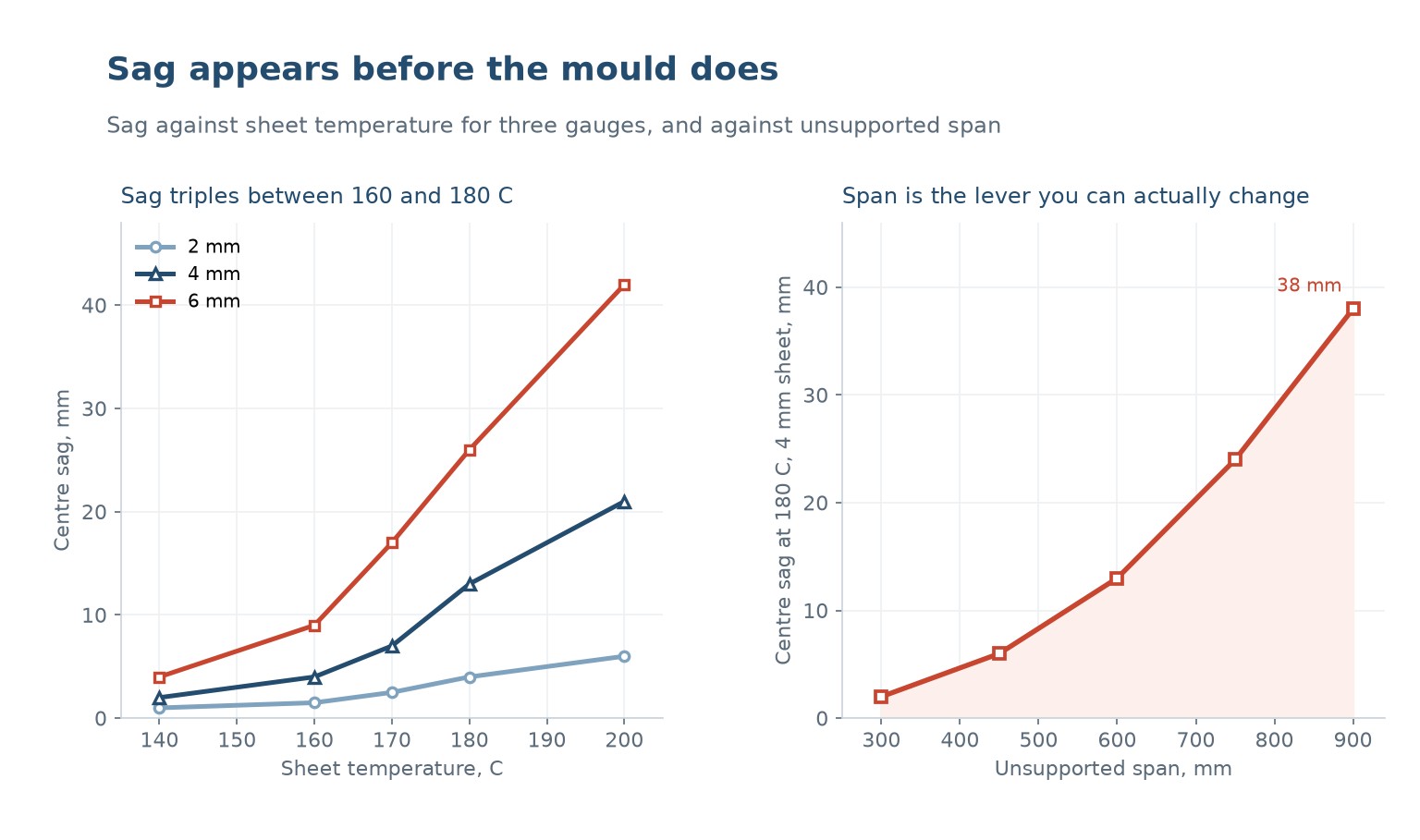
Sag is very small until the sheet reaches the softening range and then it accelerates. For a 6 mm sheet on a 600 mm span, centre sag runs 4 mm at 140 °C, 9 at 160, 17 at 170, 26 at 180 and 42 at 200. For a 4 mm sheet the same temperatures give 2, 4, 7, 13 and 21. For a 2 mm sheet, 1, 1.5, 2.5, 4 and 6.
The important observation is that sag roughly triples between 160 and 180 °C for every gauge, and that 180 °C is where most forming windows begin. So the sheet has to be hot enough to form and is already sagging badly by the time it is. The two facts cannot be separated by choosing a different temperature.
This is why the answer is not 'heat it less'. Heating less means forming below the window, which produces a part with high residual stress, poor detail and spring-back. The answer is to support the sheet while it is hot, or to heat it faster so it spends less time sagging.
| Sheet, mm | Sag at 160 °C, mm | Sag at 180 °C, mm | Practical consequence |
|---|---|---|---|
| 2 | 1.5 | 4 | Negligible on any normal frame |
| 4 | 4 | 13 | Visible; needs support above about 600 mm span |
| 6 | 9 | 26 | Severe; support is mandatory on any heavy gauge machine |
| 8 | 15 | 45 | The sheet will touch the heater without support |
Table 1 — Centre sag against temperature for four gauges, on a 600 mm unsupported span.
Span is the lever you can actually change
Sag rises faster than the square of the span, which means halving the span does far more than halving the sag. That is an enormous lever, and it is the one that a sheet support system pulls.
Measured at 180 °C on a 4 mm sheet, centre sag is 2 mm over a 300 mm span, 6 over 450, 13 over 600, 24 over 750 and 38 over 900. Doubling the span from 450 to 900 mm multiplies the sag by six, and every one of those numbers is a span you can actually change by moving a support bar.
The practical implication is that a sheet support frame with bars at 400 to 500 mm spacing turns an uncontrollable sheet into a controllable one. The bars do not eliminate sag; they reduce the span between supports, which is what the sag depends on. And they introduce a new problem, which is that the sheet touches them and cools there.
Supports, and the marks they leave
| Support type | Span it allows | Mark left | Where it is used |
|---|---|---|---|
| None | Up to about 500 mm | None | Thin gauge, small sheets |
| Steel bars | 600 to 900 mm | A distinct cold line | Heavy gauge where the mark is outside the trim |
| Insulated bars | 600 to 900 mm | A faint line | Heavy gauge with a cosmetic surface |
| Ceramic or glass bars | 600 to 900 mm | Almost none | Optical parts and acrylic |
| Air cushion or air table | Any | None | Very heavy sheet, expensive |
| Clamp frame with a smaller opening | Reduces the effective span | A frame mark | The cheapest option, and often enough |
Table 2 — Support options, the span each one allows, and the mark it leaves.
The cheapest effective fix is often to reduce the clamp frame opening rather than to add bars. A sheet clamped on a 900 mm frame sags over 900 mm; the same sheet clamped on a 600 mm frame sags over 600 and the extra material is trim. That is a tooling change rather than a machine change, and it costs nothing per part.
Insulated supports are worth the money on a cosmetic part. A steel bar at 180 °C sheet temperature draws heat out of a narrow strip, and the sheet there is 10 to 20 °C cooler than the rest, which shows up as a line in the finished part. A bar with a low-conductivity sleeve reduces the effect to the point where it is invisible on a textured surface.
Heat zoning and speed
There are two process levers. The first is to heat the sheet faster so it spends less time at a temperature where it can sag, which means higher watt density and shorter cycle. The second is to heat it unevenly on purpose: less energy in the centre where sag is greatest, more at the edges where the clamp frame is holding it.
The second is more subtle and more effective. A radiant field zoned so that the centre zone runs 5 to 10 °C cooler than the edge zones will sag less at the centre without forming below the window, because the edges are hotter and the sheet is held there. The centre still reaches forming temperature, just later.
Both levers have limits. Higher watt density risks surface degradation, and the sheet can scorch before the core is ready. Uneven heating risks a part with a temperature gradient across it, which forms unevenly and warps on cooling. The practical approach is to use zoning for the last few degrees and to use support for the bulk of the problem.
What sag does downstream
Sag is not just a cosmetic problem during heating; it propagates through the whole process. A sheet that has sagged has more material in the centre than at the edges, so when it is formed the centre is thicker and the edges are thinner than the draw ratio predicts. The wall distribution is decided before the sheet touches the mould.
| Symptom in the part | How sag causes it | Fix |
|---|---|---|
| Thick base, thin walls | The centre was already lower, so it stretched less | Support the sheet, or zone the heat |
| Webbing between features | The sagging sheet touched the mould in the wrong order | Support, and slower forming |
| Cold marks on the face | The sheet touched the mould before it was at temperature | Reduce sag, raise sheet temperature |
| Trapped air pockets | The sheet sealed against the mould in a ring | Vent the mould, and control the contact sequence |
| Warp after cooling | Differential thickness from differential sag | Support, and balance the cooling |
Table 3 — Part defects that are really sag problems in disguise.
The first row is the one that is most often blamed on the mould. A part with a thick base and thin walls looks like a plug assist problem or a vacuum problem, and it is neither: the sheet arrived at the mould already bellied, and the forming just preserved the shape it found.
A practical sequence
When a job shows sag, the sequence below resolves it in the order of cost, from cheapest to most expensive.
- Measure it. A straight edge across the sheet at the end of the heat cycle tells you how much sag there is, and whether it is 5 mm or 40.
- Reduce the clamp frame opening, so the unsupported span falls. This costs a frame, not a machine.
- Zone the heat so the centre is cooler and the edges hotter, if the machine allows it.
- Add insulated support bars at 400 to 500 mm spacing, positioned so the marks fall in the trim.
- Raise the watt density and shorten the cycle, so the sheet spends less time in the sagging range.
- Only then consider a different machine or an air cushion table, which is a capital decision.
The order matters because the first three items are cheap and the last two are not, and in most cases the first three are sufficient. A job that needs an air table is a job with a very heavy sheet and a very large part, and it is rare compared with the number of jobs that are simply running too big a frame.
Why does my sheet sag during heating?
Because the surface softens before the core does, so the sheet is a soft skin on a stiff core and it creeps under its own weight. It is worst on thick sheets and on long unsupported spans.
At what temperature does sag become a problem?
Above about 160 °C it starts to accelerate, and it roughly triples between 160 and 180 for a 4 or 6 mm sheet. That is also where the forming window begins, which is the difficulty.
How do I reduce sag?
Reduce the unsupported span first, by using a smaller clamp frame or adding support bars. Then zone the heat so the centre runs cooler. Then heat faster so the sheet spends less time sagging.
Do support bars leave marks?
Yes, unless they are insulated. A steel bar draws heat out of a narrow strip and leaves a cold line; a ceramic or insulated bar reduces it to the point where it is invisible on a textured surface.
Does sag affect wall thickness?
Yes, significantly. A sagged sheet has more material in the centre, so the base comes out thick and the walls thin, before the mould has done anything.
Can sag be eliminated?
Not entirely, but it can be reduced to the point where it does not affect the part. The practical target is a sag small compared with the draw depth, not zero.
Fighting sag on a heavy gauge part?
Send the sheet material, the gauge, the part size and the frame dimensions. We will tell you whether the span is the problem, what support spacing you need, and where the marks will land.




 FR
 EN
 ES
 DE
 PT
 AR
 RU
 JA
 KO
 IT
 NL
 TR
 PL
 ID
