
What a silver streak is
A silver streak is a shiny, silvery line or patch on the surface of a moulded part, usually radiating from the gate and usually accompanied by a faint hiss at the nozzle if you listen for it. It is not a colour defect and it is not a burn. It is a streak of vapour that was in the melt when the melt entered the cavity, and it froze into the surface as the part cooled.
The vapour can come from two places. It can be water absorbed by the resin, which flashes to steam at melt temperature and expands by a factor of over a thousand. Or it can be volatiles generated by the resin itself, by an additive, or by thermal degradation in the barrel. The first is a drying problem, the second is a temperature and residence time problem, and they look almost identical.
The distinction matters because the fixes are opposite. Moisture needs a dryer. Volatiles need a lower melt temperature, a shorter residence time, or a different additive. A moulder who treats every silver streak as moisture will keep extending the drying time and keep producing the same defect.
The moisture level at which it appears
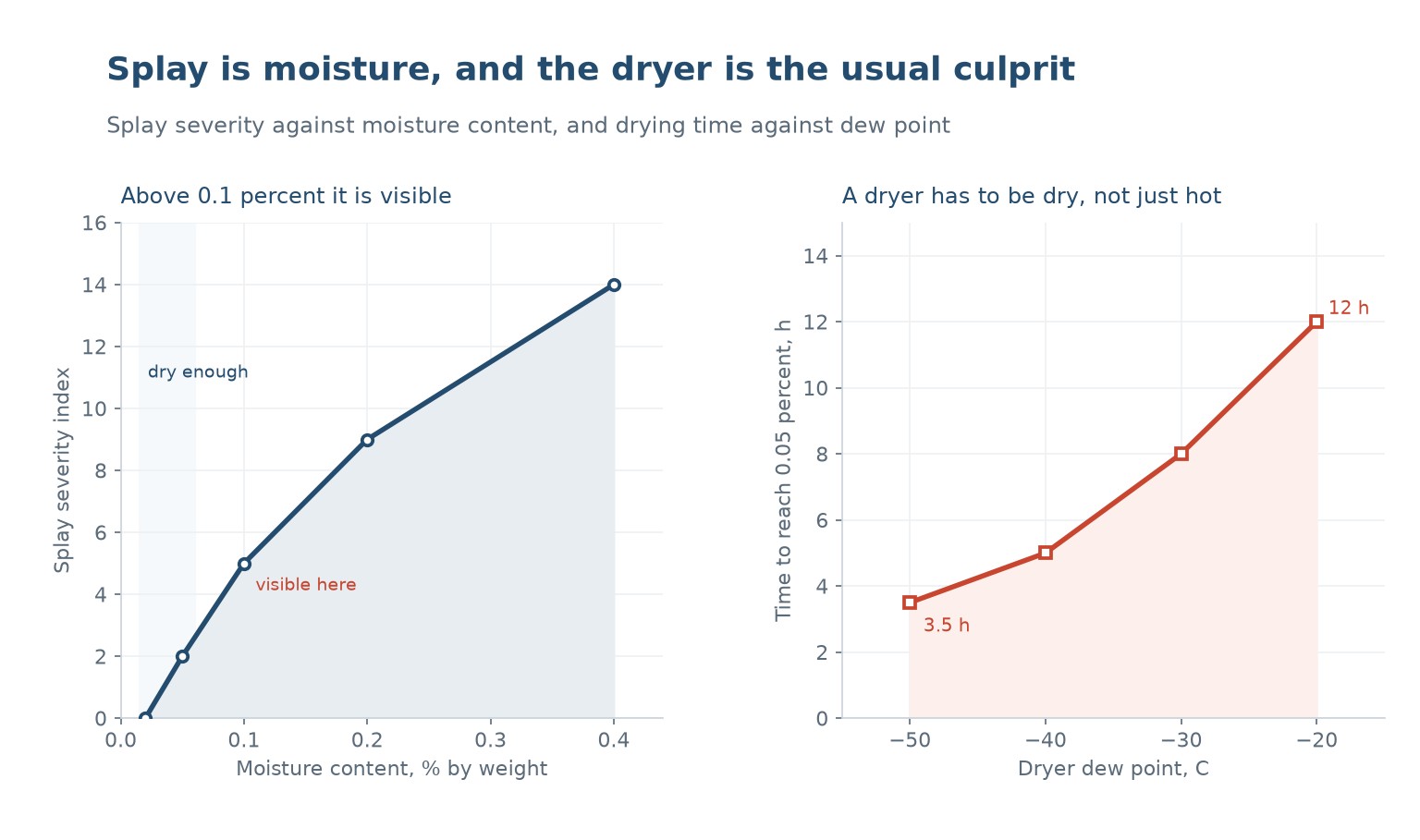
For a hygroscopic resin the relationship between moisture content and splay is steep and it has a threshold. On a polyamide, 0.02 percent moisture produces no visible splay at all, 0.05 gives a faint trace that most inspectors would pass, 0.10 gives a clear streak, 0.20 gives a heavy silvered surface and 0.40 makes the part unusable.
The practical target is therefore below 0.05 percent, and the specification on most polyamide data sheets is 0.02 to 0.05 percent. That is a narrow band, and it is much lower than most people assume: a resin that feels dry and pours freely can be at 0.2 percent.
| Resin | Target moisture before moulding, % | Typical drying temperature, C | Drying time, h |
|---|---|---|---|
| PA6 | 0.05 to 0.10 | 80 to 90 | 4 to 6 |
| PA66 | 0.05 to 0.10 | 80 to 90 | 4 to 6 |
| PC | 0.02 | 120 | 3 to 4 |
| PBT and PET | 0.02 to 0.04 | 120 to 130 | 3 to 4 |
| PMMA and ABS | 0.05 to 0.10 | 80 | 2 to 3 |
| POM | 0.05 to 0.10 | 90 to 100 | 2 to 3 |
| PP and PE | Not hygroscopic | Not required | None, but surface moisture can still splay |
Table 1 — Drying targets and conditions for the resins where splay is common.
The polyolefins at the bottom of that table are worth a note. They do not absorb moisture in any meaningful way, so a splay defect in polypropylene is almost never a drying problem. It is either surface moisture from condensation on cold pellets, or volatiles from an additive, or shear degradation. Drying a polypropylene for eight hours is a waste of energy and will not fix the defect.
Dew point, not temperature
A dryer works by passing heated air over the pellets and carrying the moisture away. The amount of moisture the air can carry depends on its dew point, and the equilibrium moisture in the resin depends on the dew point of the air around it. A dryer at 120 °C with a dew point of -10 °C will not dry polycarbonate to 0.02 percent no matter how long it runs, because the air is wetter than the resin needs to be.
The numbers are clear. To reach 0.05 percent on a polyamide, air at a dew point of -20 °C needs 12 hours, -30 needs 8, -40 needs 5 and -50 needs 3.5. Doubling the drying time at a poor dew point does not get you there; it just produces hot wet resin.
This is why desiccant bed dryers exist and why the desiccant has to be regenerated. A dryer with saturated desiccant is a heater with extra steps: it delivers air at the right temperature and the wrong humidity, and the controller will happily report the temperature set point while the resin stays wet.
Why the dryer lies
Almost every drying fault I have seen has the same shape: the dryer says it is at temperature, the resin is in it, the timer says the time has elapsed, and the parts still splay. There are four common reasons and they are all measurable.
- The controller displays the set point, not the measured temperature. A failed thermocouple reads as a plausible number, and the heater runs open loop.
- The desiccant is saturated or the regeneration cycle has failed. The dryer is delivering air at the right temperature and the wrong dew point.
- The dryer is overloaded. A hopper rated at 50 kg holds 100 kg of pellets, and the air cannot reach the middle of the bed.
- The return air is leaking. A dryer in a humid plant with a leaking seal is drying with plant air, which is wet.
- The resin is being dried in a hopper that is being continuously topped up, so the residence time is half what the timer says.
The last one is the most common and the least obvious. A dryer with a 4 hour cycle and a hopper that is topped up every 30 minutes is not drying anything for 4 hours; it is drying the oldest material for 4 hours and the newest for 30 minutes, and the average is nowhere near the target. The fix is a two-hopper arrangement: dry a batch, then use it, rather than drying continuously in line.
When it is not moisture
Shear-induced splay comes from the same visual defect but a different mechanism. At high injection speeds, the melt shears against the runner wall, and the frictional heat can degrade the polymer locally. The degradation releases volatiles, and those volatiles appear as streaks in exactly the same way as steam.
The way to tell them apart is to change one variable. Dry the resin properly and re-run: if the defect persists, it is not moisture. Then reduce the injection speed and see whether it goes away: if it does, it is shear. If neither helps, look at the melt temperature and the residence time, because a barrel that is too hot or a shot that sits too long will generate volatiles from any resin.
| Test | If it changes | If it does not |
|---|---|---|
| Dry to below 0.05 percent and re-run | It was moisture | Go to the next test |
| Reduce injection speed by half | It was shear at the gate or runner | Go to the next test |
| Reduce melt temperature by 20 °C | It was thermal degradation | Go to the next test |
| Reduce residence time (smaller barrel, shorter cycle) | It was residence time | Look at the additive package |
| Change to a virgin bag with a certificate | It was the regrind or the lot | Look at the mould and venting |
Table 2 — A sequence that separates moisture splay from shear and thermal splay.
The vent is part of the answer
Even a perfectly dried resin produces some volatiles, and they have to leave the cavity. If the vent is blocked or too shallow, the gas is compressed in the last place to fill, and it shows as a burn mark rather than a silver streak, or as a dull patch at the end of the flow.
A mould that splays only in the last 10 percent of the fill, or only at the far end of a long flow path, is telling you that the gas cannot get out rather than that the resin is wet. Deepening the vent to 0.02 to 0.03 mm, cleaning it, and adding a vent at the last point to fill will often remove a defect that three days of drying did not touch.
There is a useful rule for separating the two. Moisture splay follows the flow: it appears as streaks along the flow direction, starting at the gate. Venting-related gas follows the geometry: it appears where the flow ends, in the last corner, regardless of the gate position. Look at where the defect is before deciding what it is.
Preventing it properly
The reliable approach is a drying system with a measured dew point, a batch rather than a trickle arrangement, and a moisture measurement on the dried resin rather than a timer. That is more equipment than most shops want, and it is what separates a plant that moulds hygroscopic resin well from one that fights it.
- Specify the dryer by dew point, not by temperature, and require a meter that reads it.
- Regenerate the desiccant on a schedule, and check the regeneration heater, which is the part that fails silently.
- Size the hopper for the shot weight and the cycle, not for the shift. An oversized hopper is an under-dried hopper.
- Use a two-hopper batch arrangement so that residence time is real.
- Measure moisture on the dried resin with a loss-on-drying or a Karl Fischer test, at least weekly.
- Keep a virgin bag with a certificate for comparison when a defect appears, so the resin can be eliminated in one run.
The last point is the cheapest diagnostic in the building. A bag of certified virgin resin, dried in the same dryer, run on the same tool, will tell you in twenty minutes whether the problem is the material or the process. Most plants do not do it because they do not keep the bag, and then spend a week changing dryer settings.
What causes silver streaks in injection molding?
Vapour trapped in the melt and frozen into the surface. Usually moisture absorbed by the resin, sometimes volatiles from degradation or from an additive. They look identical and the fixes are different.
At what moisture level does splay appear?
On a polyamide, around 0.1 percent is clearly visible and 0.2 is heavy. Below 0.05 there is nothing. The target for most hygroscopic resins is 0.02 to 0.05 percent.
Why does my dryer not fix it?
Because the dryer is delivering the right temperature and the wrong dew point. Check the desiccant, check for air leaks, check the hopper is not overloaded, and check whether the resin is being continuously topped up so the residence time is not what the timer says.
Is splay always moisture?
No. Shear at the gate and thermal degradation in the barrel produce the same appearance. Dry properly, then halve the injection speed, then drop the melt temperature, and see which one changes the defect.
Does polypropylene need drying?
Not for moisture absorption, because it is not hygroscopic. Splay in PP is surface condensation, an additive, or shear degradation. Drying it for hours will not help.
How do I tell moisture splay from a venting problem?
Moisture splay follows the flow and starts at the gate. Venting problems appear where the flow ends, in the last corner, regardless of gate position.
Fighting splay on a hygroscopic resin?
Send the resin, the dryer specification and a photo of the part. We will tell you whether it is moisture, shear or venting, and what to change first.
Continue reading
- Plastic Drying Before Extrusion: Hygroscopic vs Non-Hygroscopic Resins
- Injection Molding Defects: 12 Problems, Their Causes and Fixes
- Nylon (PA6 / PA66) Injection Molding: Moisture and Conditioning
- PC Injection Molding: Drying, Melt Temperature and Stress Cracking
- PBT and PET Injection Molding: Glass Fibre, Drying and Warpage




 FR
 EN
 ES
 DE
 PT
 AR
 RU
 JA
 KO
 IT
 NL
 TR
 PL
 ID
