

Why the second shot bonds at all
Silicone does not bond to silicone by adhesion in the usual sense. There is no solvent, no keying and no mechanical interlock at a flat interface. What holds a two-colour part together is a co-vulcanised network: unreacted vinyl and hydride sites on the first surface react with the second shot while it cures, and the two networks become one.
That means the first surface has to still have reactive sites available when the second shot arrives. Immediately after demoulding, it does. The surface is fully cured but the network at the boundary is incomplete, and there are enough residual sites to form a bond.
Over time those sites are consumed by post-cure, by atmospheric moisture and by the gradual continuation of the curing reaction. The surface becomes chemically inert. A second shot applied at that point cures against a dead surface and forms a part that looks correct and separates under load.
This is the single most important difference between two-colour silicone and two-colour thermoplastic. A thermoplastic part can be overmoulded a week later because the bond is mechanical and thermal. A silicone part cannot.
The interlayer window
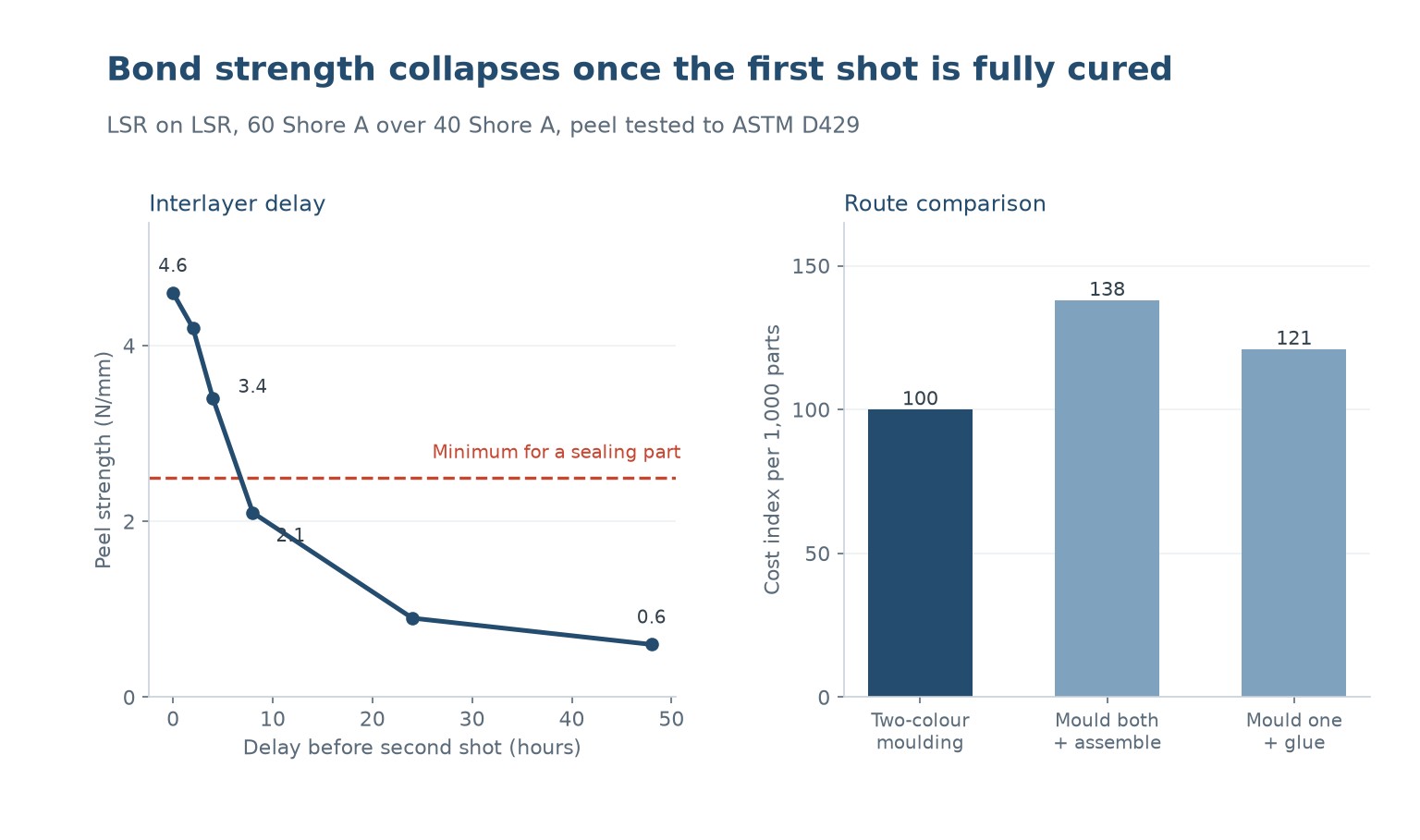
The chart on the left is peel strength against the delay before the second shot, for a 60 Shore A LSR over a 40 Shore A LSR. At zero delay the peel is 4.6 N/mm, at two hours 4.2, at four hours 3.4, at eight hours 2.1, at 24 hours 0.9 and at 48 hours 0.6.
The shape is a cliff, not a slope. Between zero and four hours the bond loses about a quarter of its strength. Between four and eight hours it loses another third. After a day it is no longer a bond, it is a contact.
In practice this means the two shots have to run in the same cell, within the same shift, without an intermediate store. That is a manufacturing constraint that has to be designed into the cell layout, not a quality rule that can be policed afterwards.
The right hand panel is the cost consequence. Running both shots in one cell is the index at 100. Moulding both halves separately and assembling them is 138, and moulding one and gluing is 121. The two-colour route is the cheapest, and it is only available if the cell is built for it.
Tooling for two colours
Two-colour silicone tooling comes in three arrangements. A rotating platen machine carries two moulds and indexes between them, so the first shot is transferred into the second cavity while still warm. A single mould with two cavities and a shuttle works for lower volumes. And a transfer arrangement uses a separate first-shot tool and a loading fixture.
The rotating platen is the most productive and the most expensive. It requires a machine with an indexable platen, two mould halves that are dimensionally matched, and a part design that allows the first shot to stay on its core during transfer.
The critical tooling detail is that the second cavity must seal against the first shot without crushing it. A crush of more than about 5 percent of the wall thickness produces a visible witness line and a locally thin section. The shut-off is usually a small step rather than a flat face.
Venting is the second detail. The second shot traps air against the first surface, and that air has nowhere to go unless the cavity is vented at the boundary. Trapped air shows up as a bubble ring exactly at the interface, which is both a cosmetic and a bond defect.
| Arrangement | Typical volume | Tool cost | Cycle penalty |
|---|---|---|---|
| Rotating platen, two moulds | Haut | Highest | Index time only |
| Single mould, shuttle | Moyen | Modéré | Shuttle and reload |
| Separate tools plus fixture | Faible | Lowest | Full second set-up |
| Manual second shot | Prototype | Very low | Labour dominated |
Table 1 — Tooling arrangements for two-colour silicone.
The three routes and what they cost
Two-colour moulding is the cheapest route at volume because it eliminates a handling step, a fixture and an assembly operation. It is the most expensive to start, because it needs matched tooling and a machine that can index.
Moulding both halves separately and assembling them costs about 38 percent more at the volumes in the chart, because the assembly operation is labour, and labour does not scale down with part size. The advantage is that each half can be made on the most efficient machine for its own geometry.
Moulding one half and gluing the other is 21 percent more than two-colour, and it carries a bond that is adhesive rather than co-vulcanised. That bond is weaker, more sensitive to temperature and much more sensitive to surface contamination, so it is a route for low-volume or non-structural parts.
The break-even between two-colour and assembly is usually around 20,000 to 50,000 parts a year. Below that the tooling amortisation dominates, above it the labour saving dominates.
| Route | Bond type | Cost index | Meilleur pour |
|---|---|---|---|
| Two-colour in one cell | Co-vulcanised | 100 | Volume, sealing parts |
| Mould both, assemble | Mechanical or none | 138 | Different geometries per half |
| Mould one, glue | Adhesive | 121 | Low volume, non-structural |
| Manual second shot | Co-vulcanised | 160 | Prototypes only |
Table 2 — Routes compared on bond quality and cost.
Colour bleed and contamination
The second shot is injected against a surface that is already coloured, and the flow front can drag pigment from the first shot into the second. This is most visible when a light colour goes over a dark one, and it appears as a halo at the boundary.
The fix is flow direction. Inject the second shot so that the flow front moves away from the boundary rather than across it, and keep the gate as far from the interface as the geometry allows. Gate position is decided in the tool, so this has to be resolved at design review.
Contamination is the other risk. Silicone picks up dust and skin oils readily, and a fingerprint on the first shot is a bond killer. Parts that are handled between shots need gloves, and the handling time counts against the interlayer window.
Inhibitors are the third risk. Sulfur, tin, some amines and certain mould release agents inhibit platinum cure, and a first shot that has been demoulded with the wrong release agent will not bond no matter how fast the second shot arrives.
Qualifying a two-colour part
A peel test on a production part is the only qualification that means anything, because the bond depends on the actual delay and handling of that part. Test coupons made in a laboratory with a controlled delay will pass and the production part will fail.
Take parts from the start, middle and end of a shift, and from the last part before a break. Peel them at 90 degrees and record both the strength and the failure mode. Adhesive failure at the interface means the bond did not form. Cohesive failure within one of the two materials means the bond is stronger than the material, which is what you want.
Add an ageing test. Store parts at 70 degrees Celsius for a week and peel again. A bond that was marginal when new will separate after ageing, and that is exactly the failure a customer will find in the field.
Finally, record the actual elapsed time between shots for every batch. If the window is four hours and the cell occasionally runs a six hour gap because of a changeover, the process is not capable, and no amount of inspection will make it so.
How long can I wait before moulding the second silicone shot?
Under four hours for full strength, and under eight hours for anything structural. By 24 hours the peel strength has fallen to about 0.9 N/mm and the bond is effectively gone.
Why does silicone not bond after a day but thermoplastic does?
Silicone bonds by co-vulcanisation, which needs reactive sites on the first surface. Those sites are consumed within hours. Thermoplastic overmoulding bonds by melting the substrate, which works at any age.
Can I use a primer to extend the window?
Primers help with adhesion to hard substrates but they do not restore a co-vulcanised bond between two silicone layers. The reliable route is to keep the delay short.
What causes a bubble ring at the interface?
Trapped air. The second cavity must be vented at the boundary where the second shot meets the first, otherwise air is trapped exactly at the bond line.
Is two-colour moulding cheaper than moulding and assembling?
At volume, yes. The cost index is about 100 against 138 for separate moulding and assembly, and 121 for moulding one half and gluing.
How do I test the bond on a production part?
Peel at 90 degrees and record both strength and failure mode. Cohesive failure is a good bond, adhesive failure at the interface means it did not form. Repeat after a week at 70 C.
Designing a two-colour silicone part?
Send the geometry and the colour split. We will tell you whether it can run in one cell and what the tooling looks like.




 FR
 EN
 ES
 DE
 PT
 AR
 RU
 JA
 KO
 IT
 NL
 TR
 PL
 ID
