
Nothing fails at a line
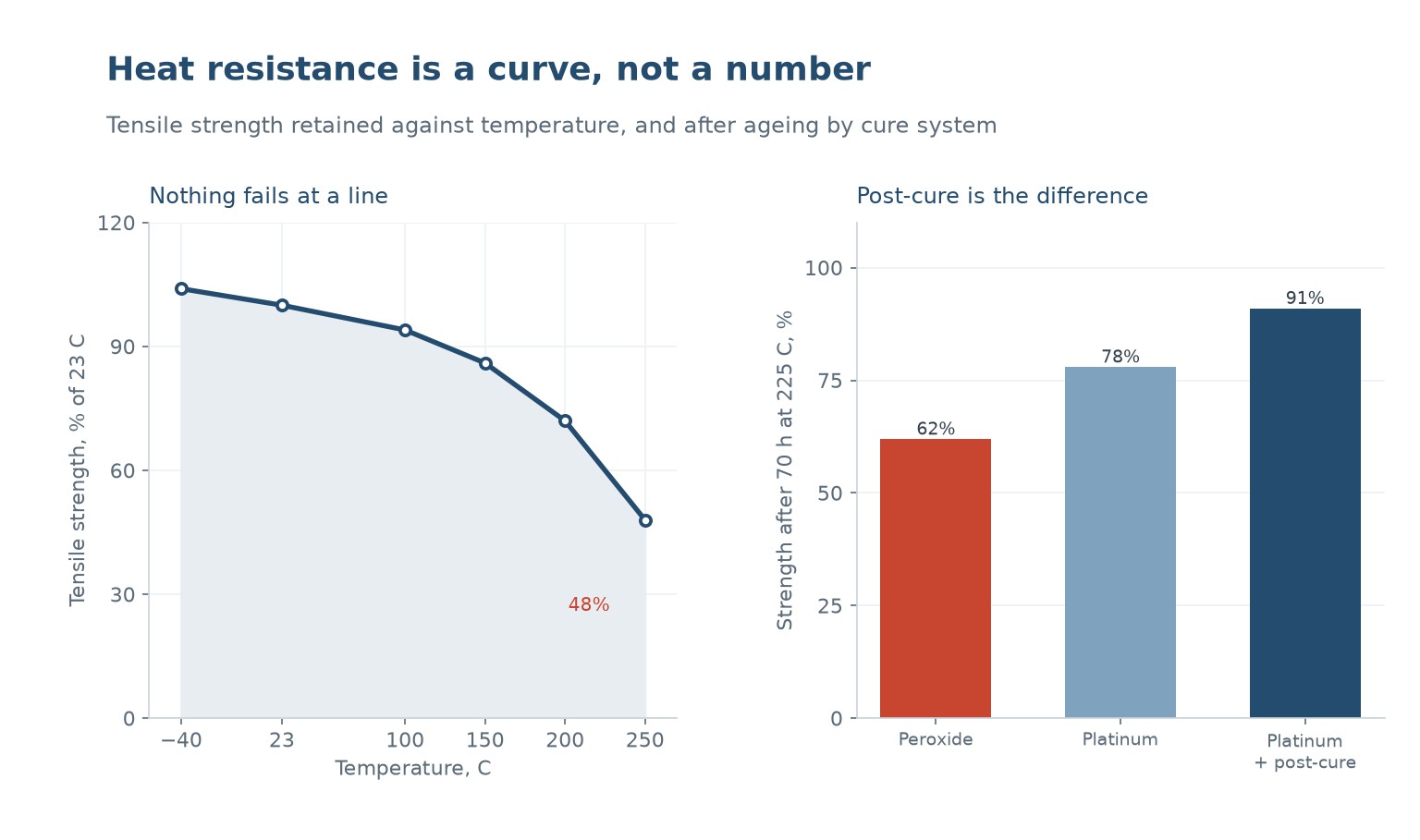
A silicone spatula is usually sold with a number on the pack, 230 C or 250 C, and the number implies a threshold. The material does not have one. It has a curve, and the curve is gentle at first and steep at the end.
Measured as tensile strength retained against temperature, a typical kitchen-grade silicone holds 104 percent at minus 40 C, 100 percent at 23 C, 94 percent at 100 C, 86 percent at 150 C, 72 percent at 200 C and 48 percent at 250 C. There is no cliff; there is a slide that starts around 150 C and accelerates.
That matters because the rating on the pack is a continuous-use temperature, not a failure temperature. A spatula rated at 230 C still has about 55 percent of its strength at that temperature, which is enough to stir a pan and not enough to lever a roast out of a tin. The number describes a working range, not a limit.
Time does what temperature does, only slower
A spatula that sits in a drawer for two years at 25 C has been aged, just not much. A spatula that goes through a dishwasher three times a week has been aged at 70 C in a detergent solution, which is a much harsher exposure than the number suggests.
The two effects combine. Heat at the moment of use softens the material and lowers its strength; heat over time crosslinks or cleaves the network and changes it permanently. A part that is used at 200 C for a minute a day is not the same as one that is aged at 200 C for a week, but both end up on the same curve.
This is why the ageing test is run at a temperature above the use temperature. Seventy hours at 225 C is a stand-in for a much longer period at a lower temperature, and the result is quoted as a percentage of the original strength so that it can be compared across compounds.
The cure system decides what survives
After 70 hours at 225 C, a peroxide-cured silicone retains 62 percent of its tensile strength, a platinum-cured one 78 percent and a platinum-cured one that has been post-cured 91 percent. That spread is larger than the spread between two different base polymers.
The reason is the same as in any addition-cured system. A peroxide cure leaves a network with a fraction of unreacted sites and ionic residues, and heat attacks those sites. A platinum cure leaves a cleaner network, and post-cure removes the low-molecular-weight fraction that would otherwise volatilise and leave voids.
The practical consequence is that two spatulas that both say 'food grade silicone, 230 C' can differ by a factor of three in how long they last. The rating is a material claim; the cure system and the post-cure are what actually deliver it.
| Cure system | Strength after 70 h at 225 C | Coût | Utilisation |
|---|---|---|---|
| Peroxide | 62% | Lowest | Short-life, low-cost lines |
| Platinum | 78% | Moyen | General kitchenware |
| Platinum + post-cure | 91% | Highest | Premium, long-life claims |
Table 1 — What is left after ageing, by cure system
Thickness changes the answer more than the compound
A thin spatula blade heats through in seconds and cools in seconds; a thick muffin mould heats slowly and holds its heat. The same compound in a 1 mm blade and a 6 mm mould is not experiencing the same temperature, even in the same oven.
This is why a muffin mould can be rated at 230 C and a thin scraper at 200 C from the same factory. The rating follows the part, not the drum. It also means that a thin part which is left resting on a hot hob will degrade much faster than the rating suggests, because the contact temperature is far above the air temperature.
The design consequence is that thin, flexible parts should be designed to be used briefly and not left in contact with heat, and thick parts can carry a continuous rating. Neither of those is a material property; both are geometry.
| Part | Typical thickness | Realistic continuous use |
|---|---|---|
| Spatula blade | 1-2 mm | 200 C, brief contact |
| Spoon or ladle | 3-5 mm | 220 C |
| Muffin mould | 2-3 mm wall | 230 C |
| Baking mat | 0.6-1 mm | 230 C, even heat |
| Handle sleeve | 2-3 mm | 180 C, no direct contact |
Table 2 — Thickness against realistic continuous use
How they actually fail
The first failure is usually not a break. It is a surface that goes tacky, or a colour that yellows, or a blade that has taken a set and no longer lies flat. All three are the same process: the network is changing and the low-molecular-weight fraction is migrating to the surface.
The second is tearing at a stress concentration. A spatula blade that has lost half its strength will still stir, but it will tear at the junction with the handle, which is where the mould has a sharp internal corner and where the strain is highest.
The third is odour and taste transfer. A part that has been overheated holds volatiles that then transfer to food, and no amount of washing removes them. This is the failure that gets a product returned, and it is invisible until it happens.
What to ask a supplier
Ask for the cure system and the post-cure cycle, not just the temperature rating. Ask for the ageing result, with the temperature and the time, because 70 hours at 225 C and 168 hours at 200 C are different tests and produce different numbers.
Ask what the part is tested against for food contact, and in which simulant. And ask whether the colour is on a platinum-compatible masterbatch, because a colour change can move the part to a different cure system without anyone noticing.
Finally, ask what the realistic continuous-use temperature is for the specific part geometry, not for the compound. A supplier who answers that question has thought about the product; one who quotes the drum data sheet has not.
Is silicone safe above its rated temperature?
For brief contact, usually yes, with a loss of strength. Above about 250 C the material starts to decompose and to release volatiles, and that is a different situation from softening.
Why does my spatula go sticky?
The network is degrading and low-molecular-weight material is coming to the surface. It is the visible sign of the same ageing that the strength test measures, and it is not reversible.
Can silicone kitchenware go in the dishwasher?
Yes, and it will survive many cycles. Detergent at 70 C is a harsher exposure than the same temperature in water, and it accelerates the surface change rather than the bulk strength loss.
Does colour affect heat resistance?
Some pigments do. A pigment can act as a catalyst poison in a platinum cure, leaving the part under-cured and less heat resistant, and dark pigments absorb radiant heat faster. A colour change should be re-tested.
What is the difference between 230 C and 250 C ratings?
Usually the cure system and the post-cure, not the polymer. A 250 C rating on a platinum-cured, post-cured part is credible; on a peroxide part it is a marketing number.
How long should silicone kitchenware last?
A well-made platinum-cured, post-cured part used within its rating should last years of normal use. The failure that ends its life is usually localised overheating, not cumulative ageing.
Developing a silicone kitchen product?
Send the part drawing and the use case. We will tell you which cure system and post-cure the rating actually requires, and what that costs per unit.
Continue reading
- Silicone Post-Curing: Volatiles, Extractables and the Oven
- Silicone Baby Products: Volatiles, Extractables and the Post-Cure
- Silicone Hardness Shore A: What the Number Does and Does Not Say
- Silicone Compression Moulding: Cycle, Flash and Tolerance
- Custom Silicone Rubber: Moulding, Extrusion and Assembly




 FR
 EN
 ES
 DE
 PT
 AR
 RU
 JA
 KO
 IT
 NL
 TR
 PL
 ID
