
What medical grade actually means
There is no single medical grade of silicone. There are materials that have been tested against a set of standards, processed under a quality system, and documented well enough for a device manufacturer to include them in a regulatory submission.
The confusion comes from the fact that most suppliers quote USP Class VI, which is one test, and buyers treat it as a complete qualification. It is a screening test for acute biological response, and it says nothing about long-term implantation, extractables at temperature, or the consistency of the next batch.
What actually qualifies a silicone for a medical device is: a tested material, a validated process, a sterilisation route that has been shown not to degrade it, and a change control system that prevents silent substitution. Three of those four are about documentation.
USP Class VI versus ISO 10993
USP <88> Class VI is a set of in vivo tests: systemic injection in mice, intracutaneous reactivity in rabbits, and implantation in rabbits. It is a pass or fail screening test that indicates the material does not cause an acute reaction. It does not characterise the material.
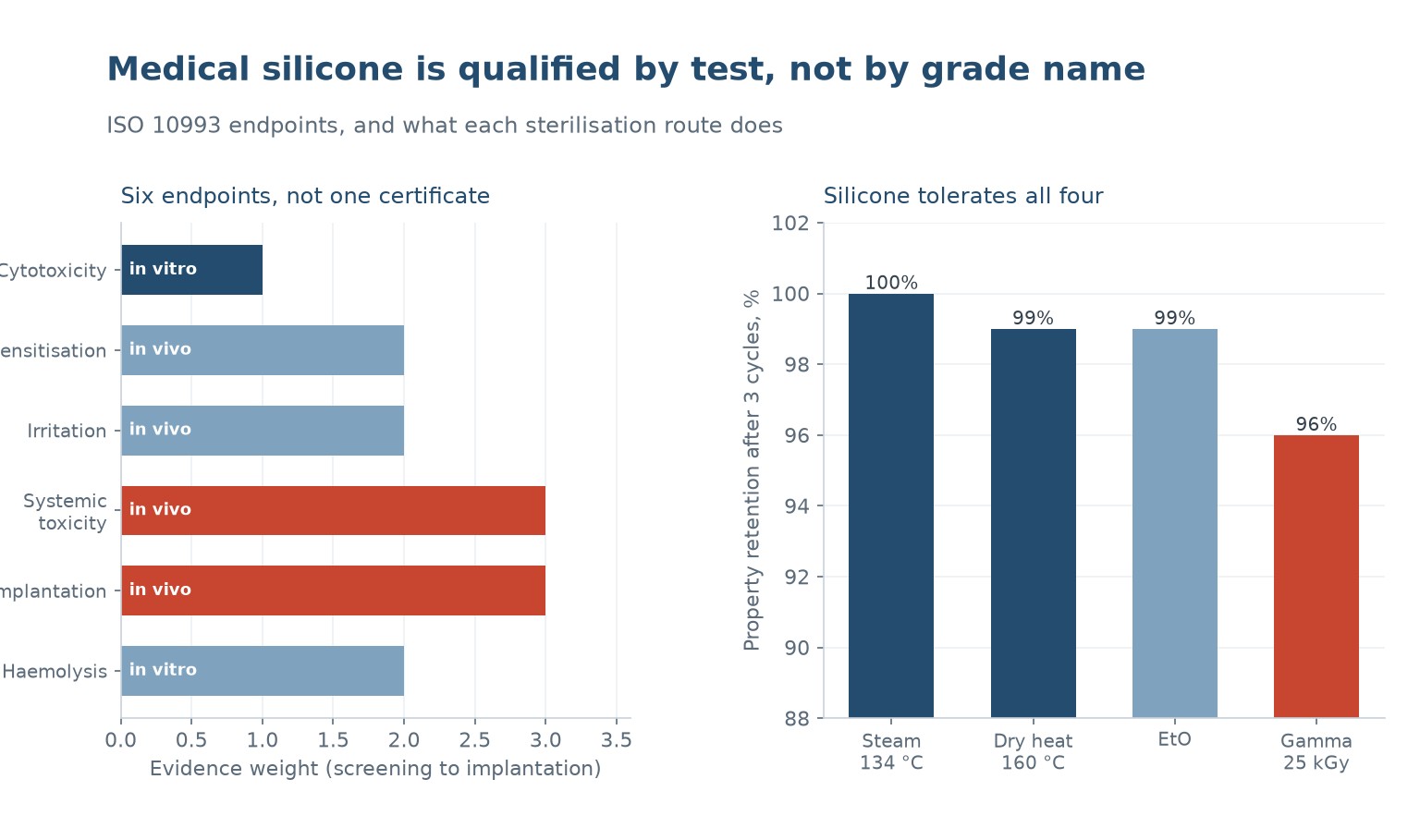
ISO 10993 is a framework, not a test. Part 1 requires a biological evaluation plan that identifies what tests are needed based on the nature and duration of contact. Part 5 covers in vitro cytotoxicity, Part 10 covers sensitisation and irritation, Part 6 covers implantation, Part 4 covers blood interaction.
The difference matters practically. A silicone intended for a 30-day blood contact device needs a different test set from one intended for a 24-hour skin contact device, and neither is covered by quoting USP Class VI. The evaluation plan is the document that decides, and it belongs to the device manufacturer, not the material supplier.
| Standard | What it is | What it does not tell you |
|---|---|---|
| USP <88> Class VI | In vivo screening test | Long-term or extractable behaviour |
| ISO 10993-5 | In vitro cytotoxicity | Anything about the whole device |
| ISO 10993-10 | Sensitisation and irritation | Systemic or implantation effects |
| ISO 10993-6 | Implantation | Blood contact or degradation products |
| ISO 10993-18 | Chemical characterisation | Biological response |
Table 1 — What each standard covers. A device submission needs a plan that selects among them, not a single certificate.
The test matrix for a typical device
For a silicone component in a short-term, indirectly contacting device, the usual set is cytotoxicity (10993-5), sensitisation and irritation (10993-10), and a chemical characterisation (10993-18) to identify extractables. For a long-term implant, add implantation (10993-6), genotoxicity, and a full extractables and leachables study.
Extractables testing is where most programmes underestimate the work. It requires extracting the finished, sterilised device in multiple solvents at multiple temperatures, identifying the compounds, and then assessing toxicological risk for each. For silicone, the compounds that appear are cyclic siloxanes, residual catalyst fragments and antioxidant residues.
The result of that assessment drives the material choice. A cheaper peroxide-cure compound may produce aromatic fragments that fail the toxicological risk assessment, while a platinum-cure compound at twice the price passes. The material cost difference is small against the cost of repeating a submission.
Sterilisation: four routes and what each does
Silicone tolerates all four common sterilisation routes better than any other elastomer. That is one of its main advantages, and it is why a single material can serve devices sterilised by different methods in different markets.
- Steam at 134 °C. The default for reusable devices. Silicone is unaffected, but the cycle count matters: 100 cycles is a different qualification from 1,000.
- Dry heat at 160 °C. Longer cycle, no moisture. Silicone tolerates it; the packaging may not.
- Ethylene oxide. The standard for single-use devices that cannot take heat. EtO residues must be aerated out, and silicone absorbs EtO more than most polymers, so the aeration time is longer.
- Gamma at 25 kGy. Fast and penetrating. It can cause some crosslinking and a slight colour shift in silicone, and it can affect the cure state of an under-cured part.
The qualification requirement is that the sterilisation route is validated against the specific part, not against the material family. A part that passes after three steam cycles may fail after fifty, and the number of cycles in the intended use is what has to be tested.
The documentation that has to exist
| Document | Who provides it | What it proves |
|---|---|---|
| Master batch record | Moulder | The part was made to a defined process |
| Material certificate | Compound supplier | The batch matches the tested material |
| Biocompatibility report | Testing lab | The tested article passed the endpoints |
| Extractables study | Testing lab | What comes out, and at what level |
| Sterilisation validation | Steriliser or OEM | The route does not degrade the part |
| Change control agreement | Supplier and OEM | No silent substitution |
Table 2 — The six documents a medical silicone component needs. The last one is the one most often missing and the one that causes recalls.
Change control is where medical silicone programmes fail. A compound supplier changes a filler source, or a moulder changes a pigment supplier, and the device is now made from a material that was never tested. Nothing in the part looks different, and the regulatory position is invalid.
The control is a written agreement that any change to material, process, site or sterilisation requires notification and re-qualification. It sounds bureaucratic and it is the only thing that prevents a silent change.
Common gaps
The first gap is a certificate for the wrong article. A biocompatibility report on a 2 mm test sheet is not a report on a 0.5 mm moulded seal with a different cure state.
The second is a cure state that was never verified. Under-cured silicone has different extractables from fully cured silicone, and the difference shows in a leachables study rather than in a visual inspection.
The third is a sterilisation route that was validated on a prototype made in a different tool. A change of tool changes the surface and the cure, and the sterilisation validation has to follow.
Is USP Class VI the same as medical grade?
No. USP Class VI is one in vivo screening test. Medical grade requires a biological evaluation plan under ISO 10993, testing on the finished sterilised article, and change control.
What is the difference between USP Class VI and ISO 10993?
USP Class VI is a specific set of three in vivo tests. ISO 10993 is a framework that selects tests based on contact type and duration. A device needs a plan, not a certificate.
Can medical silicone be autoclaved?
Yes, and it is one of the few elastomers that tolerates 1,000 cycles at 134 °C. The qualification must cover the number of cycles in the intended use, not just three.
Does gamma sterilisation damage silicone?
It can cause some crosslinking and a slight colour shift, and it can affect an under-cured part. Platinum-cure silicone tolerates gamma better than peroxide-cure.
What is extractables and leachables testing?
Extraction of the finished sterilised device in multiple solvents at multiple temperatures, identification of the compounds, and a toxicological risk assessment for each. For silicone the compounds are cyclic siloxanes and cure residues.
Why is change control so important for medical silicone?
Because a change in filler, pigment or cure schedule makes the device a different material from the one that was tested, without any visible difference. Change control is what prevents a silent invalidation of the submission.
Developing a medical device with silicone components?
Tell us the contact category, the duration and the sterilisation route. We will tell you the test set, the cure system and the documentation the submission will need.




 FR
 EN
 ES
 DE
 PT
 AR
 RU
 JA
 KO
 IT
 NL
 TR
 PL
 ID
