
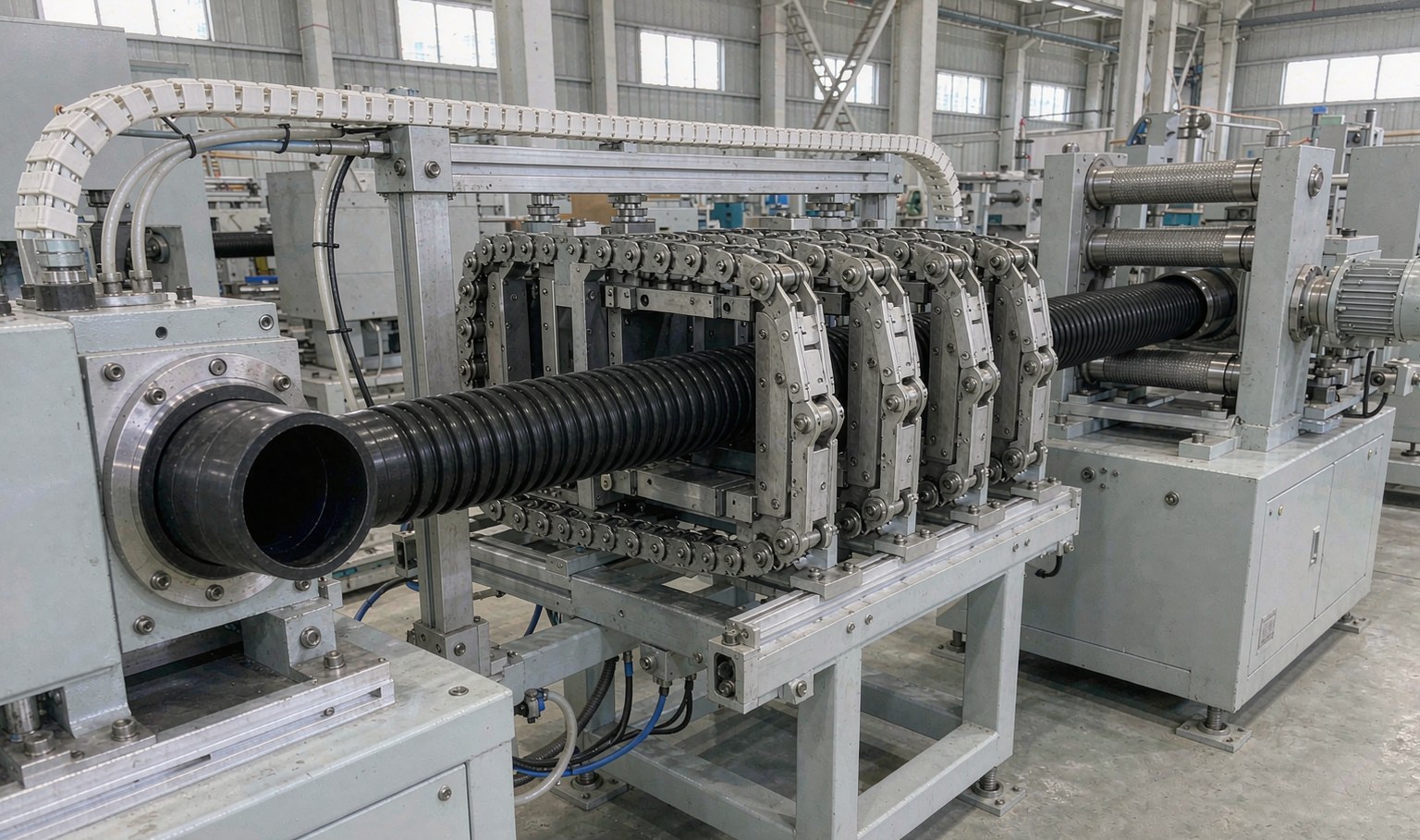
An extrusion line with a forming machine bolted on
Corrugated plastic tubing — conduit, drainage pipe, cable duct, flexible hose — is often described as an extrusion product. It is more accurate to call it a hybrid: an extruder makes a tube, and a separate machine reshapes it before it cools.
The machine is a pair of travelling mould chains. Each chain carries a sequence of half-moulds with the corrugation profile cut into them. The chains run forward at the same speed as the tube, close around it, and a vacuum or air pressure pulls the still-molten tube out into the corrugation before the mould opens and the chains return.
The key constraint: the tube must be soft enough to be blown into the corrugation and strong enough not to burst. That window is narrow, and it is set by melt temperature, wall thickness and the pressure applied. Most corrugated line problems are a failure to stay inside that window.
The process step by step
| Stage | What happens | Critical parameter |
|---|---|---|
| Extrusion | Tube leaves an annular die, usually downward | Melt temperature, die gap, wall concentricity |
| Mould closing | Travelling mould halves close around the tube | Chain speed matched to tube speed |
| Formation | Vacuum (or internal air) pulls tube into corrugation | Vacuum level, air pressure, melt temperature |
| Cooling in mould | Mould blocks cool the formed shape | Mould temperature, contact time |
| Mould opening | Blocks separate and return | Part must be stiff enough to hold shape |
| Haul-off and cut | Tube pulled and cut to length | Tension, cut length accuracy |
Table 1 — The corrugated tube process. The forming stage is the one that distinguishes it from plain tube extrusion, and it is where most of the tooling cost sits.
Some lines run downward and some horizontally. Downward is more common for large diameter because gravity helps the tube stay round before it enters the moulds; horizontal is used for small diameter and for lines where floor height is limited.
Wall distribution: the defining problem
Blowing a tube into a corrugation stretches the wall. The crest of each corrugation is stretched more than the valley, so the wall is thinner at the crest. On a deep corrugation the crest wall can be 40–50% thinner than the valley wall.
| Corrugation depth | Crest wall vs valley wall | Consequence |
|---|---|---|
| Shallow (ring only) | 85 – 95% | Minimal thinning |
| Moyen | 65 – 80% | Noticeable; design for it |
| Deep | 50 – 65% | Crest is the weak point in crush and impact |
| Very deep / flexible hose | 40 – 55% | Crest wall sets the pressure rating |
Table 2 — Wall thinning at the corrugation crest. The nominal wall on the drawing is usually the valley wall; the crest is what fails.
This is why corrugated tube specifications often state a minimum wall at the crest rather than a nominal wall. A 1.0 mm nominal tube with a deep corrugation may have only 0.55 mm at the crest, and that is the number that determines crush resistance.
The wall distribution can be improved by controlling where the tube is hottest when it enters the mould. A slightly hotter tube forms more easily and distributes better, but too hot and it bursts or sticks to the mould. The window is typically 10–20 °C wide.
Vacuum forming versus pressure forming
| Méthode | How | Advantage | Limitation |
|---|---|---|---|
| External vacuum | Vacuum applied through slots in the mould blocks | Simple; no internal air seal needed | Limited draw depth; slots wear |
| Internal pressure | Air blown inside the tube | Deeper corrugations; better crest wall | Needs a reliable seal at die and plug |
| Combined | Internal pressure plus external vacuum | Best for deep corrugations and large diameter | Complex; both systems must be tuned |
Table 3 — Forming methods. Internal pressure is what makes deep corrugations and large diameters possible, and it is what makes the line harder to run.
Internal pressure forming requires a plug or a seal at the downstream end of the forming section, so the tube can be pressurised without the air escaping. The seal is a wear item and a common source of downtime. When it leaks, the corrugation depth becomes inconsistent and the operator usually blames the vacuum.
Mould blocks: the tooling that wears
| Fonctionnalité | Matériau | Life | Notes |
|---|---|---|---|
| Block body | Aluminium or steel | Years | Steel for abrasive filled compounds |
| Corrugation insert | Aluminium, sometimes beryllium copper | 1 – 3 years | Wears at the crest; replaceable |
| Vacuum slots | Machined into insert | Wears with the insert | Block when they clog |
| Cooling channels | Drilled in block | Life of block | Scale build-up reduces cooling |
| Chain and guides | Acier | 2 – 5 years | Wear causes block misalignment |
Table 4 — Mould block components and their wear. The inserts are the consumable; the blocks themselves usually last the life of the machine.
Block alignment is critical and it degrades slowly. When the two chains drift out of register, the corrugation halves do not meet cleanly and a flash line appears along the tube. Operators compensate by increasing pressure, which accelerates wear. Checking alignment monthly is cheaper than replacing inserts.
Materials and what each one needs
| Matériau | Typical use | Processing note |
|---|---|---|
| PP | General conduit, automotive | Good formability; wide window |
| PE (HDPE) | Drainage, cable duct | Lower melt strength; watch for sag on large diameter |
| PVC (rigid) | Electrical conduit | Narrow window; scorch risk if overheated |
| PA (nylon) | Automotive, high temperature | High melt strength; good for deep corrugation |
| TPE / TPU | Flexible hose, cable protection | Very flexible; needs support until cooled |
| PP + talc filled | Stiffer conduit | Abrasive; steel inserts recommended |
| EVA / blends | Soft flexible tube | Sticky; mould release matters |
Table 5 — Materials for corrugated tube. PVC's narrow processing window is the reason it is used less than PP for conduit despite being cheaper.
Rigid PVC is the traditional conduit material and it is the most difficult. The window between "too cold to form" and "hot enough to degrade" is only about 15 °C, and the material releases HCl if it overshoots. Most modern conduit is PP for exactly this reason.
Defects and causes
| Défaut | Apparence | Cause |
|---|---|---|
| Incomplete corrugation | Shallow or rounded crests | Vacuum too low, tube too cold, slots blocked |
| Burst tube | Split along the tube | Too hot, too much internal pressure, thin wall |
| Flash line | Raised seam along the tube | Mould blocks out of register |
| Ovality | Tube not round | Uneven cooling, uneven wall, sag before forming |
| Sticking in mould | Torn surface, blocks not releasing | Too hot, poor mould surface, no release |
| Wall too thin at crest | Crush failure in service | Excessive draw, corrugation too deep for the wall |
| Inconsistent pitch | Corrugation spacing varies | Chain speed mismatch, haul-off slip |
Table 6 — Corrugated tube defects. Incomplete corrugation and burst tube are opposite failures of the same window, which is why the temperature setting is so sensitive.
Pitch inconsistency is worth a note because it is often mistaken for a mould problem. The corrugation pitch is set by the mould block spacing and the chain speed. If the haul-off pulls faster than the chain runs, the tube is stretched between blocks and the pitch increases. The fix is to match the haul-off to the chain, not to change the moulds.
How is corrugated plastic tubing made?
An extruder makes a plain tube, and a pair of travelling mould chains closes around it while it is still molten. Vacuum or internal air pressure pulls the tube out into the corrugation profile, the mould cools it, and the blocks open and return. The corrugation is formed, not extruded.
Why is the wall thinner at the crest?
Because forming stretches the tube. The crest is drawn further than the valley, so the material there is stretched more. On a deep corrugation the crest wall can be 40–50% thinner than the valley, which is why specifications often state a minimum crest wall.
What is the difference between vacuum and pressure forming for corrugated tube?
Vacuum pulls the tube out into the mould from outside; pressure blows it out from inside. Pressure allows deeper corrugations and larger diameters because the driving force is higher, but it needs a reliable seal at the end of the forming section.
Why does my tube burst during forming?
Too hot, too much internal pressure, or a wall that is too thin for the corrugation depth. The tube has to be soft enough to form and strong enough to survive the pressure — that window is only 10–20 °C wide on most materials.
What causes a flash line along the tube?
The two mould chains are out of register, so the corrugation halves do not meet cleanly and material is squeezed into the gap. Check chain alignment and guide wear; increasing pressure makes it worse.
Can corrugated tube be made in continuous length?
Yes, that is the point of the travelling mould process. The mould blocks move with the tube while it forms, so the line runs continuously and the product is cut to length on the fly. Lengths of 50 m or more are common for conduit.
What determines the corrugation pitch?
The mould block spacing and the chain speed. The haul-off must match the chain speed exactly; if it pulls faster, the tube stretches between blocks and the pitch increases. Pitch is a line-setting issue, not a mould issue.
Which material is best for electrical conduit?
PP for most applications — it has a wider processing window than PVC and better impact resistance at low temperature. PVC is still used where rigidity and flame performance matter, but it requires tighter temperature control.
Sourcing corrugated conduit or flexible tubing?
Send us the diameter, corrugation pitch, wall requirement, material and the standard you are working to. We will come back with the process route and the minimum crest wall we can hold.




 FR
 EN
 ES
 DE
 PT
 AR
 RU
 JA
 KO
 IT
 NL
 TR
 PL
 ID
