
A profile is a shape, not five numbers
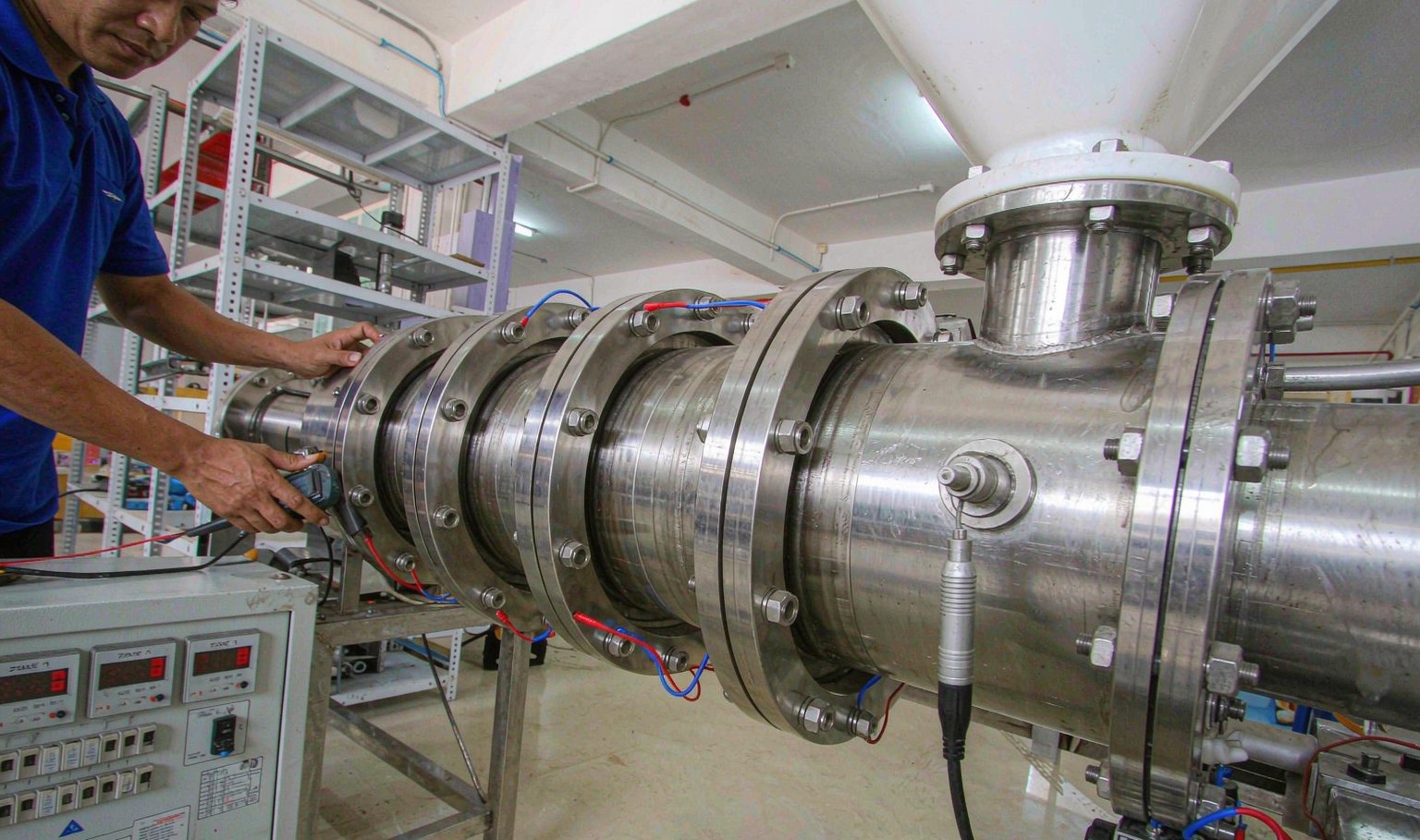
A barrel is divided into zones because a single heater cannot control a 1.5 metre steel tube uniformly. Each zone has its own band heater, its own thermocouple and its own controller, and the operator sets five numbers that together are called the profile.
The mistake is to treat those five numbers as independent. They are not. The thermocouple measures the barrel wall, not the melt, and the wall is heated by the band and cooled by the polymer flowing past it. A zone set to 195 C will read 195 on its controller and deliver a melt at 185 or 205 depending on what the zones either side are doing and how fast the screw is turning.
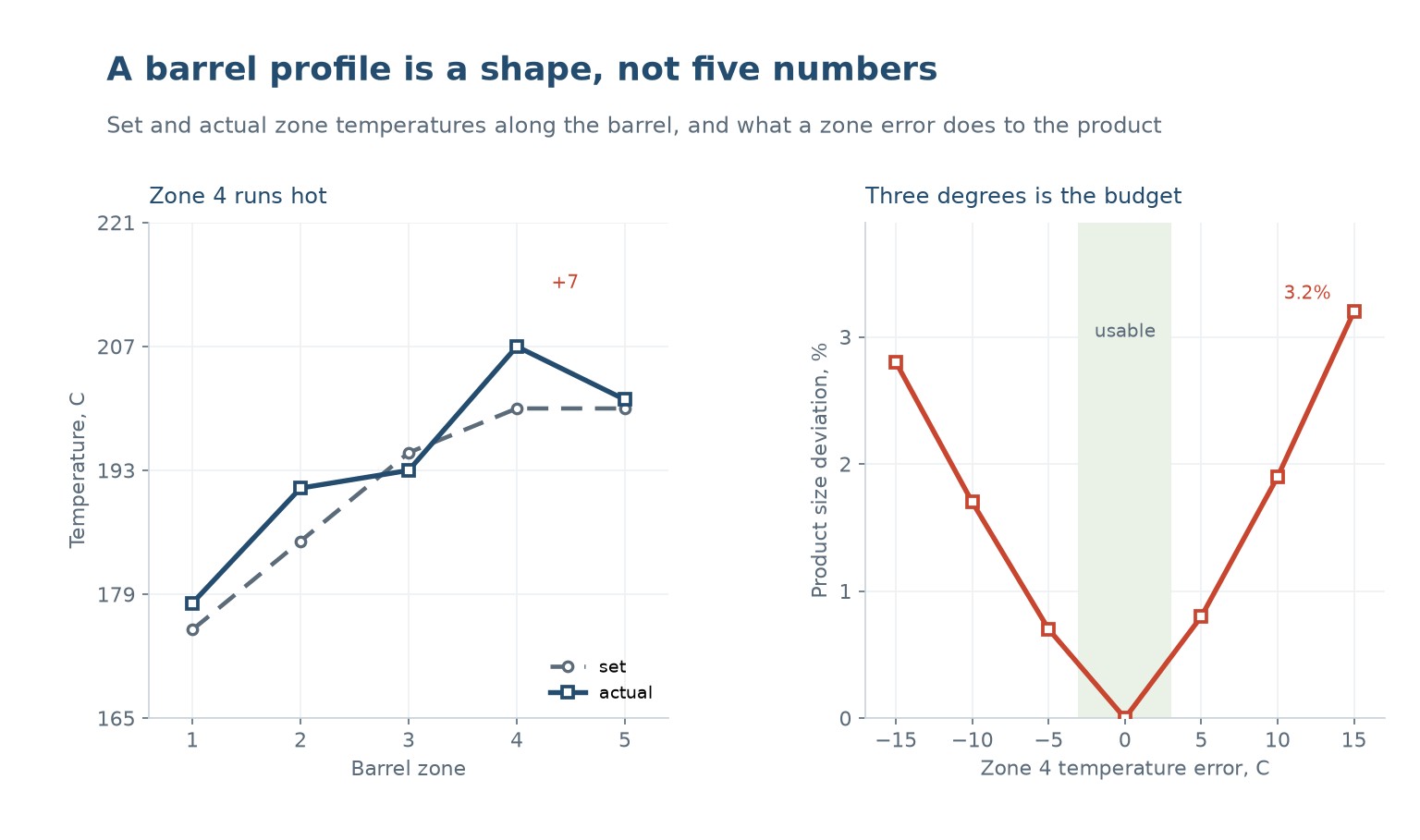
So the profile is a shape: feed zone cool, compression zone rising, metering zone flat. What matters is the slope and where the slope happens, not the absolute numbers. Two lines with the same average melt temperature and different profiles will produce different products, because the shear history is different.
The other thing that matters is that the profile is a starting point, not a specification. The number that controls the product is the melt temperature measured in the stream, and the profile is adjusted to reach it.
The profile follows the polymer
An amorphous polymer like PVC or polystyrene wants a gentle rise from the feed to the metering zone and a flat metering zone. A semicrystalline polymer like polyethylene or polypropylene wants a sharper rise, because it needs to be taken through its melting point quickly and held above it without over-shearing.
A PVC profile is deliberately flat, often 175, 180, 185, 185, 185, because PVC degrades above about 200 C and the shear heating in the compression zone adds 10 to 20 C on its own. A profile that rises to 200 at the die on a PVC line is a profile that is running the melt at 215 and burning it.
A polyolefin profile rises more steeply, 160, 180, 200, 210, 210, because the polymer needs the heat and it tolerates it. A filled compound runs lower than the unfilled version of the same polymer, because the filler conducts heat and the viscosity dissipates more energy, so the melt is hotter than the setpoints suggest.
The general rule is that the profile should rise through the compression zone and be flat through the metering zone. A profile that keeps rising to the die is a profile that is using the die to finish melting, which is a job the screw should have done.
| Polymer | Typical profile, C | Why |
|---|---|---|
| PVC, rigid | 175 / 180 / 185 / 185 / 185 | Degrades above 200 |
| Polystyrene | 170 / 185 / 195 / 200 / 200 | Gentle rise, flat metering |
| Polyethylene | 160 / 180 / 200 / 210 / 210 | Needs a fast melt transition |
| Polypropylene | 165 / 185 / 205 / 215 / 215 | Higher melting point |
| Filled compound | 10 to 15 C lower than unfilled | Filler conducts, shear heats |
| Crosslinked PE | 130 to 150 in the die | Peroxide must not decompose early |
Table 1 — Starting profiles for common polymers
What a zone error actually does
The effect of a zone error depends on which zone and how big. An error in the feed zone changes the feed rate and the bite of the screw, so it shows up as a surging output rather than a dimension change. An error in the metering zone changes the melt viscosity and therefore the die swell and the wall thickness.
On a measured jacket line, an error in the metering zone moves the product dimension by 0.7 percent for 5 C, 1.7 percent for 10 C and 2.8 percent for 15 C, in either direction. The relationship is close to linear and symmetric, which makes it easy to correct once it is measured.
The usable band is plus or minus 3 C. Beyond that the dimension is outside a typical tolerance, and at plus or minus 15 C the product is 2.8 percent off, which on a 4 mm wall is 0.11 mm.
The reason the band is so narrow is that the melt viscosity changes about 3 percent per degree for a typical polymer near its processing temperature. A 3 C error is a 9 percent viscosity change, which is a 3 to 5 percent change in die swell, which is a wall change. The arithmetic is unforgiving and it is why a barrel controller that is 5 C out is a controller that is costing money.
The thermocouple is not the melt
A barrel thermocouple sits in a well in the barrel wall, a few millimetres from the melt. It reads the wall, and the wall is not the melt. The melt in the centre of the channel can be 15 to 25 C hotter than the wall on a large barrel at high screw speed, because the shear heating happens in the melt and the wall is cooled by the band controller.
That is why a barrel that reads 200 C on all five zones can deliver a melt at 225 C, and why a melt temperature measured with a hand-held probe in the stream is the only number that matters. The probe is inserted into the melt at the die or through a purge port, and it is read after the reading stabilises.
The difference between the wall reading and the melt reading is a diagnostic. A difference of 10 C is normal. A difference of 30 C is a screw that is over-shearing, which means the compression ratio is too high or the screw speed is too high for the output, and the answer is not a lower setpoint but a different screw.
The band heaters themselves fail in a characteristic way. A band that has lost part of its element draws less current and heats slower, so its zone lags. A zone that takes 20 minutes to reach setpoint while its neighbours take 5 is a band that is failing, and it will read correctly once it gets there, which is why it is missed.
Control, and the three things that go wrong
A zone controller is a PID loop on the thermocouple. It holds the wall at the setpoint, and it does it well. What it cannot do is compensate for a thermocouple that is not in contact with the well, a band that is not tight against the barrel, or a cooling fan that is stuck on.
A thermocouple that has worked loose reads low, so the controller drives the band harder and the zone runs hot. The symptom is a zone that is 10 to 20 C above setpoint with the output at 100 percent, and the fix is to check the thermocouple seating before touching the controller.
A band that is not tight has an air gap, and an air gap is a thermal resistance. The band runs at a higher temperature than the barrel, it fails earlier, and the zone is slow to respond. Bands are clamped, not slid on, and a band that can be rotated by hand is a band that is losing heat.
A cooling fan that is stuck on cools a zone that the controller is trying to heat, and the controller loses. The symptom is a zone that oscillates or sits below setpoint with the heater at 100 percent. On a barrel with forced cooling this is worth checking before anything else.
| Symptom | Likely cause | Check |
|---|---|---|
| Zone 15 C above setpoint, output 100% | Loose thermocouple | Thermocouple seating |
| Zone slow to reach setpoint | Failing band element | Band current draw |
| Zone oscillates or sits low | Cooling fan stuck on | Fan operation |
| Melt 25 C above wall reading | Screw over-shearing | Compression ratio, rpm |
| Output surges | Feed zone too hot | Zone 1 setpoint |
| Dimension drifts all zones | Melt pump or die | Not the barrel |
Table 2 — Reading a barrel problem from the controller
How to set a profile from scratch
Start with the polymer's recommended profile from the compound data sheet, and set all five zones to it. Run the line at the target output for 20 minutes, measure the melt temperature in the stream, and compare it with the recommendation.
Then adjust the metering zone to bring the melt to the target, not the compression zone. The metering zone controls the viscosity at the die, which is what the product sees. The compression zone controls melting, which is a mechanical job that the screw does with heat assistance.
Then check the product. A dimension that is high means the melt is too hot or the draw-down is too low. A surface that is rough means the melt is too cold or the die land is too long. Adjust one zone at a time and wait for the melt to stabilise, which takes 10 to 15 minutes on a large barrel.
Should all barrel zones be set to the same temperature?
No. A profile that rises through the compression zone and is flat through the metering zone gives a better melt than a flat profile, and it avoids over-shearing in the compression zone.
Why does a barrel read 200 C but the melt measure 225?
Because the thermocouple measures the barrel wall and the shear heating happens in the melt. A 15 to 25 C difference is normal on a large barrel at high screw speed.
How much does a zone error affect the product?
About 0.7 percent of dimension for 5 C, 1.7 percent for 10 C and 2.8 percent for 15 C. The usable band is plus or minus 3 C.
Why is a PVC profile flatter than a polyolefin one?
Because PVC degrades above about 200 C and shear heating adds 10 to 20 C on its own. A rising profile on a PVC line burns the compound.
My zone 4 reads 7 C high with the heater at 100 percent. What is wrong?
Almost always a loose thermocouple. It reads low, so the controller drives the band harder. Check the seating before touching the controller.
How long does a barrel take to stabilise after a setpoint change?
10 to 15 minutes on a large barrel. Changing two zones at once and reading after two minutes is how a profile gets set wrong.
A profile that will not hold its dimension?
Tell us the polymer, the barrel size and the output. We will tell you the profile, where to measure the melt, and whether the screw is the problem rather than the heaters.




 EN
 ES
 FR
 DE
 PT
 AR
 RU
 JA
 KO
 IT
 NL
 TR
 PL
 ID
