

Four families, not one process
Thermoforming is often described as a single process with variations, and that description is misleading in a way that costs money. A roll-fed pressure former and a sheet-fed vacuum former share a principle, heat a sheet and shape it, and share almost nothing else: not the tooling, not the material form, not the cycle time, and not the parts they can make.
The four families are roll-fed pressure forming, sheet-fed pressure forming, sheet-fed vacuum forming and twin-sheet forming. The first takes material from a roll and runs continuously. The second and third take discrete sheets, usually on a clamp frame, and run in cycles. The fourth forms two sheets and joins them into a hollow part.
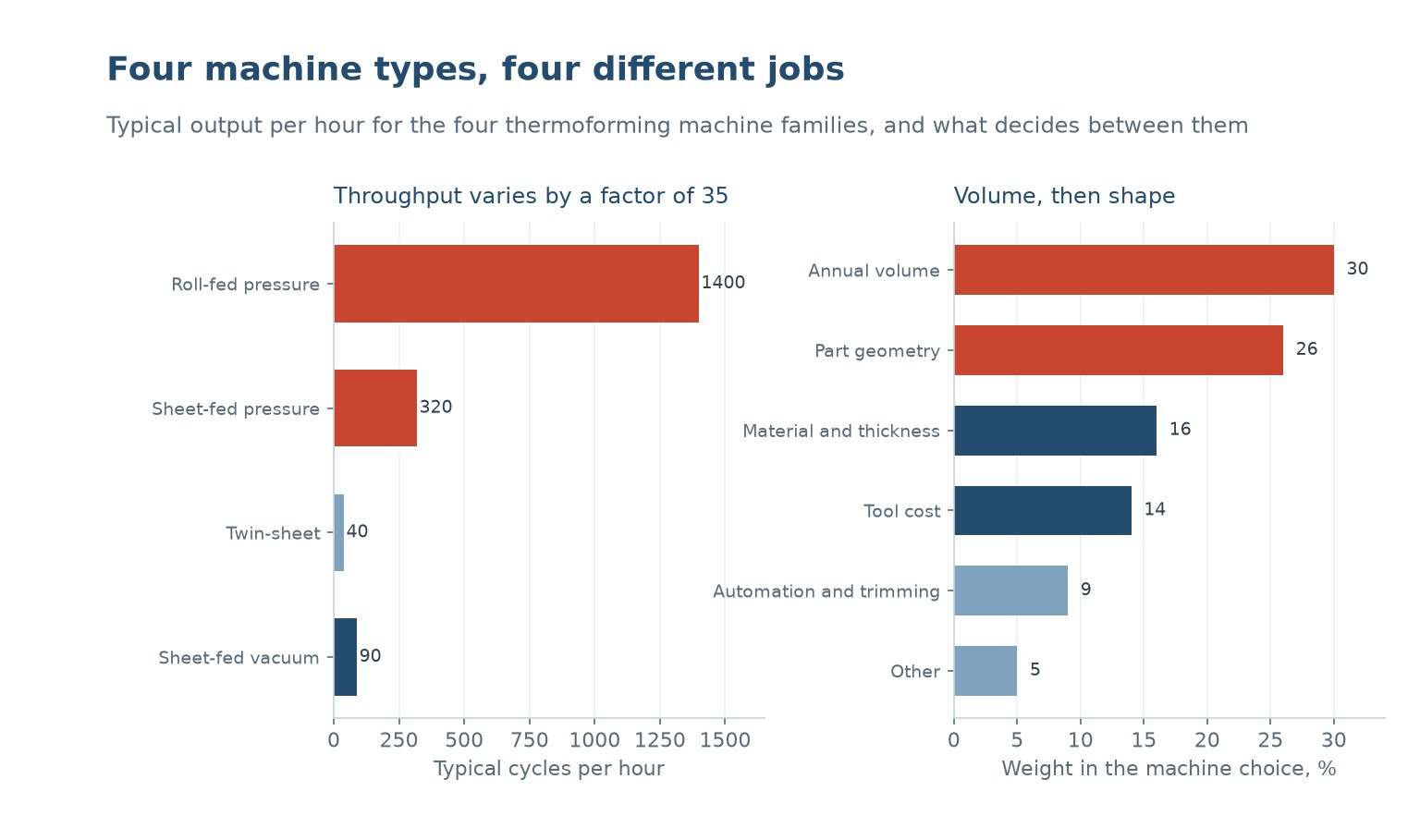
The difference in output between them is not incremental. A roll-fed pressure former making small trays runs at around 1 400 cycles an hour. A sheet-fed pressure former runs at 320. A sheet-fed vacuum former at 90, and a twin-sheet machine at 40. That is a factor of thirty five between the fastest and the slowest, and it decides which process can compete on a given part before any quotation is written.
The reason for the gap is not machine speed in the usual sense. It is that a roll-fed machine never stops: the sheet is indexed through the oven and the forming station continuously, so heating, forming and trimming overlap. A sheet-fed machine heats, forms, cools and unloads in sequence, and the oven sits idle for most of the cycle.
What the throughput gap means
The chart on the left puts the four families on one axis, and the scale is the point. Roll-fed pressure at 1 400 cycles an hour, sheet-fed pressure at 320, sheet-fed vacuum at 90, twin-sheet at 40. A part that takes 90 cycles an hour on a vacuum former takes 6.7 hours per thousand parts; the same part on a roll-fed pressure former takes 43 minutes.
Throughput only converts to cost if the tooling allows it. A roll-fed machine needs a trim tool in the line, so the part has to be trimmable in the machine and the scrap skeleton has to be manageable. A complex three-dimensional trim that would be done on a CNC router after forming is not compatible with a roll-fed line at 1 400 an hour.
The second condition is volume. A roll-fed line with in-line trimming is a substantial capital item, and it only makes sense when the annual volume keeps it busy. Below a few hundred thousand parts a year the machine sits idle and the capital charge per part exceeds the labour saved, which is why the sheet-fed vacuum former still exists and still dominates prototype and low volume work.
The third condition is material form. Roll-fed machines need sheet on a roll, in a width the machine can take and a gauge it can handle. Thick sheet, small quantities and materials that are only available in cut sheets push the job to a sheet-fed machine regardless of volume.
Vacuum forming: cheap tooling, soft detail
Vacuum forming uses atmospheric pressure, about one bar, to push a heated sheet onto a mould. One bar is not much, and it sets the limit on detail: sharp corners, fine texture and deep draws all need more force than a vacuum can supply. The reward is tooling that can be made from aluminium, epoxy or even wood, in days rather than weeks, for a fraction of the cost of a pressure tool.
That combination, soft detail and cheap tooling, is exactly right for prototypes, for large parts where the tool cost dominates, and for short runs. A 1.5 metre enclosure panel is a typical vacuum formed part because the tool is a single form and the pressure requirement is low: the sheet is large, the draw is shallow, and one bar is enough.
The limitations to design around are a minimum draft of two to three degrees, a draw ratio below about 1.5 without a plug assist, and a corner radius of at least the sheet thickness. A part that needs a sharp 1 mm corner radius at the bottom of a deep draw is not a vacuum forming part, and no amount of tooling cleverness will make it one.
Pressure forming: detail at a price
Pressure forming adds compressed air on the sheet side, typically 3 to 8 bar, with a vacuum underneath. The extra force presses the sheet into fine detail: texture, sharp radii, crisp lettering and small undercuts in the tool. It also allows a thinner sheet to be formed over the same draw, because the higher pressure stretches the material more evenly.
The cost is tooling. A pressure tool has to withstand several bar across its whole area and has to be vented properly, so it is a machined aluminium tool with a temperature control circuit rather than a cast epoxy form. The tool cost is several times higher and the lead time is longer, which is why pressure forming belongs to parts that need the detail and have the volume to amortise the tool.
Sheet-fed pressure forming is the flexible middle ground. It handles thick sheet and low volumes with pressure quality, at 320 cycles an hour. Roll-fed pressure forming is the high volume route, with in-line trimming and the tooling built into a continuous line.
| Machine type | Cycles per hour | Typical tooling | Lo mejor para |
|---|---|---|---|
| Roll-fed pressure | 1 400 | Aluminium, in-line trim | High volume packaging, thin gauge |
| Sheet-fed pressure | 320 | Machined aluminium, temperature controlled | Detailed parts, medium volume, thick sheet |
| Sheet-fed vacuum | 90 | Aluminium, epoxy or wood | Prototypes, large panels, low volume |
| Twin-sheet | 40 | Two tools plus a joining frame | Hollow parts, double wall, insulated structures |
Table 1 — The four families and where each one fits.
Twin-sheet: hollow parts without blow moulding
Twin-sheet forming heats two sheets, forms each into its own half tool, and then presses them together while both are still molten so they weld at the flange. The result is a hollow part with a double wall, made without a parison and without the wall control problems of blow moulding.
Its advantage is the cavity. A twin-sheet part can have internal ribs, baffles, mounting bosses and inserts moulded into the inside of the hollow, which a blow moulded part cannot. That makes it the process for insulated containers, air ducts, fuel tanks for low volume vehicles and structural panels with integral stiffening.
Its disadvantage is cycle time and labour. At 40 cycles an hour, with two sheets to load and a joining step in the cycle, twin-sheet is a slow process, and it is usually chosen for parts where the geometry is impossible otherwise rather than for cost. The tooling is also two tools plus a joining frame, so the entry cost is high.
Choosing a machine
The right hand panel gives the weights from real selections: annual volume 30 percent, part geometry 26, material and thickness 16, tool cost 14, automation and trimming 9, other 5. The first two are 56 percent, and both are questions about the part rather than about the machine.
The procedure that works is to eliminate by geometry first. Does the part need detail finer than one bar can produce? Then vacuum is out. Does it need a hollow interior with internal features? Then twin-sheet is the only candidate. Is the sheet only available in cut sheets? Then the roll-fed machines are out.
Then check the volume against the throughput. If the annual requirement is below the point where the fastest viable machine is busy, the slower machine with cheaper tooling wins even though its cycle is longer. That calculation is worth doing explicitly, because the intuition that faster is cheaper is wrong at low volume and right at high volume.
Finally, look at trimming. In-line trimming on a roll-fed line is fast and repeatable but inflexible; a CNC router after forming is flexible and slow. A part with a complex outline, a large aperture or a need for secondary operations is often better on a sheet-fed machine with off-line trimming, even if the forming cycle is slower.
| Requirement | Roll-fed pressure | Sheet-fed pressure | Sheet-fed vacuum | Twin-sheet |
|---|---|---|---|---|
| Volume above 500 000 a year | Sí | Marginal | No | No |
| Fine texture and sharp radii | Sí | Sí | No | Partly |
| Thick sheet above 3 mm | No | Sí | Sí | Sí |
| Hollow part with internal ribs | No | No | No | Sí |
| Tool cost below 10 000 EUR | No | No | Sí | No |
| Complex outline, routed after forming | No | Sí | Sí | Sí |
Table 2 — Which machine family meets which requirement.
What is the difference between vacuum forming and pressure forming?
Vacuum forming uses atmospheric pressure, about one bar, to pull the sheet onto the mould. Pressure forming adds 3 to 8 bar of compressed air on the sheet side, which produces sharper detail, finer texture and better wall distribution, at a higher tooling cost.
Why is roll-fed thermoforming so much faster?
Because the sheet never stops. Heating, forming and trimming happen continuously and overlap, so the oven is always working. A sheet-fed machine heats, forms, cools and unloads in sequence, and the oven is idle for much of the cycle.
What can twin-sheet forming do that blow moulding cannot?
It can put internal ribs, baffles, bosses and inserts inside a hollow part, because each half is formed in an open tool before the two are joined. Blow moulding forms against a closed cavity and cannot reach the inside.
What draw ratio can vacuum forming achieve?
About 1.5 to 1 without a plug assist, and up to 3 or more with one, depending on the material and the wall thickness requirement. Beyond that the wall at the deepest point becomes too thin to be useful.
How much draft angle does a thermoformed part need?
Two to three degrees per side as a minimum for vacuum forming, and one to two degrees for pressure forming where the higher force helps release. Less than that and the part drags on the tool, which marks the surface and slows the cycle.
Can I use a CNC router instead of in-line trimming?
Yes, and for complex outlines or secondary operations it is often the right choice. The trade is speed: in-line trimming on a roll-fed line is part of the cycle, while routing is a separate operation that adds handling and a fixture.
Which machine fits the part
Send the drawing, the material and the annual volume. We will tell you which of the four machine families can hold the detail and the wall, and what the tooling and cycle would be.




 ES
 EN
 FR
 DE
 PT
 AR
 RU
 JA
 KO
 IT
 NL
 TR
 PL
 ID
