
A streak is unmixed filler, not contamination
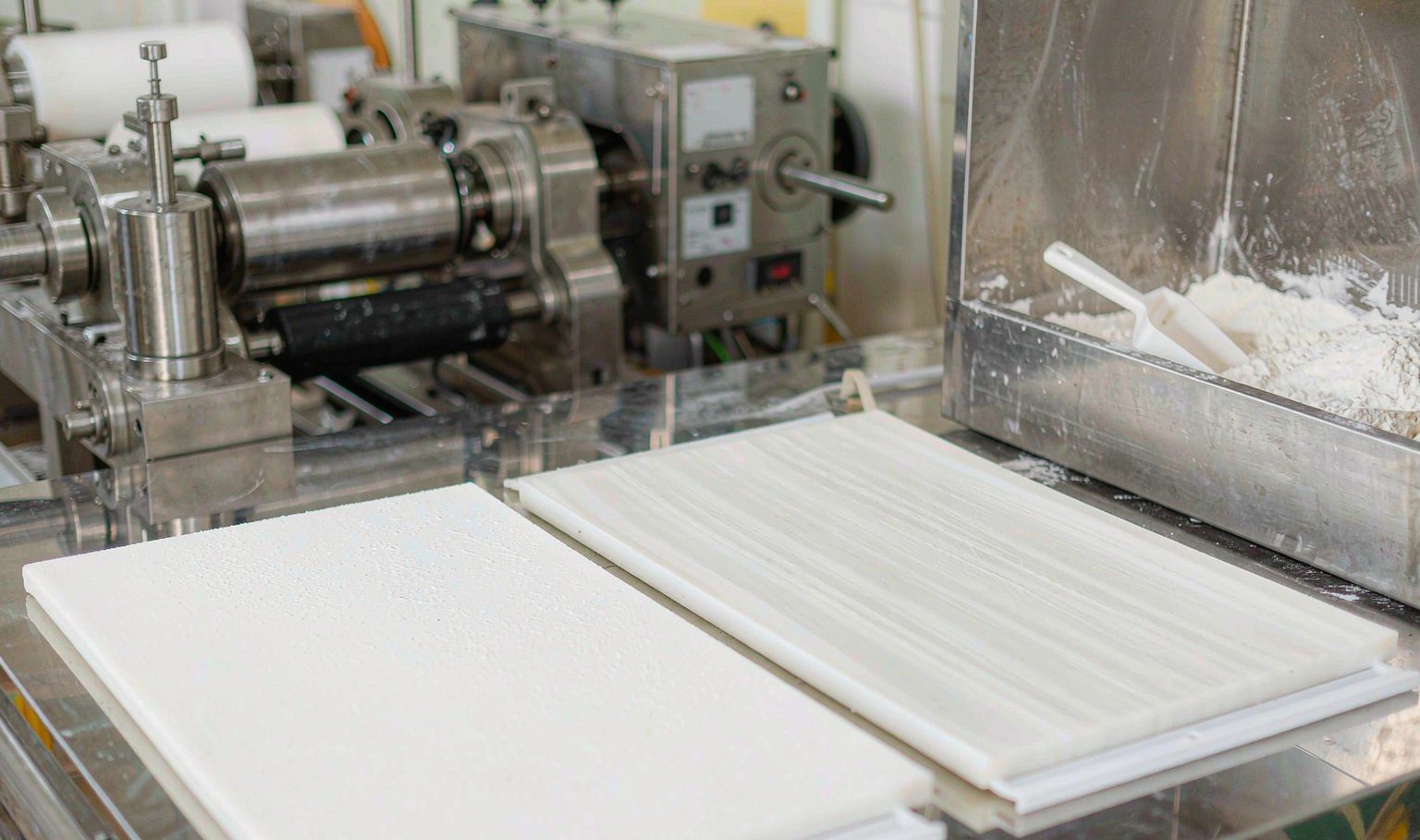
A pale streak running through a white silicone part is almost always diagnosed as dirt, oil or a bad batch of compound. It is usually none of those. It is filler that has not been wetted by the polymer, so it sits in a band with a different refractive index and shows up as a lighter line.
Silicone compounds are heavily filled. Fumed silica at 20 to 40 parts per hundred, plus ground quartz or calcium carbonate in some grades, gives a surface area that has to be wetted by a polymer of very high viscosity. Wetting that surface is a mechanical process, not a chemical one.
The filler arrives as agglomerates, which are clusters of primary particles held together by van der Waals forces. Mixing has to break the agglomerates down to aggregates and then distribute them. If the shear is too low, the agglomerates survive as streaks and as weak points.
The consequence is not cosmetic. An unwetted agglomerate is a defect: it is a stress concentration, it does not bond to the polymer, and it is where a tear starts. A part that looks streaky is also a part that tears early.
Shear does the work, time only finishes it
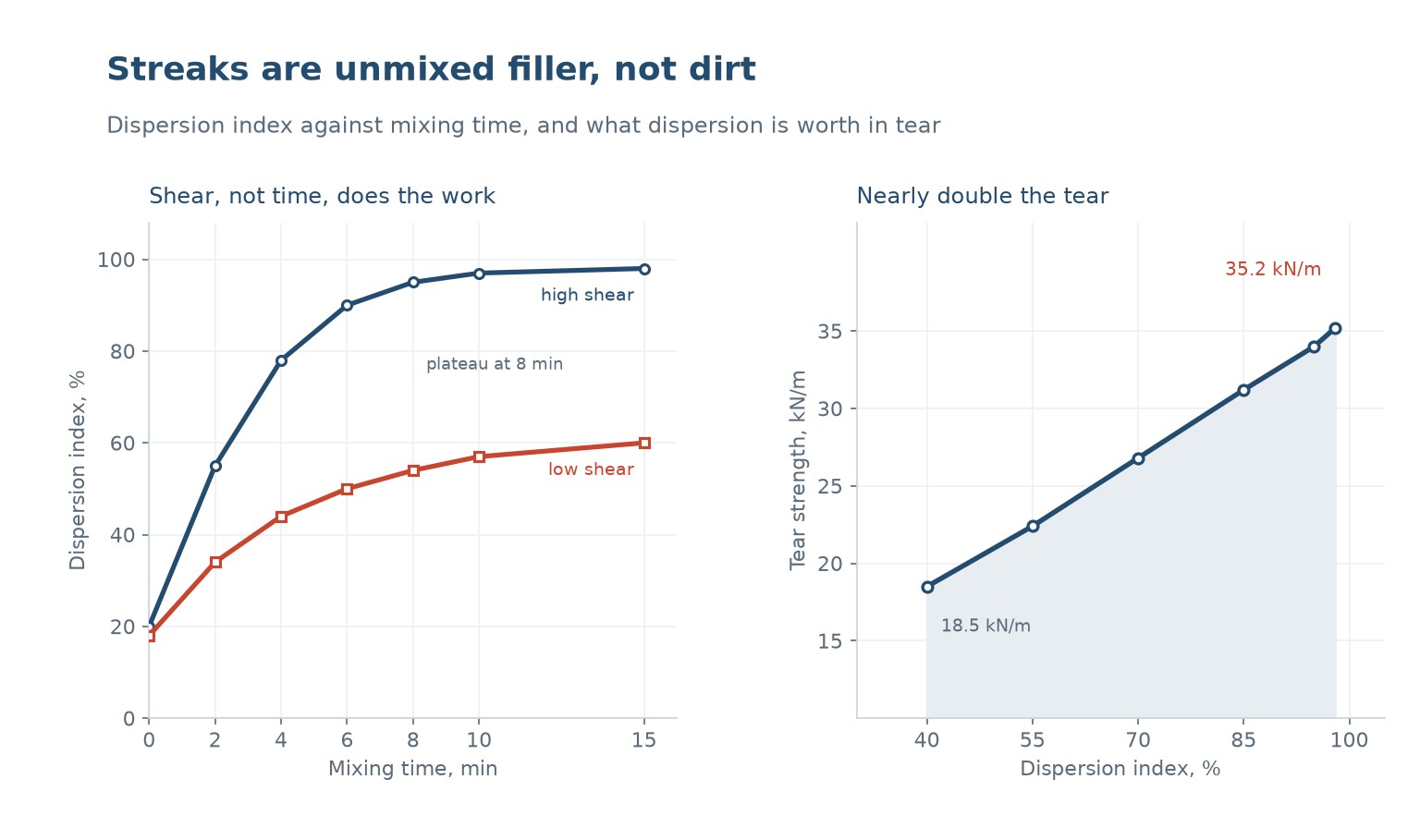
Dispersion index is measured by a surface inspection or a light transmission method, and it rises with mixing time up to a plateau. The height of the plateau and the time to reach it are both set by the shear rate, not by the duration.
On a two-roll mill with a tight nip, the index went from 20 to 55 in two minutes, 78 at four, 90 at six, 95 at eight and 97 at ten, then 98 at fifteen. On the same mill with an open nip it went 18, 34, 44, 50, 54, 57 and 60.
The tight nip reaches 95 percent in eight minutes. The open nip is still at 60 percent after fifteen and will never get there, because the shear stress in the nip is below the force needed to break the agglomerates. More time at low shear does not fix a dispersion problem.
That is the single most useful fact about mixing silicone. If the dispersion is poor, the answer is more shear, a tighter nip, a higher fill level in the mixer, or a different mixer. Adding time is the one thing that does not work.
What dispersion is worth in numbers
Tear strength is the property most sensitive to dispersion, because a tear propagates along the weakest path and an agglomerate is the weakest path. Measured on a 50 Shore A compound, tear strength was 18.5 kilonewtons per metre at 40 percent dispersion, 22.4 at 55, 26.8 at 70, 31.2 at 85, 34.0 at 95 and 35.2 at 98.
Going from 40 to 98 percent dispersion nearly doubles the tear strength. Nothing else in the compounding recipe does that for free, and no amount of curing optimisation compensates for it.
Tensile strength moves less, from about 6.8 to 9.4 MPa over the same range, and elongation at break moves least. That is why a streaky part can pass a tensile test and still fail in service: the test does not load the defect the way a tear does.
Hardness is also affected, but in the opposite direction to what people expect. A poorly dispersed compound reads low on a durometer because the indenter sits on a soft patch, so a streaky batch can measure 48 when the specification says 50.
| Dispersion | Tear strength | Tensile | Durometer reading |
|---|---|---|---|
| 40% | 18.5 kN/m | 6.8 MPa | 47 |
| 55% | 22.4 kN/m | 7.4 MPa | 48 |
| 70% | 26.8 kN/m | 8.1 MPa | 49 |
| 85% | 31.2 kN/m | 8.8 MPa | 50 |
| 95% | 34.0 kN/m | 9.2 MPa | 50 |
| 98% | 35.2 kN/m | 9.4 MPa | 50 |
Table 1 — Dispersion against three properties on a 50 Shore A compound
The five reasons a compound disperses badly
The first is shear. A mixer or mill running below the shear needed to break the agglomerates will never catch up, and the symptom is a plateau well below the target.
The second is fill level. An overfilled mixer has no free volume for the compound to fold, so the shear is applied to a static mass. An underfilled one has too little resistance and the blades slip.
The third is temperature. Silicone viscosity falls steeply with temperature, and low viscosity means low shear stress. A hot mix disperses worse than a cold one, which is why the cooling water on a mill matters.
The fourth is filler addition rate. Dumping 30 parts of fumed silica into a mixer at once produces lumps that the blades cannot wet, and those lumps become streaks. Adding it in portions with time between them is slower and better.
The fifth is the filler itself. Fumed silica that has been stored damp, or that has been compacted in the bag, is harder to disperse. A filler with a surface treatment disperses more easily than an untreated one, at a price.
| Causa | Symptom | Fix |
|---|---|---|
| Low shear | Plateau below target | Tighter nip or higher rotor speed |
| Overfilled mixer | Uneven, hot compound | Reduce batch weight |
| High temperature | Slow dispersion, low viscosity | Cool the mixer |
| Fast filler addition | Lumps and streaks | Add in portions |
| Damp or compacted filler | Streaks despite good mixing | Dry and sieve the filler |
Table 2 — Causes, symptoms and the fix for each
Detecting it before the parts are made
The cheapest test is a thin sheet. Press a 1 mm sheet and hold it up to a light: streaks show as lighter bands. It takes ten minutes and catches most problems before a batch is cured.
The second is a tear test on a cured slab. A tear specimen cut from a streaky slab fails at a lower load and often at a visibly different location, which is the defect showing itself.
The third is a dispersion index by light transmission, which is the method used for the numbers above. It is a laboratory test and it is worth doing once per compound per mixer, because it turns a subjective judgement into a number.
What does not work is a visual check on a moulded part, because the part geometry hides the streaks and the surface finish hides the rest. A part that looks fine can be at 60 percent dispersion and tear at two thirds of its rated strength.
What to do with a streaky batch
If the compound is still uncured, re-mill it on a tight nip. A second pass at high shear will bring a 60 percent batch up to 90 in a few minutes, because the agglomerates are still there to be broken.
If it is already cured, the options are to scrap it, to use it in a part where tear strength is not critical, or to accept a lower specification. Selling it as a cosmetic grade is a decision about risk, not about material.
If the problem is recurring, the fix is upstream: tighter nip, slower filler addition, cooler mix, and a check on the filler as received. Those four changes solve most dispersion problems without buying anything.
The one thing not to do is to add more mixing time to a low-shear process. The curve shows why: the open nip is at 60 percent after fifteen minutes and will be at 60 percent after an hour.
What causes white streaks in silicone?
Unmixed filler, not dirt. Fumed silica agglomerates that have not been wetted by the polymer show up as lighter bands and act as tear initiation points.
How long should silicone be mixed?
On a tight nip, dispersion reaches 95 percent at about eight minutes and plateaus. More time at low shear does not help, because the shear stress is below what breaks the agglomerates.
How much does dispersion affect tear strength?
Going from 40 to 98 percent dispersion takes tear strength from 18.5 to 35.2 kilonewtons per metre, nearly double.
Why does a streaky batch read low on a durometer?
The indenter lands on a soft, filler-poor patch. A compound specified at 50 Shore A can read 47 when it is poorly dispersed.
Can a streaky batch be reworked?
Yes, if it is uncured. A second pass on a tight nip brings 60 percent up to about 90. Once cured, the option is to scrap it or to use it where tear strength is not critical.
Does a surface-treated filler disperse better?
Yes, noticeably, because the treated surface wets more easily. It costs more per kilogram and it is often cheaper per good part.
Parts that tear early or read low on hardness?
Send the compound, the mixer type, the batch size and a photo of the streak. We will tell you whether it is dispersion, filler or cure, and which of the four fixes applies.




 ES
 EN
 FR
 DE
 PT
 AR
 RU
 JA
 KO
 IT
 NL
 TR
 PL
 ID
