
Tolerance comes before material
In most extrusion the drawing starts with a material and a size. In medical tubing it starts with a tolerance. A 1.0 mm tube at plus or minus 0.02 mm is a different product from the same tube at plus or minus 0.05 mm: different line, different gauge, different price, and often a different supplier.
| Nominal OD, mm | Achievable OD tolerance | Typical wall | Typical use |
|---|---|---|---|
| 0.5 | plus or minus 14 um | 0.10 mm | Microcatheter, ophthalmic |
| 1.0 | plus or minus 16 um | 0.20 mm | Infusion, peristaltic pump |
| 2.0 | plus or minus 19 um | 0.35 mm | Drainage, catheter shaft |
| 4.0 | plus or minus 26 um | 0.50 mm | Suction, feeding |
| 8.0 | plus or minus 40 um | 0.90 mm | Corrugated circuit, large bore |
| 12.0 | plus or minus 54 um | 1.20 mm | Surgical suction, irrigation |
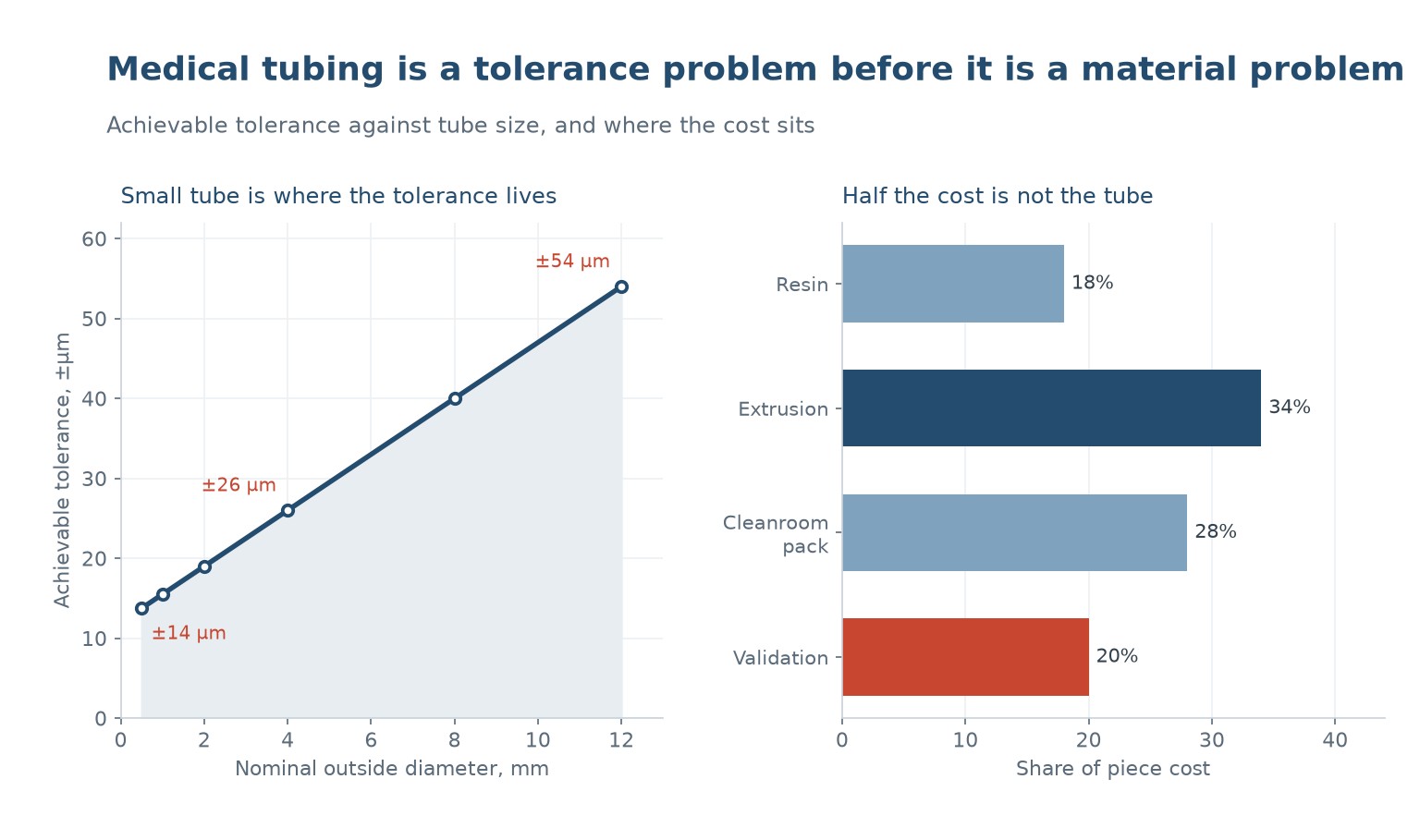
Table 1 - Achievable outside diameter tolerance on a closed-loop gauged PEBA or TPU line. Wall tolerance is normally 1.5 to 2 times the OD tolerance on the same tube.
The shape of that table matters more than the numbers. The tolerance is not a percentage of diameter: it has a fixed floor from gauge resolution, die concentricity and haul-off variation, plus a term that grows with size. That is why a 0.5 mm tube at plus or minus 14 microns is 2.8 percent of its diameter, while a 12 mm tube at plus or minus 54 microns is 0.45 percent.
It also explains why the small sizes are the expensive ones. A plus or minus 14 micron tolerance needs a process standard deviation below 4.7 microns to reach a Cpk of 1.33. That is a laser gauge sampling at 1 kHz with a closed loop on the puller, not a micrometer and a good attitude.
The lumen that must stay round
A tube can be perfectly on size and completely unusable. If the lumen has collapsed into an oval, a guidewire will not pass, a connector will not seal, and the part fails in the customer's hands rather than in inspection. Roundness is a separate specification from diameter and it is usually the one that is missing from the drawing.
The causes are mechanical. Insufficient internal air pressure lets the lumen collapse under the puller tension. Vacuum sizing applied to the outside without pressure inside pulls the wall inward. A die with poor concentricity produces a thin side that ovalises first. Water bath turbulence and a long unsupported span both add to it.
- Internal air pressure 0.2 to 0.6 bar, held by a precision regulator and a rotary union at the die. A needle valve alone drifts with temperature.
- Vacuum sizing only for the outside, with the lumen positively pressurised at the same time. Never size a lumen with vacuum.
- Die concentricity within 5 percent of wall thickness. Measure it by extruding a short length and sectioning, not by looking at the die.
- Puller tension constant. A dancer or a load cell in the loop, not a fixed motor speed.
- Water bath 15 to 25 C with laminar flow, and the first 100 mm of the bath still, so the tube sets before it is disturbed.
Measure roundness on a cross-section under a microscope, or with a rotating laser gauge that scans the tube as it turns. A two-axis gauge that measures height and width only will miss a three-lobed lumen, which is the shape a badly balanced die produces.
Resin choice: five materials and what each is for
Medical tubing is dominated by plasticised PVC for single-use devices, and by PEBA and TPU where flexibility has to survive repeated flexing. Beyond that the list is short and each entry has a specific reason.
| Material | Hardness range | Service temperature | Sterilisation | Bonding | Cost index |
|---|---|---|---|---|---|
| Plasticised PVC | 55A to 85A | 60 C | EtO, gamma with yellowing | Solvent, cyclohexanone | 1.0 |
| PEBA | 25D to 72D | 90 to 100 C | EtO, gamma | Heat, adhesive, overmould | 4.5 |
| TPU | 75A to 75D | 80 to 100 C | EtO, gamma | Solvent, RF welding | 3.0 |
| HDPE | 95A to 60D | 80 C | EtO, gamma | Heat, adhesive | 1.2 |
| PEEK | 100R | 250 C | Autoclave, 1,000 cycles | Adhesive only | 25 |
| Silicona | 30A to 70A | 200 C | Autoclave, gamma | Primer and adhesive | 6 |
Table 2 - Medical tubing materials. Cost index is relative to plasticised PVC at equal wall, before cleanroom and validation.
PVC is still the default because it bonds with a solvent, welds with RF, is clear, and costs a quarter of PEBA. The plasticiser question moved most of the market from DEHP to DEHT and DOTP rather than away from PVC, and to TPU or PEBA where the device needs more than a few hours of blood contact or repeated clamping.
PEBA is the material for catheter shafts: 25D to 72D covers a soft tip and a stiff proximal section in one extrusion, and it can be overmoulded to a hub without an adhesive. It is also four and a half times the price of PVC, which is why it appears only where the function requires it.
Cleanroom, not just a clean room
Extrusion is a dirty process dressed as a clean one. It generates heat, volatiles from the melt, and dust from resin handling. Putting an extruder in a room with a filter in the ceiling does not make it clean; the room has to be designed around the machine.
The usual arrangement is ISO 8 for the extruder, with the die head penetrating the wall so that the tube emerges into an ISO 7 take-off and packaging area. Material enters through an airlock or a closed transfer system, and the line is designed with smooth surfaces so that it can actually be cleaned rather than merely wiped.
Particle count is the visible number, but bioburden is the one that decides whether a lot ships. Monitor it monthly, set an alert limit at half the specification, and investigate the alert rather than the excursion, because by the time you have an excursion you have already made the product.
What validation actually requires
Validation is not a document set that follows a good process. It is the evidence that the process is under control at the edges of its window, and it is designed before the first run.
- Installation qualification: the machine, the utilities, the drawings, the calibration of every gauge that will produce a number.
- Operational qualification: demonstrate the process at the edges, not at nominal. High and low melt temperature, high and low line speed, high and low vacuum, each held long enough to produce a lot.
- Performance qualification: three runs at nominal, with Cpk on every critical dimension. 1.33 is the usual threshold, 1.67 for a safety-critical dimension.
- Test method validation: gauge repeatability and reproducibility under 10 percent, or under 30 percent with a written justification.
- Biocompatibility per ISO 10993-1, by contact category and duration, on the finished sterilised device.
- Sterile barrier packaging per ISO 11607 if the tube is supplied sterile, including seal strength and ageing.
The trap is a process that runs beautifully at nominal and fails at the edge. That is not a validation failure, it is a validation that worked: the edge is where you find out that the window is narrower than the drawing assumes, while you still have time to widen it.
Where the cost sits
The cost breakdown of a medical tube surprises almost every buyer. The resin, which is the thing the tube is made of, is the smallest line.
| Cost element | Share of piece cost | What drives it |
|---|---|---|
| Resin | 18 percent | Material choice and wall section |
| Extrusión | 34 percent | Line speed, gauge, scrap rate |
| Cleanroom and packaging | 28 percent | Class, bagging, lot size |
| Validation and quality | 20 percent | Test set, documentation, release |
Table 3 - Share of piece cost for a 1.0 mm PEBA tube in a 10,000 piece lot, ISO 8 extrusion, double bagged.
Two consequences follow. First, choosing a more expensive resin to avoid a validation problem is usually the cheaper decision: a 4 euro per kilogram premium on a 2 gram tube is eight tenths of a cent, while a failed validation is a quarter. Second, lot size dominates the cleanroom and validation share. At 1,000 pieces those two lines are over 60 percent of the price; at 100,000 they are under 5 percent.
This is why medical tubing quotations are so sensitive to annual volume and so insensitive to tube size. The buyer who asks for 500 pieces of a 0.5 mm tube is buying validation, and the tube comes with it.
Inspection that finds the failure
The inspection plan should be built around the failure modes, not around the drawing dimensions. For medical tube the failure modes are an out-of-tolerance diameter, an oval lumen, a thin wall on one side, a blocked lumen, and a weld or a splice that should not be there.
- Laser OD gauge, 100 percent inline, closed loop on the puller. Log it; the trend is more useful than the pass or fail.
- Ultrasonic wall thickness at intervals, or a second laser pair for ovality on the larger sizes.
- Air flow or pressure decay test on every reel for lumen patency, which catches a blocked or collapsed section that a diameter gauge cannot see.
- Visual on a light table for gels, black specks and die lines, at a defined sampling rate.
- Tensile and elongation on a sample per lot, and a solvent bond test on a bonded assembly if the customer bonds.
What tolerance can be held on a 0.5 mm medical tube?
Plus or minus 14 microns with a closed-loop laser gauge and a stable line. Without the closed loop the practical figure is plus or minus 25 microns, and a manual micrometer cannot resolve the difference at that size.
Can you extrude a multi-lumen tube?
Yes, with a multi-orifice die. The difficulty is balancing flow between lumens of different size, and the inspection problem is that a partially blocked lumen looks identical to a good one from outside.
What is the difference between ISO 8 and ISO 7?
Particle count at 0.5 microns and above: 3,520,000 per cubic metre for ISO 8 against 352,000 for ISO 7. The practical difference is the air change rate, the filter class and the gowning.
Does medical tubing need to be gamma stable?
Only if it will be gamma sterilised. Gamma causes yellowing and crosslinking in PVC and some TPUs, and it can embrittle an under-cured part. Specify the sterilisation route before choosing the resin.
Why is medical tubing so much more expensive than industrial tubing?
Validation, cleanroom and lot size, not resin. On a 10,000 piece lot, resin is under a fifth of the price and validation plus cleanroom is nearly half.
Can medical tube be braided or reinforced?
Yes, either over a mandrel with a braid and a second jacket, or inline with a wire or fibre braider between two extruders. Reinforced tube is a different process with a different tolerance stack.
Developing a medical tube or catheter shaft?
Tell us the tolerance, the lumen geometry and the sterilisation route. We will tell you whether the tolerance is achievable on a closed-loop line and what the validation will cost before you commit.




 ES
 EN
 FR
 DE
 PT
 AR
 RU
 JA
 KO
 IT
 NL
 TR
 PL
 ID
