
Startup is where the scrap is
An extrusion line that runs for a week produces most of its scrap in the first half hour. The die is cold, the melt is cold, the screw is empty and the downstream is not synchronised. Every one of those conditions produces product that has to be thrown away.
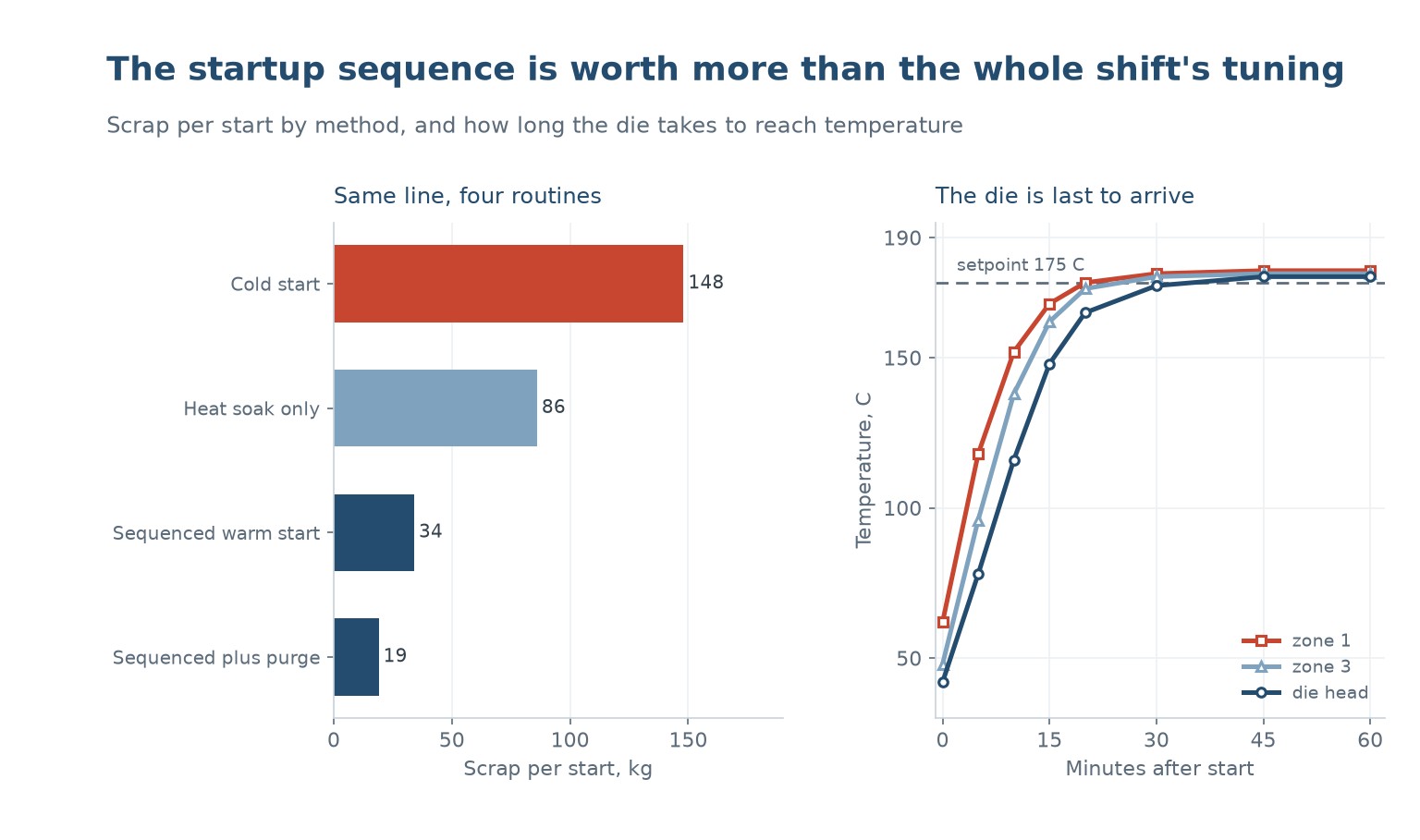
Measured on a 40 mm PVC pipe line, a cold start produced 148 kilograms of scrap before the product was in specification. A heat soak with no other change produced 86. A sequenced warm start produced 34, and a sequenced warm start with a purge produced 19.
The difference between the first and the last is 129 kilograms per start. On a line that starts twice a week, that is 13 tonnes a year, which is more than the annual maintenance budget of most lines.
None of the four routines requires new equipment. They differ in the order of operations and in how long the line is allowed to sit before anyone touches the haul-off.
Heat soak is not optional
A barrel that reads its setpoint on the controller is not at its setpoint. The heater bands heat the outside of the barrel, the thermocouple sits in the wall, and the melt in the middle is still cold. The soak time is what lets the heat conduct inward.
For a 40 mm barrel the soak is 30 to 45 minutes after the zones reach temperature. For a 90 mm barrel it is 90 minutes. The rule of thumb is one minute per millimetre of barrel diameter, and it is a rule worth following.
The die is worse. It has more mass, more surface area to lose heat, and its temperature is measured at one point. Measured on a 40 mm line, the die head reached 175 C about 45 minutes after the barrel zones, and it was still climbing at the hour mark.
A start that begins before the die is soaked produces a product with a cold skin, a rough surface and a wall that is out of tolerance. It also produces a surge when the cold material finally melts and the pressure drops, which is the point where the operator usually turns the screw up and makes it worse.
The sequence
The sequence that produces the least scrap is: heat the barrel and die, soak, start the screw at low speed with the die open, purge until the melt is clean, fit the die and sizing, establish the pull, then bring the line up to speed in steps.
The order matters because each step depends on the one before. Starting the screw before the soak gives cold melt that stalls the screw and can damage it. Fitting the sizing before the melt is clean packs contamination into the calibrator, which then has to be stripped.
The purge is the step most often skipped. It costs a few kilograms of material and five minutes, and it removes the degraded material that has been sitting in the barrel since the last shutdown. That material is the main source of the black specks that appear in the first hundred metres.
Bringing the line up to speed in steps matters because the wall and the dimensions are speed-dependent. Going from zero to full speed in one move produces a section that is out of tolerance for the first few minutes, and the operator then chases it with temperature, which is the wrong control.
| Paso | Typical time | What it prevents |
|---|---|---|
| Heat barrel and die | 20 min | Cold melt, stalled screw |
| Soak | 30 - 90 min | Cold core, pressure surge |
| Start screw slowly | 5 min | Screw damage, surge |
| Purge until clean | 5 min | Black specks, contamination |
| Fit die and sizing | 15 min | Packed calibrator |
| Establish pull | 10 min | Ovality, wall drift |
| Step up to speed | 10 min | Out-of-tolerance section |
Table 1 — A startup sequence and what each step prevents
Purging, and what to purge with
A purge compound is a high-viscosity material that scrubs the barrel and carries the degraded residue out with it. It is not the same as running production material through, which smears the residue along the barrel instead of removing it.
The purge should be run until the extrudate is uniform in colour and free of specks, which usually takes two to three barrel volumes. On a 40 mm line that is about 5 kilograms; on a 90 mm line it is 40.
The die has to be purged too, and that is where most of the contamination hides. The die has corners, dead spots and a screen pack that collects everything. Pulling the screen pack and cleaning it at every start is worth more than any amount of barrel purging.
The purge material itself has to be removed before production. A slug of purge compound in the first metres of product is a reject, and it also contaminates the sizing sleeve. Running production material for a minute after the purge, with the die off, clears it.
Establishing the pull
The pull is the moment the product first goes through the sizing and into the haul-off. It is the most delicate part of the start, because the product is soft, the sizing is cold and the haul-off is not yet synchronised.
The sequence that works is to start the haul-off slowly, below the target speed, and let the product establish itself in the sizing before increasing. Starting at target speed pulls the soft product through too fast, thins the wall and produces an oval section that then has to be corrected.
The vacuum on the sizing should be applied gradually. Full vacuum on a soft product pulls it into the slots and leaves marks; vacuum applied as the product stiffens holds it without marking. The same applies to the water spray, which should come on as the product reaches the tank.
The first length should be measured, not assumed. Cut a sample as soon as the product is stable, measure the wall and the dimensions, and set the haul-off from the measurement. That is the same procedure as a production change, and it is the only way to know where the line actually is.
Recording the start
A start that is not recorded is a start that will be different next time. The record should include the soak time, the actual die temperature at the moment of the pull, the purge quantity, the haul-off speed at each step and the wall at the first measurement.
The most useful single number is the die temperature at the pull. If the line starts well at 178 C and badly at 168, that number tells the next operator when to start. A controller setpoint of 175 does not, because the die lags the controller by half an hour.
The second most useful number is the scrap weight per start. It is easy to measure, it is comparable across shifts, and it turns startup from an art into a number that can be improved. A line that tracks it will halve it within a month.
The record should be attached to the line, not filed in an office. A laminated card at the control panel with the sequence and the key numbers is used; a binder in the supervisor's office is not.
Shutdown decides the next start
A clean shutdown is half of a clean start. Running the barrel empty, purging with a compound that does not degrade, and leaving the die and screen pack clean removes most of what makes the next start slow.
Leaving production material in the barrel over a weekend is the usual practice and the usual cause of black specks on Monday. The material degrades in the hot barrel, and the degraded layer has to be purged out before good product can be made.
If the line will be down for more than a day, drop the temperatures rather than holding them. A barrel held at production temperature for 48 hours will degrade material even with a purge in it. Dropping to 120 C costs a longer heat-up and saves the material.
The screen pack should be changed at shutdown, not at startup. Changing it at startup adds fifteen minutes to the critical path; changing it at shutdown adds nothing, because the line is stopping anyway.
| Shutdown practice | Effect on the next start |
|---|---|
| Barrel left full and hot | Black specks for the first 100 m |
| Purged and empty | Clean melt within minutes |
| Screen pack changed | No startup pressure spike |
| Die left on and hot | Degraded material in the corners |
| Temperatures dropped to 120 C | Longer heat-up, clean barrel |
| Sizing drained and cleaned | No marks on the first metres |
Table 2 — Shutdown practice and what it costs at the next start
How long should an extruder heat soak?
About one minute per millimetre of barrel diameter: 30 to 45 minutes for a 40 mm barrel, 90 minutes for a 90 mm one. The die needs longer than the barrel.
Why does my line produce black specks at startup?
Degraded material left in the barrel and the die from the last shutdown. A proper purge and a clean screen pack remove it; running production material through does not.
Should I purge at every start?
Yes, if the line has been down for more than a few hours. The purge costs a few kilograms and saves the first hundred metres of product.
What speed should I start the haul-off at?
Below target, then step up. Starting at full speed pulls soft product through the sizing too fast and thins the wall.
How much scrap should a start produce?
About 20 kilograms on a 40 mm pipe line with a sequenced warm start and a purge, against 148 for a cold start.
When should I change the screen pack?
At shutdown, not at startup. At shutdown it costs nothing; at startup it adds fifteen minutes to the critical path.
A line that loses a shift to every start?
Tell us the line, the material and the current routine. We will look at the soak, the purge and the pull sequence and tell you where the scrap is coming from.




 ES
 EN
 FR
 DE
 PT
 AR
 RU
 JA
 KO
 IT
 NL
 TR
 PL
 ID
