
Air is two orders of magnitude behind water
Air cooling is attractive because it is clean, dry, cheap to install and does not need a trough, a chiller or a water treatment plant. It is unattractive because air is a terrible heat transfer medium.
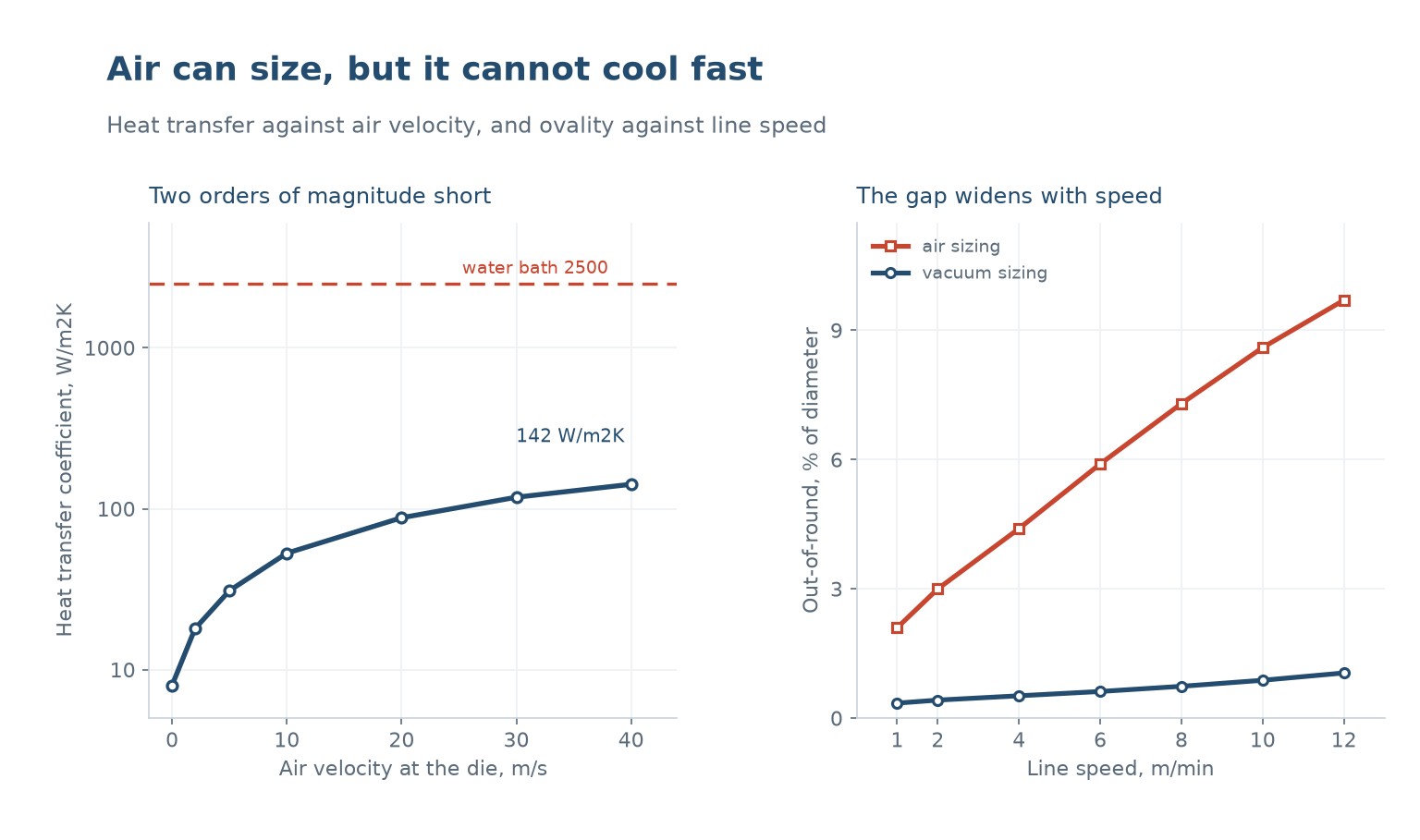
Measured at the die on a 40 mm profile, the heat transfer coefficient was 8 watts per square metre kelvin in still air, 18 at 2 metres per second, 31 at 5, 53 at 10, 88 at 20, 118 at 30 and 142 at 40. A water trough running at 0.4 metres per second gives about 2500.
That is a factor of 18 at the very best air velocity and a factor of 300 at a typical one. No amount of fan power closes a gap of that size, because the limit is the thermal conductivity of air, not the speed at which it arrives.
So the question is never can air cool this profile as fast as water. It cannot. The question is whether the profile needs fast cooling at all, and there are cases where it does not.
When air sizing is the right answer
Air sizing is right when the profile is thin, when the material is sensitive to water, when the surface must stay dry, or when touching the profile would mark it.
Thin profiles are the classic case. A 0.5 mm wall has so little heat to remove that a short air ring is enough, and the alternative, a water trough, would need a sizing sleeve that is harder to make than the die.
Water-sensitive materials are the second case. PA and some TPU grades pick up moisture, and a trough means a drying step afterwards. Air avoids the drying and the moisture, at the cost of speed.
Medical tubing and some optical profiles are the third case, because a water mark on the surface is a reject. Air leaves nothing behind, so the surface is whatever the die produced.
| Situation | Aire | Water | Verdict |
|---|---|---|---|
| 0.5 mm wall, small profile | Enough cooling | Overkill | Aire |
| PA or TPU, moisture sensitive | No drying needed | Needs a dryer | Aire |
| Optical or medical surface | No marks | Water marks | Aire |
| 3 mm wall pipe at 3 m/min | Cannot keep up | Comfortable | Water |
| Tight ovality at speed | Pobre | Bien | Water |
Table 1 — When each method is the right one
Air holds shape badly, and that is the real limit
The cooling gap is obvious. The shape gap is the one that surprises people. Air cannot support a soft profile, so an air-sized profile is held only by its own stiffness until it is cool enough to stand up.
Measured as out-of-round on a 40 mm tube, air sizing gave 2.1 percent at 1 metre per minute, 3.0 at 2, 4.4 at 4, 5.9 at 6, 7.3 at 8, 8.6 at 10 and 9.7 at 12. Vacuum sizing over the same speeds gave 0.35, 0.42, 0.52, 0.62, 0.74, 0.88 and 1.05.
At one metre per minute the difference is a factor of six. At twelve it is a factor of nine, because the air-sized profile has less time to stiffen before the haul-off pulls it and the sag accumulates.
That is why air sizing is used on small, thick-walled, self-supporting profiles and on shapes where a vacuum slot cannot be placed. It is not used where the tolerance is tight and the speed is high, because both of those push in the same direction.
What an air ring has to do
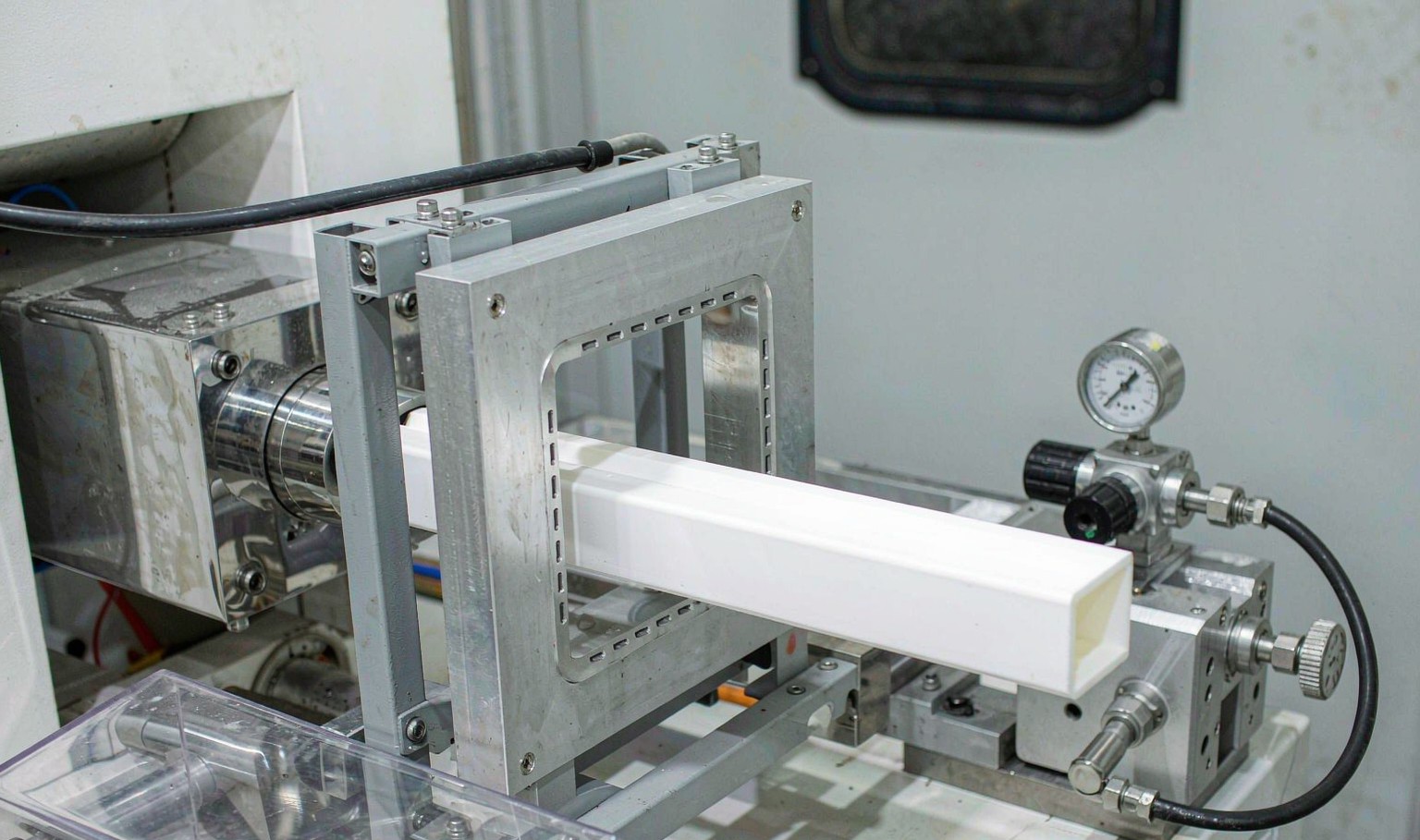
An air ring is a manifold with slots. Its job is to deliver an even curtain of air at a controlled velocity onto every face of the profile, without touching it. Uneven air is uneven cooling, and uneven cooling is a bend.
The slots have to be sized for the flow, not for the pressure. A ring with 30 small slots and one with 8 large slots at the same supply pressure deliver very different velocities, and the velocity is what sets the heat transfer.
The ring also has to be adjustable in position. The distance from the die sets how much the profile has cooled before it is blown, and the angle sets whether the air scrubs along the surface or hits it square. Both change the result, and neither is on most drawings.
The most common fault is a ring that is too close to the die. It cools the surface hard while the core is still molten, which sets up a stress gradient and a curl that shows up two metres downstream.
| Ring setting | Typical value | Effect |
|---|---|---|
| Distance from die | 80 to 150 mm | Too close: skin stress and curl |
| Slot velocity | 20 to 40 m/s | Too low: no cooling. Too high: noise and marking |
| Air temperature | Ambient | Cold air helps marginally, dry air helps more |
| Slot evenness | Within 10 percent | Uneven slots bend the profile |
| Ring alignment | Concentric to 1 mm | Offset ring cools one side first |
Table 2 — Air ring settings and what they change
The hybrid that usually wins
The most common good answer is not air or water. It is an air ring at the die to hold the shape while the skin sets, followed by a short water trough or a spray section to remove the rest of the heat.
The air ring does the job water is bad at, which is holding a soft profile without touching it or marking it. The water does the job air is bad at, which is removing heat quickly once the shape is set.
The split is usually 100 to 200 mm of air and then the trough. That is long enough for the skin to become self-supporting and short enough that the profile is still warm enough for the vacuum to pull it into the sizing sleeve.
The economics are also better than either alone. The air ring is cheap, the trough is the expensive part, and a hybrid lets a short trough do the work of a long one because the profile enters it already partly cooled and already round.
How to choose without guessing
Start with the wall. Under about 1 mm, air is often enough. Over about 2 mm at any real line speed, water is the only option and the question becomes how to size it.
Then look at the tolerance. If the out-of-round allowance is under 1 percent, vacuum sizing is the answer, and air is not in the running at any speed above 2 metres per minute.
Then look at the material. If it is moisture sensitive or the surface cannot be marked, air enters the picture even at a wall thickness where it would otherwise lose.
Then look at the line speed you actually intend to run, not the one on the nameplate. Air sizing degrades with speed faster than water sizing, so a line that works at 3 metres per minute may not work at 6.
Can air cooling replace a water trough?
Only on thin profiles, moisture-sensitive materials or surfaces that cannot be marked. Air reaches 142 watts per square metre kelvin where water reaches 2500.
Why does air sizing give poor ovality?
Air cannot support a soft profile, so the shape is held only by the material's own stiffness until it cools. Out-of-round was 2.1 percent at 1 metre per minute and 9.7 at 12.
How far should an air ring be from the die?
Usually 80 to 150 mm. Closer than that cools the skin hard while the core is molten and sets up a curl that appears downstream.
What air velocity should an air ring run at?
20 to 40 metres per second at the slot. Below 20 there is little cooling; above 40 the noise and the marking become the problem.
Is a hybrid air and water line worth it?
Often yes. An air ring at the die holds the shape without touching it, and a short trough then removes the heat, so the trough can be shorter than a water-only line would need.
Does cold air help?
Marginally. Dry air helps more, because moisture in the air condenses on the profile and leaves marks that are hard to remove.
A profile that will not stay round at speed?
Send the section drawing, the material, the wall thickness and the line speed. We will tell you whether air, water or a hybrid is the right answer and what the ring should look like.




 ES
 EN
 FR
 DE
 PT
 AR
 RU
 JA
 KO
 IT
 NL
 TR
 PL
 ID
