
Half the cycle is cooling
A thermoforming cycle is heating, forming and cooling. Heating is the part everyone watches, because the heaters are visible and the sheet changes colour. Cooling is the part that decides the cycle time, because a formed part cannot be demoulded until it is stiff enough to hold its shape, and that takes longer than most people expect.
On a thin-gauge line, cooling is typically 40 to 60 percent of the cycle. On a heavy-gauge part it can be 70 percent, because the heat has to travel out through a thick section. The tool is cold, the part is hot, and the rate is set by conduction through the sheet.
That is why the single most effective cycle-time change is not a faster heater or a higher vacuum. It is a colder tool, a better contact between the sheet and the tool, or a thinner sheet.
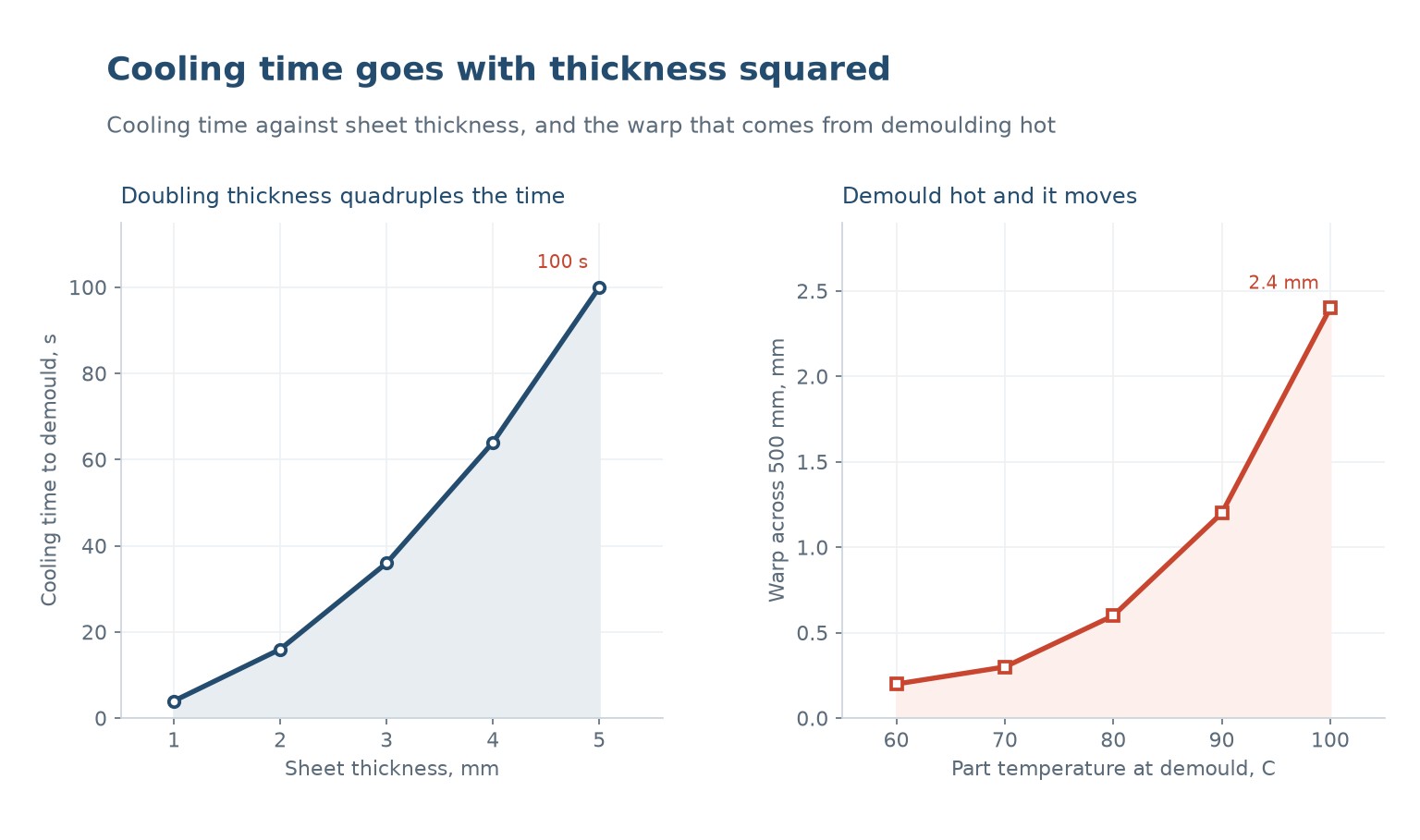
Cooling time goes with thickness squared
Heat conduction through a slab takes time proportional to the square of its thickness. A 1 mm polypropylene sheet that cools to demould temperature in 4 seconds takes 16 at 2 mm, 36 at 3 mm, 64 at 4 mm and 100 at 5 mm.
The practical consequence is that a small increase in sheet thickness costs a large increase in cycle time. Going from 1.5 to 2.0 mm is a 33 percent material increase and a 78 percent cooling increase. That is why a part designed to a 1.5 mm sheet runs so much faster than the same part in 2 mm, and why a thicker sheet is never a cheap way to fix a weak part.
The same relationship explains why cooling dominates heavy-gauge work. A 6 mm sheet takes 144 seconds to cool where a 1 mm sheet takes 4, so a heavy-gauge machine is designed around cooling and a thin-gauge machine is designed around heating.
| Sheet thickness | Abkühlungszeit | Relative | Cycle share |
|---|---|---|---|
| 1 mm | 4 s | 1.0 | About 40 percent |
| 2 mm | 16 s | 4.0 | About 55 percent |
| 3 mm | 36 s | 9.0 | About 65 percent |
| 4 mm | 64 s | 16 | About 70 percent |
| 5 mm | 100 s | 25 | About 75 percent |
Table 1 — Cooling time to demould against sheet thickness, and its share of the cycle.
Demould temperature decides the warp
A part demoulded at 60 C is stiff enough to hold its shape. One demoulded at 100 C is not, and it continues to shrink after it leaves the tool, differentially, because the thick and thin sections cool at different rates. On a 500 mm part the difference is 0.2 mm of warp at 60 C against 2.4 mm at 100.
The relationship is not linear. From 60 to 70 C the warp goes from 0.2 to 0.3, from 70 to 80 it goes to 0.6, from 80 to 90 to 1.2 and from 90 to 100 to 2.4. Each ten degrees doubles the warp, because the part is approaching the temperature where the polymer still has enough mobility to move under its own shrinkage stress.
This is why a cycle-time reduction that comes from demoulding earlier is often a false economy. The parts come off faster and then fail a flatness check, or they pass on the bench and warp in the customer's warehouse. The demould temperature is a specification, not a machine setting.
Air cooling against contact cooling
A formed part cools by three routes: conduction into the tool where it touches, convection into the air where it does not, and radiation. Conduction is by far the fastest, so the parts of the sheet that are in contact with the mould cool quickly and the parts that are not stay hot.
That is why vacuum is used on the cooling side as much as the forming side. Holding the sheet against the tool with vacuum keeps the contact, and contact is what removes heat. A part that loses vacuum early cools slowly and warps, even though the forming was correct.
Air assist on the non-tool side is the other lever. Blowing cool air onto the exposed face increases the convective coefficient and shortens the cycle, at the cost of a blower and a nozzle design. On a thick part it can take 15 to 20 percent off the cooling time, which is worth having if the part is otherwise limited by cooling.
| Route | Share of heat removed | How to improve it | Kosten |
|---|---|---|---|
| Conduction into the tool | 70 to 80 percent | Vacuum hold, colder tool, better contact | Niedrig |
| Convection to the air | 15 to 25 percent | Air assist nozzles, cooler shop | Mittel |
| Strahlung | 5 percent | Nothing practical | None |
Table 2 — Where the heat actually goes, and what each route is worth.
The jig and the shrink
A thermoformed part shrinks as it cools, and it shrinks more in the flow direction than across it. The mould is made oversize to compensate, and the allowance is 0.5 to 2 percent depending on the material, with polypropylene at the top of that range and polycarbonate at the bottom.
For parts with a tight dimensional requirement, the answer is a cooling jig: a fixture that holds the part in its correct shape while it cools below the point where it can move. A jig costs a tool and adds handling, and it is the only way to hold a flatness tolerance on a large thin part.
The jig has to be designed for the shrink, not against it. A jig that clamps the part at its moulded size will fight the shrink and leave the part stressed; a jig that allows the part to shrink into a controlled shape lets it relax. The difference is a few millimetres of clearance and a lot of scrap.
What to specify
Cooling is a process parameter, but it becomes a specification when the part has a dimensional requirement.
- Demould temperature, quoted as a maximum, and the method used to check it.
- Flatness or warp tolerance, and whether a cooling jig is part of the process.
- Shrink allowance and the direction it applies to.
- Cycle time expectation, so a quote can be compared with a real cycle.
- Whether air assist is available, which changes the achievable cycle.
- Sheet thickness tolerance, because cooling time goes with its square.
The demould temperature is the item that should be on every drawing and almost never is. It is the single number that separates a part that holds its shape from one that is measured on the bench and warped in the warehouse.
How long does a thermoformed part take to cool?
About 4 seconds for a 1 mm sheet and 100 seconds for a 5 mm sheet, because cooling time goes with the square of thickness. On thin-gauge work it is 40 to 60 percent of the cycle.
Why does a thicker sheet cost so much cycle time?
Because conduction time scales with thickness squared. Going from 1.5 to 2.0 mm is 33 percent more material and 78 percent more cooling time.
What demould temperature should a formed part have?
Low enough that it is stiff, typically 60 C or below for polypropylene and ABS. Warp across 500 mm is 0.2 mm at 60 C and 2.4 mm at 100 C.
Why do my parts warp after they leave the machine?
Usually because they were demoulded too hot, or because vacuum was lost and the sheet came off the tool while it was still soft. Check the contact before adding cooling time.
Does air assist shorten the cycle?
Yes, by 15 to 20 percent on thick parts, because it raises the convective coefficient on the exposed face. It needs a blower and a designed nozzle.
What is a cooling jig for?
Holding a part in its correct shape while it cools below the temperature where it can move. It is the only way to hold flatness on a large thin part, and it has to allow for shrink rather than fight it.
Part warping or cycle time too long?
Send the sheet thickness, the material and the flatness tolerance. We will work out whether the limit is cooling, contact or the jig, and what cycle time is realistic.




 DE
 EN
 ES
 FR
 PT
 AR
 RU
 JA
 KO
 IT
 NL
 TR
 PL
 ID
