

Three ways to put colour into silicone
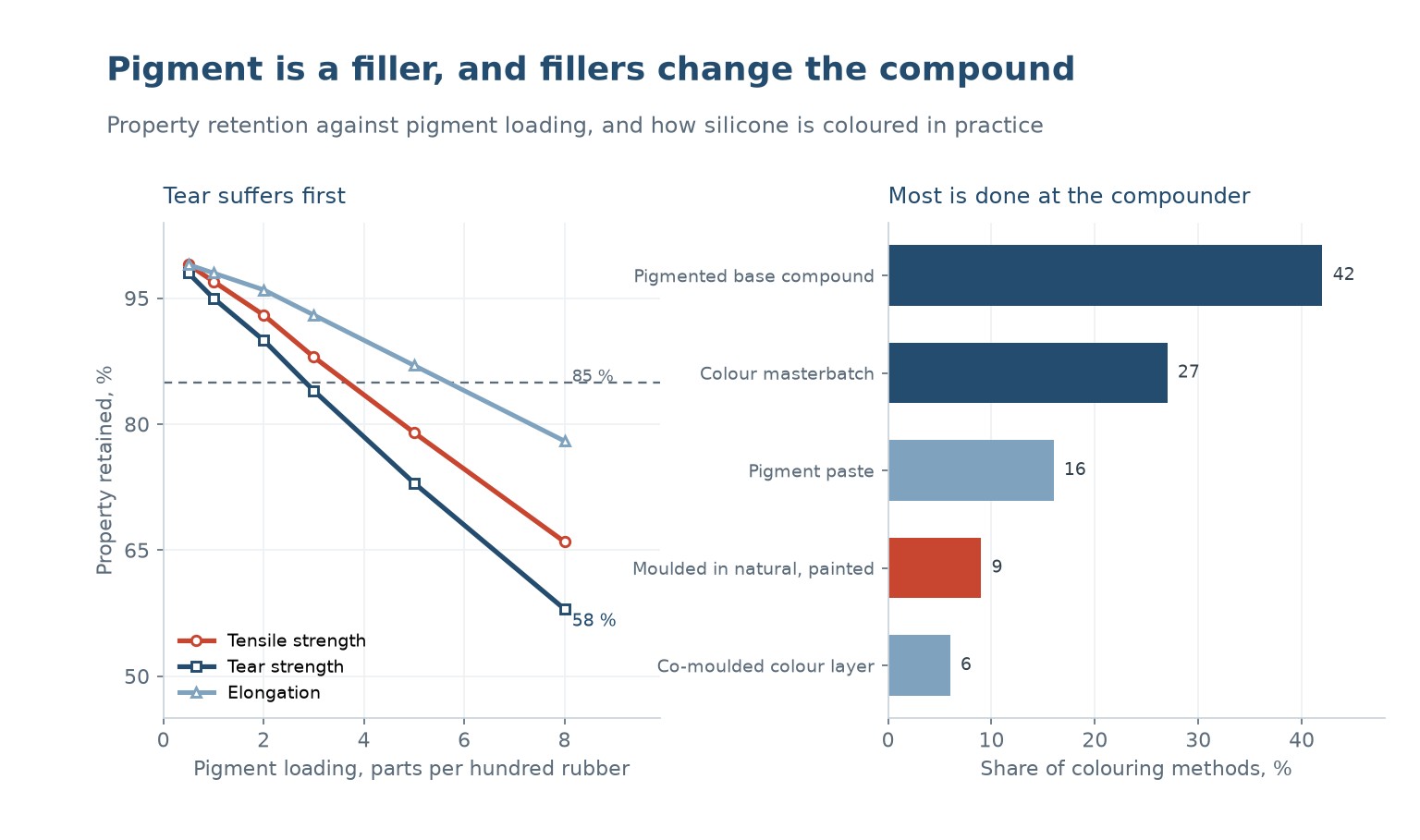
The most common is a pigmented base compound, bought ready coloured from the compounder. It accounts for about 42 percent of colouring in the survey on the right, and it is the most reliable route because the pigment is dispersed on a two roll mill under controlled conditions and the compound is tested as a whole.
The second is a colour masterbatch, added at the moulding machine at 2 to 5 percent. It is flexible, it allows a short colour change, and it is what most custom moulders use. Its weakness is dispersion: a masterbatch mixed in a short screw has less time to break down the pigment agglomerates than a compounder does on a mill.
The third is a pigment paste, added by hand or by a dosing pump at 1 to 3 percent. It is the cheapest way to make a small batch and the least consistent, because hand weighing and short mixing give variation between batches that shows up as colour drift.
Painting a natural part is the fourth option at 9 percent and is used where the colour has to be on a surface that cannot be moulded in it, or where the volume is too small to justify a coloured compound. It adds a process step and a failure mode: paint adhesion to silicone is poor without a primer.
Pigment is a filler, and fillers change the compound
The chart on the left plots property retention against pigment loading in parts per hundred rubber. At 0.5 phr the compound keeps 99 percent of its tensile strength and 98 percent of its tear strength. At 3 phr it keeps 88 and 84, and at 8 phr it keeps 66 and 58.
Tear strength falls fastest, because tear is controlled by the network's ability to redistribute stress around a flaw, and pigment particles are flaws. A compound with 8 phr of pigment has almost half the tear strength of the same compound uncoloured, which on a seal that is stretched over an edge is the difference between lasting and not.
The loading needed depends on the colour. White needs the most, because titanium dioxide has a low tinting strength in silicone and 5 to 8 phr is normal for an opaque white. Black needs the least, at 1 to 2 phr of carbon black. Bright reds and yellows sit in between and are the colours most often under loaded, which is why they look washed out.
That is the central compromise of colouring silicone: an opaque white is also a compound with 40 percent less tear strength, and a customer who asks for white and for a tear strength of 30 kN/m is asking for two things that fight each other.
Which pigments survive the cure
Silicone is cured at 120 to 170 C and post cured at 200 C, and not every pigment survives that. Some organic pigments decompose, some migrate, and some inhibit the platinum catalyst outright. A pigment that works in a thermoplastic may be unusable in an addition cured silicone.
Platinum cure inhibition is the specific hazard. Certain sulphur, phosphorus and amine containing compounds stop the hydrosilation reaction, and a pigment that contains traces of them will leave a tacky, uncured surface wherever it is concentrated. This is the same mechanism that makes sulphur contaminated gloves a problem, and it is worth asking the pigment supplier for a platinum cure compatibility statement.
Iron oxide pigments are the safest for high temperature work and are used for reds, browns and blacks. Titanium dioxide is standard for white and needs a surface treatment to avoid catalysing degradation. Phthalocyanine blues and greens are stable but can affect cure at high loading.
Fluorescent and metallic effects are a separate category. Fluorescent pigments are organic and fade under UV; metallic effects need a metallic powder that changes the compound's density and its tear behaviour. Both are possible and both should be tested on the actual part rather than on a plaque.
Dispersion is where colour goes wrong
An undispersed pigment leaves agglomerates, and agglomerates show as specks, streaks or a mottled surface. In a thin section they are worse, because there is less material to hide them and the forming or moulding flow spreads them into visible streaks.
The mixing method decides the dispersion. A two roll mill with a tight nip breaks agglomerates far better than a short screw, which is why compounder coloured material is more uniform than masterbatch coloured material. If a part is colour critical, the masterbatch route needs a screw with a mixing section and a longer residence time.
The other dispersion problem is batch to batch variation. A masterbatch diluted at 3 percent with a dosing accuracy of plus or minus 0.2 percent gives a colour variation of about 7 percent, which is close to a visible delta E of 1 on a large part. That is why colour critical parts are usually specified as compounder coloured.
| Methode | Dispersion | Colour consistency | Am besten für |
|---|---|---|---|
| Pigmented base compound | Best | Plus or minus 0.5 delta E | Colour critical, high volume |
| Colour masterbatch | Gut | Plus or minus 1.0 delta E | Short runs, colour changes |
| Pigment paste | Messe | Plus or minus 1.5 delta E | Small batches, samples |
| Painted natural part | Not applicable | Depends on the paint | Surface colour only |
Table 1 — Colouring routes and the consistency each delivers
Specifying a colour without losing the compound
The specification needs a colour target, a tolerance in delta E, a light source, and the properties that must be retained at that colour. The last item is the one that is usually missing, and it is the one that decides whether the part works.
State the minimum tear strength at the specified colour, not at the natural compound. A supplier who quotes 30 kN/m for the base compound and delivers a white part at 18 has met one specification and broken the other, and the argument is avoidable by writing both numbers on the drawing.
State the cure system as well. A peroxide cured compound tolerates pigments that an addition cured one does not, and a colour that works in one will fail in the other. If the part is platinum cured, say so, and ask for a compatibility statement with the pigment.
Finally, agree the approval sample. A colour approved on a 2 mm plaque will look different on a 6 mm moulded part, because the light path through the material changes. Approve the colour on the production geometry, in the production thickness, under the light the customer will use.
When the colour is wrong
A colour that is too pale usually means under loading, which is a dosing problem rather than a pigment problem. Check the masterbatch ratio first, then the dispersion, then whether the pigment is the one specified.
A colour that varies between batches means the dosing is unstable or the masterbatch itself varies. Weigh a sample of the masterbatch and check the pigment content, which is the fastest way to separate the two.
A surface that stays tacky after cure is platinum inhibition, and the pigment is the first suspect. Change to a known compatible pigment and re-test on the same compound before changing anything else.
A colour that fades in service is usually a UV problem rather than a pigment problem. Silicone itself is UV stable, but many organic pigments are not, and a part used outdoors needs a pigment chosen for lightfastness and, in some cases, a UV absorber in the compound.
| Symptom | Ursache | Check |
|---|---|---|
| Too pale | Under loading | Masterbatch ratio |
| Specks and streaks | Schlechte Dispersion | Mixing section, mill time |
| Batch to batch variation | Dosing or masterbatch | Weigh the masterbatch |
| Tacky surface after cure | Platinum inhibition | Pigment compatibility |
| Fading outdoors | Pigment lightfastness | UV stable pigment |
| Colour differs by thickness | Light path | Approve on production geometry |
Table 2 — Colour faults and what to check first
Does colour reduce the strength of silicone?
Yes. Pigment is a filler, and at 3 phr a typical compound keeps about 88 percent of its tensile strength and 84 percent of its tear strength. At 8 phr, which an opaque white may need, tear strength falls to about 58 percent.
What is the best way to colour silicone?
A pigmented base compound from the compounder, because the dispersion is done on a mill and the compound is tested as a whole. Masterbatch at the machine is more flexible but gives more variation and worse dispersion.
Why does my silicone stay tacky where the colour is?
Platinum cure inhibition by the pigment. Certain sulphur, phosphorus and amine compounds stop the hydrosilation reaction. Use a pigment with a platinum cure compatibility statement and re-test the compound.
How much pigment does white need?
Five to eight parts per hundred of titanium dioxide for an opaque white, which is the highest loading of any common colour. That is why white is the colour that most often loses tear strength.
Can silicone be painted instead of coloured?
It can, but adhesion is poor without a primer and the paint becomes a wear surface. Painting is used for surface colour on parts that cannot be moulded in the colour, not as a substitute for a coloured compound.
Why does the colour look different on a thick part?
Because the light path through the material is longer, so the pigment absorbs more and the part looks darker and more saturated. Approve the colour on the production thickness, not on a thin plaque.
Colour critical silicone part?
Send the colour target, the part thickness and the properties that matter. We will tell you which colouring route holds the compound and which one will cost you tear strength.




 DE
 EN
 ES
 FR
 PT
 AR
 RU
 JA
 KO
 IT
 NL
 TR
 PL
 ID
