
Cut on the line or off it
An extruded profile leaves the die as a continuous length, and something has to decide where it stops. There are two families of answer: cut on the line, with the saw travelling with the profile, or coil the profile and cut it off-line on a separate machine.
On-line cutting is the default for rigid profiles, because a rigid profile cannot be coiled. The saw is mounted on a carriage that clamps to the profile and travels with it during the cut, so the cut is square and the length is set by an encoder on the haul-off.
Off-line cutting is used for flexible profiles that can be coiled, and for short runs where setting up an on-line saw is not worth it. The length tolerance is worse because the profile has to be measured and positioned again, and the cut end is often less square.
Length tolerance by method
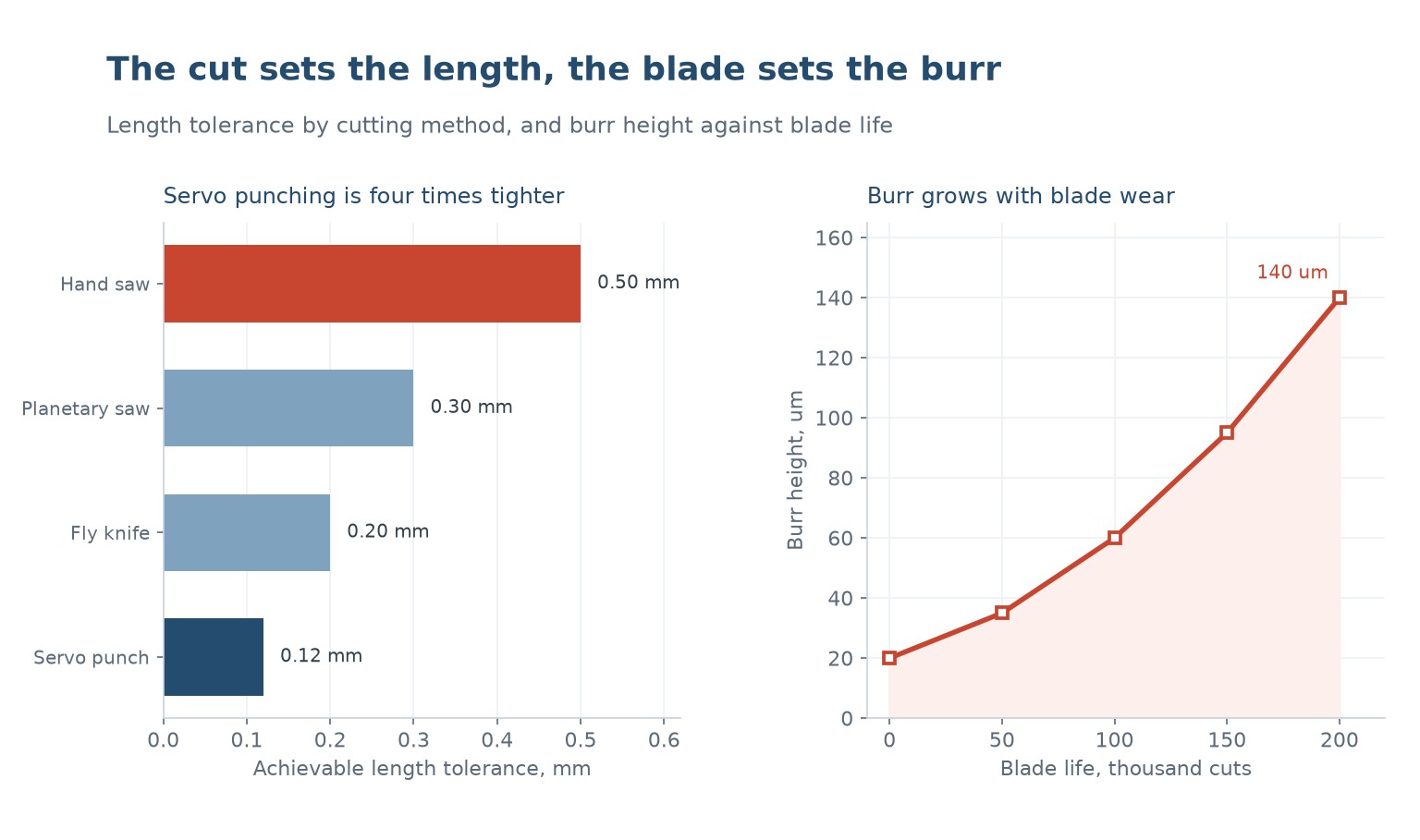
The cutting method sets the achievable length tolerance more than any other factor. A hand saw on a bench holds about 0.50 mm, a planetary saw on the line 0.30, a fly knife 0.20 and a servo-driven punch 0.12.
The differences come from how the profile is held and how the cut is triggered. A hand saw relies on a stop and an operator; a planetary saw orbits a blade around the profile so the cut is square regardless of the profile shape; a fly knife cuts with a rotating blade that matches the line speed; a servo punch positions the profile to an encoder and punches or shears in one motion.
The tolerance also depends on the profile. A thin-walled hollow section deflects under the clamp and cuts short; a thick solid section cuts to the encoder. On a 2 mm wall profile, the difference between a well-set clamp and a badly set one can be 0.1 mm of length on every piece.
| Methode | Length tolerance | Cut quality | Where it is used |
|---|---|---|---|
| Hand saw | +/- 0.50 mm | Rough, needs deburring | Site work, one-offs |
| Planetary saw | +/- 0.30 mm | Square, clean | General on-line cutting |
| Fly knife | +/- 0.20 mm | Clean, slight distortion | High speed, thin wall |
| Servo punch | +/- 0.12 mm | Clean, no swarf | Precision and notching |
Table 1 — Length tolerance and cut quality by cutting method.
Burr is a blade problem
A burr is material that has been pushed rather than cut. On a PVC profile it appears as a feather edge on the trailing side of the cut, and it is worse on a blade that is dull, on a blade with the wrong tooth geometry, and on a profile that is too warm when it is cut.
Blade wear is the dominant factor. Burr height goes from 20 micrometres on a new blade to 35 after 50,000 cuts, 60 after 100,000, 95 after 150,000 and 140 after 200,000. The progression is roughly linear, which means a blade change interval can be set from a burr specification rather than from a guess.
If the specification allows a 60 micrometre burr, the blade has to be changed at about 100,000 cuts. If it allows 35, the interval halves. That is the whole calculation, and it is worth doing because a blade changed on a schedule costs a few minutes and a blade changed on failure costs a batch of rejects.
Temperature matters as much as wear. A profile cut at 45 C cuts cleanly; the same profile cut at 65 C smears, because the material is soft enough to deform rather than fracture. Cooling the profile before the saw, or moving the saw further from the die, fixes a burr problem that no blade change will.
Punching: holes, notches and the web
Punching is used for holes, notches, drainage slots and screw ports, and it is done either in-line with a flying punch or off-line in a press. The tool is a matched punch and die with a clearance that depends on the wall thickness, typically 5 to 10 percent of the wall per side.
The failure mode is a tear rather than a cut. Too much clearance and the material tears instead of shearing, leaving a ragged edge and a stress concentration. Too little clearance and the punch wears quickly and the material picks up on the die. On a 2 mm PVC wall, a clearance of 0.10 to 0.15 mm per side is the usual starting point.
The web between two holes is the design constraint. A web narrower than about 1.5 times the wall thickness will distort or tear, and a web narrower than the wall thickness will fail. That is why a drainage slot pattern has to be designed around the punch, not drawn and then tooled.
| Merkmal | Minimum | Reason |
|---|---|---|
| Web between holes | 1.5 x wall | Below this the web tears |
| Hole diameter | 1.0 x wall | Smaller holes need a pin punch and wear fast |
| Edge distance | 1.0 x wall | Closer and the edge bulges |
| Corner radius on a notch | 0.5 x wall | A sharp corner is a crack starter |
| Punch clearance per side | 0.05 to 0.10 x wall | Too much tears, too little wears |
Table 2 — Minimum geometry for punched features in an extruded profile.
Handling and stacking
A cut profile that is stacked badly is scrap, whatever the tolerance was. Rigid profiles stacked flat and high will bow under their own weight in a warm warehouse; thin-wall profiles stacked on their cut ends will deform at the contact points.
The usual answer is to stack on a cradle with supports at 500 to 600 mm centres, and to keep the stack below about 1.2 metres. For long lengths, a stillage with end stops and a slight crown is better than a flat pallet, because it lets the profile settle into a curve rather than a kink.
Cut ends are the most vulnerable part of any profile. A burr left on a cut end will mark whatever it touches, and a cut end that is out of square will not fit a corner piece. Deburring is often skipped on the assumption that the customer will not notice, and it is the first thing a customer notices.
What to specify
A cut length is a specification, and a drawing that says only the nominal length will be supplied at whatever the saw happens to hold.
- Nominal length and tolerance, quoted as a bilateral figure in millimetres.
- Squareness of the cut end, usually as a maximum gap on a square.
- Burr height limit, and whether deburring is included.
- Hole and notch positions, with the tolerance on the position and on the size.
- Web width between holes, which has to be at least 1.5 times the wall.
- Stacking and packing method, if the profile is easily deformed.
The burr limit and the squareness are the two that get left off and cause the most complaints. Both are cheap to hold when they are specified and expensive to retrofit when they are not.
What length tolerance can a cut profile hold?
About 0.30 mm with a planetary saw, 0.20 with a fly knife and 0.12 with a servo punch. A hand saw holds 0.50 mm at best.
Why does my profile have a burr?
Usually a dull blade. Burr height goes from 20 to 140 micrometres over 200,000 cuts, so the blade change interval should be set from the burr specification.
Does cutting temperature affect burr?
Yes. A profile cut at 45 C cuts cleanly; at 65 C the material smears instead of fracturing. Cool the profile or move the saw away from the die.
What clearance should a punching tool have?
About 5 to 10 percent of the wall thickness per side, so 0.10 to 0.15 mm per side on a 2 mm PVC wall. Too much clearance tears, too little wears the punch.
How narrow can the web between two punched holes be?
At least 1.5 times the wall thickness. Narrower than that it distorts or tears, which is why the hole pattern has to be designed around the punch.
Should profiles be deburred?
If the cut end is visible or touches another part, yes. A burr marks whatever it contacts and prevents a corner piece from seating.
Need cut-to-length profiles with a burr limit?
Send the profile, the length and the burr and squareness you need. We will quote the cutting method that holds it and the blade schedule that keeps it there.




 DE
 EN
 ES
 FR
 PT
 AR
 RU
 JA
 KO
 IT
 NL
 TR
 PL
 ID
