
The gate is a throttle you design
Melt enters a cavity through a gate, and the gate is a restriction. Everything the part experiences downstream — pressure, shear, orientation, temperature — is set by how big that restriction is and where it sits. It is the smallest feature in the tool and the one with the largest effect on the part.
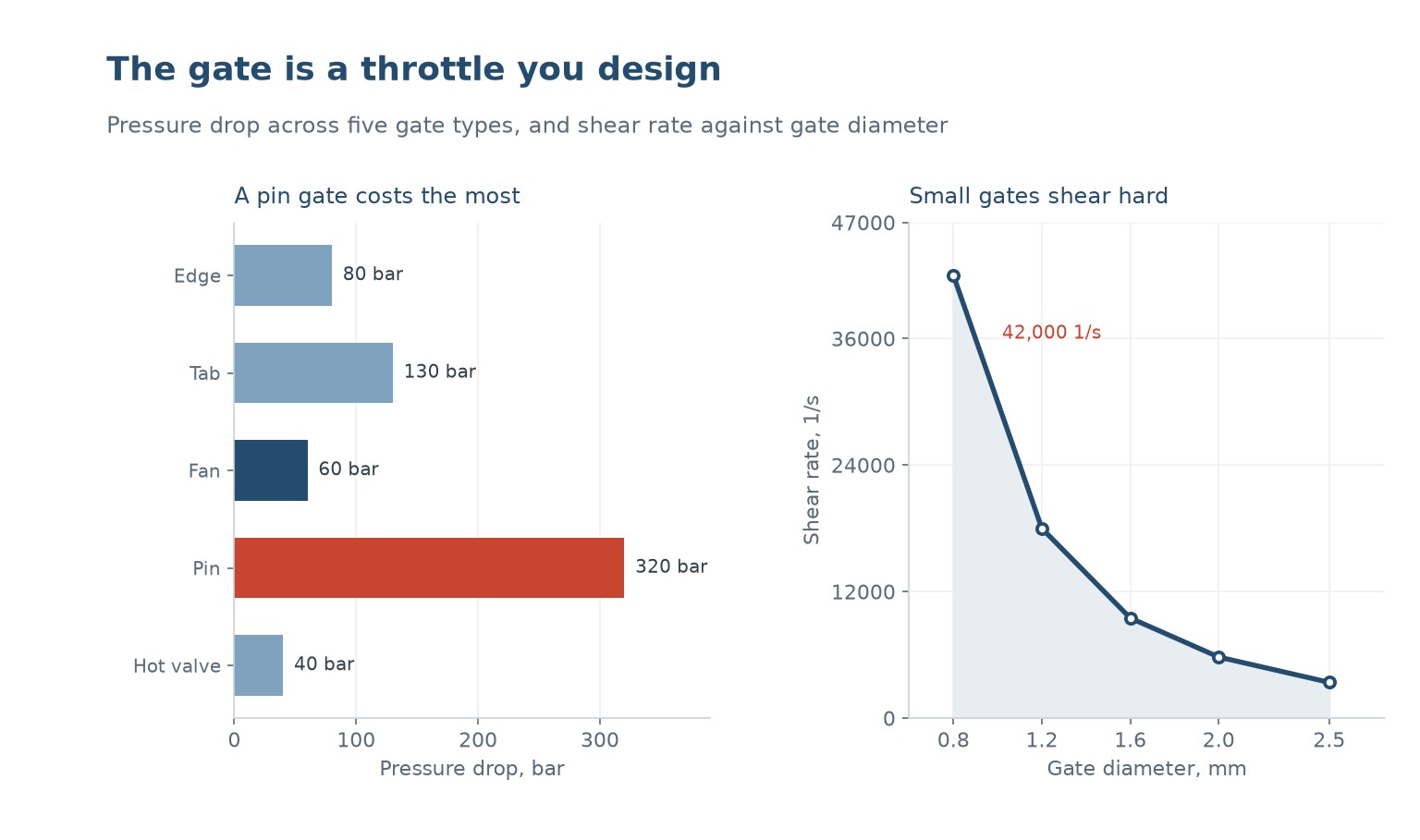
Pressure drop across the gate varies by a factor of eight between common types. An edge gate costs about 80 bar, a tab gate 130, a fan gate 60, a pin gate 320 and a hot valve gate 40. Those numbers are not a ranking of quality; they are a ranking of restriction, and the right choice depends on what the part needs.
A pin gate is restrictive because it is a small circular section feeding a large cavity, which is exactly what a multi-cavity tool needs to keep the runners small. It is also why pin-gated parts often show high orientation and a pronounced weld line opposite the gate: the melt arrives as a jet and has to spread.
Small gates shear the melt, and shear has a limit
Shear rate in a gate goes as the inverse cube of its diameter for a circular gate, so a small change in size is a large change in shear. At 0.8 mm the shear rate is about 42,000 per second; at 1.2 mm it is 18,000; at 1.6 mm 9,500; at 2.0 mm 5,800 and at 2.5 mm 3,400.
Every polymer has a shear rate above which it degrades, and the limit is different for each. Polypropylene tolerates more than polycarbonate; a glass-filled grade tolerates less than the unfilled version because the fibres concentrate the stress. Exceeding the limit shows up as splay, as a discoloured gate area, or as a weak point at the gate that fails in service.
This is the reason a gate cannot simply be made small to reduce the cosmetic witness mark. There is a floor set by the material, and the floor is usually higher than the cosmetic ideal. The compromise is a gate that is small enough to trim cleanly and large enough not to degrade, and that compromise is different for every polymer.
Position decides the weld line and the warp
The gate position sets the flow pattern, and the flow pattern sets the orientation, and the orientation sets the shrinkage, and the shrinkage sets the warp. A part gated at one end shrinks more along the flow than across it; a part gated at the centre shrinks more radially. Neither is wrong, and one of them will fit the assembly and the other will not.
The weld line is the other consequence. Where two flow fronts meet, the material is cooler and the molecules are not entangled across the interface, so the weld is weaker than the bulk. Putting the gate so that the weld falls in a low-stress region is one of the cheapest quality improvements available.
For a part with a hole or an insert, the flow splits around it and recombines behind it, which puts a weld line exactly where the stress concentration already is. Moving the gate so that the recombine point is elsewhere is often better than adding a rib to compensate.
| Gate type | Pressure drop | Witness mark | Am besten für |
|---|---|---|---|
| Edge | 80 bar | Easy to trim | Simple flat parts |
| Tab | 130 bar | Trims to a tab | Parts that need a clean edge |
| Fan | 60 bar | Wide, low | Flat parts, low orientation |
| Pin | 320 bar | Small dot | Multi-cavity, concealed gate |
| Hot valve | 40 bar | Small ring | High volume, no runner scrap |
Table 1 — Gate types, what they cost and where they are used
Sizing a gate in practice
A gate is sized from the shear rate limit and then checked against the pressure budget. Start with the material's maximum allowable shear rate, calculate the diameter that keeps the gate below it at the intended fill time, then check that the resulting pressure drop fits within what the machine can deliver.
If the two conflict, the fill time is the variable to change, not the gate. A slower fill lowers the shear rate at a given diameter, and a faster one raises it. This is why gate sizing and fill profiling are the same conversation, and why a gate chosen without a fill time is a guess.
The gate land length matters as much as the diameter. A short land gives a lower pressure drop and a less effective freeze; a long land gives a higher drop and a cleaner break. Most gates sit between 0.5 and 1.5 times the diameter in land length, and the choice is a trade between pressure and the witness mark.
What a bad gate looks like on the part
A jetting mark is a snake-like trace from the gate, caused by melt entering a cavity faster than it can spread. It is a gate size and gate angle problem, and it is fixed by enlarging the gate or by directing it at a wall rather than into open space.
A gate blush is a stress-whitened halo around the gate, caused by over-packing through a gate that freezes late. It is a gate cooling problem, and it is fixed by a smaller gate or by a shorter hold, not by changing the temperature.
A short shot that starts at the far end is a pressure problem, and if the gate is the restriction, the answer is a larger gate or a hotter melt. A short shot that starts at the gate is a venting problem, and enlarging the gate makes it worse.
Choosing between the options
For a single-cavity part with a hidden gate area, a pin gate or a hot valve gate is usually right. For a flat part where orientation matters, a fan gate spreads the flow and reduces the directionality. For a simple part where the gate can be trimmed, an edge gate is the cheapest and the easiest to run.
For high volume, a hot valve gate removes the runner and the degating operation, which is often the largest labour cost in the cycle. It costs more in the tool and it needs maintenance, and the crossover is usually somewhere in the hundreds of thousands of parts.
| Situation | Gate choice |
|---|---|
| Multi-cavity, concealed | Pin gate |
| High volume, no scrap | Hot valve gate |
| Flat part, low warp | Fan gate |
| Simple, trimmed by hand | Edge gate |
| Cosmetic edge required | Tab gate, trimmed after |
Table 2 — A starting point for gate selection
What is the maximum shear rate for a gate?
It depends on the polymer, and typical limits run from about 20,000 per second for shear-sensitive resins to over 50,000 for polypropylene. The material data sheet usually gives it, and exceeding it shows as splay or a weak gate.
Can a gate be too large?
Yes. A large gate leaves a large witness mark, freezes late and over-packs the area around it, which causes blush and internal stress. It also wastes cycle time because the gate has to cool before ejection.
Where should the gate be positioned?
Where the flow fills the cavity evenly and the weld line lands in a low-stress region. Gate position sets orientation, and orientation sets warp, so it is a design decision rather than a detail.
Why does my part have a mark opposite the gate?
That is the weld line where the flow fronts meet. It is weaker than the bulk and often visible. Moving the gate or changing the fill speed moves it, and a part that fails at the weld needs a different gate position rather than a stronger material.
What is gate blush?
A stress-whitened halo around the gate, caused by packing through a gate that is still open when the cavity is full. It is fixed by a smaller gate, an earlier gate freeze or a shorter hold.
Does a hot runner always save money?
At high volume, usually, because it removes the runner and the degating operation. At low volume the tool cost and the maintenance outweigh it, and a cold runner with a well-placed gate is cheaper overall.
A part that fails at the gate?
Send the part drawing and the current gate detail. We will tell you whether the gate is the cause, what size and type it should be, and what that does to the pressure budget.




 DE
 EN
 ES
 FR
 PT
 AR
 RU
 JA
 KO
 IT
 NL
 TR
 PL
 ID
