
A streak is unmixed masterbatch
A colour streak is a line or a swirl of concentrated pigment that has not dispersed into the melt. It is not a colour matching problem and it is not usually a masterbatch dosage problem. It is a mixing problem, and it shows up as a variation in colour across the part rather than as a uniform error.
The pigment arrives as particles of 1 to 20 micrometres, carried in a wax or a resin carrier. The carrier has to melt and the particles have to be wetted and separated by the shear in the screw. If the carrier is incompatible with the base resin, it will not mix at all, and the streaks are the carrier itself rather than the pigment.
Mottling is the same problem at a smaller scale: a patchy, cloudy appearance rather than discrete lines. It usually means the dispersion is partly achieved, which points to insufficient shear rather than to incompatibility.
Back pressure buys mixing
Back pressure is the resistance the screw works against during recovery, and it is the main process lever for dispersion. Raising it increases the shear in the melt and forces the mixture through the flights more times.
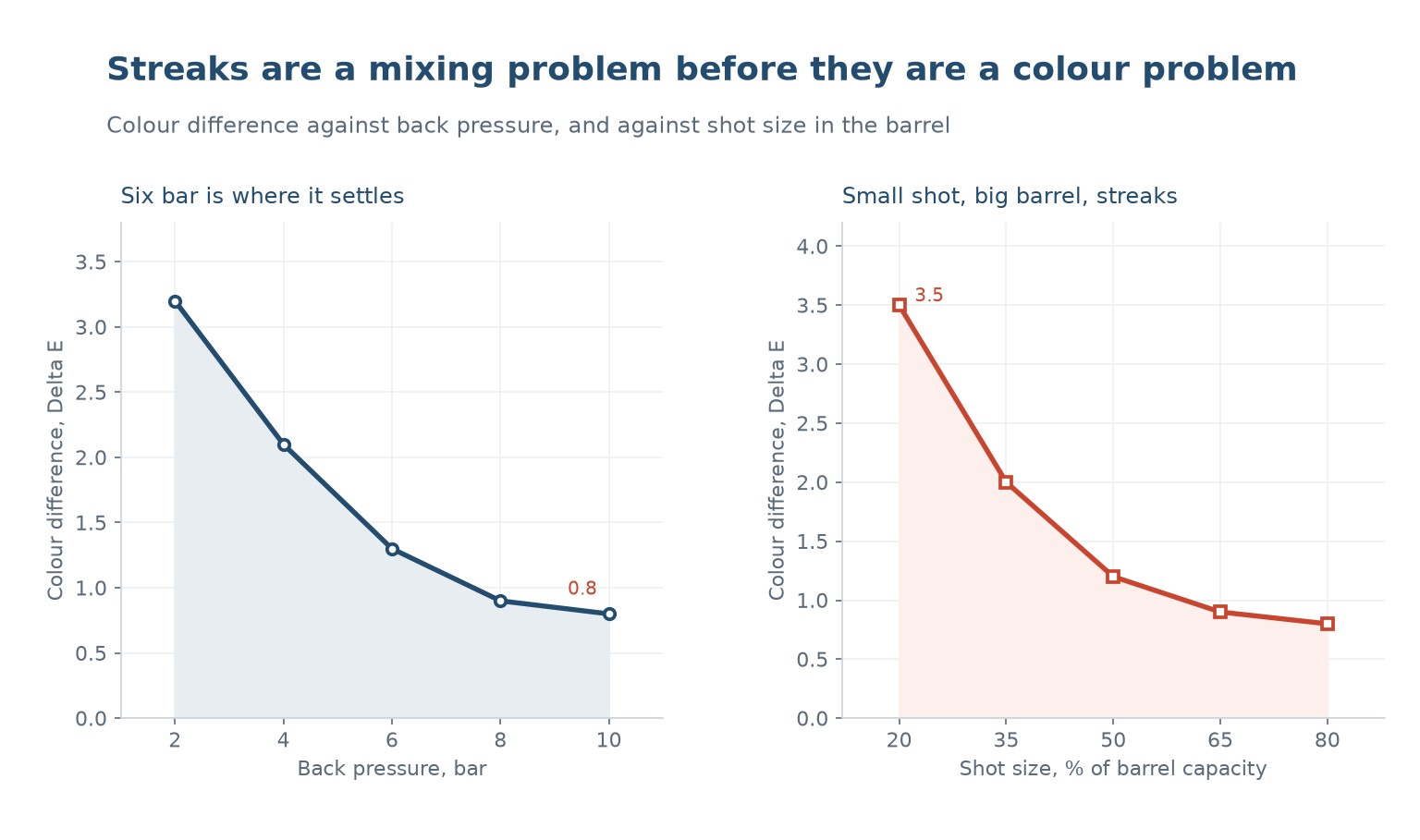
Measured as the colour difference, Delta E, across a part, the value falls from 3.2 at 2 bar to 2.1 at 4, 1.3 at 6, 0.9 at 8 and 0.8 at 10. A Delta E of 1 is roughly the threshold where a trained eye can see a difference on a uniform surface, so 6 bar is the point where the part becomes acceptable and 8 bar is where it becomes good.
Raising back pressure is not free. It increases the melt temperature, it lengthens recovery time and it puts more load on the screw drive. On a machine near its torque limit, a back pressure increase shows up as a recovery alarm rather than as a better colour.
| Back pressure | Delta E | Visible | Verdict |
|---|---|---|---|
| 2 bar | 3.2 | Clearly | Not acceptable |
| 4 bar | 2.1 | Ja | Marginal |
| 6 bar | 1.3 | On close inspection | Acceptable |
| 8 bar | 0.9 | Nein | Gut |
| 10 bar | 0.8 | Nein | No further gain |
Table 1 — Colour difference against back pressure, with the visual threshold at about 1.0.
Shot size against barrel size
The second lever is how much of the barrel the shot uses. A small shot in a large barrel means each parcel of melt spends many cycles in the screw, and it also means the melt is repeatedly heated and sheared without being refreshed. Both effects make dispersion worse, not better.
The measured colour difference is 3.5 at a 20 percent shot, 2.0 at 35, 1.2 at 50, 0.9 at 65 and 0.8 at 80. The improvement between 20 and 50 percent is large; beyond 65 percent there is little to gain and the risk of insufficient cushion starts.
The standard rule is to keep the shot between 25 and 75 percent of the barrel capacity. Below 25 the residence time is too long, above 75 there is not enough cushion to hold pressure consistently. A job that streaks is very often a job that was moved to a larger press.
Residence time and heat history
Residence time affects colour in two opposite ways. A long residence gives more mixing, which helps dispersion, and more heat history, which degrades the pigment and the carrier. On an organic pigment the second effect usually wins, and the colour drifts rather than streaking.
The symptom that separates the two is uniformity. A streak is a mixing failure: the colour is right in some places and wrong in others. A drift is a heat history failure: the colour is uniformly off, usually lighter or yellower, across the whole part.
That distinction decides the fix. A streak needs more shear, more back pressure, a smaller barrel or a better-dispersing masterbatch. A drift needs a shorter residence, a lower melt temperature or a more heat-stable pigment.
Masterbatch and carrier compatibility
A masterbatch is a pigment dispersed in a carrier resin, and the carrier has to be compatible with the base resin. A polyethylene-carrier masterbatch in polypropylene will disperse poorly because the two melt at different temperatures and have different viscosities. The pigment is fine; the carrier is the problem.
The dosage matters less than most people think, within reason. A let-down ratio that is too low gives a weak colour and encourages the operator to over-dose, which can make dispersion worse because there is more carrier to disperse. A ratio that is too high wastes pigment and can plasticise the part.
Liquid colourants avoid the carrier problem entirely, because there is no solid carrier to disperse. They are more expensive per kilogram and they need a dosing pump, and they are the standard answer for a shop that runs many colours through one machine.
| Form | Dispersion | Changeover | Am besten für |
|---|---|---|---|
| Masterbatch, same carrier | Gut | Purge needed | Long runs, one colour |
| Masterbatch, universal carrier | Messe | Purge needed | Several resins, one colour |
| Liquid colourant | Ausgezeichnet | Schnell | Frequent colour changes |
| Pre-compounded | Ausgezeichnet | Full purge | Critical colour, low volume |
Table 2 — Colourant forms, and what each one costs in dispersion and changeover.
What to change, in order
The order matters because the cheap fixes are also the ones that are usually skipped.
- Raise the back pressure in steps of 2 bar and inspect a part at each step.
- Check the shot as a percentage of barrel capacity; below 25 percent, change machine or mould.
- Confirm the masterbatch carrier matches the base resin.
- Check the melt temperature and the residence time for a pigment degradation drift.
- Check the screw for wear, which reduces both shear and mixing.
- Only then consider a different colourant form.
The first two cost nothing and fix most cases. A shop that goes straight to a liquid colourant system because a job streaks has usually bought a dosing pump to solve a back pressure setting.
What causes colour streaks in injection moulding?
Unmixed masterbatch. The pigment has not dispersed into the melt, usually because the back pressure is too low, the shot is too small for the barrel, or the carrier is incompatible with the base resin.
Does back pressure fix colour streaks?
Usually. Colour difference falls from 3.2 at 2 bar to 0.8 at 10 bar, with most of the gain by 6 to 8 bar. It costs melt temperature and recovery time.
Why did streaks start after moving to a bigger machine?
Because the shot became a smaller fraction of the barrel, so the melt is sheared and heated repeatedly without being refreshed. Keep the shot between 25 and 75 percent of capacity.
How do I tell a streak from a colour drift?
A streak is uneven: some areas match the master and some do not. A drift is uniform across the part, and it points to heat history rather than mixing.
Can a masterbatch be incompatible with the base resin?
Yes. A polyethylene carrier in polypropylene disperses poorly because the melting points and viscosities differ. Match the carrier, or use a universal grade or a liquid colourant.
Is a higher masterbatch dosage better?
No. Over-dosing adds carrier that also has to disperse, and it can plasticise the part. Fix the dispersion before increasing the dose.
Colour that will not run clean?
Send a photo of the part and tell us the masterbatch, the dose and the barrel capacity. We will work out whether it is shear, residence or carrier compatibility.




 DE
 EN
 ES
 FR
 PT
 AR
 RU
 JA
 KO
 IT
 NL
 TR
 PL
 ID
