
Pressure die or tube die, and what each gives
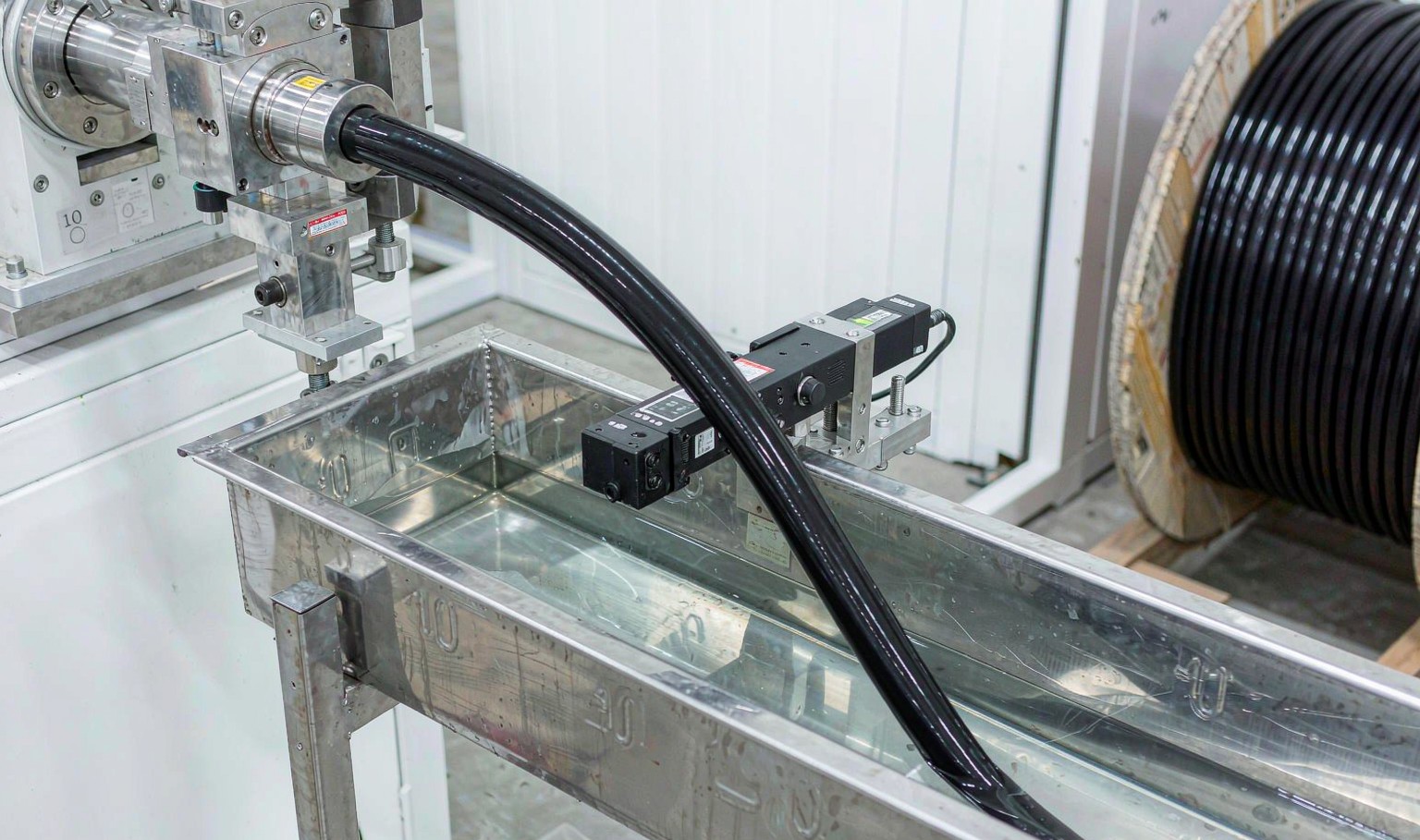
A cable jacket is applied by one of two die types. A pressure die forces the melt against the core under pressure inside the die, so the melt fills the space and the jacket is formed by the die. A tube die extrudes a tube slightly larger than the core and draws it down onto the core outside the die, with vacuum applied between them.
A pressure die gives better adhesion and a smoother surface, because the melt is in contact with the core while it is still under pressure. It is also less tolerant of core variation, because the die gap is fixed and a larger core means a thinner jacket.
A tube die is more tolerant of core diameter variation and it can run at higher line speed, because the drawdown is doing the sizing rather than the die. It gives a looser jacket and a more matte surface, and it needs vacuum to pull the tube onto the core without trapping air.
Drawdown is what makes it tight, and what roughens it
Drawdown ratio is the ratio of the die gap to the finished jacket wall, or the ratio of the die diameter to the finished cable diameter. A ratio of 1.0 means the jacket leaves the die at its final size; a ratio of 2.0 means it is pulled to half that size after leaving the die.
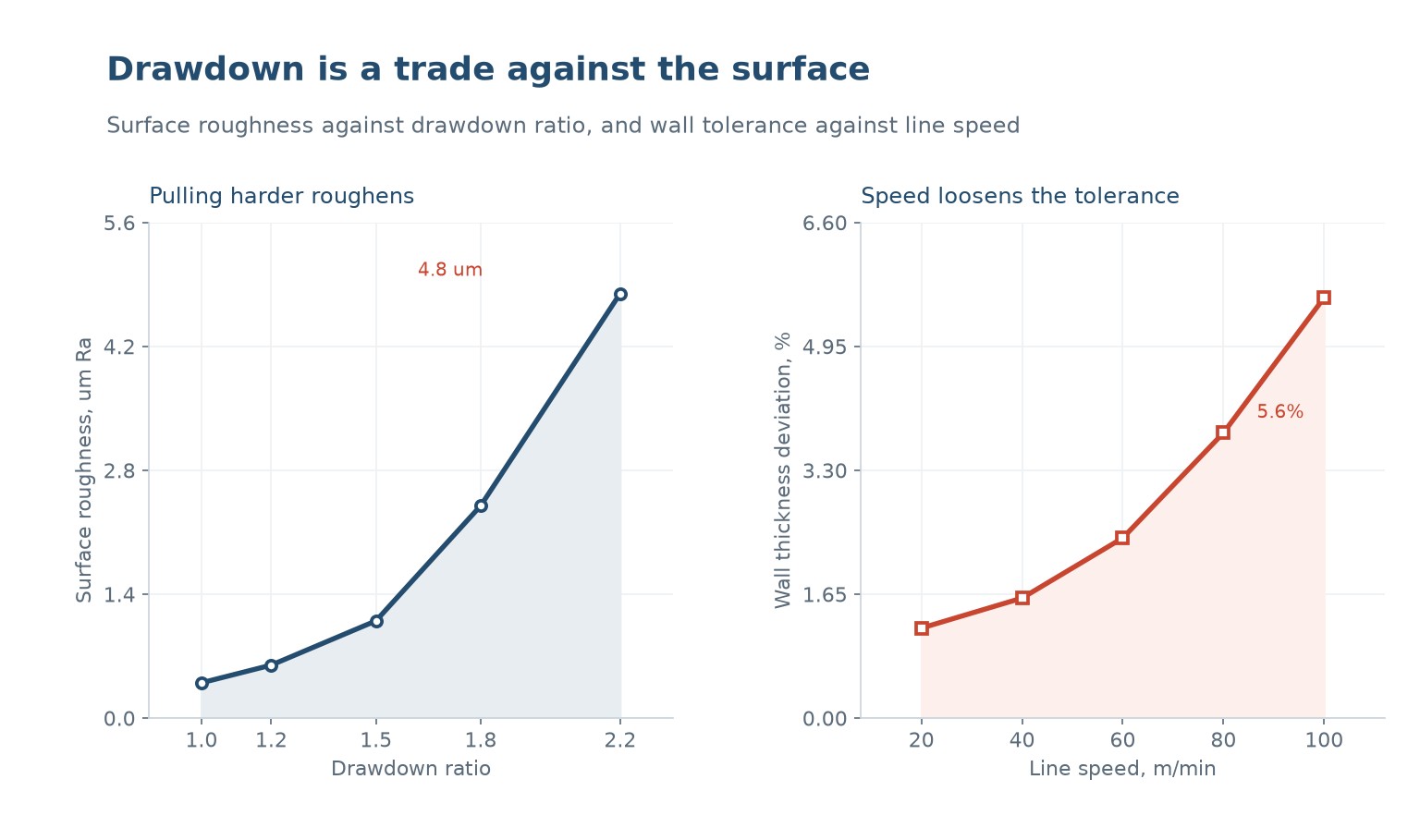
Some drawdown is necessary. It is what makes the jacket grip the core and what closes the die marks. But drawdown also stretches the surface, and past a point the stretch produces a rough, matte finish. Surface roughness goes from 0.4 microns Ra at a drawdown of 1.0, to 0.6 at 1.2, 1.1 at 1.5, 2.4 at 1.8 and 4.8 at 2.2.
That is a factor of twelve across the range, and it is the reason a glossy jacket and a tight jacket are in tension. A jacket that is drawn down enough to grip is a jacket that has lost its gloss, and the compromise is usually somewhere around 1.2 to 1.5.
Line speed loosens the tolerance
Wall thickness deviation rises with line speed: 1.2 percent at 20 m/min, 1.6 at 40, 2.4 at 60, 3.8 at 80 and 5.6 at 100. The cause is that the sizing and cooling have less time to work, and any variation in the melt or the core arrives at the finished cable with less damping.
The wall tolerance matters because the jacket is a mechanical protection, not a dielectric. A thin spot is where the cable will fail in a bend or an abrasion test, and it is invisible from outside. The specification is usually a minimum wall, for the same reason as wire insulation.
The way to run fast and hold tolerance is to cool harder and sooner. A longer trough, colder water or a spray ring right at the die all help, and they cost less than running slowly.
Getting a surface that looks right
A glossy jacket needs a hot die, a short air gap and low drawdown. The melt has to be fluid enough to flow out against the die wall and it has to be cooled quickly once it leaves, so that the surface it had in the die is the surface it keeps.
A matte jacket is produced deliberately by raising the drawdown, lowering the die temperature, or adding a matte agent to the compound. It hides handling marks and it is easier to make consistent, which is why most industrial cable is matte and most visible cable is glossy.
The third option is embossing, where a textured sizing sleeve or a wheel marks the surface with a pattern or text. That is a separate operation and it interacts with drawdown, because the pattern is stretched along with the jacket.
| Die type | Adhesion | Surface | Core tolerance |
|---|---|---|---|
| Druck | Best | Glossy | Schlecht |
| Tube with vacuum | Gut | Matte to satin | Gut |
| Tube without vacuum | Schlecht | Matte | Gut |
| Semi-pressure | Gut | Satin | Mäßig |
Table 1 — Die types and what each gives
The defects and their causes
A loose jacket that slides on the core is a drawdown problem or a vacuum problem. If the drawdown is too low the jacket never grips; if the vacuum is too low, air is trapped between the jacket and the core and the jacket is loose in patches.
A jacket with a visible seam or a stripe is a die problem, usually a damaged die land or a build-up of degraded material on one side. It appears as a line running along the cable, and it is fixed by cleaning or replacing the die.
A jacket that is oval rather than round is a cooling problem. The jacket cools from the outside while it is still soft, and if the cooling is uneven, or if the cable is touching something before it is set, the section goes oval. A sizing sleeve and a straight water trough fix it.
Specifying a jacket
The drawing needs the core diameter and its tolerance, the jacket compound, the minimum wall, the overall diameter, the adhesion requirement and the surface finish. It also needs the bend and abrasion requirements, because those decide the compound and the wall more than the electrical requirements do.
It should name the test for adhesion, because there are several and they do not agree. A strip test, a pull test and a ring test give different numbers, and a specification that says 'good adhesion' specifies nothing.
| Eigentum | Typical value | Test |
|---|---|---|
| Minimum wall | 0.8-2.0 mm | Section |
| Overall diameter | ±0.2 mm | Laser gauge |
| Adhesion | 10-30 N | Strip or pull |
| Surface | Gloss or matte | Visual against master |
| Ovality | Under 3% | Diameter gauge, two axes |
Table 2 — The five lines a jacket drawing needs
What is a normal drawdown ratio for a cable jacket?
Between 1.2 and 1.5 for most jackets. Below that the jacket does not grip; above that the surface roughens and the wall tolerance suffers.
Why is my jacket loose on the core?
Either insufficient drawdown or insufficient vacuum between the tube and the core. A loose jacket in patches is usually trapped air, which points at the vacuum.
What is the difference between a pressure die and a tube die?
A pressure die forms the jacket inside the die under pressure, which gives better adhesion and a glossier surface but less tolerance of core variation. A tube die extrudes a tube and draws it down onto the core, which is more tolerant and gives a matte finish.
How fast can a jacket line run?
It depends on the wall and the cooling. Wall tolerance goes from 1.2 percent at 20 m/min to 5.6 at 100, so running faster needs more cooling, not just more speed.
Why is the jacket oval?
Uneven cooling, or the cable touching something before the jacket has set. A sizing sleeve and a straight trough fix it.
Can a matte jacket be made glossy?
Usually by raising the die temperature and lowering the drawdown. If the compound contains a matte agent, the gloss will be limited by the compound rather than the process.
A jacket that is loose, oval or too rough?
Send the construction and the defect. We will tell you whether it is the die, the drawdown or the cooling, and what the line should be set to.




 DE
 EN
 ES
 FR
 PT
 AR
 RU
 JA
 KO
 IT
 NL
 TR
 PL
 ID
