

There are two shrinkages, and only one is on the drawing
When a thermoformed part leaves the machine it has already shrunk once, on the tool, while it cooled. That is the shrinkage the toolmaker compensated for, and it is the number in the material data sheet. It is also not the number that matters a month later.
The second shrinkage happens after the part is off the tool, and it continues for weeks. It comes from the residual orientation in the sheet: the sheet was stretched during forming, the polymer chains were aligned, and they slowly relax back toward a random coil. Relaxation means contraction, and contraction continues as long as the chains have mobility.
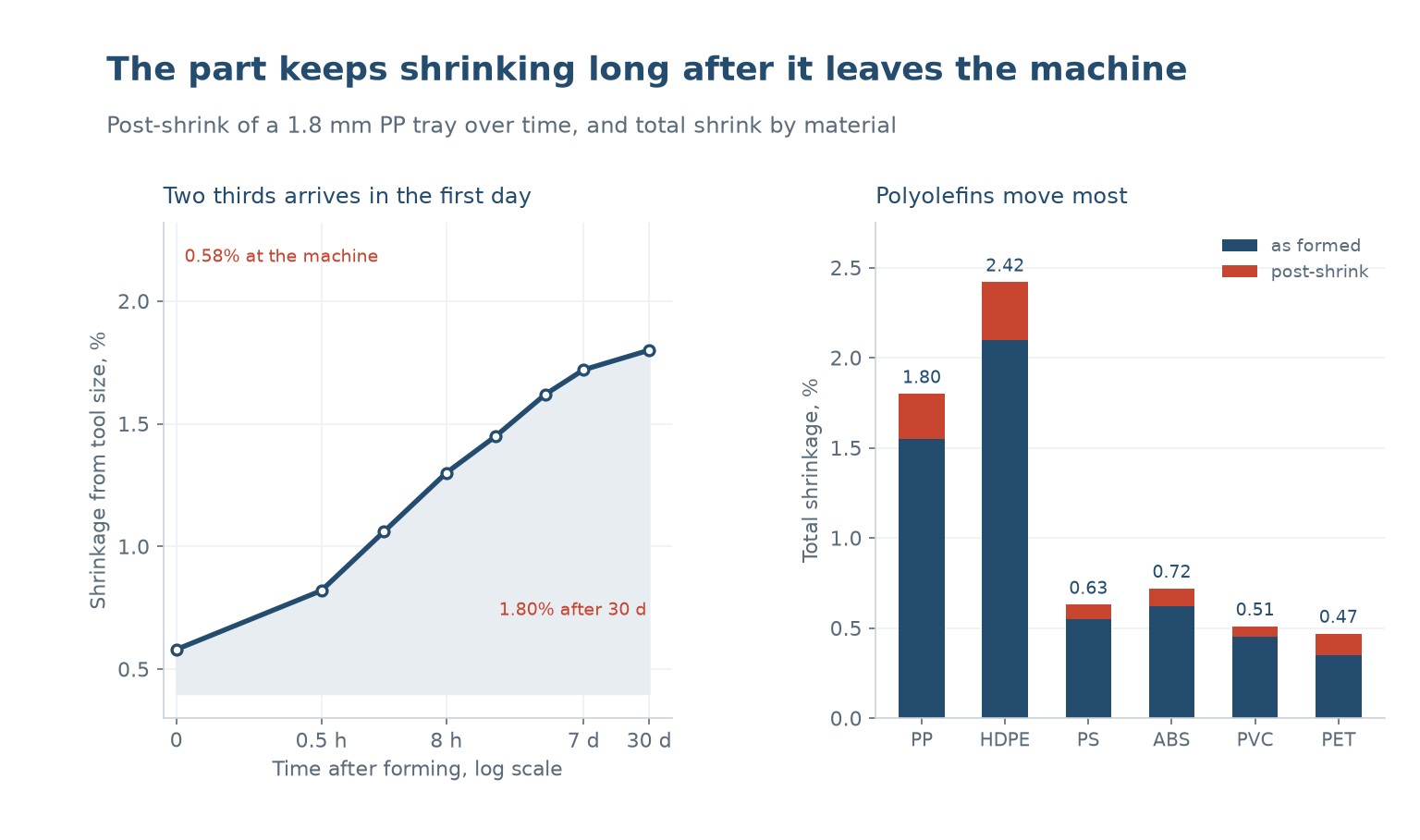
On a 1.8 mm PP tray, the part measures 0.58 percent smaller than the tool at the moment it leaves the machine, and 1.80 percent smaller after thirty days. Two thirds of that total arrives in the first twenty-four hours, which is why a part checked on the shift it was made looks acceptable and a part checked in the warehouse does not.
The gap between those two numbers is the whole subject. If you set the tool for the as-formed figure, every part will be undersize by the time the customer measures it. If you set it for the thirty-day figure, every part will be oversize on the day it is made, and the first-off inspection will fail.
Which materials move, and why
Polyolefins move most. PP totals about 1.80 percent and HDPE about 2.42, split roughly 1.55 plus 0.25 and 2.10 plus 0.32. The high crystallinity is the reason: crystallites pack more densely than the amorphous phase, and the crystallisation continues slowly after the part is off the tool.
Styrenics and vinyls move much less. PS totals about 0.63 percent, ABS 0.72, PVC 0.51, PET 0.47. These are largely amorphous, so there is no slow crystallisation to continue, and the post-shrink component is small: 0.08 for PS, 0.10 for ABS, 0.06 for PVC.
That split is what makes material substitution so dangerous. Swapping PP for PS to get a stiffer part changes total shrinkage from 1.80 to 0.63 percent, which on a 300 mm part is a 3.5 mm difference. The tool cannot absorb that, and the part will not fit.
Fillers change the picture again. Talc-filled PP shrinks less than unfilled, because the filler particles do not shrink and they restrain the matrix. Glass-filled PP can come down to 0.4 percent, but the shrinkage becomes anisotropic, different along and across the flow, and a tool cut for isotropic shrinkage will produce a part that is right in one direction and wrong in the other.
Distortion is shrinkage that is not uniform
A part that shrinks uniformly gets smaller and stays the same shape. A part that shrinks unevenly distorts, because the regions that shrink more pull the regions that shrink less. Almost every warped thermoformed part is a shrinkage gradient, not a shrinkage value.
The gradient comes from three places. Sheet temperature that varies across the sheet, so one end is drawn hotter and oriented more. Wall thickness that varies, so thin walls cool faster and hold more orientation. And cooling rate that varies, because one face is against the mould and the other is against air.
The mould-side face cools fast and freezes the orientation in; the air-side face cools slowly and has time to relax. That difference alone produces a curl toward the mould side, which is why almost every thermoformed tray curls the same way.
On the trays in the photograph, the flat one came off a machine with a balanced heater profile and a mould at 90 C. The one with a lifted corner came off the same machine twenty minutes later with the same settings but a colder mould at one end. The twisted one was formed from a sheet that had been sitting in a cold warehouse overnight and was 8 C below the others at the start of the cycle.
| Source of the gradient | What it produces | Kontrolle |
|---|---|---|
| Uneven sheet heating | One end shrinks more than the other | Zone profile, IR check across the sheet |
| Uneven wall thickness | Thin walls hold more orientation | Plug shape, sheet gauge profile |
| Mould temperature gradient | Corner lift, curl toward the mould | Water circuit, check both ends of the tool |
| Fast cooling on one face | Curl toward the mould side | Mould temperature up, cooling time down |
| Sheet moisture | Blisters and local distortion | Dry the sheet before forming |
| Trim releasing stress | Part moves after trimming | Trim after 24 hours, or stress-relieve |
Table 1 — Where the gradient comes from and what it looks like
Setting the tool for the shrink you will actually get
The correct tool size is the finished part size divided by one minus the shrinkage you expect at the time the part is measured. If the customer measures at 24 hours, use the 24 hour figure. If they measure in the warehouse a month later, use the thirty day figure. Those are different tools.
For the PP tray, a 300 mm finished dimension needs a tool at 305.5 mm if the part will be measured at thirty days, and 303.4 mm if it will be measured at the machine. The 2 mm difference is larger than most drawing tolerances, which is why the measurement point has to be agreed before the tool is cut, not after.
Where the tolerance is tight, the practical answer is to cut the tool slightly oversize and trim to size after the part has stabilised. That is a second operation and it costs money, but it is cheaper than a tool that has to be welded and re-cut.
The other lever is to shorten the time to stability. A part that has been annealed, held at 70 to 80 C for an hour, reaches its final dimensions in a day instead of a month. For a part with a tight tolerance and a short delivery, that is often the cheapest route to a part that measures the same on day one and day thirty.
How to measure it without fooling yourself
Measure on a granite table, not on a bench. A part that rocks on a flat surface is already telling you about distortion, and measuring it on an uneven surface hides that.
Record the age of the part at measurement. A dimension without an age is not a measurement, it is a number. On a first-article inspection, note the hours since forming, and repeat the measurement at 24 hours and at seven days if the tolerance is tight.
Measure the same features the customer will measure, in the same way. A caliper across a flexible rim gives a different answer from a CMM on a restrained part, and the difference on a thin-wall tray can be a millimetre. Agree the method before the argument, not after.
For distortion specifically, put the part on the table and measure the gap under the highest corner. That single number, in millimetres, is more useful than any dimensional measurement, because it is what the customer sees when they open the box.
Design choices that reduce the problem
Ribs and steps help. A flat panel with no features has nothing to resist the shrinkage gradient and will curl; the same panel with a shallow rib pattern holds its shape because the ribs act as stiffeners in the direction that matters.
Asymmetric wall thickness hurts. A part that is 1.2 mm on one side and 2.0 on the other has two different cooling rates and two different orientation levels, and it will bend toward the thin side. Uniform wall is the single most effective distortion control in thermoforming.
Generous radii help, for the same reason they help in injection moulding: they spread the strain instead of concentrating it. A sharp internal corner is where the orientation is highest and where the part will start to move.
And the material choice matters more than any of it. If the tolerance is tight and the part is large, an amorphous material with 0.5 percent total shrinkage is a much easier design than a polyolefin with 1.8, even if the polyolefin is cheaper per kilo.
| Material | Total shrink, % | Post-shrink, % | Tolerance you can hold |
|---|---|---|---|
| HDPE | 2.42 | 0.32 | Loose, plus or minus 1 mm on 300 mm |
| PP | 1.80 | 0.25 | Plus or minus 0.8 mm on 300 mm |
| ABS | 0.72 | 0.10 | Plus or minus 0.4 mm on 300 mm |
| PS | 0.63 | 0.08 | Plus or minus 0.4 mm on 300 mm |
| PVC | 0.51 | 0.06 | Plus or minus 0.3 mm on 300 mm |
| PET | 0.47 | 0.12 | Plus or minus 0.4 mm on 300 mm, crystallinity dependent |
Table 2 — What each material lets you hold, before any annealing
Why does my thermoformed part keep getting smaller after it is made?
Post-shrinkage from relaxation of the orientation built in during forming. On a PP tray it goes from 0.58 percent at the machine to 1.80 percent after thirty days, with two thirds of that in the first day.
Should the tool be cut for the as-formed size or the final size?
For the size at the moment the customer measures it. If they measure a month later, use the thirty day shrinkage. Agree the measurement point before the tool is cut; the difference on a 300 mm part can be 2 mm.
Why does my tray curl toward one side?
The mould-side face cools fast and freezes the orientation in, while the air-side face relaxes. The result is a curl toward the mould side. Raising the mould temperature and shortening the cooling time reduces it.
Can annealing fix the shrinkage?
It shortens the time to stability rather than changing the final number. An hour at 70 to 80 C gets the part to its final dimensions in a day instead of a month, which is useful when the tolerance is tight.
Which material distorts least?
Amorphous materials with low total shrinkage: PVC at about 0.51 percent, PET at 0.47, PS at 0.63. Polyolefins move three to four times as much and are much harder to hold to a tight tolerance.
Why did the part pass inspection at the machine and fail at the customer?
Because it was measured too early. A dimension without the age of the part is not a measurement. Record hours since forming and repeat the check at 24 hours on tight-tolerance parts.
Part that will not hold its size?
Send the drawing, the material and the dimension that drifts. We will tell you what shrinkage to cut for, whether annealing is worth it, and which features are causing the distortion.




 DE
 EN
 ES
 FR
 PT
 AR
 RU
 JA
 KO
 IT
 NL
 TR
 PL
 ID
