

What an unformed pocket actually looks like
An unformed pocket is not usually a hole or a torn shape. It is a shallow dimple with the outline of the pocket in it, maybe two millimetres deep where the tool wanted twelve. The material stretched a little, gave up, and cooled before it could go further. That partial shape is the signature: the vacuum pulled, the sheet moved slightly, and then it stopped.
This matters because it separates two very different faults. If the vacuum had failed completely there would be no dimple at all, just a flat sheet with a faint ring. If the sheet was cold, you get the dimple. The dimple says the tool and the vacuum are working and the material was not soft enough to follow them.
There is a second version that gets confused with the first: a pocket that forms fully but springs back when the vacuum releases. It looks formed for a second and then relaxes to half depth. That is also a heat problem, but at the other end of the scale, and it usually comes with visible stress whitening around the rim.
On a multi-cavity tool the failure is rarely even. It clusters at one end of the sheet, or in a band across the middle, or on the pockets furthest from the centre line. Where the cluster sits tells you which heater zone is short, and that is the fastest diagnostic in the whole process.
Heat is a rate, not a temperature
The heater does not set the sheet temperature directly. It sets a radiant flux, and the sheet temperature is the integral of that flux over time, minus what the sheet loses to the air and the clamps. Two lines running the same setpoint can have different sheet temperatures because one has a dirty reflector, or a different lamp age, or a longer index time.
So the useful number is not the heater percentage. It is the sheet surface temperature at the moment the platen closes, measured with an infrared gun or a contact probe on a scrap sheet. For rigid PVC blister sheet the forming range is roughly 130 to 165 C; for PET it is 120 to 150 C; for PP it is 145 to 165 C. Outside that band you get exactly the two failures described above.
Heater zone balance matters as much as total power. A six-zone heater on a 500 mm wide sheet typically runs the edge zones hotter than the centre, because the edges lose heat to the clamps and to the surrounding air. If all six zones are set the same, the centre overheats and the edges stay cold, and the rejects cluster at the edges with blisters in the middle.
Lamp age is the hidden variable. A tungsten halogen lamp loses about 10 to 15 percent of its output over 5,000 hours. Six lamps of mixed age across a heater give a sheet with a temperature profile that has nothing to do with the zone settings, and the operator compensates by turning everything up, which pushes the newest lamps into the blistering range.
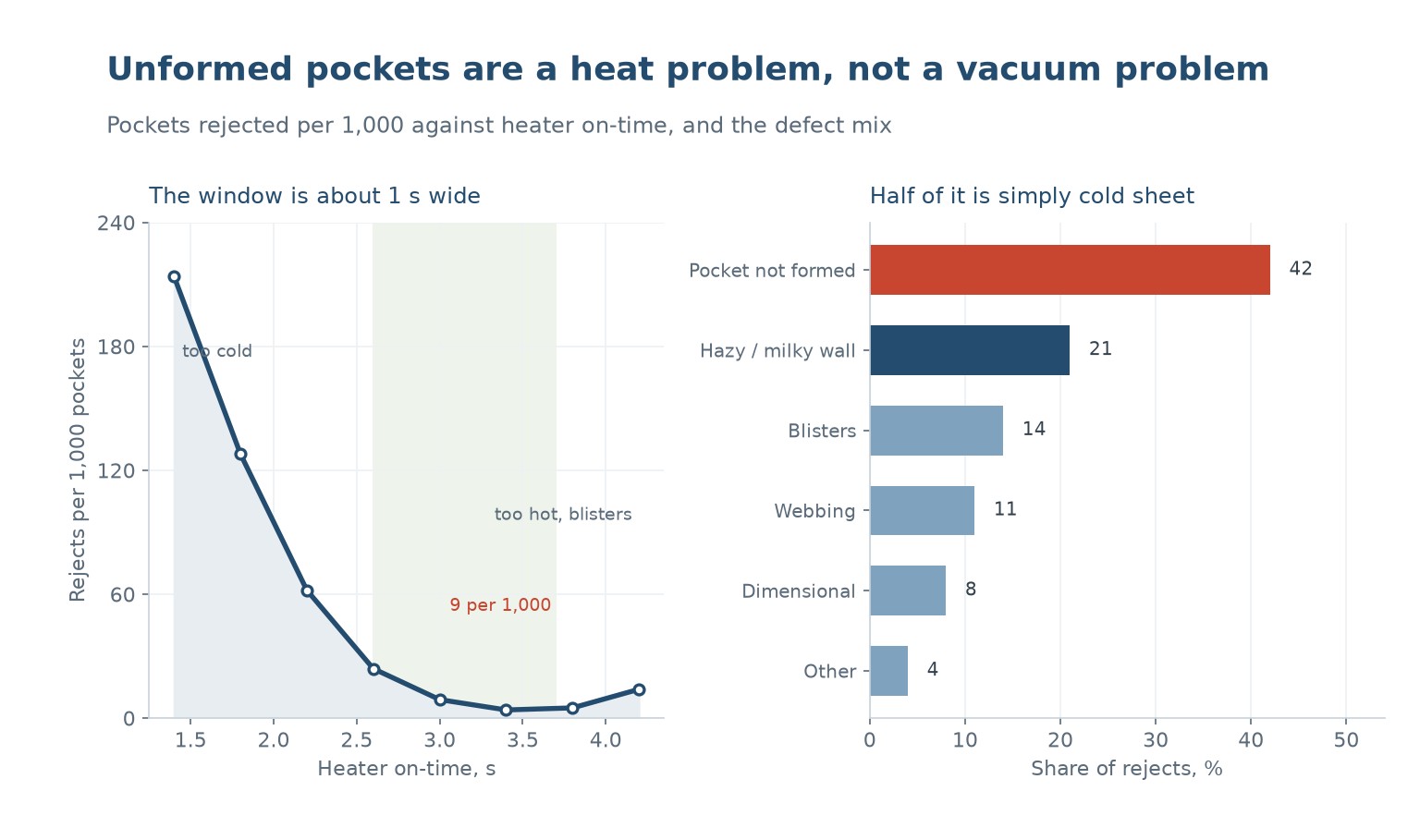
The window is about a second wide
On the 0.6 mm PVC sheet in the chart, heater on-time runs from 1.4 to 4.2 seconds. At 1.4 seconds, 214 pockets per thousand fail to form. At 3.0 seconds it is 9. At 4.2 seconds it is 14 again, but the failure has changed from unformed to blistered and hazy.
The usable band, where rejects stay under about 10 per thousand, is roughly 2.6 to 3.7 seconds. That is 1.1 seconds of heater time on a 3 second cycle. It is not a wide window, and it is why a blister line that runs well at the start of a shift can drift out of specification by mid-afternoon without anyone touching a setting.
The drift comes from the machine warming up. A cold machine loses heat from the platen and the clamps into the frame; two hours in, those parts are at operating temperature and the sheet retains more of what the heater gives it. The same on-time that was correct at 07:00 is 5 percent too hot at 10:00. Good lines compensate by trimming the on-time once the machine is warm, or by holding the platen temperature with a water circuit.
The second source of drift is sheet. A new roll of the same nominal gauge can be 4 percent thicker, and 4 percent more material takes 4 percent longer to reach temperature. If the roll change is not recorded, the operator sees a sudden run of unformed pockets and starts adjusting the heater, which is the right fix for the wrong reason and leaves the setting wrong for the next roll.
When it is not heat
About one unformed pocket in five is not a heat problem, and treating it as one wastes a shift. The other causes are worth knowing because they look identical on the sheet and completely different on the machine.
Vacuum leaks are the first. A cracked hose, a perished O-ring on the vacuum box, or a partially blocked vacuum port reduces the pressure differential. The pocket forms slowly and may not reach full depth before the sheet cools. The tell is that the pockets nearest the vacuum connection form better than the ones furthest away, which is a distance pattern rather than a zone pattern.
Vent holes are the second. A pocket with no vent traps air, and the trapped air resists the draw exactly like a weak vacuum. Vent holes block with plastic dust and with the oil that comes off some sheets. A pocket that forms on a clean tool and stops forming after a week is usually a blocked vent, not a tired heater.
Third is sheet gauge. A pocket needs a certain amount of material to draw into it; if the sheet is thinner than the tool was designed for, the pocket either tears or stops short. This shows up as a uniform failure across the whole sheet with no zone pattern, and it starts at a roll change.
| Pattern on the sheet | Most likely cause | First check |
|---|---|---|
| Shallow dimple, no tear | Sheet too cold | Sheet surface temperature at platen close |
| Full form, springs back | Sheet too hot or too cold at release | Cooling time and mould temperature |
| Pockets far from the vacuum port | Vacuum leak or weak pump | Hose, O-rings, pump vacuum gauge |
| Isolated single pocket | Blocked vent hole | Blow through the vent with air |
| Whole sheet uniform, no dimple | Wrong gauge or blocked vacuum box | Sheet micrometer reading |
| Blisters plus unformed together | Heater zone imbalance | Zone profile with an IR gun |
Table 1 — Reading the failure pattern before touching a setting
The two-minute diagnosis
Take a rejected sheet and hold it up to a window. The dimple tells you the vacuum worked. Now look at where the dimples are: edge, centre, one end, or scattered. Edge cluster means edge zones are cold; centre cluster means the centre is cold, which is unusual and usually means a failed lamp; one end means the sheet is not sitting square in the clamps.
Then measure. An infrared gun on the sheet as the platen opens gives a number in two seconds. Compare it with the number the material supplier gave you. If it is 15 C low, the heater is the problem and you have found it without changing a single setting.
If the temperature is right and the pockets still fail, check the vacuum gauge on the box, not the pump. A pump pulling minus 0.9 bar through a leaking hose gives minus 0.4 bar at the box, and the gauge on the pump will look perfect. Tee a gauge into the box and read it during the draw.
Last, check the vents. Pull the tool, blow air through every vent, and see if any are blocked. On a tool with 200 pockets this takes ten minutes and it solves a surprising share of stubborn cases.
Keeping it out of the run
The first-piece check should include a sheet temperature reading and a pocket depth measurement, recorded, not just a visual pass. A pocket that is 0.3 mm shallow will pass a glance and fail a customer's fill test three weeks later.
Log the heater on-time against the roll number. When a new roll goes on, the on-time that worked for the last roll is a starting point, not a setting. Two minutes of adjustment at the roll change is cheaper than an hour of rejects halfway through it.
Keep the reflectors clean. A dusty reflector loses a large share of its output, and the loss is not uniform because dust settles unevenly. Cleaning the reflector on a schedule is one of the few maintenance tasks on a thermoformer that pays back the same week.
| Check | Frequency | What good looks like |
|---|---|---|
| Sheet temperature at platen close | Every start and roll change | Within 5 C of the target for the material |
| Pocket depth on first piece | Every start | Full depth within 0.2 mm |
| Vacuum at the box | Weekly | Within 0.05 bar of the pump reading |
| Vent holes blown through | Every tool change | Free flow on all pockets |
| Reflector condition | Monthly | No visible dust film |
| Lamp hours per zone | Monthly | Zones within 1,000 hours of each other |
Table 2 — A schedule that keeps the window under control
Why do only the pockets at the edge of the sheet fail to form?
Because the edges lose heat to the clamps and to the surrounding air faster than the centre. Edge heater zones usually need to run hotter, or the sheet needs a longer index time so the edges catch up.
The vacuum gauge on the pump reads fine. Why are pockets still shallow?
The gauge is measuring at the pump, not at the box. A leaking hose or a perished O-ring can drop the pressure at the box by half while the pump gauge stays at full vacuum. Tee a gauge into the vacuum box and read it during the draw.
Can I fix unformed pockets by increasing the vacuum?
Only if the vacuum is genuinely weak. If the sheet is cold, more vacuum pulls a slightly deeper dimple and then the sheet cools anyway. The pocket depth is limited by how far the material can stretch while hot, not by how hard you pull.
Why did the line run fine in the morning and start failing at noon?
The machine warmed up. A warm platen and warm clamps retain more of the heater output, so the same on-time delivers a hotter sheet. Trim the on-time once the machine reaches operating temperature, or hold the platen on a water circuit.
Is a blistered pocket the same fault as an unformed one?
No, it is the opposite end of the same window. Blisters mean the sheet was too hot and the surface degraded or the material drew too far. Both come from the heater, which is why the fix for one makes the other worse if you overshoot.
How do I know if the sheet gauge is the problem?
Measure it. A pocket needs a fixed volume of material; if the sheet is thinner than the tool expects, the pocket stops short or tears, and the failure is uniform across the sheet with no zone pattern. It usually starts at a roll change.
Chasing unformed pockets on a running line?
Send the sheet material, gauge, pocket depth and a photo of a rejected sheet. We will tell you whether it is heat, vacuum or tooling, and what to change first.




 DE
 EN
 ES
 FR
 PT
 AR
 RU
 JA
 KO
 IT
 NL
 TR
 PL
 ID
