
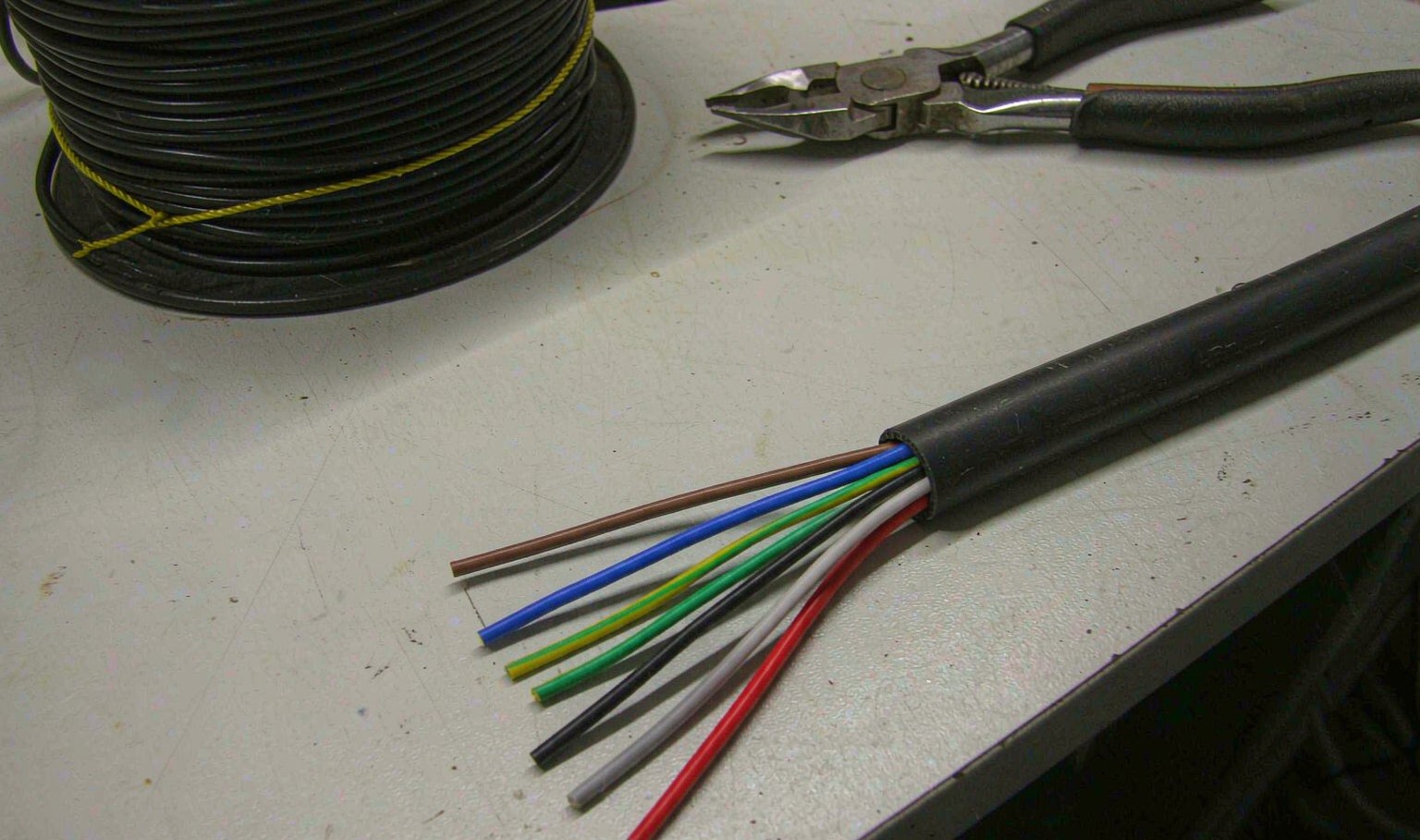
Colour is a safety device
A colour code is not decoration and it is not branding. It is the only information a person has when they are standing at the end of a cable in a plant room at two in the morning with a knife, deciding which core to cut. Get it wrong and the outcome is a short, a shock or a dead circuit.
That framing changes what the code has to do. It has to be readable under a torch, on a cable that has been pulled through a duct, by somebody who is tired, in a hurry and probably not wearing the glasses they should be. Legibility under bad conditions is the design requirement, and it is why a thin stripe is a defect and not a styling choice.
It also explains why the standards are so specific about the colours. Brown, blue and green-yellow are not arbitrary: they are the harmonised European identification, they are recognised across borders, and they are recognised by an electrician who has never seen the cable before.
Under half a millimetre it is a guess
The correct identification rate against stripe width is a steep curve. At 0.3 mm the rate is 62 percent, at 0.5 mm it is 81, at 0.8 mm it is 94, at 1.2 mm it is 98, and at 2.0 mm it is 99.
Half a millimetre is the threshold, and it is a threshold in both directions: below it the identification is a guess more than a third of the time, above it the rate climbs fast. A stripe narrower than the core's own surface texture is not a code, it is a suggestion.
The practical rule is 0.8 mm minimum on a core up to 4 mm, and 1.2 mm on anything larger. Below 0.8 the stripe also fades faster, because a thin stripe has a higher surface to volume ratio and the pigment at the surface is what oxidises.

More cores, more mistakes
Core count does the other half of the damage. In a two core cable the mis-identification rate is 0.3 percent, which is essentially zero. In a four core it is 0.8, in an eight core 3.1, in a sixteen core 9.5, and in a twenty-four core 18 percent.
The reason is not that the colours get worse. It is that the number of pairs a person can confuse grows with the square of the core count, and the colours available do not. A seven core cable uses the seven standard colours; a twenty-four core cable cannot, so it uses rings, numbers or repeats, and every repeat is a chance to read the wrong core.
That is why the standards switch method at a core count. Up to five cores, solid colours. Six to twelve, colours plus a printed number or a coloured ring. Above twelve, black cores with printed numbers, or coloured rings in a counting pattern. The switch is not arbitrary: it is where solid colours stop being sufficient.
How a stripe is put on
A solid colour is the simplest: the whole insulation is pigmented. It costs the least per metre and it is the most durable, because there is nothing to wear off. Its limit is the number of colours a compounder will hold in stock.
A longitudinal stripe is co-extruded. A small secondary extruder feeds a stripe of pigmented compound into the crosshead, and the stripe is laid into the insulation as it is drawn down. The die geometry sets the width, and the width is what the legibility depends on.
A spiral stripe is made by rotating the die or the take-off, which wraps the stripe helically. It reads from any angle, which matters on a thin core that twists, and it costs more because the rotating hardware is a maintenance item.
Rings, numbers and ferrules are added after extrusion. An ink jet prints a ring or a number at intervals, or a printed tape is wrapped under the sheath. These are the only options above about twelve cores, and they are the least durable, because ink on silicone or on a plasticised PVC is a coating and not a material.
| Method | Cores | Durability | Cost |
|---|---|---|---|
| Solid colour | Up to 5 | Best | Low |
| Longitudinal stripe | Up to 12 | Good | Low |
| Spiral stripe | Up to 12 | Good | Medium |
| Coloured rings | Up to 24 | Fair | Medium |
| Printed numbers | Unlimited | Fair | Medium |
| Wrapped tape | Unlimited | Poor | Low |
Table 1 — Colour coding methods and where each one stops working
Standards and the harmonised colours
IEC 60445 sets the identification of conductors, and it is the basis for most national codes. The harmonised European scheme is brown for line, blue for neutral and green-yellow for protective earth, and it replaced an older scheme in which line was red or black and neutral was black. Cables made to the old scheme are still in service and they are a hazard.
Three phase is brown, black and grey in the harmonised scheme, and black, red and blue in the North American one. That difference is why an imported machine can have a blue conductor that is a live phase rather than a neutral, and why a cable should be identified at both ends rather than trusted.
Green-yellow is reserved and cannot be used for anything else. That reservation is the strongest rule in the whole area, because the protective earth is the conductor that protects a person, and a green-yellow core that is not an earth is worse than no code at all.
| Function | Harmonised | North American |
|---|---|---|
| Protective earth | Green-yellow | Green or bare |
| Neutral | Blue | White or grey |
| Line, single phase | Brown | Black |
| Line 1, 2, 3 | Brown, black, grey | Black, red, blue |
| Control, AC | Black numbered | Red or numbered |
Table 2 — The two schemes that matter, and where they disagree
The stripe that fades
A colour code that fades is a code that stops working, and fading is a materials problem rather than a process one. The pigment has to survive the extrusion temperature, the crosslinking if there is any, the UV in service and the plasticiser in a PVC compound.
Peroxide crosslinking is the harshest case. The peroxide attacks many organic pigments, so a colour that is stable in a thermoplastic polyethylene can shift by several shades after curing. That is why a crosslinked cable is colour matched after cure and not before.
Plasticiser migration is the slow one. A heavily plasticised PVC releases plasticiser over years, and the plasticiser carries pigment with it, so a stripe on a flexible cable goes pale and eventually disappears. A thin stripe goes first, which is another reason for the 0.8 mm minimum.
UV is the one people forget. An outdoor cable with a red stripe goes pink and then white, and the code is gone in three or four years. Carbon black in the sheath protects the insulation, but it does not protect a stripe on a core that has been exposed by a damaged jacket.
How wide should a colour stripe be?
0.8 mm minimum on a core up to 4 mm and 1.2 mm on anything larger. Below 0.5 mm the correct identification rate falls to 81 percent, and below 0.8 the stripe also fades faster.
How many cores can a colour code handle?
Five reliably, twelve with stripes or rings. Above twelve the mis-identification rate climbs past 9 percent with solid colours, so the cable needs printed numbers or a counting ring pattern.
What are the harmonised colours?
Brown for line, blue for neutral, green-yellow for protective earth, and brown, black and grey for three phase. Green-yellow is reserved and cannot be used for anything else.
Why is my stripe fading?
Usually plasticiser migration in a plasticised PVC, or UV on an exposed core. A thin stripe fades first because it has more surface per unit of pigment.
Does crosslinking change the colour?
Yes. Peroxide attacks many organic pigments, so a colour stable in a thermoplastic can shift after cure. Match the colour after crosslinking, not before.
Can I use ink jet numbers on silicone cable?
It is done but it is the least durable option. Ink on silicone is a coating, not a material, and it rubs off. A coloured ring in the compound or a moulded marker is better.
A cable whose colour code is not readable in the field?
Send the core count, the core size and the environment. We will tell you the stripe width, the method and the pigment that survives your process.
Continue reading
- Cable Jacket Extrusion: Pressure Die, Drawdown and Surface Finish
- Wire Insulation Extrusion: Concentricity, Wall and the Spark Tester
- Cable Trunking Profile: Extruding a Straight Length That Stays Straight
- Silicone Wire Harness Seal: The Grommet That Keeps Water Out
- Plastic Extrusion Solutions: Profile, Sheet, Pipe and Tube




 EN
 ES
 FR
 DE
 PT
 AR
 RU
 JA
 KO
 IT
 NL
 TR
 PL
 ID
