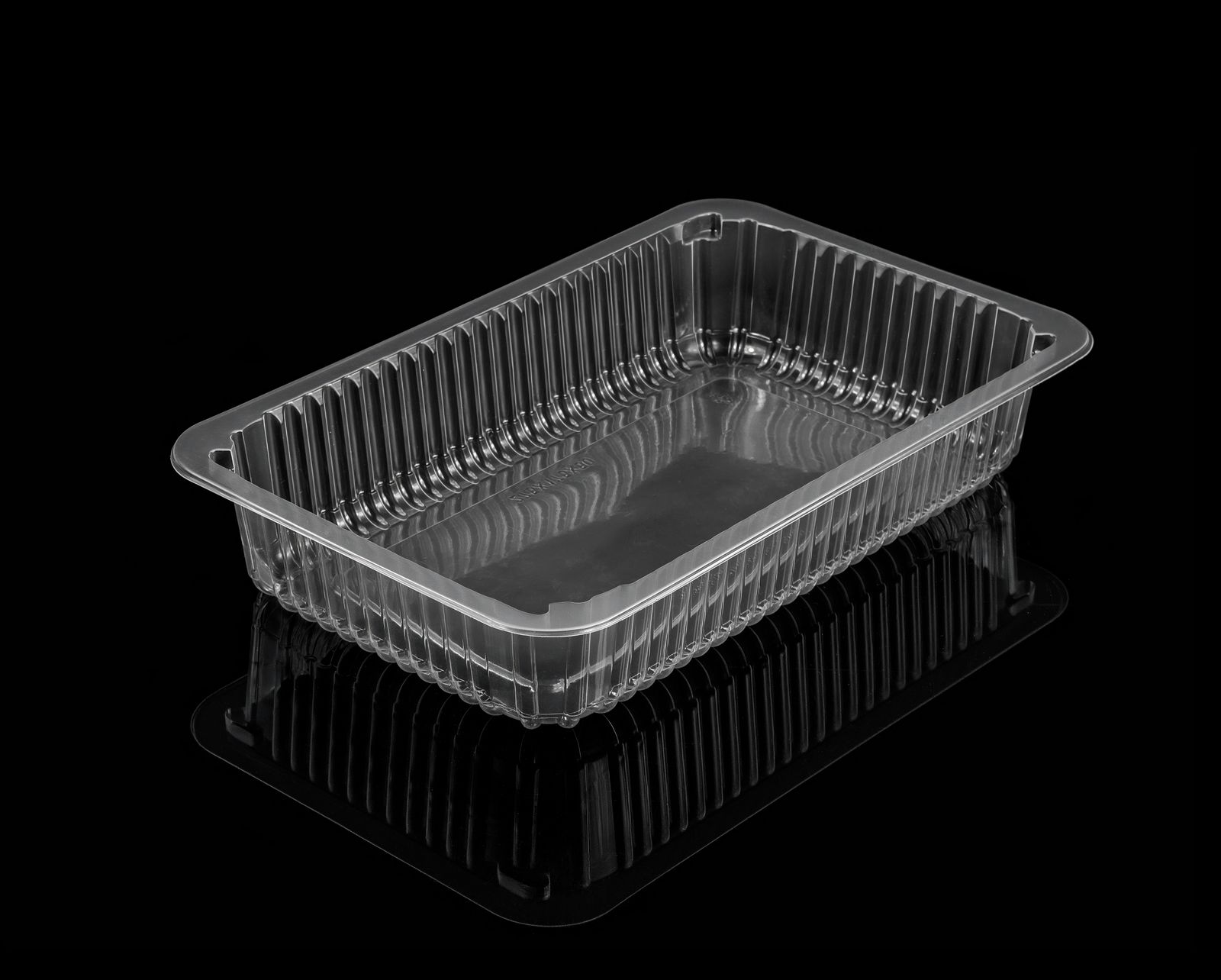
The problem
Symptom. A new APET sheet lot arrives at 0.64 mm instead of the qualified 0.60 mm, and formed trays sag in the oven on the locked 6.0 s recipe, with no notice from the supplier.
What it costs. A 35 000-tray run is scrapped before anyone connects the sag to the lot, and the supplier says the gauge was still inside the +/-0.04 mm order tolerance, so the forming behaviour changed without notice.
This guide shows how to compute the oven-dwell effect of a gauge change, run incoming checks and a trial, and write a change-notification clause into the purchase order.
- 1. Sag on a new lot is a forming-window fault, not a tool fault
- 2. Compute the dwell effect before adjusting the oven
- 3. Gauge, IV and incoming sheet checks to specify
- 4. Variables that shift the window after a lot release
- 5. A change-notification and first-off clause for the order
- 6. Costing a lot trial against a scrapped forming run
Sag on a new lot is a forming-window fault, not a tool fault
A thicker sheet needs more heat. Conduction heating time scales with the square of gauge, so a 0.64 mm lot against a qualified 0.60 mm needs (0.64 / 0.60)^2 = 1.14, about 14 % more oven dwell than the locked 6.0 s.
| What the line sees | What is physically happening | First measurement |
|---|---|---|
| Web sags on a locked recipe | Thicker lot needs about 14 % more dwell | Oven dwell to reach 130 °C |
| Good one lot, bad the next | Gauge or IV changed without notice | Incoming gauge at five width points |
| Wall thickness shifts | Draw ratio applied to a different gauge | Formed wall at a 2.5 draw ratio |
| Sheet draws off the chain | Slip or regrind level differs by lot | Slip additive and regrind on the certificate |
Table 1 - Classifying a lot-change fault before adjusting the oven
Need a fixed price for this formed tray?
Send the tray drawing, sheet gauge and annual volume. We will review draft, trim and material, then quote a production tool with a written line-acceptance test.
Get a thermoforming quotationEmail [email protected]WhatsApp
Compute the dwell effect before adjusting the oven
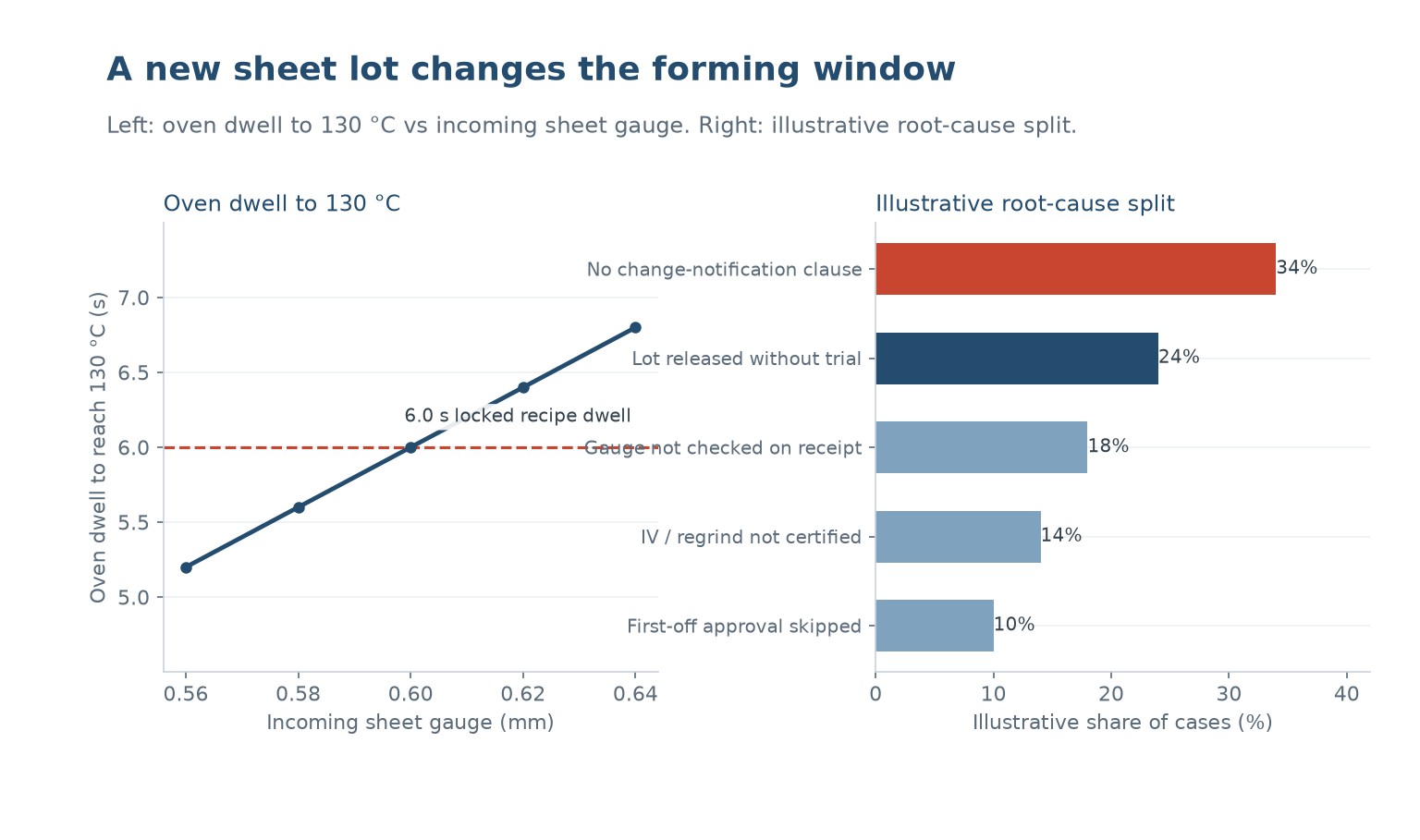
Check incoming gauge at five points across the width and read the IV. A representative 0.64 mm lot needed 6.0 × 1.14 = 6.8 s to reach 130 °C, while the 6.0 s recipe left its core at 122 °C and the web sagged.
A five-step diagnostic sequence
- Require notice.
Write 10 working days' change notification and a lot certificate into the order. - Check the gauge.
Measure incoming sheet at five width points against 0.60 mm +/- 0.02 mm. - Read the IV.
Record intrinsic viscosity and regrind level from the lot certificate. - Run a trial.
Form 300 shots and log the dwell needed to reach 130 °C. - Approve the first-off.
Sign off 30 trays from the new lot before releasing it to production.
The chart below is a typical result from that measurement step. Use it to separate a design limit from a setting that can still be recovered.
Gauge, IV and incoming sheet checks to specify
Three checks protect the window: gauge at five points within +/-0.02 mm of 0.60 mm, IV of 0.76-0.80 dL/g, and moisture below 0.3 %. At a 2.5 draw ratio, 0.60 mm gives 0.24 mm wall and 0.64 mm gives 0.256 mm.
| Parameter | Typical target | What goes wrong outside it |
|---|---|---|
| Incoming sheet gauge | 0.60 mm +/- 0.02 mm at five points | A 0.64 mm lot needs 6.8 s of dwell |
| Intrinsic viscosity | 0.76 - 0.80 dL/g | Low IV sags on the locked 6.0 s recipe |
| Sheet moisture | ≤ 0.3 % | Higher moisture causes voids and haze |
| Trial and approval | 300 shots, 30 trays, first-off sign-off | An untrialled lot sags mid-run |
Table 2 - Incoming checks to write on the sheet purchase order
Variables that shift the window after a lot release
The window shifts again as the lot is handled. A reel stored at 30 °C relaxes differently, a higher regrind content changes melt strength, and a different slip additive alters forming behaviour off the pin chain.
| Process variable | Effect on the forming window | Practical control |
|---|---|---|
| Gauge up from 0.60 to 0.64 mm | Dwell to 130 °C rises from 6.0 to 6.8 s | Re-set dwell per incoming lot |
| IV down to 0.76 dL/g | Lower melt strength sags earlier | Require an IV value per lot |
| Reel stored at 30 °C | Relaxation changes the draw | Log storage temperature on receipt |
| Moisture above 0.3 % | Steam voids and haze appear | Dry and certify moisture per lot |
Table 3 - Lot variables that shift the window after release
A change-notification and first-off clause for the order
A gauge tolerance alone cannot protect a forming recipe. Add a clause: 10 working days' notice of any lot change, with a gauge and IV certificate, a 300-shot trial and first-off approval on 30 trays before release.
Want the tray checked against your line?
Send us the tray drawing and the line conditions. We will flag the geometry and material choices that cause jams, and quote a tool with an acceptance test.
What to send us
- Tray drawing with draft and radii
- Sheet grade and gauge
- Stack depth and line speed
- Drawings of the magazine or denester
Costing a lot trial against a scrapped forming run
A 300-shot trial and incoming gauge checks add roughly 1-2 p per tray but catch the 0.64 mm lot before it sags. One scrapped 35 000-tray run costs more than the checks across the whole contract.
Before you sign off this thermoformed tool
- A 10 working days' change-notification clause is stated on the sheet purchase order
- Incoming gauge is checked at five width points against 0.60 mm +/- 0.02 mm
- IV, regrind level and moisture are certified on every incoming lot
- A 300-shot trial and first-off approval on 30 trays gate lot release
- The oven dwell is re-set and re-recorded whenever a new lot is approved
A tray that looks right in the carton can still stop a filling line. Test the stack, not a single part.
Why did the trays sag on a new lot?
The 0.64 mm lot needs more heat. Conduction dwell scales with gauge squared, so (0.64 / 0.60)^2 = 1.14 means about 14 % more time; the locked 6.0 s recipe left the core at 122 °C instead of 130 °C.
But the gauge was inside the order tolerance?
A +/-0.04 mm gauge tolerance protects thickness, not forming behaviour. A 0.64 mm lot is legal yet needs 6.8 s of dwell. Add a change-notification clause and a trial for any lot change.
How much dwell does the new lot need?
About 6.0 × 1.14 = 6.8 s to reach 130 °C. Run a 300-shot trial, log the dwell that gives a stable web, and re-set the recipe before the lot is released.
What about formed wall thickness?
At a 2.5 draw ratio, 0.60 mm sheet gives 0.24 mm wall and 0.64 mm gives 0.256 mm. Section a formed tray so the wall change is recorded alongside the gauge.
Do IV and regrind matter?
Yes. IV of 0.76 dL/g against 0.80 dL/g lowers melt strength and sags earlier, and a higher regrind level changes the draw. Require both on the lot certificate.
What should the change clause say?
Ten working days' notice of any lot change with a gauge and IV certificate, incoming checks at five points, a 300-shot trial and first-off approval on 30 trays before the lot is released.
Get a tray that runs on your filling line
Send us the tray drawing or a sample stack. We will review draft, trim and material, then quote a production tool with a measurable line-acceptance test written into it.
To get an accurate quote, send:
- Tray drawing or sample stack
- Sheet material and gauge
- Line speed and denesting method
- Annual volume and target unit price
Request a tool and tray quotation
Why buyers work with Uplastech
ISO 9001, ISO 14001 and ISO 45001 certified. Founded in 2016, with injection moulding lines in Shanghai and an extrusion plant in Jiangsu. Moulding machines from 90T to 1100T and a maximum shot weight of 5100 g. Samples and a written quotation are available on request.






 EN
 ES
 FR
 DE
 PT
 AR
 RU
 JA
 KO
 IT
 NL
 TR
 PL
 ID