
What a silicone mould actually has to do
A compression mould for silicone is a heated press tool. It is not a precision injection tool with a cavity pressure of 800 bar; it closes on a weighed blank of uncured rubber and squeezes it into shape at 5 to 20 MPa while the platens hold it at 165 to 175 degrees Celsius.
That changes the requirements. Wear is not the main enemy, because the compound is soft and filled rather than abrasive. What matters is heat transfer, dimensional stability at temperature, and a surface that releases without tearing the part.
It also changes the economics. Silicone parts are often low volume with many variants, so a tool that costs a third as much and can be re-cut when the design changes is worth more than a tool that lasts a million shots.
The result is that aluminium is far more common in silicone tooling than in thermoplastic injection tooling, and for good reasons that are mostly thermal.
Thermal expansion decides the tolerance
Aluminium expands at roughly 23 parts per million per degree Celsius. Steel expands at about 11 to 12. Over a 150 degree rise, that is a factor of two, and on a 200 mm cavity it is the difference between 0.72 mm and 0.33 mm of growth.
Both numbers are large compared with a typical silicone part tolerance. The point is not that aluminium is worse; it is that the cavity has to be cut for the temperature it runs at, not for room temperature, and the correction is twice as large for aluminium.
That correction is manageable when the tool runs at one temperature and one material. It becomes a problem when a tool is used for several compounds at different cure temperatures, because the same cavity is now being asked to be right at two different expansions.
Steel also has a lower and more predictable expansion, which is why a tight-tolerance part with a flatness or a bore callout usually ends up in steel even when the volume does not justify it.

Where aluminium wins
Heat-up time is the first win. Aluminium conducts heat roughly four times better than steel, so a 200 mm plate reaches 170 degrees in about 22 minutes where a steel plate takes 45. On a low-volume part with many short runs, that difference is paid back every time the press is started.
Cycle time is the second. Faster heat transfer through the plate means the cure is more even across the part, and the platen does not have to overshoot to keep the cavity face at temperature. Even cure matters more for silicone than fast cure.
Machinability is the third. An aluminium cavity can be cut, modified and re-cut in a fraction of the time, and design changes on a silicone part are common because the part is often a seal or a cover that gets revised.
The limit is pressure and repetition. Aluminium is softer, so parting lines and shut-offs wear and dent. At high closing pressures, or with a filled compound that is abrasive, an aluminium tool will lose its shut-off within tens of thousands of shots.
Where steel wins
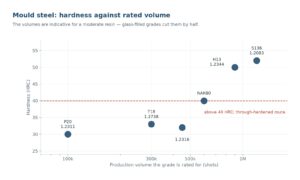
Steel wins on shut-offs. A silicone mould seals on a thin land at the parting line, and that land has to survive repeated closing under pressure. Hardened steel holds a sharp land for a million shots; aluminium rounds it over and starts flashing.
Steel wins on thin walls and deep cores. A core that is 30 mm tall and 3 mm wide in aluminium will deflect under closing pressure, and the part comes out with a wall thickness that varies along its length.
Steel wins on surface finish retention. Silicone releases from a polished steel surface very predictably. Aluminium picks up dents and scratches that transfer into the part as small raised marks, and those are hard to polish out without losing the cavity form.
The cost of that durability is heat-up time and machining time. A steel tool for the same part costs more, takes twice as long to reach temperature, and is slower to modify when the design changes.
| Property | Aluminium 6082 | Steel P20 | Effect on the part |
|---|---|---|---|
| Thermal expansion | 23 ppm per C | 12 ppm per C | Cavity must be cut undersize |
| Heat-up to 170 C | About 22 minutes | About 45 minutes | Start-up cost per run |
| Thermal conductivity | About 170 W per m K | About 30 W per m K | Even cure across the part |
| Shut-off wear | Rounds over | Holds a sharp land | Flash appears on aluminium |
| Modification | Hours | Days | Design changes are cheaper in aluminium |
Table 1 — Tool material compared on the properties that matter for silicone.
Surface finish and release
Silicone releases from a smooth, hard surface. A polished steel cavity at Ra 0.2 to 0.4 micrometre releases cleanly and repeatedly. The same finish on aluminium is achievable but does not last, because the surface work-hardens and then scratches.
Texture is the opposite problem. A textured silicone part needs the texture in the tool, and texturing aluminium is possible but the texture wears faster. On a part where the texture is functional, such as a grip surface, steel is the safer choice.
Coatings help both materials. A thin hard coating on aluminium improves release and shut-off life at modest cost, and it is often the compromise that makes an aluminium tool viable for a mid-volume part.
Whatever the material, the parting line has to be vented. Silicone traps air in the same way thermoplastics do, and a tool with no vent shows it as short moulding in the last-filled corner rather than as a burn.
Choosing between them
Start with the tolerance. If the part has a bore or a flatness callout tighter than about 0.15 mm over 100 mm, steel is the default, because the expansion correction is smaller and more repeatable.
Then the volume. Under about 5,000 parts, aluminium with a coating is usually the right answer: it heats fast, it can be modified, and it will last the programme. Above 50,000 parts, steel pays for itself on shut-off life alone.
Then the shape. Thin upstanding cores, deep narrow slots and long unsupported sections all push toward steel regardless of volume, because deflection under closing pressure is a stiffness problem and aluminium has a third of the modulus.
Finally, the number of variants. A family of five similar seals with small differences is a natural aluminium programme, because five aluminium tools cost less than two steel ones and each can be re-cut when a variant changes.
| Situation | Tool material | Reason |
|---|---|---|
| Prototype or bridge tool | Aluminium | Fast to cut, cheap to change |
| Up to 5,000 parts, simple shape | Aluminium, coated | Heat-up time dominates cost |
| Tight bore or flatness callout | Steel | Half the expansion, more repeatable |
| Thin cores or deep slots | Steel | Three times the stiffness |
| 50,000 parts or more | Steel | Shut-off land survives |
| Family of similar parts | Aluminium | Five tools for less than two in steel |
Table 2 — Which tool material fits which programme.
Is aluminium good enough for a silicone mould?
For simple shapes up to about 5,000 parts, yes, especially with a hard coating. It heats in half the time of steel and is far cheaper to modify. It loses shut-off sharpness and dents more easily.
How much does a silicone mould grow when it heats up?
A 200 mm aluminium cavity grows about 0.72 mm from 25 C to 175 C. The same cavity in steel grows about 0.33 mm. The cavity has to be cut undersize by that amount.
Why do silicone moulds flash after a while?
The shut-off land at the parting line wears or dents. Aluminium rounds over first. Once the land is not sharp, compound escapes and the flash thickness grows with every cycle.
Does tool material affect cure time?
Yes, indirectly. Aluminium conducts heat about four times better than steel, so the cavity face reaches cure temperature sooner and more evenly. Cure time is set by the compound, but even cure depends on the tool.
Should I use hardened steel for silicone?
Only when the volume or the shape justifies it. Hardened steel holds shut-offs and thin cores, but it is slower to machine and slower to modify, and silicone compounds are not abrasive enough to demand hardness on their own.
What surface finish should a silicone mould have?
Ra 0.2 to 0.4 micrometre on the cavity and a sharp, polished shut-off land. Rougher surfaces hold the part and cause tearing on ejection; polished surfaces release cleanly.
New silicone part?
Send the drawing, the annual volume and the tolerance. We will tell you whether the tool should be aluminium or steel, and what the cavity has to be cut to.






 EN
 ES
 FR
 DE
 PT
 AR
 RU
 JA
 KO
 IT
 NL
 TR
 PL
 ID
