
What residence time actually measures
Barrel residence time is how long a pellet of polymer spends between the feed throat and the nozzle. It is not a single number for the whole barrel, because material does not move through a screw as a plug. It moves as a distribution.
The material at the front of the shot has been in the barrel for one cycle. The material at the back of the screw, near the feed zone, may have been there for eight or ten cycles, slowly being dragged forward a little each time the screw rotates.
That tail is the part that matters. It has the longest heat history, the most shear history and the least stabiliser left, and when it finally reaches the nozzle it arrives as a black speck, a brown streak or a gel.
So the useful definition is peak residence time: the age of the oldest material that can reach the part. Average residence time is a comfortable number that hides the problem.
Calculating it from the shot
The quick estimate is barrel capacity in shots multiplied by cycle time. A barrel that holds four shots on a 45 second cycle gives a peak residence time of about three minutes, and a barrel that holds ten shots gives seven and a half.
The trap is that barrel capacity is quoted in grams of polystyrene, and the same barrel holds fewer grams of a filled or a high density material. Always convert to the material actually running before comparing.
The second trap is that shot weight is often set by the part, not by the machine. A 40 gram part in a 250 tonne machine with a 400 gram barrel is running at 10 percent of capacity, and that is the origin of most mysterious speck problems in job shops.
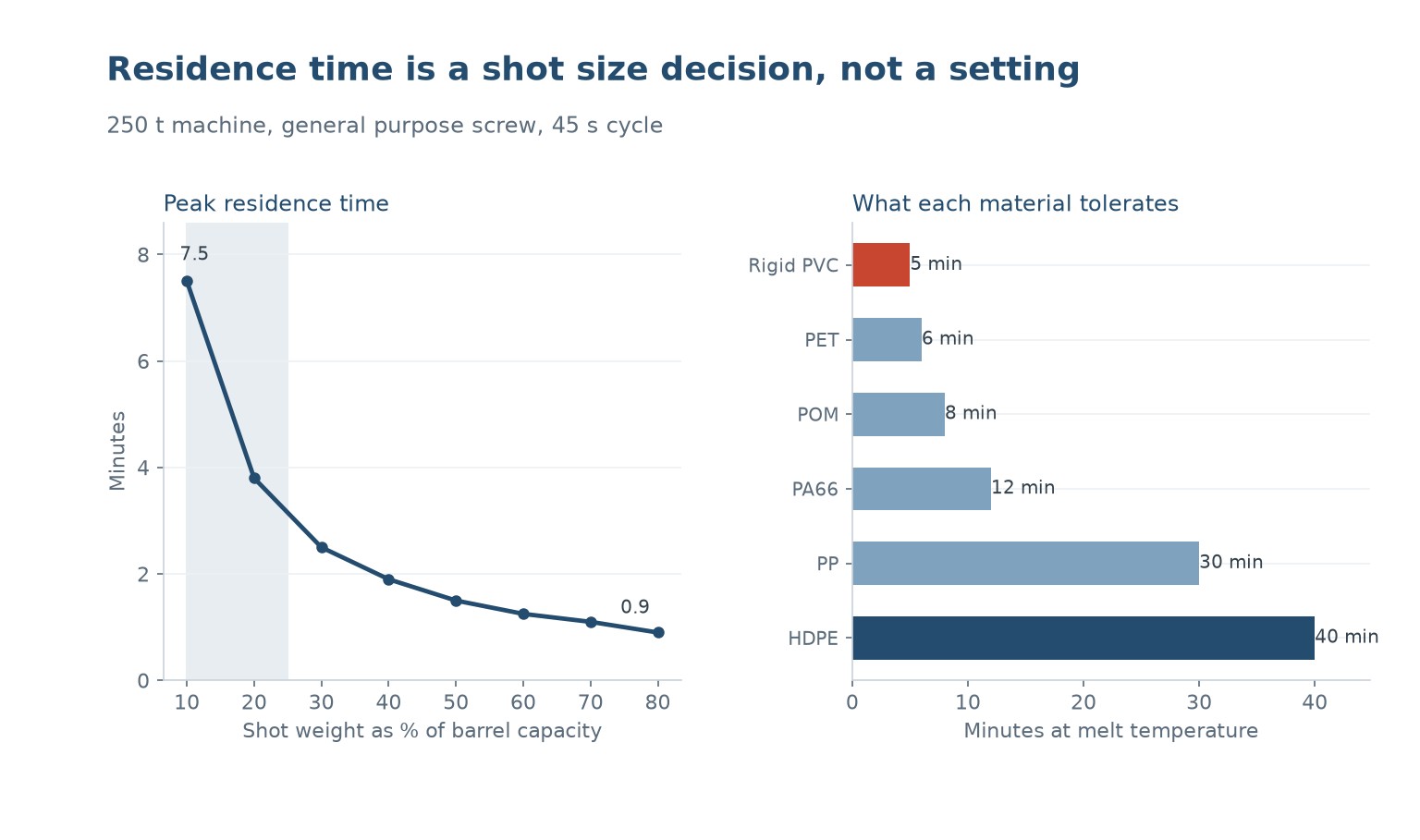
The chart on the left is that relationship for a 45 second cycle. At 10 percent of barrel capacity the peak residence time is 7.5 minutes, at 40 percent it is 1.9 and at 80 percent it is under a minute.
What each material tolerates
Rigid PVC is the most sensitive at around five minutes at melt temperature. That is one reason PVC injection is run on dedicated small machines with short barrels and fast cycles, and why a PVC barrel is never left hot and idle.
PET and POM sit next, at six to eight minutes. Both are attacked by prolonged heat in a way that is not obvious until it fails: PET loses intrinsic viscosity and the part becomes brittle, POM unzips and releases formaldehyde.
Polyamide tolerates around twelve minutes, but it is sensitive to moisture rather than time, so the two effects are often confused. A PA66 that has been in the barrel too long and a PA66 that was dried badly both produce weak parts.
Polyolefins will sit for half an hour without complaint, which is why a shop that runs mostly PP and PE can get away with an oversized barrel for years and then destroy a technical job in a week.
| Material | Practical limit | First sign of trouble |
|---|---|---|
| Rigid PVC | 5 min | Colour shift, then HCl smell |
| PET | 6 min | Brittle parts, low IV |
| POM | 8 min | Formaldehyde smell, voids |
| PA66 | 12 min | Discolouration, low strength |
| PP | 30 min | Little, until it is very long |
| HDPE | 40 min | Surface oxidation, poor weld lines |
Table 1 — Residence time each material will take at melt temperature.
Reading the symptoms
The classic symptom is intermittent contamination. A black speck appears on one part, then nothing for two hundred shots, then two parts in a row. That pattern is a slug of degraded material sitting in a dead spot and being released when the flow field changes.
The second symptom is a colour that drifts over a run. A masterbatch change that takes forty shots to clear is a residence time problem, not a mixing problem, and no amount of colourant will fix it.
The third is a mechanical property that is right in the sample and wrong in the production part. Long residence time at temperature degrades the molecular weight, and the effect shows in impact and in elongation before it shows in appearance.
The fourth is a start-up problem. A barrel that has been sitting hot overnight releases its degraded layer into the first twenty shots, which is why a purge shot count on start-up should be based on residence time rather than on habit.
| Symptom | What it suggests | Confirm by |
|---|---|---|
| Intermittent black specks | Degraded slug in a dead spot | Strip the screw |
| Slow colour changeover | Long residence time | Calculate shots per barrel |
| Impact lower than sample | Molecular weight loss | Melt flow comparison |
| Dirty first shots | Overnight degradation | Purge count against residence |
Table 2 — Symptoms that point at residence time rather than at the resin.
Fixing a barrel that is too large
The correct fix is a smaller barrel or a smaller machine. Most plants resist this because the machine is bought for the largest job it might ever run, and the result is that every small job runs at 15 percent of capacity forever.
The second fix is a shorter, lower compression screw with a proper mixing section, which reduces the volume of slow moving material near the feed. It does not change the barrel volume but it tightens the distribution.
The third is to run the cycle faster where the part allows it. Cooling time is usually the largest part of the cycle, and a two second reduction is a measurable reduction in residence time across a shift.
The fourth is discipline on shutdown. A barrel left hot with material in it produces a degraded layer overnight, and that layer is released into production the next morning. Purge before stopping, not after starting.
Measuring instead of guessing
The direct method is a colour change trial. Feed natural material behind a coloured one, count the shots until the colour is gone, and multiply by cycle time. That gives the real peak residence time including the tail, and it takes half an hour.
A cheaper proxy is to log the shot count per barrel fill. If the barrel holds fewer than three shots, residence time is not your problem; if it holds more than six, it probably is.
The best long term answer is to record barrel capacity and shot weight for every tool in the plant, and to route small tools to small machines as a planning rule rather than as an emergency.
Residence time is one of the few process variables that is fixed by machine selection rather than by settings. That is exactly why it is so often overlooked, and why it explains so many problems that settings cannot.
How do I calculate barrel residence time?
Barrel capacity in shots multiplied by cycle time gives the peak figure. A barrel holding four shots on a 45 second cycle gives about three minutes.
What is a good shot weight as a percentage of barrel capacity?
Between 40 and 80 percent. Below 30 percent the residence time tail becomes long enough to degrade heat sensitive materials.
Why do black specks appear intermittently?
Because degraded material collects in a dead spot and is released when the flow field changes. One speck every few hundred shots is a residence time signature.
Which material is most sensitive to residence time?
Rigid PVC, at around five minutes at melt temperature. PET and POM follow at six to eight minutes, and polyolefins will take half an hour.
Does a larger machine always mean longer residence time?
Yes, for the same shot. Barrel capacity is fixed and shot weight is set by the part, so a bigger barrel on a small part means more cycles of material sitting in the screw.
Can a mixing screw reduce residence time?
It reduces the spread rather than the volume. A mixing section keeps material moving and avoids stagnant layers, which shortens the tail even though the barrel volume is unchanged.
Speck problems that will not go away?
Tell us the machine, the shot weight and the material. We will tell you whether it is residence time, a dead spot or the resin.






 EN
 ES
 FR
 DE
 PT
 AR
 RU
 JA
 KO
 IT
 NL
 TR
 PL
 ID
