
The arithmetic that decides it
Consolidation has one large fixed cost and one small recurring saving. The fixed cost is the new tool, which is bigger, more complex and usually needs a larger press. The recurring saving is the assembly labour that disappears, plus handling, inventory and the quality cost of joints that can be assembled wrong.
Because one number is fixed and the other is per part, the decision is entirely a question of volume. Below a certain annual quantity the extra tool never pays back. Above it, the saving compounds every year. The break-even is where the two annual cost lines cross, and it can be calculated before any design work starts.
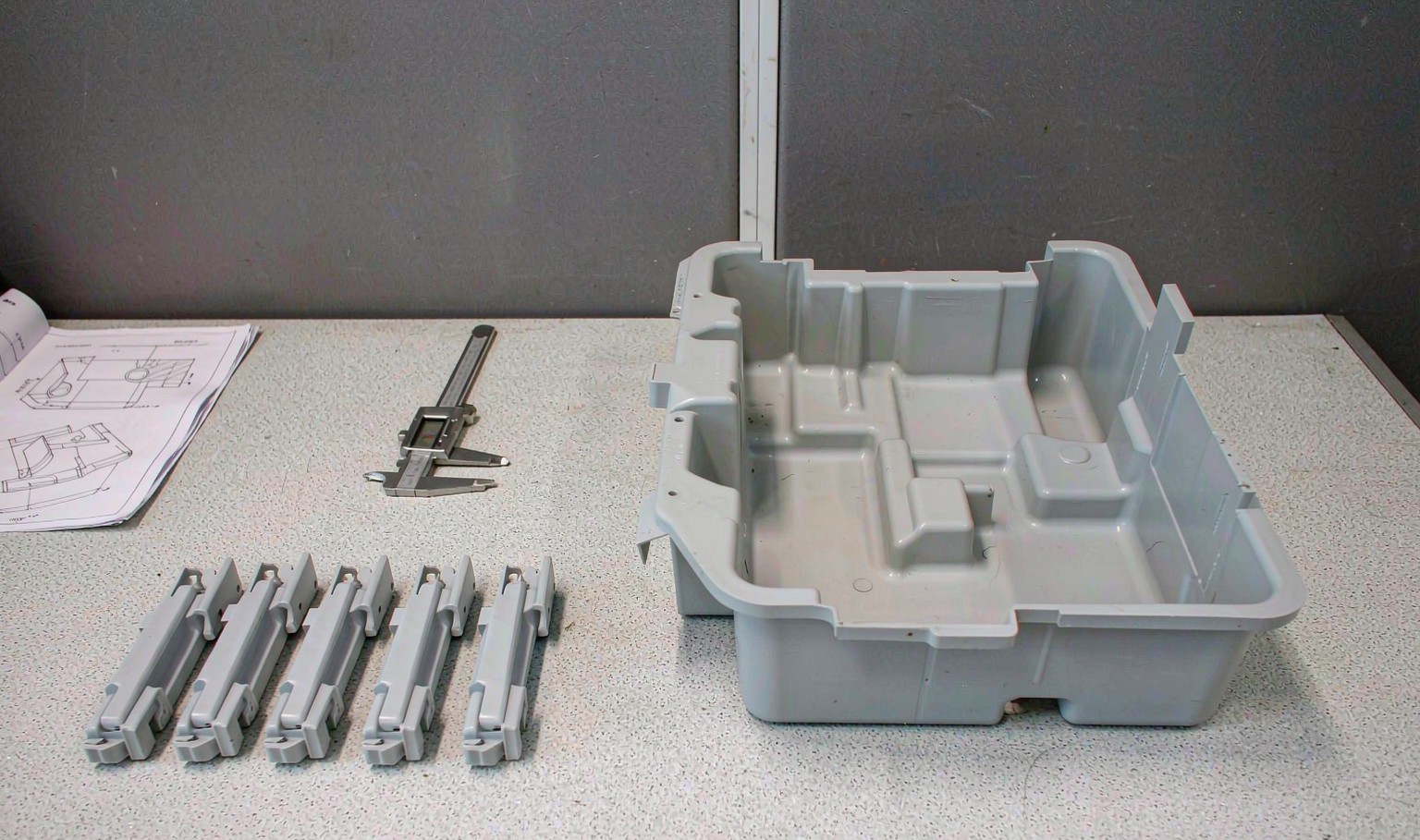
The chart on the left is a real case: five moulded parts assembled with four screws and two snap joints, against a single part with the same external geometry. Five tools cost EUR 90,000 in total. One tool for the consolidated part cost EUR 140,000, because it needs a larger press, four lifters and a hot runner with eight drops.
The per part cost moved the other way. Five parts plus assembly came to EUR 7.00. One part came to EUR 4.50, most of the difference being the EUR 3.00 of assembly labour that no longer exists. The two lines cross at 20,000 pieces a year, which for this part was below the customer's forecast and above their current volume.
What consolidation costs in tooling
The tool cost is not simply the sum of the parts it replaces, and it is worth understanding why before quoting. A consolidated part usually has a larger projected area, which means a larger press, which means a larger mould base. The base is often the single biggest line in the quote and it scales with the square of the part size.
The second cost is the mechanism. Features that were separate parts often become undercuts, which need lifters or sliders. Four lifters on a large tool can add 25 to 40 percent to the tool cost and a meaningful amount to the cycle time, and they also add a maintenance item that did not exist before.
The third is the feed system. A consolidated part has more volume and a longer flow path, so it usually needs a hot runner with more drops, or a larger cold runner with more regrind. Both add cost, and the regrind from a large cold runner can be a quality problem if the material is hygroscopic.
The fourth is the risk. Five separate tools fail independently; one tool fails completely. A cracked core on the consolidated tool stops the whole product, where a cracked core on one of five tools stops one part and the line keeps running on buffer stock. That risk has a cost even if it does not appear in the quote.
The design problems that appear when parts merge
The first problem is wall thickness. Five parts can each have their own wall, chosen for their own load. A consolidated part has one wall that has to serve all five functions, and it is usually thicker than the thinnest part needs and thinner than the thickest part wants. Thick sections sink, thin sections warp, and the difference shows up as a cosmetic defect on the face that used to be hidden.
The second is material. Five parts may have been made in three materials for good reasons: a stiff one for structure, a flexible one for a seal, a lubricated one for a sliding surface. A single material has to compromise, and the compromise is often a glass-filled grade that solves the stiffness problem and creates a surface finish problem.
The third is tolerance stack-up, in reverse. Separate parts absorb tolerance at each joint; a consolidated part has to hold the combined tolerance in one mould. A feature that was positioned by an assembly fixture now has to be positioned by the tool, and the tool has to hold it across a larger mould at a higher temperature.
The fourth is serviceability. A part that was replaceable is now part of a larger component, and a field failure that used to cost a gasket now costs a housing. This is a commercial decision as much as an engineering one, and it should be made explicitly rather than discovered after launch.
| Design check | Why it matters after consolidation | What to do |
|---|---|---|
| Wall thickness range | One wall serves five functions | Keep the spread within 2:1, core out the thick sections |
| Material compromise | Three materials become one | Decide which property is non-negotiable before choosing |
| Undercuts created | Separate parts become features | Count lifters early, they drive tool cost and cycle time |
| Tolerance stack-up | Joints no longer absorb variation | Re-tolerance from the assembly, not from the parts |
| Cosmetic faces | Faces that were hidden become visible | Agree the cosmetic surfaces before the tool is cut |
| Service and repair | A small failure replaces a large part | Decide the field replacement strategy |
| Press size | Projected area grows | Confirm the press before the tool is designed |
Table 1 — Design checks before committing to a consolidated tool
Where the savings actually come from
The right hand chart breaks the per part cost change into its components at 50,000 pieces a year. Assembly labour is the dominant term at minus EUR 3.00, and it is the only term that is genuinely large. Everything else is small and some of it is negative.
Handling and logistics contribute minus EUR 0.62, because one part is one bin, one label and one inspection instead of five. Material adds EUR 0.54, because the consolidated part is heavier: the walls that used to be separate are now one, and the joints that used to be empty space are now solid. Cycle time adds EUR 0.31, because the part is larger and cools more slowly.
Scrap risk adds EUR 0.24 and tooling amortisation adds EUR 1.03 at this volume. Those two terms are the ones that decide whether a marginal case goes ahead. At 20,000 pieces the tooling term would be EUR 2.50 and the whole saving would vanish.
The point of the breakdown is that consolidation is not a general purpose saving. It is a specific trade of assembly labour for material, cycle time and tooling, and it only wins when the assembly labour is large and the volume is high enough to spread the tool.
When consolidation is the wrong answer
It is wrong when the volume is below the break-even and the customer cannot commit to it. A tool that pays back in four years is a tool that will be obsolete before it pays, especially on a product with a two year life.
It is wrong when the parts are made in different materials for functional reasons. Forcing a seal and a structure into one material produces a part that does neither well, and the cost of the compromise usually exceeds the assembly saving.
It is wrong when the assembly is automated and cheap. A robot that places five parts in eight seconds is not a labour cost worth removing, and the EUR 3.00 of manual assembly in the example above would be EUR 0.40 in an automated cell. The whole case disappears.
It is also wrong when service access matters. A consolidated housing that has to be replaced as a unit turns a five euro repair into a fifty euro repair, and the warranty cost shows up two years later in a place nobody is looking.
A worked example: five parts into one
The case in the charts is an equipment housing: a base, a cover, a bezel, a cable clamp and a mounting bracket. In the original design the base and cover were ABS, the bezel was a PC-ABS blend for gloss, the clamp was PA66 for thread strength and the bracket was glass-filled PA for stiffness.
The consolidated design used PC-ABS throughout, with a brass insert for the thread and a glass-filled rib section for the bracket area. The insert added a moulding step and EUR 0.18 per part. The rib section added 40 g of material and required a thicker wall in one area, which produced a sink mark that had to be textured out.
Tooling went from five tools at EUR 90,000 to one tool at EUR 140,000, with four lifters and a hot runner. Cycle time went from 22 seconds for the largest of the five parts to 41 seconds for the consolidated part, which on a single machine is a net reduction because five separate runs became one.
The result at the customer's forecast of 35,000 pieces a year was a saving of EUR 1.50 per part, or EUR 52,500 a year, against an extra EUR 50,000 of tool. Payback was just under a year. At the customer's previous year's volume of 14,000 pieces the same project would not have paid back inside the product life.
Testing the decision before you cut steel
The cost model takes an hour to build and is the cheapest part of the project. Build it before the design, with the volume as a variable rather than a number, and look at where the break-even sits against the forecast. If the break-even is above the forecast, the project is a bet on growth, and it should be described that way.
The second test is a mould flow analysis on the consolidated geometry. A larger part with a longer flow path and thicker sections is a different filling problem, and a flow analysis that predicts a weld line on a cosmetic face is worth doing before the tool is cut, not after.
The third test is a physical prototype of the consolidated part in the proposed material. Print it, or machine it, and put it in the assembly. The problems that appear at this stage are the ones that cost nothing to fix: a rib in the way of a cable, a face that is now visible, a screw boss that no longer lines up.
| Stage | What to check | Cost of being wrong |
|---|---|---|
| Cost model | Break-even volume against forecast | An entire project on the wrong side of the line |
| Mould flow | Weld lines, air traps, packing on a large part | A tool that produces cosmetic rejects |
| Prototype | Fit, cable routing, visible faces | Design changes after the tool is cut |
| Press check | Shot size, clamp tonnage, platen size | A tool that does not fit the machine |
| First article | All dimensions against the new tolerance stack | Rework or a second tool |
Table 2 — Checks in the order that costs least to be wrong
The last check is the least popular and the most valuable: run the consolidated part through the customer's assembly line before the tool is cut. The operators will find the problem that no drawing review found, and they will find it while it is still a CAD model.
At what volume does consolidation usually pay back?
There is no universal number, but the shape of the answer is always the same: the extra tool cost divided by the per part saving. In the example here, EUR 50,000 of extra tool against EUR 1.50 of saving gave 33,000 pieces, and the crossover in annual cost was at 20,000. Most projects land between 15,000 and 50,000 pieces a year.
Does consolidation always reduce the number of moulding machines needed?
Not necessarily. It reduces the number of runs, which is usually a saving on setup and scheduling, but the consolidated part has a longer cycle, so the machine hours per part can go up. The comparison should be total machine hours per year, not cycles per part.
What happens to the tolerance when five parts become one?
It gets tighter in the tool and looser in the assembly. Features that were positioned by a fixture now have to be positioned by the mould, across a larger tool at a higher temperature. Re-tolerance from the assembly requirement rather than from the individual parts, and expect the tool to need a trial run before the dimensions settle.
Can consolidation work if the parts are different materials?
Only if one of the materials can do all the jobs. That usually means overmoulding, which adds a second shot and a second tool, and the economics rarely survive. If a seal is involved, keep it as a separate part and consolidate the structural parts only.
Is a family tool a better option than full consolidation?
Sometimes. A family tool moulds several different parts in one shot, which keeps the materials separate and removes the assembly only where the parts are joined in the mould. It suits small parts with similar material and similar cycle, and it avoids the single point of failure of one large tool.
How do I justify the risk of one tool instead of five?
Quantify it. A spare core, a second source or a buffer stock all have a cost, and that cost belongs in the model. If the project still pays back with the risk cost included, it is a good project; if it only pays back without it, the saving is being borrowed from a future outage.
Thinking about merging parts?
Send the part list, the annual volume and the assembly steps. We will build the break-even model and tell you whether the tool pays back inside the product life.




 EN
 ES
 FR
 DE
 PT
 AR
 RU
 JA
 KO
 IT
 NL
 TR
 PL
 ID
